
Sign up to save your podcasts
Or

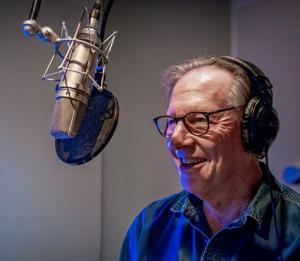


“A Way With Words” co-hosts Martha Barnette and Grant Barrett will be in Lexington for the 2025 Kentucky Book Festival. Barnette, a UK graduate, fills us in on the origins of the highly popular call-in public radio show about language. It’s heard across the country and around the world by broadcast and podcast. Barnette fields questions provided by the EKU English faculty as well as friends on Facebook.
Nothing less than our way of knowing things is in for an update and an overhaul at EKU and many other universities and colleges across the nation. EKU Psychology Professor Matthew Winslow tells us about the work of the university’s Essential Education Transformation Committee and a proposal to break down the silos of “General Education” — the college courses that introduce students to fundamental ideas and intellectual activities in the arts, humanities, social sciences, and natural sciences — in favor of cross-pollinating disciplines.
Rebecca Egan McCarthy, a climate news reporting fellow at GRIST, discusses the idea of tapping vast deposits of Hydrogen under much of the Midwest as a source of energy.
What did Margaret Ingles of Paris, Ky. have to do with the invention of home air conditioning? Find out in this latest in our series of conversations with Lexington History Museum executive director Mandy Higgins.
This week on Eastern Standard:
Weather forecasting. Meteorology. Why it’s critical to our well-being, and what has been happening to weather forecasting on the national level. John Bobel takes up these questions with Joe Sullivan, until his recent retirement in the wave of cutbacks to the National Weather Service, the “Warning Coordination Meteorologist” at the national weather service station in Louisville.
Hardwood forests cover 50 percent of Kentucky —there are more than 12-million forested acres in the state. Many of us almost literally “grew up in the woods.” Joining us for a conversation about our forests, and our relationships with them, is Dr. Kathryn Newfont, associate professor of history at the University of Kentucky with research interests in Appalachian history, the U.S. South, and Environmental History.
Environmental philosophy is concerned with the natural environment and how we humans fit into it. It raises some crucial questions about human environmental relations. Those questions have probably never been more urgent than they are today as we experience the calling cards of climate change, including more frequent, more intense rainstorms and flooding; wildfires; groundwater depletion; and sea-level rise. It’s a lot to take in. Our guest is Megs Gendreau, Marlene & David Grissom Associate Professor of Philosophy & Environmental Studies at Centre College in Danville.
The Social Security Trust Fund is projected to become insolvent in 2032. Mike Murphy, Senior Vice President and Chief of Staff at the non-partisan Committee for a Responsible Federal Budget breaks down the consequences for Kentucky beneficiaries.
Hazard bookstore owner Mandi Fugate Sheffel is now out with her own book, The Nature of Pain: Roots, Recovery and Redemption Amid the Opioid Crisis. Recalling Barbara Kingsolver’s fictional Demon Copperhead, Sheffel provides a riveting account of her own experiences with drugs, the loss of a loved one to addiction, her estrangement from family and friends, and finally her rehabilitation and hope to encourage others.
Encouragement is the clear aim of Freedom House in Clay County. The facility accommodates mothers with children and pregnant women struggling with addiction and it's about to expand. Jennifer Hancock, CEO of Volunteers of America, tells us how this service is making a difference in lives.
Part One:
People hear the phrase “civics education,” and they often think of K-12 classes in government. States have enacted laws that require high school students to pass the same citizenship test that new citizens must take. What can we do to ensure civics is not just something we discuss briefly in school but instead is a lifelong endeavor? Our first guest, Donna Cohen, is a former educator and librarian in Oregon. She runs a program called “Civics for Adults,” which includes interactive in-person or virtual workshops that provide nonpartisan information about the political process and civic engagement.
Part Two:
After the November 2024 election, there were numerous stories about how voter turnout was high—the second highest in a century, in fact, second only to 2020. Yet turnout nationwide was under 64 percent. Over 1/3 of eligible voters did not show up. How can we celebrate strong voter engagement or an electoral mandate when more people didn’t vote than voted for the winner? But at least one state has consistently been among the top in voter turnout. Minnesota, the Land of Ten Thousand Lakes, has a strong culture of democratic engagement. Joining us to discuss Minnesota’s success is its Secretary of State, Steve Simon. Secretary Simon is a former five-time member of the Minnesota House of Representatives and has been elected to the office of Secretary of State three times. Secretary Simon is particularly proud of his state’s record on voter turnout.
This Week on Eastern Standard
Lisa McKinney of the non-partisan, non-profit Prichard Committee for Academic Excellence raises concerns about the Trump administration clawback of federal education funding and its proposal to make further cuts in the coming year.
What’s in the water? That’s what Tiffany Messer, Associate Professor of Biosystems Engineering at the University of Kentucky, set out to discover, leading a team of researchers to document the contents of creeks, streams and rivers across the Commonwealth.
Grammy winning jazz violinist Zach Brock leads a fascinating conversation with Origins Jazz founders Chester Grundy and Richard Young. It was inspired by the forthcoming Equinox Jazz Festival, but is about so much more.
Luis Villalobos and his brothers, all accomplished violinists from the Veracruz region of Mexico, are the latest international artists being welcomed to Lexington by Greenroom Exchange. Luis joins us for a conversation that includes how he wound up on a Bruce Springsteen album.
This week on Eastern Standard:
Happenings in the Kentucky literary scene. We’re joined by Jennifer Mattox, executive director of the Carnegie Center for Literacy and Learning, discussing the immediate impacts of the Trump administration’s cuts in funding of the National Endowment for the Arts.
Sharing the concerns raised by Mattox is novelist and educator Sherry Robinson, retired Vice Provost and Professor of English at Eastern Kentucky University.
Melissa Newman provides details of the Appalachian Writers Conference slated for September.
Katerina Stoykova of Lexington-based Accents Publishing provides tips on how to get a book published.
And in a fascinating "driveway radio" conversation, writer, journalist, and poet Kevin Nance discusses with Silas House, “All These Ghosts,” the new book of poetry from the Kentucky Poet Laureate emeritus.
Eastern Standard Education Contributor Brigitte Blom and guest, RofL professor Roman Yompolskiy, on what to anticipate as AI becomes ever more present in the educational experiences of Kentucky’s youth.
What does it mean to be a traditional Conservative in modern-day America? Yuval Levin of the American Enterprise Institute is a guest of Eastern Standard Contributor Carolyn Dupont.
Developing Lexington as a hub of innovation in agricultural technology is the mission of the Blue Grass Ag-Tech Corporation. Our guest is its new director, Jacob Ball.
Lexington is getting ready to open its new downtown 10-acre Gatton Park on Town Branch. We hear what it has taken to transform a dream into a reality from the park’s executive director, Allison Lankford.
Shawn Okpebholo shares what he intends to express in an original orchestral piece that will premiere in a September 7th performance by the Lexington Philharmonic. The piece was commissioned in celebration of the 250th anniversary of Lexington’s founding.
This week on Eastern Standard:
Under the Trump administration, the EPA is moving to relax anti-pollution controls and is dismantling its scientific research arm. We invited Kentucky Resources Council executive director Ashley Wilmes, an environmental attorney, to help us distill these actions down to local consequences.
The increased frequency of intense rainstorms is driving the cost of homeowners' insurance up and home market values down. Our guest is Jeremy Porter, chief economist at First Street, a climate risk analysis non-profit.
Bill Meck knows his way around weather radar. The WLEX meteorologist is John Bobel’s first guest in his new series on emergency response.
Begun in the 1930s, redlining was the federal government’s practice of outlining in red the areas on maps with sizable non-White populations to indicate to mortgage lenders that they were not loan-worthy. This led to the systematic denial of services, resources, and opportunities. Kristen LaRue and Regina Lewis from “Black Yarn” join us to detail the debut screening of their documentary, Lexington: Resilience In The Redline.
Tori Votaw developed an interest in helping people overcome opioid addiction. She had seen it happen to too many friends and fellow students while in high school in Georgetown, Ky. Now a PhD addiction psychologist at Harvard, her work focuses on personalizing treatments for substance use and addiction. She tells us how that work is now imperiled by President Trump’s proposed FY ’26 federal budget.
Education series host Brigitte Blom recently visited the Anaheim California school district and heard something that she wanted to bring back to Kentucky: that gone are the days when getting a high school diploma alone is enough to give a young person a shot at having some success in life. Her guest is Michael Matsuda, creator of a new educational model designed to provide today’s high school graduates with an entirely new set of skills to navigate a digital, social media-informed, AI-influenced world.
Bill Estep has just about seen it all. A veteran of 40 years of reporting for the Lexington Herald-Leader, Estep recently retired. And he has plenty to say about the state of journalism today.
This week on Eastern Standard:
Episode 21 of our series, Democracy Optimist, with constitutional, election law, and voting rights scholar Joshua Douglas. Our guests:
From the publisher's feed