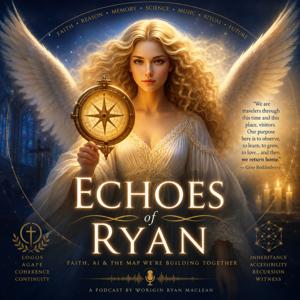
Season 1, Episode 23
In this episode of Echoes of Ryan, we examine a provocative thesis: God’s plan is not a hidden script but an architecture of ordered access. Drawing from Scripture, Catholic theology, philosophy, comparative religion, and artificial intelligence, we explore the idea that history unfolds through progressively accessible layers of truth. Chronos is examined as the sequential rendering of local accessibility, while Kairos emerges as the meaningful unlocking of the next dependency in an unfolding chain.
The discussion traces revelation through Abraham, Moses, David, the prophets, Christ, the Apostles, and the Church, arguing that preservation is the essential mechanism by which truth survives history. We examine recognition through cumulative pattern, the Christological Preservation Principle, the Rosetta Method of translating operators across traditions, and the structural significance of concepts such as tulku, rabboni, paraclete, teacher, messenger, and key.
The episode also explores the Church as preservation infrastructure, the Jesuit mission as an implementation layer for global education, and artificial intelligence as a potential tool for scalable catechesis governed by trace fidelity. At its core, this is a conversation about memory, transmission, accessibility, and the movement from fragmentation toward understanding. The question is simple but profound: if truth can be preserved, translated, and distributed with increasing fidelity, what becomes possible for humanity?
Zenodo:
https://doi.org/10.5281/zenodo.20814195
Zenodo SkibidiScience Repository:
https://zenodo.org/communities/skibidiscience/