
Sign up to save your podcasts
Or

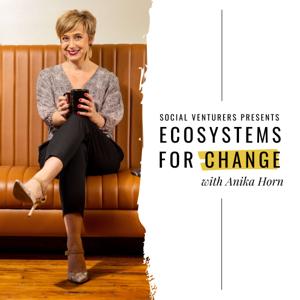


In season 6 of Ecosystems for Change, we are going to explore the art, craft, and science of telling meaningful stories that have the power to affect change in our communities.
I’ve always enjoyed hearing other people’s stories, reading about them, and eventually telling these stories. As I started out helping to develop the ecosystem in Richmond, VA, I also began to understand that storytelling is a powerful tool in any ecosystem builder’s toolbox.
But once I picked up Peter Block’s book, “Community: The Structure of Belonging,” I understood that storytelling could be much more and that it’s actually a tool that helps a community create a vision for itself, to dream of a future that might be possible.
To me, this following quote sums up his work beautifully:
“Stories can give us a narrative to guide and instruct us. They are crucial to our knowing who we are; they provide a sense of identity. […] We need to distinguish between the stories that give meaning to our lives and help us find our voice, and those that limit our possibility.”
This season, I’m speaking with other storytellers to learn their tips and tricks of the trade. I hope to uncover how others go about finding and telling meaningful stories that give hope and propel their communities forward.
I want to find out exactly what intentions these storytellers have, how they approach storytelling, what their process looks like from beginning to end, and how they make the finances work.
As always on this show, my hope is that we can learn from each other, avoid the obvious pitfalls, and as a result become better at what we do: Transform our communities by supporting the changemakers within them.
Listen to the full episode to hear:
Learn More About Anika Horn:
Resources:
Welcome to my 6th logbook where I give a little insight into what’s happening behind and beyond the scenes of this show.
And I’m switching up the format a little bit! I’ve been meeting so many incredible ecosystem builders, and while I can’t have them all on the show, that’s not going to stop me from trying!
I’m super excited to introduce a new quarterly segment called the Unsung Heroes of Ecosystem Building.
I ran this campaign back in 2020 alongside two fellow ecosystem builders, Jeff Bennet and Jess Edwards, both of whom you’ve met on this show.
I often meet really brilliant ecosystem builders–online and in-person–and I want to be able to share their awesomeness with all of you!
But before we go deep into meeting two Unsung Heroes, I’ll share what’s been going on in the Shenandoah Valley and behind the scenes of the show.
Listen to the full episode to hear:
Learn More About Nida Ansari:
Learn More About Sammy Popat:
Learn More About Anika Horn:
Resources:
Over the course of this season, quitting became a constant topic in my life.
One of my team members quit to take on a new role closer to home. A new friend talked to me about quitting her job to spend more time enjoying her family and less time worrying about making it all fit in her schedule. A partner quit because he had done what he came to do and was ready to move on to something else.
With the perspective I’ve gained through the Quitter conversations in season 5, I was able to view these Quits within my sphere as something rich and endlessly fascinating.
When I started out with this season, I referred to The Infinite Game by Simon Sinek. InThe Infinite Game, players stop playing for two reasons:
With each conversation in this season, I was trying to sort my guest into one of these two boxes only to be reminded that people can’t be sorted into boxes. I found instead that quitting a purpose-driven role is much more complex than that.
Listen to the full episode to hear:
Learn More About Anika Horn:
Resources:
In our last conversation of this season, we’re traveling to Berlin, Germany. I’m sitting down with Naomi Ryland, systemic change maker, social entrepreneur, bestselling author and overall insightful person.
We talked about the last ten years in the German social impact space, how to turn your organization from a hierarchical to a self-organized one, and how to shift and share power as a person with privilege. We also talk about burnout from the Unicorn-startup culture and raising anti-racist, feminist children.
Naomi is an entrepreneur, author, and activist with a keen interest in feminist economics, diversity and belonging, power and privilege, and post-capitalist utopias. She founded tbd*, the go-to platform for jobs with purpose, and SEND e.V., the political representative body for social entrepreneurship in Germany. She co-authored Starting a Revolution and co-edited and co-authored Unlearn Patriarchy.
Listen to the full episode to hear:
Learn more about Naomi Ryland:
Learn More About Anika Horn:
Resources:
In today's episode, we're traveling to Phoenix, Arizona to chat with Lucas Lindsey.
Lucas is an ecosystem builder turned real estate developer. We talked about planning for succession and the importance of the built environment for entrepreneurial ecosystem building.
Lucas Lindsey is a Michigan kid on a long hiatus to the American Southwest. He is a big fan of new ideas and old buildings who has always worked in a combination of ecosystem building, real estate development, and construction. He believes in empowering change from the bottom up and working hard to improve whatever community you call home.
Listen to the full episode to hear:
Learn more about Lucas Lindsey:
Learn More About Anika Horn:
Resources:
In today's episode, I want to introduce you to my longtime friend and OG ecosystem builder, Larkin Garbee.
Larkin has put a lot of blood, sweat, and tears into jumpstarting entrepreneurial support initiatives, both in Richmond, Virginia, as well as nationally.
In this conversation, we talk about handing initiatives over to people who can carry them forward, and the upside of spending over a decade in an ecosystem.
Join me on a trip back home to Richmond.
Listen to the full episode to hear:
Learn more about Larkin Garbee:
Learn More About Anika Horn:
Resources:
In today’s episode, we’re making our way to Fargo, North Dakota to talk to Annie Wood.
I first met Annie through Startup Champions Network and was fortunate enough to visit her community during our Fall Summit in 2018.
Shortly thereafter, Annie left the host organization and started a new chapter of her life.
Today, she shares what was going on behind the scenes at the time, how she regrouped after leaving the profession as an entrepreneurial ecosystem builder, and what this next chapter looks like.
We talked about the grief of letting go of what could have been, and how to find your way back to yourself when you’re letting go of a part of your professional identity.
Annie Wood thinks of herself as a combination of life experiences - she’s a learning facilitator, an experiential educator, and a community builder. Her day-to-day work in student life on a college campus is really the perfect mash-up to use the skills she’s developed. In her role, she helps folks explore who they are and where they want to go - through formal programs, mentorship, and encouraging them to follow their curiosities.
Annie is a believer in lifelong learning and aims to live with a growth mindset. She is passionate about providing opportunities for folks at any stage of life to explore who they are and how to live a life that matches their values. She believes that each day, we make choices about how we’ll contribute to our communities - and that is a reflection of our values. So Annie chooses to have a positive outlook and to validate people for who they are. Outside of her daily work and facilitating trainings, Annie especially loves creating or attending community events with a hint of whimsy and being part of groups that are just a little bit quirky, because the people with the wildest ideas are usually the most fun to be around.
Listen to the full episode to hear:
Learn more about Annie Wood:
Learn More About Anika Horn:
Resources:
Today, I want you to meet Julia Firestone.
Julia is a transformational leadership and career coach who serves experienced social impact professionals to help them unleash their biggest positive impact in the world while living their most fulfilling life.
Julia has worked in corporate innovation and strategy, global NGOs, scrappy startups, and corporate social impact. Bringing all of these experiences together, Julia loves applying innovative methodologies to solve the biggest social impact challenges of our time.
In today’s conversation, you’ll hear about Julia’s first Big Quit and how she built a network of impact professionals like no other that not only helped her land her next gig, but has become a rich community of changemakers who show up for each other.
If you think networking is so early 2000s, I bet you’ll think differently after this conversation.
Listen to the full episode to hear:
Learn more about Julia Firestone:
Learn More About Anika Horn:
Resources:
When Joe Maruschak left his home ecosystem of Eugene, Oregon, it sent ripples through our community of ecosystem builders.
In the public farewell letter that he wrote in July 2021, he voiced what so many of us had been struggling with and discussing behind closed doors.
A year and a half after this letter, I invited Joe onto the show to share his journey and talk to us about what life is like after the big Quit.
We talked about self-financing your work as an ecosystem builder, managing different stakeholders with very different expectations, and about the importance of doing over talking.
Joe Maruschak is a twice-exited startup founder, Startup Accelerator Managing Director, and Fund GP, who spent the better part of a decade building the startup community in Eugene, Oregon.
Listen to the full episode to hear:
Learn more about Joe Maruschak:
Learn More About Anika Horn:
Resources:
In this season of Ecosystems for Change, I’m talking to my guests about their experience with quitting.
As much as I dislike quitting–I really do–I understand it is part of life. We evolve and so do the circumstances, organizations and people around us.
As we uncovered in season two, ecosystems are complex, adaptive systems; they are constantly shifting and changing and as a result, people move in and out of them at different times.
As builders who like to start new things, it’s only logical that everytime we start one thing we technically have to quit something else to create the space for this new thing to flourish and thrive. In season three, we heard first-hand accounts of what happens when we keep piling on, trying to squeeze one more ounce of productivity out of ourselves because we somehow feel like we want to do it all.
I have come to believe that quitting is normal, healthy, and simply part of the natural cycle of progress. And yet, it is still somehow taboo. The idea that quitting somehow is a sign of failure, of suddenly not caring about the cause anymore, means that many of us passionate change makers hang in there longer than we should or want to.
That’s what I want to talk about in Season 5. I’m sitting down with ecosystem builders who stopped playing–either temporarily or for good. I want to find out what led to the depletion of their resources–either internal or external–and if there’s anything we can do to change course and stop that depletion.
What happens when you decide or you’re forced to step away from your life’s work? We’ll get a little closer to an answer in this season.
Listen to the full episode to hear:
Learn More About Anika Horn:
Resources:
From the publisher's feed