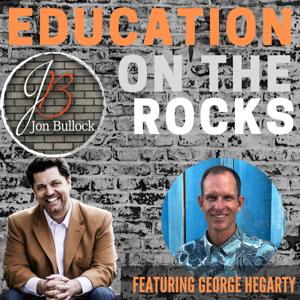
Education on the Rocks

Education on the Rocks

By Jon BullockEducation
Download on the App Store

Education on the Rocks episodes

  • EP 36 – The “Words, Words, Words” Edition
    Whether in digital or paper form, books have always been a major part of what drives education in the United States. Whether those books are novels or entire curriculums marketed to state assemblies for adoption, books and education are often commingled with politics. Historically, we’ve seen districts and states ban books from classrooms in ways that bring politics and faith into our students’ classrooms. We’re going to take up the knotty issue of reading in schools and how it’s about a lot more than simply worrying about how many pages there are for homework. Today, George and I talk about our experiences with books and schools, the books we’ve read and didn’t read, and the books we’ve taught or elected not to teach, as we ask, “What’s on the syllabus?”

    Context:
    Today’s episode is inspired by an November 3rd article in The New York Times Education Briefing by Amelia Nierenberg that details the role that Toni Morrison’s Beloved may have played in Virginia’s recent gubernatorial race. Also, we’re drawing on an ongoing campaign by Rep. Matt Krause to inventory over 850 titles in Texas schools, as they might cause students to feel “discomfort.”

    Key Questions:
    What’s the strangest reading experience you’ve had in school?
    What’s the best book you were assigned to read in high school?
    What’s the best book that you didn’t read in high school?
    Let’s talk about textbook adoption - don’t schools just fill out a scholastic book order as we did in elementary school?
    As an educator, have you ever been questioned about readings on your syllabus?
    From your experience, why do people choose to challenge reading lists or books?
    44 min
  • EP 35 - The “One Stop Shop” Edition
    As children of the ‘80’s, George and I were barraged with images of the shopping mall in movies and on the 5 TV channels we got - the mall was the place to go to see and be seen, and to find everything you needed, all under one massive roof. So, the mall offered a place to socialize, to find the durable goods one needed from corduroys to bestsellers to the latest releases from U2 and Run-DMC, and to eat something deep fried in the food court. Getting in our hot tub time machines, we’re going to teleport back to 2021, a time when one could argue that the mall has been replaced by our public schools. Where schools have always been about more than just the learning, today they are restaurants, transportation hubs, community theaters, sports stadia, vaccine clinics, health centers, and yes there are dances and they even have classrooms. So, today, we wonder about the role of public schools in American society when we ask, “Are our schools trying to do too much?”

    43 min
  • EP 34 - The “Am I a Freshman or Not?” Edition
    Sometime between elementary and high school in the United States, all of us went to middle school. Or did we? Some of you are probably thinking that you went to junior high or that you moved from a lower to an upper school. Or, like my co-host, you found the years so trying that you’ve erased them from your memory. Today, we tackle the middle years in the American public school system, and we’re particularly interested in thinking about what it means to be in 9th grade. For many of us, our 9th-grade year was our freshman year in high school, but in some systems, 9th grade is the final year in middle school, so unlike many aspects of our system, there’s a lot of variability concerning how we should place our 14 and 15-year-olds. Today, we tackle the middle years, as we ask, “You’re in 9th grade, so you’re a freshman, right?!?!”
    40 min
  • EP 33 - The Attendance Bells Ring Again Edition
    With Labor Day behind us, schools around the country are welcoming students back to their campuses. Over the past two seasons, we’ve spent a lot of time talking through what it means to be a part of the American public education system during a pandemic, but today we’re going to share the in’s and out’s of starting an academic year. In no other industry that we know of is there a new start every year, and these new beginnings offer their gifts and challenges. Today, we talk about what it’s really like to get the educational machine up and running every fall, as we ask: can we really do this again?
    48 min
  • EP 32 - Teaching Teachers to Teach
    Over the past year-plus, we’ve talked a lot about the challenges our school systems face and how our students are learning and will continue to learn in classrooms both remote and in person. At the heart of all these discussions are the professionals who work with young people across the country. Today, as we approach Memorial Day Weekend, the “finish line” of the academic calendar, we want to talk about those people, our teachers. So, we hope that you join us in conversation, as we ask: who would want to become a teacher?
    44 min
  • EP 31 - The “Always Innovate” Episode
    As spring rushes quickly towards summer, students across the country are trying to figure out what to do with summer months that are likely to be a bit freer than last year, but far from normal. To meet students’ needs, schools are in the process of designing summer opportunities to enrich student learning and to, if we’re being honest, fill in potholes that COVID school has left in their education. This is leaving a lot of people involved in K12 education wondering how they’re going to pull off new programs on very tight timelines, which leads us to think about how innovation functions in the American public education system. So today, we think about the what, when, and how of schools re-inventing themselves as we ask: how do individual schools and entire school systems innovate to meet the ever-evolving needs of their students?
    35 min
  • EP 30 - The “We’ve Got to See Our Way through this” Episode
    Over the past year, George and I have spent a lot of time discussing how schools and students’ learning have been affected by the pandemic. Today we’re going to think about our schools not so much as places where students learn academic skills and earn grades, but as places that will be vital to helping our students navigate worlds that have been turned upside down for the last 13 months. With so much local and national attention on getting schools open, we want to pause to think about the evolving roles that schools will play in young people’s lives as we ask: how will school balance students’ wellness needs with learning and growth targets?
    39 min
  • EP 29 - Want a Diploma - First, We’ve Got to Get You Vaccinated
    With the relatively widespread availability of the COVID vaccine in the United States, more and more colleges and universities are making plans to open up in the fall. After having shuttered in-person education for the entirety of the 2020-2021 academic year, college administrators are trying to figure out how to safely bring back tens of thousands of students to campuses across the country. Late last week, Duke University announced that it’s planning to require all students to show proof of vaccination. In a letter to that effect, Vincent E Price, the university president, writes: “With this in mind, we plan to require all new and returning Duke students to present proof of vaccination to Student Health before they can enroll for the Fall 2021 semester. This policy will cover all undergraduate, graduate, and professional students—in all degree programs—who intend to be on the Duke campus for any period of time starting with the Fall 2021 semester. Documented medical and religious exemptions will be accommodated.” So, with this in mind, today we’re going to discuss the connection between vaccination and education, as we ask: should schools require students to be vaccinated in order to attend classes in the fall of 2021?
    36 min
  • EP 28 - College Apps and Admissions in the Post-COVID Landscape
    Almost exactly a year ago, George and I launched this podcast in hopes of talking through, as much for ourselves as for our audience, the myriad factors that shape what public education looks like in the United States. At the time, we were just getting used to platforms like Zoom, platforms that have become ubiquitous in our daily lives. As we’ve passed the one year mark of the COVID pandemic, and while there have been countless educational interruptions and pivots, and business has been anything but usual for everyone in and beyond our schools, students are still going to school and graduating and going to college. So, today, with many of the country’s seniors facing choices about which college they should attend and our juniors, the class of 2022, looking hopefully towards their graduation dates, we’re talking college as we ask: what does it take to “get into” college? And then, even more importantly, what does it take to be a successful college student?
    40 min
  • EP 27 - Remember when THAT happened
    Believe it or not, George and I haven’t always been educational professionals. In fact, we’re both products of the American public school system. While I grew up in the Oregon system and George in California, we both started and ended our K-12 experiences in public schools. Today, we’re going to test our memories as we jump in our mental Deloreans and head back, way back into the 1980s to think about the highs and lows of our lives in public schools. And then, we’ll take those memories and speculate on the future of public education as we ask: Remember when That happened???
    38 min

About Education on the Rocks

From the publisher's feed

For years, the American public and politicians have decried the state of education in the United States. Endless reform efforts and enhanced accountability measures have stressed our public education…