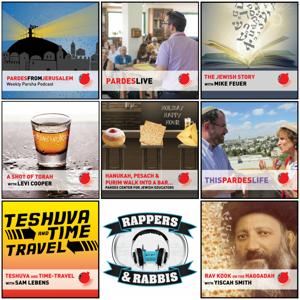
Elmad Online Learning

Elmad Online Learning

By Pardes Institute of Jewish StudiesReligion & SpiritualityEducationHistoryJudaism
Download on the App Store

Elmad Online Learning episodes

  • Tisha B’Av 2018: In the End of Days There Will Be No Death: The Rabbi Who Fooled the Grim Reaper
    Tisha B’Av 2018 at Pardes is sponsored in loving memory of Ben Blutstein z”l by his family who miss him dearly.

    In this live lecture for Tisha B’Av 2018, Gila Fine talks on the topic of In the End of Days There Will Be No Death: The Rabbi Who Fooled the Grim Reaper. If listening via ITunes or another podcast provider, see the source sheet at https://elmad.pardes.org/.
    Click here for more online learning for Tisha B’Av.
    48 min
  • “Pumpkin Flowers” by Matti Friedman
    Israel’s war, in Lebanon, against Hezbollah in the 1990s was the first war of the 21st century, foreshadowing the conflicts in Iraq, Afghanistan, and elsewhere. It shaped a generation of Israelis. But it has been largely forgotten. Matti’s book Pumpkinflowers: A Soldier’s Story of a Forgotten War describes one outpost in that war based on his own experience. In this lecture that was recorded live at Pardes as part of the Summer Evening Lecture Series, Matti uses the outpost as a springboard to discuss the experience of Israelis in the army, and the way the events in Lebanon continue to echo today. Pumpkinflowers was a 2016 New York Times Notable book and was chosen by Amazon as one of the 10 best books of the year.
    The Pardes Summer Evening Lecture Series is sponsored in memory of Brondell Pomrenze by Huti and Jay Pomrenze.
    1 hr 18 min
  • Uncovered: Kol Isha (The Voice of a Woman)
    In this podcast we will look at the complicated topic of Kol Isha or the voice of a woman as representing a source of sexual temptation. As we will see, the traditional approach today which is to prevent women from singing in public or private spaces is actually an innovative approach that reinterprets the rabbinic sources that dominated from the Gemara until the 17th century. We will try to understand why this approach is perceived as the most legitimate one and whether there is a way to return to tradition and allow women to sing.

    The series Uncovered look at three major topics that often restrict women’s presence in traditional Jewish communities: Dress, Hair and Voice. The famous Talmudic statements that “the leg of a woman is nakedness”, “the voice of a woman is nakedness” and “the hair of a woman is nakedness” are often presented at face value but in fact, as the series will uncover, the Talmudic conversation is centered around the laws of saying Shema and do not reverberate outward into a greater conversation anywhere else in the Talmud with one fairly minor exception. However, those statements became the platform for modern halakhic and religious discourse on women, modesty and sexuality and can be perceived as empowering or suffocating depending on where and how the conversation is unpacked. Suffice to say, it is never a neutral conversation. In this series we will try to understand the larger picture before beginning to look at the rabbinic sources that structure the conversation.
    0 min
  • The History of Spain Episode 2
    Class two focuses on the Golden Age as a time of cultural fusion and thriving life. But the challenges which language and philosophy pose to tradition Jewish life were laid in this era as well, and the future may not look as rosy as the past.

    This session was given as part of The Marilyn and Sigi z”l Ziering Omer Program.

    Click here for more episodes in the series.
    1 hr 30 min
  • The History of Spain Episode 1
    The first in a series of five, this class introduces the origins of Spanish Jewry from the perspective of the historical documentation as well as their own inner narrative. It covers the period from the end of the Roman Empire, through the Visigothic kingdom up to the birth of the Caliphate of Cordoba.

    This session was given as part of The Marilyn and Sigi z"l Ziering Omer Program.

    Click here for more episodes in the series.
    1 hr 33 min
  • Uncovered: Hair Covering Part 2
    In this podcast we will look at the Talmudic statement that “the hair of a woman is nakedness” in order to understand it’s implications for the ongoing halakhic conversation around hair covering. We will see how the ideas developed in the previous podcast around Dat Moshe and Dat Yehudit become synthesized with the idea of nakedness in some of the halakhic discourse while in others, remain separately addressed. In the end, we will see how women come to cover or uncover their hair in many different ways.
    Click here to listen to part 1.

    The series Uncovered looks at three major topics that often restrict women’s presence in traditional Jewish communities: Dress, Hair and Voice. The famous Talmudic statements that “the leg of a woman is nakedness”, “the voice of a woman is nakedness” and “the hair of a woman is nakedness” are often presented at face value but in fact, as the series will uncover, the Talmudic conversation is centered around the laws of saying Shema and do not reverberate outward into a greater conversation anywhere else in the Talmud with one fairly minor exception. However, those statements became the platform for modern halakhic and religious discourse on women, modesty and sexuality and can be perceived as empowering or suffocating depending on where and how the conversation is unpacked. Suffice to say, it is never a neutral conversation. In this series we will try to understand the larger picture before beginning to look at the rabbinic sources that structure the conversation.
    37 min
  • Yom Hashoah Faculty Panel: What does “never again” mean to you?
    Pardes hosted a live faculty panel discussion made up of children and grandchildren of survivors of the Holocaust. The panel addressed the following questions:

    * How does the Holocaust influence your Jewish identity in worldview and in action?
    * What has been the impact of the stories you've heard on your relationship with non-Jews?
    * From you experience, what does a healthy relationship to the Holocaust look like?
    * Is there a central lesson that you derive from the Holocaust?
    * What does "never again" mean to you?

    Thanks to Rabbi Meir Schweiger, Rabbi Mike Feuer and Dr. David Bernstein for their participation in this panel.

    Click here for more learning on Yom Hashoah.

    1 hr 10 min

About Elmad Online Learning

From the publisher's feed

The Pardes Institute of Jewish Studies Digital Library