Empires Before The Fall

Empires Before The Fall

Download on the App Store

Empires Before The Fall episodes

  • The ridge that split a drop of rain decided which ocean it hit
    A drop of rain on a Rwandan ridge will decide which ocean it reaches - Atlantic or Indian? Where does it go?

    The ridge that split a drop of rain decided which ocean it hit

    In this episode, we follow how a single raindrop on the Congo-Nile divide in Rwanda can begin journeys thousands of kilometers apart toward the Indian Ocean or the Atlantic. The episode traces the geology, the lakes and forests, and the open question about the Nile’s most distant headwaters to ask why such a small country controls so much of Africa’s hydrology.

    Person: Researchers who traced a Nile headwater in 2006
    Location: Congo-Nile divide, Rwanda
    Feature: Nyungwe Forest, ~1,013 square kilometers
    Event: Discovery of a spring in Nyungwe linked to Nile headwaters (2006)
    Statistic: ~80% of Rwanda drains to the Nile basin; ~20% to the Congo

    - A raindrop lands on ground no wider than a footpath and can flow either east toward Lake Victoria and the Nile or west toward Lake Kivu and the Congo.
    - The Congo-Nile divide runs through Rwanda and was created by the East African Rift System as land rose and fell 25-30 million years ago.
    - Nyungwe Forest, one of Africa’s oldest montane rainforests, sits on the divide and hosts a spring traced in 2006 to a branch of the Nile’s headwaters.
    - Rwanda’s altitude ranges roughly 3,500 meters within a country the size of Haiti or Albania, concentrating valleys, escarpments, and volcanic highlands into a compact area.
    - Lake Kivu, on Rwanda’s western edge, is a deep volcanic lake with cold surface waters and gas-saturated depths of carbon dioxide and methane.

    To listen to this podcast ad-free and access premium episodes, try our subscription with a 14-day free trial at obomedia.com.

    © 2026 OBOMEDIA. All rights reserved.
    This episode and its content (audio, text, and related materials) are the exclusive property of OBOMEDIA and are protected by applicable copyright laws. Reproduction, distribution, editing, or commercial use, in whole or in part, without prior written permission from OBOMEDIA is prohibited. For permissions, licensing, and business inquiries: [email protected].

    17 min
  • The Clean-Air Scrubbers That Unmasked Decades of Hidden Warming
    A chemist in 1958 measures CO₂ that never stops climbing, and decades of clean-air scrubbers reveal hidden warming-what actually happened?

    The Clean-Air Scrubbers That Unmasked Decades of Hidden Warming

    In this episode, we follow the scientific record from Charles David Keeling’s first CO₂ reading in 1958 through ice-core archives and twentieth-century emissions. We outline how fossil fuel combustion, solar and volcanic forcing, and aerosol pollution intersected - and ask how clean-air policies changed what the climate record revealed.

    Person: Charles David Keeling
    Date: 1958 first Mauna Loa CO₂ reading
    Location: Mauna Loa, Hawaii; Antarctic and Greenland ice cores
    Topic: Keeling Curve, atmospheric CO₂ and methane trends
    Event: Introduction of industrial scrubbers and declining aerosol emissions

    - Keeling installed a precise instrument at Mauna Loa and recorded 313 ppm CO₂ in 1958, launching a continuous measurement series.
    - Ice-core bubbles show CO₂ held near 280 ppm for 800,000 years before rising sharply over ~200 years with combustion of coal, oil, and gas.
    - By 2019 atmospheric CO₂ reached 415 ppm and methane rose ~160% above its 1750 baseline, matching the highest levels in the ice-core record.
    - Studies found solar and volcanic forcings could not account for the post-1985 warming; anthropogenic radiative forcing far exceeded solar changes.
    - Between 1961 and 1990 sulfate aerosols caused measurable global dimming; later scrubbers cut particulates and allowed suppressed warming to emerge.

    To listen to this podcast ad-free and access premium episodes, try our subscription with a 14-day free trial at obomedia.com.

    © 2026 OBOMEDIA. All rights reserved.
    This episode and its content (audio, text, and related materials) are the exclusive property of OBOMEDIA and are protected by applicable copyright laws. Reproduction, distribution, editing, or commercial use, in whole or in part, without prior written permission from OBOMEDIA is prohibited. For permissions, licensing, and business inquiries: [email protected].
    18 min
  • The siege that waited thirty‑three months-and why Oman vanished
    Omani fleet starves Portugal’s Fort Jesus over 33 months-so how did that empire quietly vanish?

    The siege that waited thirty‑three months-and why Oman vanished

    In this episode, we trace the arc of an empire born on the sea, from a single sailing ship in New York Harbor to a string of fortified ports across the Indian Ocean, and ask how an empire that mastered maritime power collapsed from within. What forces-succession, ambition, and the limits of coastal control-hollowed it out?

    Person: Saif bin Sultan
    Date: October 4, 1711
    Location: Fort Jesus (Mombasa), Muscat, Zanzibar, Mozambique, Mogadishu
    Event: 33‑month siege of Fort Jesus

    - April 13, 1840: the Arab sailing ship Al‑Sultanah anchors in New York Harbor with fifty‑six Omani sailors and cargo from across the Indian Ocean.
    - 1507: Portuguese seize Muscat and occupy Oman for 143 years, turning it into a fortified stop on the India route.
    - 1650s: Ya'rubid dynasty expels the Portuguese from Muscat and pursues them down the East African coast to Zanzibar and Mombasa.
    - 1696-1699 (approx.): Omani fleet besieges Fort Jesus for thirty‑three months, maintaining a patient blockade until the garrison starves.
    - 1711-1719: Saif bin Sultan dies with vast estates; the Ya'rubid line ends and the Al Busaid takeover unfolds through regencies, coups, and violent succession struggles.

    To listen to this podcast ad-free and access premium episodes, try our subscription with a 14-day free trial at obomedia.com.

    © 2026 OBOMEDIA. All rights reserved.
    This episode and its content (audio, text, and related materials) are the exclusive property of OBOMEDIA and are protected by applicable copyright laws. Reproduction, distribution, editing, or commercial use, in whole or in part, without prior written permission from OBOMEDIA is prohibited. For permissions, licensing, and business inquiries: [email protected].
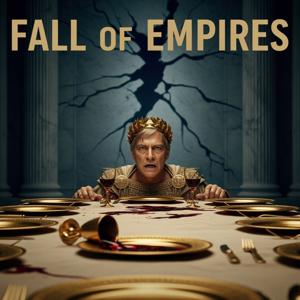
    16 min
  • Charlemagne's silver table hacked up and handed out, undoing the empire
    Charlemagne’s silver table is hacked apart and given to soldiers-one object, one moment that may explain why an empire unraveled?

    Charlemagne's silver table hacked up and handed out, undoing the empire

    In this episode we follow the months and decisions around Louis the Pious’s death and the collapse of his inheritance. We trace how a symbolic object and a series of succession choices created the conditions for an empire to fracture rather than the familiar tale of greedy sons; what really happened when the table was broken and distributed?

    Person: Louis the Pious
    Person: Lothar I
    Person: Judith
    Date: June 840 (emperor’s death); late winter 842 (table hacked)
    Event: Ordinatio Imperii issued in 817

    - Louis issues the Ordinatio Imperii in 817 to make Lothar sole heir while granting subordinate kingdoms to his other sons.
    - Judith, Louis’s second wife, campaigns at court after bearing Charles and pushes for lands for her son, undoing earlier succession promises.
    - Pippin I of Aquitaine deposes Louis at Compiègne in 830, Judith is imprisoned, and the Ordinatio’s authority is weakened.
    - The Field of Lies in 833 sees Louis betrayed by supporters, publicly humiliated, and temporarily stripped of power, then restored in 834.
    - In late winter 842 Lothar has Charlemagne’s engraved silver table hacked apart and distributed to soldiers as bribes, a symbolic act within ongoing succession turmoil.

    To listen to this podcast ad-free and access premium episodes, try our subscription with a 14-day free trial at obomedia.com.

    © 2026 OBOMEDIA. All rights reserved.
    This episode and its content (audio, text, and related materials) are the exclusive property of OBOMEDIA and are protected by applicable copyright laws. Reproduction, distribution, editing, or commercial use, in whole or in part, without prior written permission from OBOMEDIA is prohibited. For permissions, licensing, and business inquiries: [email protected].

    18 min
  • The Confucian temple that made a nomad court govern like an empire
    A towering khagan builds a Confucian temple in a nomad Supreme Capital, forcing a steppe court to govern like an empire-what did he change?

    The Confucian temple that made a nomad court govern like an empire

    In this episode, we follow Abaoji’s rise from Yila chieftain to Khagan and the unprecedented state he created that mixed steppe and Han institutions. We trace his military alliances, internal purges, and the administrative choices that folded settled civilization into a nomadic ruling structure-how did he hold it together?

    Person: Abaoji
    Date: 903 (height recorded), 916 (state proclaimed)
    Location: Northern steppe, Supreme Capital
    Event: Creation of a dual nomad-settled imperial system
    Topic: Confucian temple and Han administration within a Khitan court

    - Yao Kun, a Tang envoy, noted Abaoji’s over-two-meter height when meeting him in 903.
    - Abaoji was elected Yila tribal chieftain in 901 and named supreme commander of Khitan forces in 903.
    - He allied with warlord Li Keyong in 905 and became Khagan by demand in 907 amid Tang collapse.
    - Between 912 and 918 he crushed four family insurrections, centralizing authority into his line.
    - In 916 he proclaimed a state, built a walled Supreme Capital and a Confucian temple, and placed Han officials like Kang Moji, Han Yanhui, and Han Zhigu at the core of governance.

    To listen to this podcast ad-free and access premium episodes, try our subscription with a 14-day free trial at obomedia.com.

    © 2026 OBOMEDIA. All rights reserved.
    This episode and its content (audio, text, and related materials) are the exclusive property of OBOMEDIA and are protected by applicable copyright laws. Reproduction, distribution, editing, or commercial use, in whole or in part, without prior written permission from OBOMEDIA is prohibited. For permissions, licensing, and business inquiries: [email protected].

    17 min
  • The Farming Manual That Outlived Carthage-and Why
    A Roman consul orders a single Carthaginian farming manual spared as the city is razed-why save agriculture when an entire civilization is erased?

    The Farming Manual That Outlived Carthage-and Why

    In this episode, we follow the story of Carthage through the fragments that survived and the choices made by Rome about what to preserve. We trace the city’s scale, maritime mastery, political institutions, and the uncomfortable question: was preserving a farming manual accidental or deliberate?

    Person: Cato the Elder
    Location: Carthage (peninsula, northern Africa; modern Tunisia)
    Event: Destruction of Carthage, 146 BCE
    Topic: Survival of a Carthaginian farming manual
    Period: Punic Wars (end of Third Punic War)

    - Carthage was a mercantile maritime power with engineered harbors for two hundred and twenty warships and a separate commercial port.
    - Aristotle analyzed Carthage’s mixed constitution, comparing it to Sparta and Crete, indicating a sophisticated political system.
    - Carthaginian navigators like Hanno and Himilco conducted systematic explorations along the Atlantic and European coasts and recorded their findings.
    - Military clashes included an engagement where Carthage disabled ninety-eight of Pyrrhus’s one hundred ten ships and Hannibal’s campaigns in Italy culminating at Cannae and later Zama.
    - After Zama Carthage became a Roman client state, rebuilt wealth through trade and agriculture, and was later destroyed while Rome chose to preserve an agricultural treatise.

    To listen to this podcast ad-free and access premium episodes, try our subscription with a 14-day free trial at obomedia.com.

    © 2026 OBOMEDIA. All rights reserved.
    This episode and its content (audio, text, and related materials) are the exclusive property of OBOMEDIA and are protected by applicable copyright laws. Reproduction, distribution, editing, or commercial use, in whole or in part, without prior written permission from OBOMEDIA is prohibited. For permissions, licensing, and business inquiries: [email protected].
    19 min
  • The refusal to sack Mogontiacum cost Postumus his life and his empire
    A Roman general built a rival Gallic Rome-but when his troops demanded the sack of Mogontiacum, he refused. What happened next?

    The refusal to sack Mogontiacum cost Postumus his life and his empire

    In this episode, we follow the rise of Postumus from Rhine commander to founder of the Gallic Empire, tracing how he built Roman institutions in Gaul and defended the frontier while repeatedly declining to march on Rome. Why did a man who created a parallel Roman state refuse to seize the central throne, and how did that restraint lead to his death?

    Person: Postumus
    Event: Battle of Empel (260) and decade of frontier peace
    Location: Rhine frontier and Mogontiacum (Mainz)
    Period: 260-269
    Topic: Founding and fall of the Gallic Empire

    - Postumus defeats a major Frankish incursion at Empel in 260 and secures roughly ten years of quiet on the Rhine.
    - He establishes a functioning parallel Roman state: minting coins with consular dates, annually elected consuls, a Senate, and a Praetorian Guard centered at Augusta Treverorum.
    - He orders the killing of Saloninus and the praetorian prefect Silvanus at Cologne, an act that cements the break with the central empire.
    - In early 269 a legion at Mogontiacum proclaims Laelianus emperor; Postumus marches, retakes the city, and executes Laelianus.
    - Postumus refuses his troops’ demand to sack Mogontiacum, and that refusal prompts his soldiers to kill him.

    To listen to this podcast ad-free and access premium episodes, try our subscription with a 14-day free trial at obomedia.com.

    © 2026 OBOMEDIA. All rights reserved.
    This episode and its content (audio, text, and related materials) are the exclusive property of OBOMEDIA and are protected by applicable copyright laws. Reproduction, distribution, editing, or commercial use, in whole or in part, without prior written permission from OBOMEDIA is prohibited. For permissions, licensing, and business inquiries: [email protected].
    19 min
  • The soldiers who pointed buildings and lit Jakarta's fires challenged the chaos
    In May 1998, short-haired men in civilian clothes moved through Jakarta pointing at buildings as fires spread - who organized the burnings?

    The soldiers who pointed buildings and lit Jakarta's fires challenged the chaos

    In this episode, we follow the chaotic days of May 1998 in Jakarta when fires consumed neighborhoods and witnesses described organized, directed violence amid a national economic collapse. The episode traces how currency collapse, student protests, and security forces' actions overlapped - and asks what the presence of soldiers pointing at targets reveals about who set the city aflame.

    Date: May 13, 1998
    Location: Jakarta, Indonesia
    Event: Fires and riots amid Reformasi protests
    Person: Suharto
    Topic: Currency collapse and organized violence

    - Witnesses across multiple neighborhoods described men with short hair in civilian clothes appearing at crowd edges and calmly pointing to specific buildings.
    - The crisis began after the rupiah lost over eighty percent of its value following the 1997 Asian financial contagion that started in Thailand.
    - Student protests escalated after security forces opened fire at Trisakti on May 12, killing four students by name.
    - Soldiers were present throughout the city during the fires, and multiple documented accounts suggest some did not intervene and may have directed actions.
    - Officials described the riots as spontaneous chaos, while witnesses reported coordinated targeting of malls, banks, and department stores.

    To listen to this podcast ad-free and access premium episodes, try our subscription with a 14-day free trial at obomedia.com.

    © 2026 OBOMEDIA. All rights reserved.
    This episode and its content (audio, text, and related materials) are the exclusive property of OBOMEDIA and are protected by applicable copyright laws. Reproduction, distribution, editing, or commercial use, in whole or in part, without prior written permission from OBOMEDIA is prohibited. For permissions, licensing, and business inquiries: [email protected].
    19 min
  • The polar bear Franz on the third floor proved the ice age never left
    A polar bear named Franz stands in a village museum - can a school director make a landscape speak?

    The polar bear Franz on the third floor proved the ice age never left

    In this episode, we follow how a school director turned a lakeside building into a three-floor interpretive center to teach locals the glacial story written in their landscape. What happens when a community is asked to read the terrain beneath their feet differently?

    Person: Asta Tuusti
    Location: Lake Saadjärv, Äksi, Vooremaa
    Date: 2004 (project start)
    Cost: approximately €4,000,000
    Feature: three-floor interpretive center with full-scale reconstructions

    - Tuusti, director of the Saadjärv Nature School, recognized the surrounding hills as a drumlin field shaped by glaciers.
    - She proposed a three-floor center on the lake shore with immersive dioramas and full-scale animal reconstructions.
    - The project secured municipal investment and partial European Regional Development Fund support despite the village’s small size.
    - The first floor opens with a life-size woolly mammoth and tactile ice samples to make glacial conditions tangible for children.
    - The topmost exhibit includes a full-height polar bear named Franz placed on the third floor as part of the museum’s narrative.

    To listen to this podcast ad-free and access premium episodes, try our subscription with a 14-day free trial at obomedia.com.

    © 2026 OBOMEDIA. All rights reserved.
    This episode and its content (audio, text, and related materials) are the exclusive property of OBOMEDIA and are protected by applicable copyright laws. Reproduction, distribution, editing, or commercial use, in whole or in part, without prior written permission from OBOMEDIA is prohibited. For permissions, licensing, and business inquiries: [email protected].
    18 min
  • The one-word label "preconditioned" unmade the official climate record
    Preconditioned" begins appearing on a scientist's instruments. What does it mean?

    The one-word label "preconditioned" unmade the official climate record

    In this episode, we follow how a single word from a Science paper spread into datasets, reports, and legal texts as 2025-26 delivered unprecedented ocean heat and cascading measurement gaps. What happens when the systems built to track a crisis start disappearing as the crisis intensifies?

    Date: August 10, 2025
    Event: Glacier collapse into Tracy Arm fjord
    Location: Alaska
    Topic: Ocean heat and measurement infrastructure
    Period: 2015-2026

    - A 481-meter rock face collapsed into Tracy Arm in under three minutes, producing a 100-meter wave traveling ~70 m/s.
    - Nine consecutive years of record ocean heat culminated in 2025, confirmed by Advances in Atmospheric Sciences on Jan 9, 2026.
    - On the same day, Oxfam reported the wealthiest 1% had used their annual carbon budget in ten days.
    - Multiple studies in 2026 showed models underestimating warming: AMOC slowdown, reduced forest carbon uptake, and earlier Arctic soil carbon release.
    - Scientific and policy records adopted the word "preconditioned," which began appearing across ocean temperature data, Arctic reports, legal manuals, and ocean instruments' protocols.

    To listen to this podcast ad-free and access premium episodes, try our subscription with a 14-day free trial at obomedia.com.

    © 2026 OBOMEDIA. All rights reserved.
    This episode and its content (audio, text, and related materials) are the exclusive property of OBOMEDIA and are protected by applicable copyright laws. Reproduction, distribution, editing, or commercial use, in whole or in part, without prior written permission from OBOMEDIA is prohibited. For permissions, licensing, and business inquiries: [email protected].
    16 min

About Empires Before The Fall

From the publisher's feed

Sometimes a place feels older than its ruins. You stand where thousands once lived, ruled, celebrated, and vanished, and for a moment the silence feels occupied. Empires Before The Fall explores that…