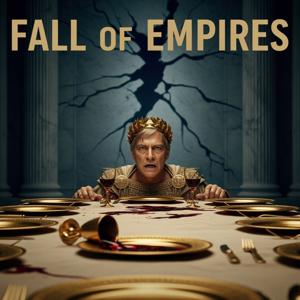
Empires Before The Fall

Empires Before The Fall

Download on the App Store

Empires Before The Fall episodes

  • The "1.5" Painted on a Hamburg Street Recast a Goal as a Passed Milestone
    Activists paint "1.5" on a Hamburg street - by 2024 that number may mark a crossed climate milestone; how did this happen?

    The "1.5" Painted on a Hamburg Street Recast a Goal as a Passed Milestone

    In this episode, the story follows how a number stenciled on a Hamburg commercial street came to mean two things at once: an international goal and evidence of progress already lost. We trace the political choices, scientific estimates, and model debates that let one figure shift from promise to measurement - how did a widely agreed pledge fray so quickly?

    Person: Activists in Hamburg
    Event: Painting the number "1.5" on a commercial street
    Date: Spring 2022 (painting); by end of 2024 meaning had shifted
    Topic: Paris Agreement temperature limit of 1.5°C
    Institution: IPCC special report (2018) and climate model estimates (2015-2018)

    - The 1.5°C number was adopted in Paris 2015 as a diplomatic anchor after years of fraught summits and pressure from small island states.
    - Between 2015 and 2018 climate model estimates placed the probability of holding warming to 1.5°C between 1% and 13% under various assumptions.
    - The IPCC’s 2018 special report said 1.5°C was still physically possible only with immediate and radical transformations across energy, land, transport, and industry.
    - By 2019 peer-reviewed research flagged that cryosphere tipping points, including the West Antarctic Ice Sheet threshold, may already have been approached or passed.
    - By the end of 2024, public-facing data and a Guardian survey showing only 5% of climate scientists believing the target would be met reframed "1.5" from aspirational goal to contested measurement.

    To listen to this podcast ad-free and access premium episodes, try our subscription with a 14-day free trial at obomedia.com.

    © 2026 OBOMEDIA. All rights reserved.
    This episode and its content (audio, text, and related materials) are the exclusive property of OBOMEDIA and are protected by applicable copyright laws. Reproduction, distribution, editing, or commercial use, in whole or in part, without prior written permission from OBOMEDIA is prohibited. For permissions, licensing, and business inquiries: [email protected].

    17 min
  • The ledger that kept tally exposed why Russia sold Alaska
    A ledger and seven hundred Russians on the edge of an empire force a sale of Alaska - but why did Moscow really sell two cents an acre?

    The ledger that kept tally exposed why Russia sold Alaska

    In this episode a narrative of Alaska’s sale unfolds from the first sightings and shipwrecks to the brutal fur economy and the colony’s ledgers. It traces how demographics, logistics and accounting framed the decision and asks what the numbers reveal about sovereignty and empire.

    Date: April 9, 1867
    Person: Ivan Fedorov; Aleksei Chirikov; Vitus Bering; Alexander Baranov
    Location: Alaska; Cape Prince of Wales; Aleutian Islands; Fort Ross (California)
    Topic: Russian America fur trade; population collapse; colonial ledger

    - A U.S. Treasury clerk signed a $7,200,000 check on April 9, 1867 - two cents an acre for 586,000 square miles.
    - Russia’s first confirmed Alaskan contact was a sighting in 1732; early expeditions suffered shipwrecks, missing crews, and deaths.
    - Sea otter pelts launched Russian presence: promyshlenniki hunters exploited marine fur and relied on forced Aleut labor.
    - Between 1741 and 1799 the Aleut population declined by 80% from disease introduced after contact.
    - The Russian-American Company shipped 15 million rubles of fur (1806-1818) but received under 3 million rubles in provisions, exposing chronic deficit.

    To listen to this podcast ad-free and access premium episodes, try our subscription with a 14-day free trial at obomedia.com.

    © 2026 OBOMEDIA. All rights reserved.
    This episode and its content (audio, text, and related materials) are the exclusive property of OBOMEDIA and are protected by applicable copyright laws. Reproduction, distribution, editing, or commercial use, in whole or in part, without prior written permission from OBOMEDIA is prohibited. For permissions, licensing, and business inquiries: [email protected].
    17 min
  • The tram that kept time after the Empire abdicated
    A punctual Berlin tram on November 10, 1918 runs as an empire collapses - why did Germany’s quiet fall matter?

    The tram that kept time after the Empire abdicated

    In this episode, we set the scene on Berlin streets the morning after the German Empire collapsed and trace how small, ordinary moments connected to decisions in military headquarters, naval orders, and city uprisings. What does a tram’s punctuality tell us about how power shifted and why that fragile transfer mattered?

    Person: Ernst Troeltsch
    Date: November 10, 1918
    Location: Berlin
    Event: German Empire collapses after eleven days of revolution
    Case: Kiel mutiny and naval order of October 24, 1918

    - Troeltsch observes a tram running on time the morning after the empire’s fall, a detail that puzzled contemporaries.
    - On September 29, 1918, General Erich Ludendorff tells civilian leaders the war is lost and urges immediate democratization so civilians will sign the armistice.
    - Admirals Hipper and Scheer issue an unauthorized order on October 24 for the fleet to sortie, prompting sailors in Kiel to refuse and let boilers cool.
    - Mass protests in Kiel on November 3 lead to soldiers firing and at least nine deaths, triggering broader refusal by troops and a general strike by November 4.
    - By November 7 the revolution reaches Munich as Kurt Eisner leads a march and King Ludwig III flees without a formal abdication.

    To listen to this podcast ad-free and access premium episodes, try our subscription with a 14-day free trial at obomedia.com.

    © 2026 OBOMEDIA. All rights reserved.
    This episode and its content (audio, text, and related materials) are the exclusive property of OBOMEDIA and are protected by applicable copyright laws. Reproduction, distribution, editing, or commercial use, in whole or in part, without prior written permission from OBOMEDIA is prohibited. For permissions, licensing, and business inquiries: [email protected].
    15 min
  • They weren't slave rebels - one thousand bought boys made a dynasty
    A regiment of mamluks in Egypt seizes power after capturing Louis IX - so how did that corps remake a sultanate and keep control?

    They weren't slave rebels - one thousand bought boys made a dynasty

    In this episode, we follow the small, deliberate institution built by Sultan as-Salih that created a regiment of one thousand mamluks and changed the balance of power in the eastern Mediterranean. We track how those men were raised, armed, and mobilized, and ask what happened when loyalty bound to an owner collided with dynastic succession.

    Person: Louis IX
    Person: as-Salih
    Person: Shajar al-Durr
    Date: April 1250
    Location: Fariskur, Nile Delta

    - A regiment of roughly one thousand mamluks was purchased as boys between 1229 and 1249 and trained into a cohesive fighting force.
    - The mamluks were converted, schooled in cavalry and archery, and raised within households that framed the owner as a paternal "ustad."
    - As-Salih garrisoned his Bahri mamluks on a Nile island and forged them into the region’s most disciplined army by 1249.
    - After as-Salih’s death, his son Turanshah failed to command the Bahri’s cultivated loyalty and was killed by the regiment in May 1250.
    - Shajar al-Durr, as-Salih’s widow, assumed rule for eighty days, negotiated Louis IX’s ransom, and later married Aybak under pressure from mamluk commanders.

    To listen to this podcast ad-free and access premium episodes, try our subscription with a 14-day free trial at obomedia.com.

    © 2026 OBOMEDIA. All rights reserved.
    This episode and its content (audio, text, and related materials) are the exclusive property of OBOMEDIA and are protected by applicable copyright laws. Reproduction, distribution, editing, or commercial use, in whole or in part, without prior written permission from OBOMEDIA is prohibited. For permissions, licensing, and business inquiries: [email protected].

    19 min
  • The Pra River treaty that froze a border and forced five wars
    A British general’s gold‑rimmed skull on the Pra River boundary sparks conflict-who will control the coast and the gold?

    The Pra River treaty that froze a border and forced five wars

    In this episode, we lay out how a single 1831 treaty that fixed the Pra River as a boundary reshaped relations between the Asante Empire and Britain. We trace the decisions, institutions, and moments that kept the conflict alive and ask how a state that rimmed a rival’s skull in gold could be whittled down by repeated campaigns.

    Person: Sir Charles MacCarthy
    Date: 1831 treaty establishing Pra River boundary
    Location: Pra River / Asante territory and British-controlled coast
    Event: Five separate wars between Asante and Britain
    Topic: Golden Stool (Sika dwa) as the Asante polity’s soul

    - Sir Charles MacCarthy marched into Asante territory in 1823, refused negotiations, was killed, and his skull was rimmed with gold and used ceremonially.
    - The Asante name derives from Twi roots meaning “because of war,” reflecting centuries of forest occupation and military state formation before the 1700s.
    - Osei Tutu I and Okomfo Anokye consolidated clans into the Asante polity, creating institutions where chiefs and elders could check the Asantehene’s power.
    - By the mid‑1700s the Asante extracted tribute and paid ground rents from European settlements; records show European payments to Asante authorities, including the British.
    - After the first war the 1831 Pra River treaty paused hostilities without ceding power, creating a border that both sides observed while underlying tensions and rivalries persisted.

    To listen to this podcast ad-free and access premium episodes, try our subscription with a 14-day free trial at obomedia.com.

    © 2026 OBOMEDIA. All rights reserved.
    This episode and its content (audio, text, and related materials) are the exclusive property of OBOMEDIA and are protected by applicable copyright laws. Reproduction, distribution, editing, or commercial use, in whole or in part, without prior written permission from OBOMEDIA is prohibited. For permissions, licensing, and business inquiries: [email protected].

    20 min
  • The CDC's delayed mortality estimate upended the 2009 pandemic
    A global pandemic was declared over in 2010, but the CDC’s delayed estimate suggested far more deaths - which number was true?

    The CDC's delayed mortality estimate upended the 2009 pandemic

    In this episode, we lay out the timeline and evidence around the 2009 H1N1 pandemic, the surveillance gaps that produced competing death tallies, and how delayed counting shifted the way the outbreak was understood. How do you fight a virus you cannot measure while you are still inside it?

    Person: Centers for Disease Control (CDC)
    Date: 2009-2015 events described
    Location: Global, with examples in India and Nepal
    Event: 2009 H1N1 influenza pandemic and later mortality estimate
    Topic: Delayed mortality estimation and surveillance gaps

    - The WHO declared the 2009 pandemic over in August 2010 with 18,449 confirmed deaths, based on lab-confirmed diagnoses.
    - The CDC published a 2012 mortality estimate attributing between 151,000 and 575,000 global deaths to the 2009 H1N1 strain.
    - Surveillance historically recorded fifty confirmed zoonotic influenza transmissions since 1958, with six documented deaths across those events.
    - Virologists identified an H1N2 lineage in pigs around 2000; six of its genes later appeared in the 2009 pandemic strain.
    - In 2014-2015 the same H1N1 strain caused outbreaks in India and Nepal, where limited testing and a major earthquake in April 2015 disrupted counting and response.

    To listen to this podcast ad-free and access premium episodes, try our subscription with a 14-day free trial at obomedia.com.

    © 2026 OBOMEDIA. All rights reserved.
    This episode and its content (audio, text, and related materials) are the exclusive property of OBOMEDIA and are protected by applicable copyright laws. Reproduction, distribution, editing, or commercial use, in whole or in part, without prior written permission from OBOMEDIA is prohibited. For permissions, licensing, and business inquiries: [email protected].
    18 min
  • The payroll that turned emperors into paperwork and ended Rome
    A teenage boy in a purple robe surrenders the imperial office in Ravenna-so how did paperwork defeat an empire?

    The payroll that turned emperors into paperwork and ended Rome

    In this episode, we follow the last days of the Western Roman state as power shifts from emperors to military patrons and federate troops. We trace decisions and dependencies-from land grants to unpaid wages-that turned political authority into a ledger, and ask why Rome’s end was administrative rather than apocalyptic.

    Person: Orestes
    Person: Romulus Augustulus
    Date: September 4, 476
    Location: Ravenna
    Event: Transfer of imperial office by a teenage emperor

    - Odoacer’s troops accepted the imperial resignation in Ravenna without a battle on September 4, 476.
    - For decades Rome relied on federate soldiers paid with land and money rather than citizen levies.
    - Ricimer, a half-Visigoth magister militum, ruled by installing and removing puppet emperors for roughly sixteen years.
    - Orestes rose from serving Attila to seizing control, then placed his teenage son Romulus on the throne.
    - The immediate crisis was a refusal by Orestes to grant land to foreign soldiers who expected payment, triggering the final unraveling.

    To listen to this podcast ad-free and access premium episodes, try our subscription with a 14-day free trial at obomedia.com.

    © 2026 OBOMEDIA. All rights reserved.
    This episode and its content (audio, text, and related materials) are the exclusive property of OBOMEDIA and are protected by applicable copyright laws. Reproduction, distribution, editing, or commercial use, in whole or in part, without prior written permission from OBOMEDIA is prohibited. For permissions, licensing, and business inquiries: [email protected].
    19 min
  • The Billion Trees Promise-and the Labs That Never Produced Evidence
    A 30-year-old founder in Lagos vows to plant one billion trees - but the public record stops before the evidence appears. How is that possible?

    The Billion Trees Promise-and the Labs That Never Produced Evidence

    In this episode, we lay out the timeline and public claims behind a major climate pledge and the rapid rise of a new organization. What did Climate Action Africa actually build, who signed on, and where does the documentation stop?

    Person: Grace Oluchi Mbah
    Organization: Climate Action Africa
    Date: June 2024 (billion trees announced); July 14, 2021 (organization registered)
    Location: Lagos, Nigeria; Nairobi (Africa Climate Summit)
    Event: Launch of Climate Action Africa Labs and Climate Stories four Kids

    - A business administration graduate, Grace Oluchi Mbah co-founded Climate Action Africa at age 27 and announced one billion trees at 30.
    - In year one the group opened physical Climate Action Africa Labs intended to bring government, researchers, and scientists together.
    - Climate Stories four Kids launched with a declared target of reaching one million children.
    - By 2023 the organization participated in processes feeding into the global stocktake at the Africa Climate Summit in Nairobi.
    - A February 2024 memorandum of association formalized cooperation between the National Council on Climate Change and Climate Action Africa.

    To listen to this podcast ad-free and access premium episodes, try our subscription with a 14-day free trial at obomedia.com.

    © 2026 OBOMEDIA. All rights reserved.
    This episode and its content (audio, text, and related materials) are the exclusive property of OBOMEDIA and are protected by applicable copyright laws. Reproduction, distribution, editing, or commercial use, in whole or in part, without prior written permission from OBOMEDIA is prohibited. For permissions, licensing, and business inquiries: [email protected].
    16 min
  • The 1984 rule that locked species to the past
    An Australian team drove 300 km north to release juvenile tortoises - must conservation abandon the 1984 rule?

    The 1984 rule that locked species to the past

    In this episode, we follow Australian scientists debating whether to move western swamp tortoises outside their recorded range as climate dries their historic wetlands. The episode covers the species’ rediscovery, decades of captive breeding, and the regulatory history that limited translocations - and asks whether responsibility now means moving species to where they might survive.

    Species: western swamp tortoise
    Person: Nicola Mitchell
    Date: 2016
    Location: 300 kilometers north of original range
    Law: 1984 regulatory change requiring experimental populations remain within historical range

    - Researchers transported twenty-four juvenile tortoises in transport containers along three hundred kilometers of highway.
    - The tortoises’ wetlands in southwestern Australia warmed and dried as winters became shorter and rains shifted later and earlier.
    - By 2016 there were zero western swamp tortoises living wild in their original habitat; all survivors existed because of captive breeding and reintroduction.
    - The 1984 clause added “historical range” as a requirement for experimental populations under U.S. endangered species regulations.
    - Early foundational reviews of translocations, including a 1989 Science review, did not account for climate change as a driver of species decline.

    To listen to this podcast ad-free and access premium episodes, try our subscription with a 14-day free trial at obomedia.com.

    © 2026 OBOMEDIA. All rights reserved.
    This episode and its content (audio, text, and related materials) are the exclusive property of OBOMEDIA and are protected by applicable copyright laws. Reproduction, distribution, editing, or commercial use, in whole or in part, without prior written permission from OBOMEDIA is prohibited. For permissions, licensing, and business inquiries: [email protected].
    17 min
  • The Name They Never Used That Unmade the Golden Horde
    A Mongol khan and Russian grand prince face off on the frozen Ugra River in 1480 - what broke the Golden Horde?

    The Name They Never Used That Unmade the Golden Horde

    In this episode, we follow the story of the Ulug Ulus - the political and fiscal machine behind two and a half centuries of rule - and trace how a name, an inheritance split, and a system of tribute shaped its fate. What internal fractures and administrative choices unraveled an empire without a decisive battle?

    Person: Batu
    Date: 1480 autumn (standoff at the Ugra River)
    Location: Sarai (capital), lower Volga; Ugra River; Volga Bulgaria; Kiev; Central Europe
    Topic: Ulug Ulus governance, tribute system, and naming

    - Batu refused to attend the 1242 kurultai and settled on the lower Volga, signaling a geographic break from central Mongol control.
    - Contemporary sources call the state the Ulug Ulus (“Great State”), not “Golden Horde,” with “Golden Horde” appearing only in a 1565 Russian chronicle.
    - A Franciscan friar Iohanca in 1320 recorded that rulers tolerated any religion as long as people paid tribute and fulfilled military duties.
    - The Ulug Ulus operated chiefly through a tribute and yarlyk system: Russian princes required a khan’s patent to rule locally.
    - Prince Michael of Chernigov’s 1246 refusal to perform ritual obeisance and bow before an image of Genghis Khan led to his execution and a lasting precedent for compliance.

    To listen to this podcast ad-free and access premium episodes, try our subscription with a 14-day free trial at obomedia.com.

    © 2026 OBOMEDIA. All rights reserved.
    This episode and its content (audio, text, and related materials) are the exclusive property of OBOMEDIA and are protected by applicable copyright laws. Reproduction, distribution, editing, or commercial use, in whole or in part, without prior written permission from OBOMEDIA is prohibited. For permissions, licensing, and business inquiries: [email protected].
    21 min

About Empires Before The Fall

From the publisher's feed

Sometimes a place feels older than its ruins. You stand where thousands once lived, ruled, celebrated, and vanished, and for a moment the silence feels occupied. Empires Before The Fall explores that…