
Sign up to save your podcasts
Or

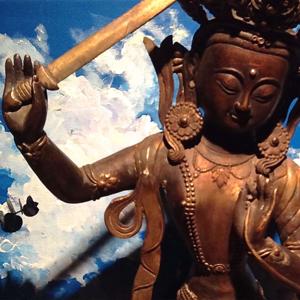


Recorded October 31, 2026.
Viewed in an eerie Halloween light, the 2nd koan of the Gateless Barrier, “Master Pai-Chang and the Fox,” becomes a lively, shape-shifting encounter. Trick or treat! Pai-chang meets an old man who, though he wears a human mask, is is a fox, or fox spirit. The koan then removes that mask to reveal that Pai-chang is not face-to-face with a fox, but with his own past self! And we’re not even in our own world cycle. In the koan we go back before Shakyamuni was the Buddha, to a distant world age when the Buddha was named Kashyapa. Back then, old Pai-chang, as the former head of the monastery was asked an essential question: “Does an enlightened person fall under the law of cause and effect or not?” His answer that the enlightened person doesn’t fall under cause and effect turned him into a fox for 500 lives. Now he asks current Pai-chang to answer more correctly and free him from his fox body. So — what do you say? Does enlightenment free us from karma? What’s the point of Zen practice? Happy Halloween!
Books -
Etching — Demon Sitting in Zazen by Richard Wehrman
Recorded October 24, 2026.
Long ago, world ages back, we humans got so clever we created a nifty trick. We figured out how to forget or suppress our Original Mind and Fundamental Vow to liberate all beings. With this trick we were able to gather all kinds of goodies for ourselves. Unfortunately, there were unforeseen side-effects: isolation, cosmic loneliness, and the whole catastrophe that Buddhism sums up as greed, anger, and ignorance — which we see playing out in our world today.
Jataka tales present the Buddha’s personal past-life history as he worked to undo our self-created catastrophe and come home to Original Mind and Fundamental Vow. They are a skillful means gifted to us by the Buddha to help us do what he did. It won’t be quick or easy — as the jatakas show. It took even him countless lifetimes. And it all began with a Vow made countless world cycles ago.
Is this mere imagination? Is imagination “mere”? Isn’t the Vow of the Bodhisattva to liberate all beings, down even to the bushes and last blade of grass, an immense, indeed, overwhelming act . . . of Imagination. Blake wrote, “The Imagination is not a State: it is the Human existence itself.” Buddhas on altars, sutras, teishos, koans, ceremonies, jatakas, thangkas maintain the Dharma treasure. By awakening not just our intellects but our imaginations, they move us from simple belief to ongoing practice-realization. Flattening out the “mythic” element flattens Zen itself.
_____
Galaxy painting by Rafe Martin.
Recorded October 3, 2026.
Case no. 41 Gateless Barrier:
Bodhidharma sat facing the wall. Huike, the Second Ancestor, having cut off his arm, stood in the snow and said, “Your disciple’s mind has no peace as yet. I beg you, master, to please put it to rest.”
Bodhidharma said, “Bring me your mind, and I will put it to rest.”
The Second Ancestor said, “I have searched for my mind, but I cannot find it.”
Bodhidharma said, “Then I have completely put it to rest for you.”
The koan of Bodhidharma and his heir, Huike, plunges us into the heart of it: we are not at peace. How can we find peace? Huike’s request for help is to the point. The Buddha’s teaching, has not lost its relevance. At some point, we all come to recognize the difficulties and challenges of this life and are troubled. All we need do is, as Bodhidharma says to Huike, is bring forth our troubled mind so it can be pacified. That shouldn’t be too hard to do, should it? Ha!
Books — “The Three Pillars of Zen” — Philip Kapleau
Photo — Bodhidharma Altar, Oct 2026, Endless Path Zendo
Recorded 9/26/2026.
In this lively, enjoyable teisho, Roshi Martin edits on the fly from the final two short chapters of his book, A Zen Life of Bodhisattvas — “Zen Failure” and “Painting of a Rice Cake: Creative Imagination and the Way of the Bodhisattva.”
From “Zen Failure:” “Quantum theory suggests that each moment arises out of a field of endless possibility and has, in turn, endless lines of possibility extending from it. All such possible lines collapse into the one line we call “reality.” Ordinary reality then, is the perfect expression of Zen Master Wu-men’s (Mumon’s) statement —“The failure is wonderful indeed!” The red of the apple, the taste of this tea, the blue of the sky, the smile of a child — the failure IS wonderful indeed!”
From “Painting of a Rice Cake:” “We create our real lives out of the imagination, something that athletes may know better than scholars. If you want to swim better, visualize yourself in the pool, the water flowing smoothly past, the chiming, churning sound of that flow, the kick of your legs, the perfect effortless stroke. Get in the pool afterward and — you swim better! What happens in the imagination makes us who we are. . .”
Web article:
https://sweetcakeenso.blogspot.com/2010/09/rafe-martin-on-gabyo-zen-master-dogens.html
Teeny Tiny Tower: archival print by Ariya Martin (the artist Ariya Aladjem Wolf)
Recorded September 12, 2026.
In this latest teisho (Zen talk) Roshi Martin, reads, comments on, and edits on the fly Chapter 11 —“The Bodhisattva Saves the Realm as the Consciousness of a Tree” from his book, “A Zen Life of Bodhisattvas” (Sumeru, 2023).
“You and the tree in your backyard come from a common ancestor. A billion and a half years ago, the two of you parted ways. But even now, after an immense journey in separate directions, that tree and you still share a quarter of your genes.” Richard Powers, quoting Canadian botanist Suzanne Simard in “The Overstory: A Novel”
“In the assemblies of the enlightened ones there have been many cases of mastering the Way bringing forth the hearts of plants and trees; this is what awakening the mind for enlightenment is like.” Zen Master Dogen
Through root systems, leaves, and fungal webs every tree is woven into a planetary web of life that enfolds the body of the Earth, as well as endlessly up into the light of sun, moon, and stars. So, where does a tree’s body and consciousness end?
How might a tree use its expansive consciousness to fulfill the three general resolutions of bodhisattvas to — “do good, avoid evil, and save the many beings”?
Listen to this unique teisho and find out!
Referenced: "The Overstory: A Novel," Richard Powers
Painting: "Trees at Night, West Branch St. Regis River" by Rafe Martin
Recorded on August 8, 2026.
This teisho is a potpourri made up of 3 shorter sections from "A Zen Life of Bodhisattvas" — namely a folktale of Fugen Bosatsu, a jataka tale of the Buddha in a past life when he was the consciousness of a tree, and a short piece on Zen, Creativity, and imagination all read aloud and commented on by their author, Roshi Rafe Jnan Martin.
Tree painting by Rafe Martin
Read Roshi Rafe Martin's latest book: Finding Your Buddha Smile: Coming Home To What Zen is Really All About. Available from Amazon , Sumeru Books, and Barnes & Noble Online.
Recorded 08/01/2026.
What does it mean to be human? Does the form of having two feet, legs, eyes, and ears, a nose, brain, and heart sum it up? If so there are billions of us. But if by “human” we mean someone wise and compassionate, not driven by greed, anger, ignorance, or fear; someone who can be counted on when the going gets rough, then that number may be rather small. What does it take to be or become such a genuinely human, human being?
The Buddha in a distant past life was on the path of becoming fully human — that is, he was on the Way of the Bodhisattva — when a wrong choice led to an unexpected life. What did he do? How did he resolve it? What did he learn and how does knowing any of this help us? Give a listen and you’ll see why the image of a whale accompanies this teisho.
Books:
Photo of John Perry sperm whale sculpture by Rafe Martin
Recorded July 25, 2026.
Case no. 25, Gateless Barrier: “Yang-shan’s Sermon From the Third Seat” is as follows:
Yang-shan dreamed he went to Maitreya’s realm and was led to the third seat. A senior monk struck the stand with a gavel and announced, “Today the monk in the third seat will preach.”
Yang-shan rose, struck the stand with the gavel, and said, “The Dharma of the Mahayana is beyond the Four Propositions and transcends the Hundred Negations. Listen, listen.”
Why does Master Wu-men, creator of the Gateless Barrier, use a story of an old teacher’s dream as a koan? Koans present actual words and doings. But this is just a dream. What value could it have?
Roshi Kapleau used to say that enlightenment is a dream. After all, enlightenment is simply the realization of our own Mind, the selfless Mind that’s been ours from the beginning. What are we going to get with enlightenment that we don't already have? The problem is that we don't know it. So, while lost in dreams, we should not discount the dream’s value. Bob Dylan says “I’ll let you be in my dream if I can be in yours.” (“Talking World War III Blues.” Dreams within dreams. Within a dream.
Roshi Kapleau used to relate how, not long after he’d arrived at Hosshinji Monastery a monk asked him, “Kapleau-san. Do you believe in dreams?” He told us that it took many years of Zen practice before he grasped what that monk was getting at. Do you believe in dreams? Who is it that believes in dreams? There is a dream dreaming dreams. Is it wrong that our life is a dream? With this dream scenario, Yang-shan and Wu-men have found a way to pull the wool not over, but off our eyes. This is a pretty good trick, wouldn’t you say?
Book: Zen Life of Bodhisattvas by Rafe Martin
Photo of Hotei at Endless Path Zendo by Rafe Martin
Recorded on July 11, 2026.
Asked to write something about the Bodhisattva of Great Compassion, Hakuin penned: “Even if the rivers and seas all receded and became dry land,/ Her vow to save all sentient beings still would never cease.” In other words even if the world turns upside down and seas become mountains and mountains seas, (which has actually happened), even if what is beyond imagining occurs, even, then, the Bodhisattva of Great Compassion will not fall into thinking only of her self but will remain dedicated to the welfare of All — so deep and fundamental is her Great Vow.
Zen practice doesn’t care who we know or what our salary or social standing might be. It’s an iron mountain or, as Western fairy tales have it, a glass hill. We try, we fail, we try again. Through trying, failing, getting back up and trying again, Zen practice becomes genuine and we ourselves, authentic, authentically ourselves. Avalokitesvara Bodhisattva’s own great Vow matured through such heart-felt failure — which is rather hopeful indeed.
Books —
Photo — detail: Avalokitesvara thangka at Endless Path Zendo by Rafe Martin
Recorded June 6, 2026.
In preparation for the Jukai (receiving the precepts) on 6/20/2026, before leaving for the American Zen Teachers Association gathering, Roshi Martin read and commented on Aitken Roshi’s opening chapter of “The Mind of Clover: Essays in Zen Buddhist Ethics” — “The Nature of the Precepts.” Here’s that teisho, as presented at Endless Path Zendo on 6/06/2026.
Books -- "The Mind of Clover" by Robert Aitken
Photo of Aitken Roshi at Palolo Zen Center, Honolulu, HI.
From the publisher's feed
Endless Path Zendo, is a lay Zen Buddhist community. Intimate and non-institutional in atmosphere, we are dedicated to realizing the Buddha Way in the midst of our own ordinary lives, finding our…
Zen teacher (roshi) Rafe Jnan Martin began traditional Zen practice in 1970, becoming a personal disciple of Roshi Philip Kapleau, author of The Three Pillars of Zen. After Kapleau Roshi’s retirement, he practiced with Robert Aitken Roshi, founder of the Diamond Sangha, then from 2002-2016 worked intensively with Danan Henry Roshi, founding teacher of the Zen Center of Denver and a Kapleau Roshi Dharma Heir as well as a Diamond Sangha Dharma Master.
Rafe received full lay ordination in 2009, and in 2012 received inka—recognition of his successful completion of the Diamond Sangha/ Harada-Yasutani koan curriculum, along with authorization to begin teaching. In 2016 he received full Dharma Transmission as an independent Zen teacher.
An award-winning author and storyteller whose work has been cited in Time, Newsweek, The NY Times, and USA Today, Rafe has a master’s degree in English literature and literary criticism and is a recipient of both national and state awards, including the Empire State Award for the body of his work. His writing has appeared in Tricycle, Lion’s Roar, Parabola, The Sun, and Inquiring Mind, among other journals of religion and myth. He has given talks at Zen and Dharma Centers around the US and Canada, as well as such venues as the American Museum of Natural History, Zuni Pueblo, and The Joseph Campbell Festival of Myth and Story.
His most recent books are A Zen Life of Buddha (Sumeru 2022), The Brave Little Parrot (Wisdom Publications, 2023) and A Zen Life of Bodhisattvas (Sumeru, 2023).