
Sign up to save your podcasts
Or

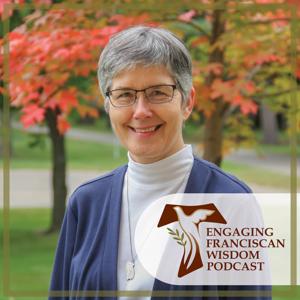


Join our guest, Franciscan Sister Ange Mayers, as she shares the richness of her living and working across cultures, her love of Eucharist, her baking and sharing the bread of love as she breaks open her life in service.
Sister Ange notes that "While doing cross-cultural ministry among the native people of Arizona, I learned that no culture is better than another culture. Each culture is blessed with gifts to share with other cultures. These gifts are expressed in food, language and customs. It is our responsibility and privilege to learn what they are."
"One Holy Thursday, I was overwhelmed by the needs of neighbors. I didn't want ANOTHER person coming to the door asking for help. BUT, I did say "YES"! After taking them to get a can of propane gas, I had a change of heart. I BAKED BREAD and got renewed and NOURISHED. The kneading of the dough, released frustration with each punch; the rising of the bread birthed new life; the aroma of baked bread fed my being."
"The meaning of receiving communion: Just as the food we eat determines the state of our physical being, when we receive the body of Christ, Christ becomes a part of our spiritual being. We become united, one body, and as we drink wine together, we become spiritually united. At the last supper, Jesus said, do this in memory of me. We do the same receiving his body and blood to be strengthened, to feed those who are hungry and thirsty spiritually. By receiving communion, we are nourished as a community to do as Jesus did."
"God loves me all the time, not only when I am good. Making mistakes is a part of life; God did not make us perfect. And God walks with us through our mistakes throughout our whole life. This we Franciscans call continual conversion."
References:
The Feeding of the Five Thousand, Mark 6:34-44: a story of the multiplication of loaves of bread. See: https://bible.usccb.org/bible/mark/6.
Comunidades de Base: Base Christian communities: See:
https://en.wikipedia.org/wiki/Basic_ecclesial_community and https://www.encyclopedia.com/humanities/encyclopedias-almanacs-transcripts-and-maps/christian-base-communities.
Poem by Charlotte Madigan, CSJ:
Kneading, needing bread
We bravely work and hope.
We hunger till we eat
the bread of love, of life
and drink the cup of warmth
and tender wine.
Ah mystery!
enhancing the taste
of the bread and of each other.
water into wine again.
Warning:
To eat and drink
pre-occupied
is foolish waste and loss.
Cross cultural ministry in Arizona:
--Tohono O'odham nation: http://www.tonation-nsn.gov/
--Pascua Yaqui tribe: https://www.pascuayaqui-nsn.gov/ - "Culture is an important element with all Yaqui communities and bonds both Christianity and Yaqui spirituality in the hope for a better view of the world and morality."
--Communities are Prevention: Addiction Prevention Program: CAP draws from the work of Don Coyhis and Wellbriety. Listen to and read about Don: https://encore.org/purpose-prize/don-coyhis/; here is the White Bison website: : http://www.opensource-projects.com/Default.aspx
Break this Bread, by Lourdes Music Group:
Please break this bread, Lord; please break this bread.
Bread of your body, risen in us.
Pour out your wine, Lord. Pour out your wine.
Let it flow though us to a thirsty world.
Pope Francis in his encyclical Fratelli Tutti: On Fraternity and Social Friendship, 237, 284:
"Forgiveness and reconciliation are central themes in Christianity, and in various ways in other religions…Each one of us is called to be an artisan of peace. By uniting and not dividing, by extinguishing hatred and not holding onto it, by opening paths of dialogue and not by constructing new walls."
Sister Marilyn Lacey, RSM, of Mercy Beyond Borders: "This then may be the world's only hope for peace, that all of us, friends and enemies, allies and foes, brothers and sisters and strangers alike, we understand that we meet as guests together in God's own tent."
Join our guest, Franciscan Associate Deb Galvez, for this interview. As a chaplain, she accompanies those in need of care, finding that mutual encounter reveals the blessing of being loved by God. Deb explores the mystery of divisions being transformed to loving one another and honoring the goodness of each person.
Deb observes "Meeting people in the hospital when they're in a hospital bed levels the playing field. There is no rich, no poor, there is no division. Everybody is there for health issues and I walk in as a sister of them; I don't feel higher or lower, I don't feel richer or poorer. It is like we're both here on this journey, walking on the road to Emmaus, and there are no barriers. There's nothing to get in the way."
"I've seen so many people who have been hurt because they're the 'Other'. Whether it's ageism, sexism, a different color, a different religion, a different viewpoint. I would just love to see us sit down and really listen to the Other, and know that God loves us for who we are and that we are good. … I've talked to so many people who do not feel that they are good. … I hope and pray that is one thing that I can bring to the world in the greater Franciscan vision, that people are good, they are loved, and they are worthy."
"Wouldn't the world be different if we could live in love of neighbor, as Jesus taught in the Good Samaritan, wherever and whomever that neighbor, here, near, or far might be, if we would know and live out of that knowing, being known that God loves us and we're good? And that we could pray, whether with or without words; it would transform some interactions, and perhaps our inner hearts, to be more available to what's needing work and healing, and what is still needing attention."
References:
What is a Newman Center? http://newmanconnection.com/locations. More about Saint John Henry Newman, in whose honor the Newman Centers are named: http://newmanconnection.com/about/blessed.
Franciscan Associates: Deb is referring to the Associate relationships with the Franciscan Sisters of Little Falls: https://www.fslf.org/BecominganAssociate/. Other religious communities may have lay associates, affiliates, companions or cojourners as well.
The Road to Emmaus: Luke 24:13-35; see: https://bible.usccb.org/bible/luke/24.
Francis meets the leper: see https://www.franciscanmedia.org/franciscan-spirit-blog/st-francis-meets-the-leper. See also the earliest biography of Saint Francis by Thomas of Celano (1C 17) https://www.franciscantradition.org/francis-of-assisi-early-documents/the-saint/the-life-of-saint-francis-by-thomas-of-celano/636-fa-ed-1-page-195.
The Good Samaritan: Luke 10:25-37; see: https://bible.usccb.org/bible/luke/10.
Deb recommends:
+Daily Scripture Readings: https://bible.usccb.org/daily-bible-reading#subscribe
+Daily Minute Meditations: https://www.franciscanmedia.org/minute-meditations
+Richard Rohr Daily Meditations: https://cac.org/category/daily-meditations/
+Henri Nouwen Society Daily E-meditations: https://henrinouwen.org/read-nouwen/free-daily-meditation/
Join our guest, Eunice Park, as she reflects on the blessings and challenges of her heritage as a Korean American, as well as her accompaniment of immigrant young adults. This episode is filled with wisdom born of experience as Eunice creates safe space for people to do their inner work and find freedom.
Eunice notes "Rather than having to prove our value and prove our worth through materialism or through money or finances, our inherent value is in our created-ness. We are born with dignity and the basis of our creation, this Imago Dei, this gratuitous love of God. We cannot earn that love and we cannot have that love destroyed. God wouldn't love us any less or any more by anything that we do."
"The job of the minister becomes accompanying and journeying with that person, helping guide them, being there for support and being their safe space so that they can let that inner identity manifest fully on the outside, rather than trying to figure out who they are on the outside in, and feeling insecure about it....So that they can understand that who they are is because of whose they are. Who they are is because of God, who God is."
"Understanding poverty as something much more than giving up money or a salary: it's a way of release, a way of freedom. I think the pandemic invites us to a sense of poverty of control...we think we're in control, but are we really? I haven't left my house at all for a year; understanding that this is how our lives are and leaning into this understanding of poverty is a freedom, rather than a lack of control. By letting go, we open ourselves up to receiving more."
References:
Confucianism - The Analects are the most famous resource of Confucius' teachings:
https://en.wikipedia.org/wiki/Analects
Franciscan Spirituality: Franciscan Spirituality | Franciscan Friars
Immigrant trauma: https://www.ilctr.org/understanding-immigrant-trauma/?gclid=Cj0KCQjw1a6EBhC0ARIsAOiTkrGjlPZyS1M7vEAkQh1hrwY2iAbh52q3YnXYXrD5c9iggtWg9JQSEdYaAiGpEALw_wcB
Honor and Shame in Asian cultures: https://www.psychologytoday.com/us/blog/minority-report/201406/asian-shame-and-honor
Imago Dei Catholic Teaching: https://www.vatican.va/roman_curia/congregations/cfaith/cti_documents/rc_con_cfaith_doc_20040723_communion-stewardship_en.html
Asian Pacific Islanders - Some API resources: https://www.ncapaonline.org/,
https://www.advancingjustice-aajc.org/ and https://18millionrising.org/
St Joseph Worker Program in Orange: http://csjorange.org/ministries/st-joseph-worker-program/; the SJWP Facebook page: https://www.facebook.com/stjosephworkerprogramorange/
Sexual violence in US statistics: https://www.rainn.org/statistics/victims-sexual-violence
Spiritual accompaniment: https://www.catholicapostolatecenter.org/art-of-accompaniment.html
Helicopter Parenting: When too much help is no help: https://www.health.harvard.edu/parenting-issues/helicopter-parenting-when-too-much-help-is-no-help
Charism: a gift, talent or skill given for the building up of the community and from which we find energy: https://siena.org/charisms-faq
Join Franciscan Sister Gloria Haider as she reflects on her journey from 'human doing' to more fully living as a 'human being' during the pandemic. She sees beauty, is inspired by diverse prayer practices, and accompanies those who are in need as she listens for the Spirit's guidance. Come and see with her eyes, encountering Beauty wherever she finds beauty, seeing the Divine Artist wherever she finds art.
Sr. Gloria notes that "Looking at beauty, seeing God as a divine artist, helps me to live each day in gratefulness and abundance and happiness. My time in community has helped me look at different areas of justice and peace, ...at the value and dignity of everything around me and within me; they have a positive, optimistic vision of a human person. Living in community is not always easy as we all know; it is a wonderful time to look at our own selves and those that we are living with, and try to be people who are willing to listen and to change. How blessed I am, to be living at this time in community, able to share my joys and my sorrows with other people, it's a great blessing."
"During Covid...I was discerning and thought maybe I should go back to Minnesota, but the Spirit kept saying, 'Oh no, stay, stay where you're at. You need to wait. You need to learn how to just be and wait.' This was very important for me during this time. It helped me to remember that I'm not just a doer, but I'm a human being. That I need to at times just wait and see what the next step is. I'm grateful that I followed the Holy Spirit's guidance."
References:
Stations of the Cross: https://www.fslf.org/blog/2017/03/31/stations-of-the-cross-facebook-series?fbclid=IwAR2GDqy5Jm7Jc67DBTdHIAK9hMYmHA0RCvJdUOhUM3_OrEP57f7w9MAdCKM and
https://www.franciscantradition.org/blog/31-the-way-of-the-cross-part-of-everyday-life-in-jerusalem.
Thomas Merton: For a look at the influence of Saint Francis in Merton's life, see: https://www.amazon.com/Franciscan-Heart-Thomas-Merton-Inspiration/dp/1594714223.
Franciscan Communities Sr. Gloria referred to: Franciscan Sisters of Little Falls (www.fslf.org) and
Sisters of St. Francis, located in Rochester (https://rochesterfranciscan.org/).
The mystic poetry of St. Francis of Assisi: Gloria notes the Canticle of Brother Sun as an example; here is an introductory blog with the text: https://www.franciscanmedia.org/franciscan-spirit-blog/st-francis-and-his-canticle.
Sr. Gloria's favorite quote from our Rule of Life: "Let the sisters and brothers always be mindful that they should desire one thing alone, namely, the Spirit of God at work within them."
-TOR Rule 32; see also Saint Francis' Later Rule 10:8 and Saint Clare's Rule 10:7
John Duns Scotus and the unique 'thisness' of every person and everything; he coined the Latin term: haecceitas. Here are a two sample links: https://cac.org/irreplaceable-thisness-2018-03-18/, and https://www.ssfamericas.org/post/a-hagiography-of-blessed-john-duns-scotus.
Beauty in the Franciscan Tradition:
In the Introduction to her book, Rejoicing in the Works of the Lord: Beauty in the Franciscan Tradition, Mary Beth Ingham, CSJ says that a central Franciscan insight is "that all life can be best understood according to a via pulchritudinis, a journey or way of beauty. Franciscans see all of life: creation, the human person, human action, divine life and love through the prisms of harmony and beauty." (p. 3) Reference to the book: https://www.franciscanpublications.com/products/rejoicing-in-the-works-of-the-lord-beauty-in-the-franciscan-traditioin?variant=7282429061.
Quote from *The Franciscan Moral Vision: Responding to God's Love, ed. by Thomas A. Nairn, OFM. Franciscan Institute Publications, 2013. See Chapter 3 "Moral Goodness and Beauty," by Mary Beth Ingham, CSJ:
"Proper proportion is another aspect of beauty: here everything fits in its place, there is not too much of one thing. The relationship of balance is pleasing to the eye and ear. Harmonic chords and tonal passages also express this idea of proportion. Because of the important role of desire in the spiritual journey, Bonaventure notes, contemplation (the activity of the highest form of wisdom) has both cognitive and affective dimensions. We are to be those 'lovers of divine wisdom and inflamed with a desire for it' wishing to give ourselves 'to glorifying, admiring, and even savoring God.' The saint adds the aspect of luminosity as central to our experience of beauty. Luminosity suggests that beauty can enter our lives as a type of theophony: a divine revelation." (p. 95-96)
*This text will be re-published; a current link: https://www.amazon.com/Franciscan-Moral-Vision-Response-Gods/dp/1576592081/ref=tmm_pap_swatch_0?_encoding=UTF8&qid=&sr=.
Favorite Prayer forms:
Earth Literacy:
Berry named Three Principles of the Universe – three primordial patterns of differentiation/diversity; subjectivity/interiority; communion/community/interconnectedness (http://www.sistersofthegoodshepherdcontemplatives.com/sites/default/files/MTM%20-%203%20Principles%20of%20the%20Universe.pdf).
Seeing God as Divine Artist, in Beauty:
In art he [Francis] praises the Artist; whatever he discovers in creatures he guides to the Creator. He rejoices in all the works of the Lord's hands, and through their delightful display he gazes on their life-giving reason and cause. In beautiful things he discerns Beauty Itself. -2 Celano 165
(See: https://www.franciscantradition.org/francis-of-assisi-early-documents/the-founder/the-remembrance-of-the-desire-of-a-soul/1442-fa-ed-2-page-353#ges:searchword%3Dhe%2Bpraises%2Bthe%2BArtist%26searchphrase%3Dall%26page%3D1).
Rio Grande Valley Connections:
Join Franciscan Associate Rick Dietz as he traces his spiritual journey of cobbling together his own path with God until his discovery of Franciscan Spirituality. This encounter brought him into a community of brothers and sisters, a deepened relationship with God who is good and loving, and a greater freedom to serve those in need.
Currently Director of the Franciscan Life Center which is based out of Little Falls, Minnesota, Rick notes "that at the core of the Trinity is a good and loving relationship between the Trinity which over spills into all of creation....We are really brothers and sisters to all that is in creation, and should be respectful of and defenders of all that is in creation."
"I started looking into Franciscan spirituality and the understanding of the Trinity and how this divine relationship spills over into creation. ...Franciscans have this understanding that relationships are not just prized, but are somehow reflective of the divine. There's a primacy to relationship more so than of knowledge. Relationship and spirituality go together much more than knowledge and spirituality."
References:
Masculine Spirituality: Rick recommends this classic: Wildmen, Warriors, and Kings: Masculine Spirituality and the Bible by Patrick Arnold (https://www.amazon.com/Wildmen-Warriors-Kings-Masculine-Spirituality/dp/0824512529).
Hesychia School of Spiritual Direction: http://desertrenewal.org/hesychia-sd-school/.
Saint Francis of Assisi's Praises to be said at all Hours, verse 11
"All powerful, most holy, most high, supreme God: all good, supreme good, totally good, You Who alone are good, may we give you all praise, all glory, all thanks, all honor, all blessing, and all good. So be it! So be it! Amen."
See: https://franciscantradition.org/francis-of-assisi-early-documents/the-saint/writings-of- francis/the-undated-writings/the-praises-to-be-said-at-all-the-hours/178-fa-ed-1-page-162.
God as Good and Loving:
Rick submitted this passage for your reflection: Saint "Bonaventure was apparently impressed by the notion of ultimate divine goodness. In the New Testament, he writes, God reveals his name as Good (Lk 18:19 'No one is good but God alone'); whereas in the Old Testament, God revealed his name as Being (Exod 3:14 'I am who Am'). Since God reveals Godself as Good in the New Testament, the Trinity must be essentially grounded in the good…Charity (love) is the supreme content of the good, the highest form of the good. Thus, if God is good then God is also charity or love. Where there is fullness of divinity there is fullness of goodness, and where there is fullness of goodness there is fullness of charity (love)."
-Ilia Delio OSF, Simply Bonaventure, pp. 41-42, Hyde Park NY, New City Press, 2001.
(https://www.newcitypress.com/simply-bonaventure-2nd-edition.html)
All of creation are sisters and brothers, sharing the same source:
"From a reflection on the primary source of all things, filled with even more abundant piety, he would call creatures, no matter how small, by the name of "brother" or "sister," because he knew they shared with him the same beginning."
-St. Bonaventure, Major Legend 8:5; see: https://www.franciscantradition.org/francis-of-assisi-early-documents/the-founder/the-legends-and-sermons-about-saint-francis-by-bonaventure-of-bagnoregio/the-major-legend-of-saint-francis/the-life-of-blessed-francis/1679-fa-ed-2-page-590.
God as Triune Communion; call to deep relationships of love:
"For Franciscans, the moral order transcends the individual self and points toward communion and relationship with others, but ultimately with God. Understanding God as Triune Communion, participation in divine life is the true human goal. This goal is ultimately a deep relationship of love based upon the nature of God as source of reality. Relationship is the moral goal because the divine is essentially relational, because we are created in the image of God, and because we are invited to enter freely into that relationship."
-Mary Beth Ingham, CSJ, "Moral Goodness and Beauty," in The Franciscan Moral Vision:
Responding to Gods Love, ed. Thomas A. Nairn. (Franciscan Institute Publications, 2013), p. 118.
Styles of Leadership transformed; Pat Smith reflects:
"Franciscans lead from a position of littleness. The Incarnation was central to Francis' theology; it formed and shaped his leadership style. He led from the stance of humility, like the Word of God who bent low to assume our humanity. Franciscan leadership is not something to be sought but rather is to be humbly lived wherever we happen to find ourselves. Francis found God and led others to God in the context of simply being a little human creature."
-Pat Smith OSF, "Franciscan Leadership: Mutual Love Generating a Future," Keynote
Presentation of the Franciscan Federation Annual Conference, July 10-13, 2009.
Being examples and mirrors in community:
"For the Lord himself has placed us as a model, as an example and mirror not only for others, but also for our sisters which the Lord has called to our way of life as well, that they in turn might be a mirror and example to those living in the world. Since the Lord has called us to such great things that those who are a mirror and example to others may be reflected in us, we are greatly bound to bless and praise God and to be strengthened more and more to do good in the Lord."
-Saint Clare of Assisi, Testament 19-22
See: https://www.franciscantradition.org/clare-of-assisi-early-documents/the-testament-clare-of-assisi/237-ca-ed-1-page-61.
Saint Clare's method of contemplative prayer and how bring it into the world: In her Second Letter to Agnes of Prague, Clare includes four steps, inviting us to embrace the poor Christ, following him as we Gaze, Consider, Contemplate, and Imitate.
-2LAg 18-20; see the fuller text: https://www.franciscantradition.org/clare-of-assisi-early-documents/the-second-letter-to-agnes-of-prague/225-ca-ed-1-page-49.
Saint Francis saw all as gift, Rick calls him a "re-gifter;" he often gave away cloaks or tunics that had been given to him.
-See: Saint Bonaventure, Major Legend 8:5: See text: https://www.franciscantradition.org/francis-of-assisi-early-documents/the-founder/the-legends-and-sermons-about-saint-francis-by-bonaventure-of-bagnoregio/the-major-legend-of-saint-francis/the-life-of-blessed-francis/1679-fa-ed-2-page-590.
Pope Francis, encyclicals and documents draw from Saint Francis' experience of others and all of creation being our brothers and sisters.
--Laudato Si: you can purchase a print copy, or here is an electronic version: http://www.vatican.va/content/francesco/en/encyclicals/documents/papa-francesco_20150524_enciclica-laudato-si.html.
--The Franciscan Character of 'Laudato Si', by Dan Horan: https://www.americamagazine.org/issue/franciscan-character-laudato-si.
--Fratelli Tutti: you can purchase a print copy, or here is an electronic version: http://www.vatican.va/content/francesco/en/encyclicals/documents/papa-francesco_20201003_enciclica-fratelli-tutti.html.
--Franciscan Study Guide for Fratelli Tutti: https://www.franciscanmedia.org/fratelli-tutti-study-guide.
--Document on Human Fraternity for world peace and living together is a brief consideration of some of these values; signed 2-4-19 by Pope Francis and the Grand Imam of Al-Azhar, Ahmed el-Yayeb: http://www.vatican.va/content/francesco/en/travels/2019/outside/documents/papa-francesco_20190204_documento-fratellanza-umana.html.
From the publisher's feed