Dr. Patrick Brown, Associate Professor in the ETSU College of Public Health’s Department of Health Sciences, is a past recipient of ETSU’s Distinguished Faculty Award in Teaching and has received national recognition for his work with the Process Oriented Guided Inquiry Learning (POGIL) method of instruction.
In this episode, he discusses online learning, ETSU's Center for Teaching Excellence, high-impact instructional practices, and more.
You know, we focus so much, rightly or wrongly, on career preparation -- yeah -- in higher ed. And are we, are we preparing them for their 21st century careers? But, you know, the purpose of higher ed is so much more than that. We're not just training students for a career. We are ideally preparing informed, compassionate citizens.
Dr. Kimberly D. McCorkle:
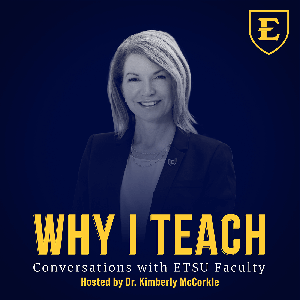
Hi, I'm Kimberly McCorkle, Provost and Senior Vice President for Academic Affairs at East Tennessee State University. From the moment I arrived on this campus, I have been inspired by our faculty: their passion for what they do, their belief in the power of higher education, and the way they are transforming the lives of their students. This podcast is dedicated to them, our incredible faculty at ETSU. Hear their stories as they tell us Why I Teach. In this episode, we will talk with Dr. Patrick Brown, Associate Professor in the ETSU College of Public Health's Department of Health Sciences. Dr. Brown is a past recipient of ETSU's Distinguished Faculty Award in Teaching and has received national recognition for his work with the Process Oriented Guided Inquiry Learning, or POGIL, method of instruction. He earned a Ph.D. in cellular biology from the University of Georgia and a B.S. in biology from the University of Tennessee, Chattanooga. His research includes studies of the application of student-centered, active learning pedagogies in undergraduate science curricula. In 2015, Dr. Brown was ETSU's keynote commencement speaker, and he shared his inspiring insights with graduates. Today, I am pleased to have him here to share his expertise on teaching and preparing our students for graduation and success beyond the classroom. Enjoy the show. Dr. Brown, welcome to the show.
Dr. Kimberly D. McCorkle:
I start my podcast with the same question for every guest. Take me back to your first day of teaching at ETSU as a faculty member, and looking back on that day, what is one piece of advice you would have given yourself?
Probably slow down. Yeah, I'd already been teaching for a while.
Dr. Kimberly D. McCorkle:
I started out at what is now King University up in Bristol, and I was teaching A & P, Anatomy and Physiology I, for the first time. When I was at King, I'd only taught the second half of the course.
Dr. Patrick Brown:
And so I was trying to prepare materials. And I don't just stand up and talk. I put my students to work. And so I was putting together materials. I had a toddler at home, and I was just so anxious and wrung out. And I wish I could go back and just say, "Slow down; it'll be okay. You know what you're doing."
Dr. Kimberly D. McCorkle:
You know, looking back 12 years later, yeah, this is my 13th year at ETSU.
Dr. Kimberly D. McCorkle:
I do know what I'm doing, at least to some degree, but, but just slow down and trust yourself. And trust the students.
Dr. Kimberly D. McCorkle:
You know, I've been overwhelmed with how supportive our students are of us as faculty and how forgiving they can be.
Dr. Kimberly D. McCorkle:
When we're not, when we're not our best from the second we walk into the classroom. So, yeah, I would have just told him, "Slow down; it'll be okay. You're going to get through this just fine. The students are going to learn, and everything is going to be okay. Slow down."
Dr. Kimberly D. McCorkle:
Right. So as you said, you've been teaching here at ETSU for more than a decade now. So what's changed the most since you began teaching?
I tell you, I've noticed it a lot more because of the pandemic.
Dr. Kimberly D. McCorkle:
But it is the students' willingness to approach remote learning.
Dr. Kimberly D. McCorkle:
And kind of the normalization of online, especially online asynchronous learning. When I'd gotten, you know, when I got here, that was a really rare thing.
Dr. Kimberly D. McCorkle:
You didn't have a lot of online courses. And then over the course of my time here, you know, MOOCs were a big thing, those massive online -- what did that stand for?
Massive open online courses MOOCs.
Dr. Kimberly D. McCorkle:
You know, we were afraid they're going to destroy you know, they're going to destroy higher education. Everybody's afraid AI's going to destroy higher education. It's always something. But I think the, the normalization of learning online, I have learned so much about teaching and learning online. I'm very fortunate to be good friends with two of ETSU's certified Master Online educators.
Dr. Kimberly D. McCorkle:
And so I've been able to lean on them and not just for the courses that I teach that are completely online, but even in my in-person courses. The lessons I have learned over this time about online learning are translating to resources that I can make available through our course management system.
Dr. Kimberly D. McCorkle:
Like D2L, or Desire to Learn, you know that. But the people listening might not. You know, so if you look at the structure of my course web presence, even for my in-person classes, it's very different now than it was 10 years ago. And, you know, the goal there is so that I don't I'm only in their presence for 3 hours, 3 to 5 hours a week.
Dr. Kimberly D. McCorkle:
So I can kind of make myself present outside of the classroom using those digital tools in a way that I wouldn't even have thought of 12 years ago.
Dr. Kimberly D. McCorkle:
Oh, it's really good insight. And it provides such resources to students.
Dr. Kimberly D. McCorkle:
And some of the feedback I get, you know, in our end-of-course student assessments of instruction is that you know they appreciate having all of this stuff available for them outside of class. So you know, whatever we do in class, I've captured it digitally somehow.
Dr. Kimberly D. McCorkle:
And that resource is available for them, even though, you know, a lot of what I do requires student interaction, a collaboration for maximum effect. But that doesn't mean there isn't some benefit to completing some of those activities on their own. But it's really just like a, you know, an ability to project what we're doing in the classroom outside of the classroom. So, if a student has to miss because they're ill or they have family emergency or something like that, they can still access the course resources and course materials. The technology has given me flexibility to, you know, to be responsive, to be accommodating.
Dr. Kimberly D. McCorkle:
So there's, there are things that I can do now that I would have liked to have done when I first started here, but it wasn't possible.
Dr. Kimberly D. McCorkle:
So you have been involved with the Center for Teaching Excellence since its inception at ETSU and have served as a Faculty Fellow for a long time. In that work, I know you assist in training your peers in teaching strategies. Tell us about the work that you've done with the CTE.
So this actually goes back to my time when I was in the Faculty Senate. So Virginia Foley was the President of the Faculty Senate, and we had been without any kind of Center for Teaching for a whole lot of years.
Dr. Kimberly D. McCorkle:
And so she created a committee of Faculty Senators to kind of explore what's out there, what are other universities that kind of have a similar makeup to ours, what are our peers doing? And I chaired that committee. And we put together a report and submitted it to our then Provost, Dr. Bach, and there was some interest, and then the Committee for 125 convened, and they had an education subcommittee, a teaching subcommittee, and they recommended creation of a Center for Teaching Excellence. And so then at that time, Dr. Amy Johnson had been leading our Quality Enhancement Plan in top form, and that was kind of winding down. And so they transitioned her into the first Director of the Center for Teaching Excellence, and I was on the initial advisory board for the CTE when it first started, and then four years ago, so this would have been winter of 2019, Dr. Johnson invited me to her office, and she said, "Hey, you know, we're getting we're getting bigger." I had done some stuff, you know, little things, but mostly I had been serving for those first two years as an advisor.
Dr. Kimberly D. McCorkle:
You know, on the faculty advisory board. And she said, "I want to bring you in as a Fellow; at the time, Dr. Alison Barton was the Faculty Fellow, and she was like, "The Provost is agreed; we're going to have a second Fellow. And, you know, I have some things I want you to do." And so that was all great. And the first thing I was going to do is we were gearing up for this international year. And she was going to send me to Korea. And that was supposed to happen in March of 2020.
Dr. Kimberly D. McCorkle:
And then the world turned upside down.
Dr. Kimberly D. McCorkle:
And I was very, I was very fortunate to have just, you know, just started this fellowship when in March of 2020, we got the word, "Oh, by the way, you're not coming back to school after spring break."
Dr. Kimberly D. McCorkle:
And so then it was kind of all hands on deck. So I, you know, Amy had just brought me on board, and so she and Phil Smith, the assistant director of the CTE, and Alison and I were just scrambling to put together programming for our faculty who, some of whom had never even populated their their D2L page, their course website, and were now going to have to be teaching online full time.
Dr. Kimberly D. McCorkle:
I had a colleague who's since retired who used to tell his students on the first day of class, "I know there's a D2L site for this class, but if you see anything on there, I didn't put it there."
Right. He just was not about it. And he had to go teach fully online.
Dr. Kimberly D. McCorkle:
And so for my first, for the first year of my fellowship, really, because I started in January of 2020, so for that first year, it was really transitioning people to online.
Dr. Kimberly D. McCorkle:
And, and helping faculty be as effective as they could be in this new modality and getting them ready for that '21-22 school year where we were going to be, you know, kind of mixed methods.
Dr. Kimberly D. McCorkle:
Dr. Patrick Brown:
I remember I taught my lectures online, and then I had an optional in-person lab, but with half capacity. I had the students split over two rooms, like it was, it was, it was something else. But I've also been very fortunate to have you know, I've worked for Amy Johnson, and then when she stepped down as Director, Alison Barton came in as the Director. And both of those women are not just gifted educators and gifted programmers of faculty development, they're also my friends. And so they, they have really tried to lean into my strengths, and I guess probably avoid my weaknesses and let me develop programming and the things that I think are really interesting. So of course, I'm doing a workshop this afternoon for the Biology Department in active and collaborative learning, which is my jam. I'm doing another workshop for them tomorrow morning that I developed with Dr. Sarah Melton over at the College of Pharmacy initially, but it's on item writing, writing multiple-choice items, which almost everybody, especially if you teach large classes uses.
Dr. Kimberly D. McCorkle:
But very few of us are trained in how to do it well.
Dr. Kimberly D. McCorkle:
And there's, there's, there are mistakes you can make that can reduce the validity of your assessment. And so that's something I really enjoy helping people learn about.
Dr. Kimberly D. McCorkle:
And then I also am very interested in the ways in which we measure learning not just through multiple-choice items, but in doing instructional design and starting at the end point.
Dr. Kimberly D. McCorkle:
What Wiggins and McTighe called backwards design.
Dr. Kimberly D. McCorkle:
Dr. Patrick Brown:
So if you start with where you want them to be and then you figure out how you're going to get him there and how you're going to measure it. So those are the kinds of things that I've worked on.
Dr. Kimberly D. McCorkle:
So in your introduction, I mentioned your nationally recognized work with POGIL, the POGIL method of instruction. So with that in mind, what impact has this method had on your teaching? And tell us more about the method itself.
So I don't think anything has transformed what I do in the classroom more than POGIL. POGIL was an NSF grant to Rick Moog and Jim Spencer, who are both chemists, and they had kind of independently come up with this just like super- Constructivist method of teaching. So Constructivism is the idea that learning is, learning occurs when we construct our own understanding of concepts and integrate this new understanding with what we already know.
Dr. Kimberly D. McCorkle:
You know, as pioneered in the early 20th century by French psychologist Jean Piaget. But she she was like, I loved using this in my chemistry class I'm starting to use it in my medicinal chemistry classes in pharmacy. You should check it out. And because they were NSF-funded, their workshops were free. And so they had this three-day workshop at Guilford College in Greensboro. And so I went out there and met some people who are, to this day, dear, dear friends, and who have been wonderful mentors to me, Andy Brissette, Suzanne Ruder, Megan Hoffmann; I can't list them all. We'd be here all day. But I can remember during the, and it was an intense three days, I mean, we worked from first thing in the morning until pretty late in the evening, all three days. And I can remember being in that first day. And one of the great things about the POGIL project, you know, the people who train folks to use POGIL, is that you learn it by doing it. You know, a lot of educators who are listening can, can commiserate with this. You go to this workshop on active learning, and you're going to learn how to do this active-learning thing. And then you get lectured at for three hours.
Dr. Kimberly D. McCorkle:
And that's not how these people roll at all. They, you were doing the whole time. If you go to a POGIL workshop whether it's a three-hour workshop, a one-day workshop, or a three
day workshop, you're working.
Dr. Kimberly D. McCorkle:
Right. And I remember we were doing this activity called the Nuclear Atom. And we were about halfway through it, and I was like, "Oh my gosh; I just learned what makes an element." And nobody told me; nobody used the word "element." But I just realized that the reason, you know a student doing this for the first time would realize that the reason that hydrogen's hydrogen and helium's helium is because hydrogen has one proton and helium has two. But they you, you, you construct your understanding first.
Dr. Kimberly D. McCorkle:
Then they put the word to it. They're like, "Oh, by the way; that thing with one proton, that's hydrogen. And that thing with two is called helium."
Dr. Kimberly D. McCorkle:
And because and those are different elements.
Dr. Kimberly D. McCorkle:
Right. And so I was floored. I had never realized this. And then, you know, when I try to explain Constructivism to somebody now, I say, "Find me a toddler." And you show that toddler a picture of a Maine Coon and an American, a domestic shorthair, and a tiger, and they'll know that all of those are cats. And you show them a picture of a Rottweiler and of a Chihuahua and of an Australian Shepherd, and they'll know that those are dogs. No one has ever defined cat or dog for that child. But by seeing examples of them and making those comparisons -- oh, kitties have long whiskers, doggies have shorter whiskers, kitties have that cute little lip thing, and doggies don't do that. The child constructs a concept of what is a cat and what is a dog.
Dr. Kimberly D. McCorkle:
And as new information comes in, they adapt that concept. And that's what's going on with Constructivist education.
Dr. Kimberly D. McCorkle:
And that's so the thing that makes POGIL really neat, though -- so that's the guided inquiry learning, the GIL part of POGIL so the activities are created very carefully so that the students are guided through questions. Right. We ask them questions. So if I'm wanting them to say, okay, how many protons are in hydrogen, how many protons are in a helium, how many neutrons are in each thing? How many electrons? Okay, which ones? What has a charge? And I do an activity very similar to this on the third day of my Anatomy and Physiology course, because we need to know about some different elements and stuff. And so you guide them through inquiry to learning.
Dr. Kimberly D. McCorkle:
But the thing that makes POGIL really unique is the PO, the process-oriented bit. When you survey educators -- employers, sorry, not educators -- when you survey employers, and you ask them what do you want people coming out of university to know, what do you want them to be able to do?
Dr. Kimberly D. McCorkle:
Content knowledge is always near the bottom of the list.
Dr. Kimberly D. McCorkle:
The thing that people want college graduates to be able to do is to communicate.
Dr. Kimberly D. McCorkle:
To manage, to manage themselves, to manage others, to process information, to think critically.
Dr. Kimberly D. McCorkle:
Dr. Patrick Brown:
And very often, although well-meaning, few of us intentionally, so to say, bake that into our instruction. And the thing that makes POGIL really unique is that those are called process skills, right? Information processing, critical thinking, management, those are process skills, and POGIL activities are constructed so that we target one or two of those process skills in every single activity.
Dr. Kimberly D. McCorkle:
So when I write a POGIL activity, I'm thinking, okay, in this one we're going to focus on information processing. Can the students find what's relevant, what's not relevant? Use the relevant information to collaboratively reach a conclusion?
Dr. Kimberly D. McCorkle:
Where in this one we're going to work on teamwork. Teamwork is an important process skill. So on this one, we're going to have the students acting in different roles as part of this team,
and through fulfillment of their role, they're going to learn some lessons about teamwork, but it's cooked right in.
Dr. Kimberly D. McCorkle:
When you use these methods, do you tell them, we're working on teamwork today? We're working on...
Sometimes -- yeah -- sometimes I do. But when, so when I published my activity collection as a textbook, the instructor's guide, or the facilitator's guide, tells the facilitator, all right, here's the targeted process skill. Here's what we're working on. And I give them tips for facilitation. So as you're facilitating, make sure that you're enforcing the roles so that the student who's acting as the team manager is managing, and the student who's acting as a spokesperson is the only one who's allowed to speak for the group. And so it's in the instructional materials. Sometimes I'll tell the students flat out, but my favorite thing to do with them is to point out when they've done it, you know?
Dr. Kimberly D. McCorkle:
It's almost like I'm tricking them into learning.
Dr. Kimberly D. McCorkle:
This happens every semester because a student will say, "Is this right?" I'll be like, "You tell me." I never answer that question, "Is this right?" Most of the students I'm training are going in health care.
Dr. Kimberly D. McCorkle:
And I tell them, "You're going to have to come to a time where you can't seek validation from an expert, a supervisor, whomever."
Dr. Kimberly D. McCorkle:
"Because you're going to, you're going to be making decisions where minutes count."
Dr. Kimberly D. McCorkle:
"And seconds matter. And so you need to get to a point where you can gather information, make a decision based on that information and defend your decision using that, using that information."
Dr. Kimberly D. McCorkle:
That's critical thinking. And so sometimes they'll be working, and they'll say, "Hey, Brown; is this right?" I'm like, "You tell me." Like, "What?" "Well, why did you say A and B are similar?" Like, "Well, if you look up here, you know, in the model you gave us, we see A and we see B, and I see the similarities here, but D and E, you know, they don't look quite the same. And C is, you know, similar but not quite the same. So we said A and B go together."
Dr. Kimberly D. McCorkle:
And I'll be like, "What did you just do right there?" Like, "I don't know." It's like, "That's critical thinking."
Dr. Kimberly D. McCorkle:
"You just used"-- right -- "data to reach a conclusion, and you backed up your conclusion using those data. That's critical thinking. You just did that." And I'll ask them, "How many times has somebody told you that critical thinking is a really important skill to have?"
Dr. Kimberly D. McCorkle:
And they'll all -- how many of you have been told this? -- the whole class will raise their hands. I'll say, "All right. How many of you have ever been told what that actually means?"
Dr. Kimberly D. McCorkle:
Two, three hands out of 110 will go up.
Dr. Kimberly D. McCorkle:
And so I love it. It's not really a gotcha moment, but it kind of is for me as an educator, because I'll be like, "Ha ha; you learned something."
Dr. Kimberly D. McCorkle:
Right. And you point it out; that's so affirming.
Yes. And it's really, if I wasn't teaching the way I teach with POGIL I wouldn't have those opportunities. So that's one of the real, real gifts of this teaching method is that I get to see the learning happening in real time.
Dr. Kimberly D. McCorkle:
Right. Patrick, you are known for your engaging teaching style. Can you share a particularly rewarding or memorable experience that you've enjoyed as an educator?
Dr. Patrick Brown:
The vast majority of my student population are first-semester college students. So here in three weeks, I'm going to welcome 216 first-year students.
Dr. Kimberly D. McCorkle:
And while a lot of them are not first-generation, quite a few of them are, but very few of them had to work as hard in high school as I'm going to make them work. And so I love telling them I don't just teach you anatomy, I get to teach you how to college. And that's really fun.
Dr. Kimberly D. McCorkle:
I have a late colleague, Chris Dula.
Dr. Kimberly D. McCorkle:
Unfortunately passed away several years ago, but Chris really did this, you know, he really took that to heart as well -- because he taught in the first-year curriculum, he taught Intro Psych.
Dr. Kimberly D. McCorkle:
And those of us who teach in that first year, you know, we're really privileged in that we're not just helping our students learn whatever our subject is, we're also helping them learn how to study, how to manage their time.
Dr. Kimberly D. McCorkle:
You know, I remember when I was a college freshman, I was very much intoxicated with the freedom. And so helping them learn how to manage that and self-regulate, it's just a really special part of my job.
Dr. Kimberly D. McCorkle:
That's great. That's a great story. So let's talk about Lamb Hall. I know that our faculty and students are so excited about a major change that's happened to Lamb Hall over the last several years, and the building has been renovated and will finally reopen this fall with new labs, classrooms, and common spaces. Can you tell us how you think this renovation will impact the student experience, especially in the programs that you teach in?
Yeah, I think one of the biggest things is we're all going to be in one spot now.
Dr. Kimberly D. McCorkle:
One of the, I wouldn't say frustrating, but, you know, one of the minor irritations prior to this was there were no classrooms that could accommodate my class.
Dr. Kimberly D. McCorkle:
I generally have between 100 and 110 students per section, and the only classrooms that could accommodate them were not in Lamb Hall.
Dr. Kimberly D. McCorkle:
So the students would, the first week of class, they would show up to Brown Hall looking for their lab, but their lab wasn't in Brown Hall, their lab was in Lamb Hall. Their lecture was in Brown Hall. So one, having everything in one spot, which is also the building where my office is, now the students know if it has to do with anatomy and physiology, or if it has to do with microbiology, you're going to come to Lamb Hall. Everything's going to be there.
Dr. Kimberly D. McCorkle:
Another thing that I'm excited about, you know, I lobbied hard for a particular kind of classroom for our new, we have a new large, I think it seats over 150 students, classroom. It's lovely. And I advocated for a thing called a scale-up classroom, which is it's designed from the ground up to be for small-group active learning. But it's very expensive, and you can't fit as many people in the room. So the people who were in charge of the renovation were like, "Yeah, that'd be nice, but we've only got the one room." But what they did was they still managed to design a learning space that is going to accommodate active learning better than any classroom I've been in since I've been here.
Dr. Kimberly D. McCorkle:
Because there's tables with movable chairs.
Dr. Kimberly D. McCorkle:
Although the tables are fixed, the fact that the chairs move means that I can be very flexible. So the students, for the past two years I've been teaching in a theater.
Dr. Kimberly D. McCorkle:
I've been with thick seats, with thick seats, you know, those horrible little, tiny desk things that fold out, and it's very hard to facilitate collaboration when the person with whom you're supposed to be collaborating is behind you and above.
Dr. Kimberly D. McCorkle:
Right. You can't move closer.
Dr. Kimberly D. McCorkle:
And so now, that's one of my tasks for this week is to figure out how I'm going to seat the students in their groups so that, you know, they're going to be able to collaborate a lot more efficiently. And when I say, "Okay, now I need everybody to go," because one of the things I like to do is have them go to another group and compare answers and see, okay, did they reach the same conclusions we did? And if not, you know, we discuss it and hash it out. But because of the the open design of that space, there's so much more room for them to move around. I think it's going to be a lot of fun to teach in that classroom.
Dr. Kimberly D. McCorkle:
Yes. The science labs are also just impressive, and the collaboration spaces that didn't exist before for students and faculty.
And I've even noticed, I moved back into Lamb Hall back in the spring, but I've noticed the collaboration space that's on the third floor has been steadily populated by Audiology students all summer long.
Dr. Kimberly D. McCorkle:
So it's fun. I would go up to the third floor to kind of unpack some of our laboratory stuff, and I'd see, there's movable whiteboards in that collaboration space, and you would see very cramped, multicolored writing and little, little diagrams of action potentials in the hair cells in the ears. You know, they're diagramming this stuff out. So it's all over. I'm already seeing that. So I'm really excited to see, you know, what those collaboration spaces look like when, you know, when my students are there.
Dr. Kimberly D. McCorkle:
And because in the past they've always had to go to the library.
Dr. Kimberly D. McCorkle:
That was the only place that they could study together. So now that there's going to be some spaces that are just, you know, one floor up from me so that now, one of the nice things of during the Lamb Hall diaspora of the last two years was that my temporary office space was in the library. So a lot of times if the students were studying, they could come up and bang on my door, and be like, "Hey, Brown, can you come help us?" And I could pop right downstairs and help them.
Dr. Kimberly D. McCorkle:
So the fact that I'll be able to continue doing that because they'll be probably be studying in the same building that I'm my office is in will be very nice.
Dr. Kimberly D. McCorkle:
Yes. Finally, Patrick, what impact do you hope that you've made on your students?
Dr. Patrick Brown:
You know, we focus so much, rightly or wrongly, on career preparation in higher ed. And are we, are we preparing them for their 21st century careers? But, you know, the purpose of higher ed is so much more than that. We're not just training students for a career. We are ideally preparing informed, compassionate citizens.
Dr. Kimberly D. McCorkle:
And, you know, I hope more than anything else that my students leave my classroom not just learning stuff. I tell them on the first day of class, say, "Thank you, Dr. Brown," and they'll be like,
"Thank you, Dr. Brown. Why? Why are we saying thank you?" Because there's 206 bones in the adult human body, and I only make them learn 205 of them. So I'm a sweet man, but the point is, I want them to have learned more than just the names of those bones. I want them to learn how to engage with one another, how to be respectful and kind, even when you have a difference of opinion with someone. And if I do just even a fraction of that work, if I have just a tiny little impact on creating someone who is a better teammate, a better colleague, a more compassionate citizen, then I'm a very happy guy.
Dr. Kimberly D. McCorkle:
Oh, thank you. It's been a pleasure to be here.
Dr. Kimberly D. McCorkle:
I really enjoyed our conversation and learning your insights. I also appreciate your deep commitment to teaching excellence and to cultivating active-learning experiences for our students. I hope you have a wonderful and rewarding fall semester.
Dr. Kimberly D. McCorkle:
Thanks for listening to "Why I Teach." For more information about Dr. Brown, the ETSU College of Public Health, or this podcast series, visit the ETSU Provost website at ETSU dot edu slash Provost. You can follow me on social media at ETSU Provost, and if you enjoyed this episode, please take a moment to like and subscribe to "Why I Teach" wherever you listen to podcasts.



 View all episodes
