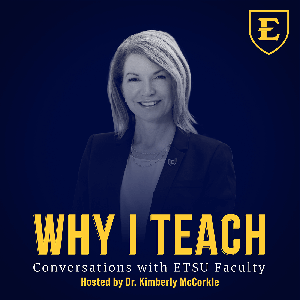
Join ETSU Provost Dr. Kimberly D. McCorkle in this inspiring episode of the “Why I Teach” podcast as she speaks with Dr. Kyle Leister, Assistant Professor and Program Director of ETSU’s new Master of Science in Orthotics and Prosthetics program – the first in Tennessee and one of only 14 nationwide. Dr. Leister shares his unique journey into rehabilitative medicine – from treating NHL athletes with the Pittsburgh Penguins to working on Paramount Studios' medical team – as well as his passion for student mentorship and the human side of prosthetic and orthotic care.
Listen to more episodes of “Why I Teach,” where Dr. Kimberly D. McCorkle explores stories of impact and success of ETSU faculty. Subscribe at https://why-i-teach-conversation-with-etsu-faculty.podbean.com/.
ETSU College of Health Sciences: https://www.etsu.edu/chs/
ETSU School of Clinical Sciences: https://www.etsu.edu/chs/clinical-science/default.php
ETSU Master of Science in Orthotics and Prosthetics: https://www.etsu.edu/chs/rehabilitative-sciences/orthotics-prosthetics/default.php
ETSU Health: www.etsuhealth.org
Probably the most important part of this question is why orthotics and prosthetics at ETSU. And I think that we can tie that directly back to ETSU's mission statement, the ability to be able to serve the people of the region and beyond.
Hi, I'm Kimberly McCorkle, Provost and Senior Vice President for Academic Affairs at East Tennessee State University.
From the moment I arrived on this campus, I have been inspired by our faculty, their passion for what they do, their belief in the power of higher education, and the way they are transforming the lives of their students.
This podcast is dedicated to them, our incredible faculty at ETSU. Hear their stories as they tell us "Why I Teach."
In this episode, we will talk with Dr. Kyle Leister.
Dr. Leister serves as Assistant Professor and Program Director of the Orthotics and Prosthetics Master's Program at East Tennessee State University.
One of just a handful of experts in the world holding both a clinical certification in orthotics and prosthetics and a doctoral degree, he brings a uniquely broad background to his role.
Originally from Pittsburgh, his academic and professional journey has taken him from serving the Pittsburgh Penguins as an athletic trainer, to working on the medical team on Paramount Pictures' lot, to earning degrees from Northwestern University, University of Houston, and finally a Ph.D. from Syracuse University.
Since joining ETSU in 2023, Dr. Leister has spearheaded the launch of the university's M.S. in Orthotics and Prosthetics, the first such program in Tennessee and only the 14th nationwide.
Under his leadership, the Karl Fillauer Learning Center opened in June 2024, outfitted with leading-edge fabrication labs and collaborative clinical facilities at the Quillen VA campus.
Dr. Leister, welcome to the show.
I start my podcast with the same question for every guest. Take me back to your first day of teaching at ETSU as a faculty member. And looking back on that day, what is one piece of advice you would have given yourself?
So first of all, thank you for having me and allowing me to be a part of this. I listen to a lot of podcasts. This is actually the first time I've ever been a part of one. So thank you very much for that.
Jumping right into your first question. So this is actually pretty fresh on my mind because it wasn't that long ago that we finally had students in our program and that I had the opportunity to actually get in front of them.
So that day is actually pretty fresh. So I remember waking up that morning, making sure that my shirt looked good, that my socks matched my jacket, and I was ready to go out there and literally deliver the State of the Union address. I had my slides memorized, my coffee, the whole deal.
So I went in and I was really focused on the time of making sure that I was nailing all my slides. I was providing all the information that the students would need.
But in retrospect, I may have been forgetting about that collaborative nature, that connection that I needed to be building with the students, especially as a new program and their first time going, a lot of them going from undergrad into the master's level of learning.
So while it was a valuable experience, and I think that I hopefully did a good job despite probably sweating through my shirt there at 9 o'clock in the morning, the valuable lesson that I learned from that was that it's more about the collaboration and the connection that you're building with those students, rather than the information and the depth of that information that you're trying to provide right off the bat.
That will certainly come by being able to establish that initial connection is something that if I could rewind the hands of time, I would have told myself, "Try to be a little bit more focused on that than some esoteric statistic that a student may never remember whenever they go into clinical practice."
So that was probably the biggest lesson that I learned and something that I wish that I could inform myself if I could rewind the hands of time.
That's excellent insight.
You've had such a fascinating journey from working with the Pittsburgh Penguins to movie sets in Hollywood. What led you from athletic training to orthotics and prosthetics?
Yes, so I'm sure there are listeners out there that just heard you read that description are wondering what the connections are. Yes, and it certainly is a nonlinear road that I've taken to get where I am right now.
There are some central driving factors that have been present in all of my educational experiences and my clinical experiences along the way.
So starting out first with my experience with the Pittsburgh Penguins, I graduated from Duquesne University in 2009 with an undergraduate degree in athletic training, as you mentioned, and I was fortunate enough that my first job right out of undergrad was with the Pittsburgh Penguins.
I'm not sure how many hockey fans we have here in this part of Tennessee, but in Pittsburgh, hockey is huge. I grew up being a huge hockey fan, playing hockey and enjoying everything about the sport.
To be able to land a job with a professional hockey team was a big deal. That was made even sweeter by the fact that we ended up winning the Stanley Cup in the 2008-2009 season, and it was Sidney Crosby's first Stanley Cup victory.
Those of you who don't know Sidney, he's widely regarded as one of the best hockey players of all time. So to be a part of that and seeing the determination and the grit and the collaboration between the players was wonderful. It was truly inspiring.
During that time, the theme that kind of became apparent to me was that no matter who you are, whether you're performing at the highest possible level, where these professional athletes were, or an individual who may have a sprained knee or something like that in your everyday daily life, there's this common link that if something is wrong, it's disrupting your ability to perform.
We want to do everything that we can to get back to that baseline, back to that homeostasis.
So after wrapping up my time with the Penguins, I moved out west and was performing a similar role on Paramount Pictures' lot. So I was working with a lot of the talent and the executives on that lot in a medical capacity. They had everything that you could imagine on that lot.
Again, the theme remained the same, that any sort of disruption to our everyday lives in terms of injury, illness, or disability – that becomes paramount.
So that fact became really, really interesting to me and something that I wanted to dive into deeper and explore at a deeper level.
And that's where the human connection of orthotics and prosthetics came in around that same time is being able to work with these individuals that are performing at the most highest level. What happens whenever you have somebody that's got a profound disability and needs to get back to their baseline?
So it's that human factor that really drew me into orthotics and prosthetics initially. And then once I got into the field, I realized that there's this whole other realm to it. It's the fabrication. It's the material science. It's the physics behind these devices work that really kept me in the field of orthotics and prosthetics.
So I think that that was kind of a roundabout way of answering your question, but I hope I touched all of those points that you were looking to have addressed.
And what fascinating experiences to have just out of undergrad.
Orthotics and prosthetics is such a specialized field. For those who aren't familiar, can you explain what these professionals do and why their work is so important?
Yeah, absolutely. And I think the best way to sort of start out this discussion is providing some sort of an operational definition for what is an orthosis versus what is a prosthesis. And that'll sort of set the stage.
So in the practice of orthotics, we are really designing devices, whether they're custom or off-the-shelf or custom fit to the patient, that are really designed in order to supplement a weakened or injured or a deformed body segment. So the key word is that the body segment is still there.
That differs from prosthetics, where we're trying to craft a custom device in order to replace a missing or a deficient limb. So that's the big distinguishing factor.
We use similar biomechanical principles to guide our decisions, both in orthotics and prosthetics. But really the difference lies in is the limb there and just deformed or weakened or needing some sort of support, then we think orthotics.
Or is a limb absent, do we need to replace that limb or supplement that limb? Then we think about prosthetics.
So the reason why I feel this work is so important is because as orthotists-prosthetists, we are very often faced with a patient that has just gone through one of the most traumatic things that a human could ever encounter, whether it's a mother and a father that just gave birth to a child that has cerebral palsy
and needs an orthosis in order to be able to learn how to walk properly and remain mobile or a patient that just lost their limb, whether it was through trauma or some sort of a surgical procedure, we're being tasked with being able to manage that patient, as well as their caregivers, through this incredibly difficult time through an intervention that we're directly applying to them.
Another thing that I think that's interesting and important about what we do is that orthotics and prosthetics is a field that we get instant gratification for the devices that we provide.
We can immediately see that the tangible, the measurable outcomes that we're able to provide our patients, whether it's a patient coming in in a wheelchair and then being able to get up and walk out of that clinic because of a prosthesis that we've been able to provide them, or a patient with a spinal cord that just wants to be able to stand up and do the dishes by themselves.
We can design and fabricate devices that are able to facilitate that for the individuals, and that's instant gratification whenever we see that it works properly.
So we recently received the excellent news that ETSU's Orthotics and Prosthetics Program received full accreditation by the Commission on Accreditation of Allied Health Education Programs.
Our program is the first of its kind in Tennessee.
What inspired the creation of this program and why now?
Yeah, absolutely. That's a great question. And first and foremost, I mean, getting the initial accreditation was certainly a labor of love.
Going into it just to provide a background of how the accreditation process works in O&P, students who graduate from either an MPO, a Master's of Prosthetics or Orthotics, or an MSOP, Master's of Science in Orthotics and Prosthetics, must graduate from an accredited program.
So that means that if we don't have that accreditation and we make it through the two years of the program and the students matriculate and go off to do their residencies, they're not eligible to sit for their boards.
So there was a great deal of, I don't want to call it pressure, but responsibility on my part to make sure that that happened for the sake of my students. It meant a lot that our initial 10 students had the faith in me that I was going to be able to do that and get that done well in time for them to be able to graduate.
And that was really my motivation to make sure that I did it at the highest possible level in collaboration with the rest of my faculty as well as ETSU leadership.
So now on to the second part of your question, the why, which is probably the most important part of this question is why orthotics and prosthetics at ETSU.
And I think that we can tie that directly back to ETSU's mission statement, the ability to be able to serve the people of the region and beyond.
So if we look at the evidence base, we're consistently seeing that people are living longer, which is going to result in the need for orthotic or prosthetic intervention just due to the natural progression of age and pathophysiology that comes along with that.
But we're also seeing a rise in metabolic diseases, things like type 2 diabetes and peripheral vascular disease, which are the number one cause for amputation in a lot of the patients that we see.
As a result, the demand for our services is currently far outweighing the supply.
That's compounded even further in the fact of where we live in the eastern part of Tennessee, which is considered more rural than a lot of the other city centers that may have multiple O&P clinics for patients to be able to travel to in order to get their services.
So I think, and I've heard this quite a few times in my time here, that this program was created to be a very mission-centric program.
And I think that what that means is this program was created to give us the opportunity to sort of allow our students to go out into the community and be able to provide this service at a high level. And it's our job to make sure that we're training them in order to do that.
So I think that answers the why question. Why is this program part of ETSU?
And I think that by the time our first cohort graduates and then beyond, we're going to be able to serve that mission.
So tell us a bit more about what it's like to build a program like this from the ground up.
So in short, it's not an easy thing to do. And I can provide a little bit more context behind that. So looking at my timeline, rewinding the clock almost two years from now. So I finished my Ph.D. in, or I defended my dissertation on August 15, 2023.
By August 20th, I had my whole life packed up, including my wife and at the time a three-year-old and a six-month-old child driving from New York to Tennessee.
And by August 29, I was in my office staring at this big, empty space wondering, what am I doing?
And I would be lying to say that I was 100% confident that I was going to come in and be able to knock this out of the park on my first try. Again, fortunately, I had people behind me that were willing to support me. Dr. Jeff Snodgrass, who's the current dean of the College of Health Sciences, who was instrumental to this. Dr. Lynn Williams was also a great help during this process.
I've been in the field of orthotics and prosthetics for quite a while now. I've worked in a lot of different clinical scenarios, a lot of different clinics and laboratories. But those laboratories have always just been there. I never had to really worry about how to build a lab. What tools do we absolutely need? What equipment needs to be there? So that was probably the biggest hurdle that I needed to first overcome.
Based on that, one of the things that I learned during my Ph.D. training and my time in clinic was by definition, the Ph.D. teaches you how to think. And when you realize that you don't know an answer to, it also teaches you how to go find those answers and be able to apply what's already been done to your scenario or your situation.
And while I didn't know exactly what I was going to do right off the bat, I had the skills necessary and the resources necessary to build what we have right now. And I'm very, very grateful for all the support that we've had all the way from the top at ETSU in order to build and establish the program here at East Tennessee State University.
Well, it's amazing to think that what you've done in under two years, yeah, that's congratulations again.
It's pretty wild to think about that in retrospect, you know, going from, again, walking in with very little established with the curriculum, the students, the faculty, the lab space, to go from that to now having, you know, 10 very, very ambitious students in the seats progressing through this program. It is pretty wild to think about that.
Our current cohort, we have students coming from across the country to be a part of this, to be a part of the program and what ETSU has to offer. It all started with an interview for most of the students. And I think after that initial interview, they were all sold on the ETSU community as well as our program.
So you also have the opportunity to be housed on the VA campus. Can you tell us a bit about how that location may assist in program development?
Yeah, the VA, we look at that as being a very, very valuable asset to us and our program. So the VA, not just in a clinical standpoint, has a lot of great opportunities from a research perspective. So being able to collaborate with them in terms of patient care and research is an avenue that we definitely look to explore and very fertile ground for us. I mean, we could be in the physical therapy and the rehabilitation space within the VA in under a 10-minute walk. So we really are looking to build upon that relationship.
ETSU's O&P program also shares a building with our occupational therapy and physical therapy programs, creating a space that's ideally suited for interprofessional education.
How will ETSU's approach to interprofessional education benefit our O&P students?
So that's a great question. And in my time in this role, I've already given quite a few tours to prospective students, parents, people that are interested to see what we're seeing, what we're doing in our building and in our department.
And one of the ways that I always start off my tours is right there in the lobby where we've got the O&P center to my right and the OTD, the occupational therapy program, on my left, and the PT program running directly above us. And that's where I always start my conversation, letting people know how unique and advantageous this is to have all three programs under one roof in such close proximity.
Going back to my experience as a clinician, I worked in the clinic for about eight years before entering academia, and it was almost a daily basis that I was working with an occupational therapist or a physical therapist. And while most of the time those conversations and those relationships were great, there were instances where I found myself thinking, "I wish that we could be speaking the same language. We're all in it for the same reason, to make sure that our patients are getting optimal treatment and optimal care." But there always, not I don't want to say always, but there were times where I felt that there were disconnects between the three professions that again are very, very closely related.
I see this as an opportunity now to narrow that gap, to make sure right off the bat that our students are working with the physical therapists, are working with the occupational therapists, so that when they go out into clinical practice, we are all speaking the same language. So not only does it align with this idea of multidisciplinary care and interprofessional education, but it's going to certainly translate to whenever our students go out into clinical practice, as well as the students in these other programs go out into clinical practice.
With all the technological advances like 3D printing and AI, how is the field of orthotics and prosthetics evolving?
I think the short answer to that question is it's evolving very rapidly. A lot of the ways that it's evolving, we're well set up to be able to expose our students to this new technology.
The first thing that you mentioned was 3D printing. Our laboratory space, whenever we were designing the initial layout, we wanted to make sure that we had an ample room, an ample space for additive manufacturing or scanning, 3D printing, and then manufacturing a device that can be provided to a patient in an educational standpoint.
3D printing, while it's not necessarily a novel technology, the things that have been coming a long way are the materials. I remember earlier on in my career when 3D printing was really starting to take off, a lot of the applications were mainly reserved for our upper extremity individuals, specifically because we didn't have materials that were robust enough to allow a patient to consistently weight bear through. For the upper extremity application, we don't necessarily have to worry about those materials failing and resulting in an injury or a fall. Well, that's all changed. We now have materials that are certainly robust enough to allow for a patient to be able to utilize as a definitive prosthesis.
The sort of evolution that we're seeing now with 3D printing is that we're in a position now that our materials are commensurate with a lot of different amputee activity levels. That gives us the opportunity to be able to get in there, take a digital impression of the patient's residual limb or body segment, and then be able to print a socket and kind of cut out a lot of the extra fabrication time that typically is more of a laborious task that results in a lot of waste, a lot of things that can really slow the process. We're seeing a trend now that additive manufacturing is becoming a lot more prevalent in the field of orthotics and prosthetics.
Interestingly enough, I was recently at a conference in Stockholm, a global orthotics and prosthetics conference, and I was sitting in a keynote, one of the keynote lectures, which focused on osteointegration, which is another technique that while it's been, I don't want to say commonplace, but it's been more common in European countries and places like Australia, it's starting to show a lot more in the United States as well. So in osteointegration, I'll back up one more time, the bane of every prosthetist's existence is getting that comfortable socket fit. The socket is the connection between the patient and the machine. It doesn't matter if we have the most state-of-the-art technology that the patient is walking on in terms of a microprocessor knee unit or a microprocessor foot unit. If we don't get that socket interface done and done at a high level and comfortable, that's just going to be a very, very expensive paperweight for the patient.
So osteointegration is a technique where an insert or an implant is actually placed inside the long bone of the residual limb. So say if a patient has an amputation above the knee, that insert would go into the thigh bone or the femur bone, exit the residual limb, and allows an amputee then to be able to attach distal componentry right onto that insert or that implant that's exiting their skin. This completely forgoes the need for that socket. Now, there's still a great use for the prosthetist in order to be able to manage that type of patient from an alignment and a biomechanical standpoint. But this is technology that, while maybe more prevalent in other parts of the world, is definitely making a presence here in the United States more common in something that our students need to know about.
That's great. What about AI?
Specifically for the opportunity to be able to decrease on the computer work and being in front of a computer in more time in front of the patient, the tools that AI is able to provide us.
For students or listeners interested in health sciences, what advice would you give them about finding a meaningful path in a specialized field like yours?
So I think the best way would be for the students to ask their own questions. Obviously, what we do is not as apparent as what a physical therapist or an occupational would do. an occupational therapist would do. We're not as widespread out there. I think in the entire field, we maybe have 3,000 practicing clinicians in the United States. So as a result, students that may be aware of this field need to do a lot of their own research to determine if this is the path that they want to go through.
Another way that I would recommend is reaching out to your local clinician, seeing if you can get into the clinical practice and do some shadowing hours. You don't know until you're actually in there what the day in the life of the orthotist-prosthetist looks like. One of the things that's very unique about our field is that not only are we working with amputees or individuals with limb loss or limb difference, we're also working with a myriad of individuals with a lot of different pathologies that are treated with orthotics. So being able to decipher the difference between orthotics and prosthetics and asking those questions is probably the best way to start.
Finally, what impact do you hope you've made on your students?
So I think that story is still yet to be written, considering how new we are as a program. But I think if I were to answer that question right now, so new into this role and with such a new program, I just hope that I'm able to relay how excited I am to be a part of the greater picture and be able to have the opportunity to train the next generation of O&P clinicians.
I love this field very much. I take what I do very, very seriously. And I hope that my students are able to realize that whenever I'm trying to relay these concepts over to them. I want them to know that there will be difficult days. And what we do is very challenging. To be able to be a competent orthotist-prosthetist, you have to know a lot. And I hope that they know that I'm going to be there with them every step along the way.
Dr. Leister, thank you so much for joining us today on "Why I Teach." Launching a new program in a short amount of time is no small feat. I sincerely appreciate your work and wish you well as you begin your fall semester.
Thanks for listening to "Why I Teach." For more information about Dr. Leister, the College of Health Sciences, or this podcast series, visit the ETSU Provost website at etsu.edu/provost. You can follow me on social media @ETSUProvost. And if you enjoyed this episode, please take a moment to like and subscribe to "Why I Teach" wherever you listen to podcasts.