
Sign up to save your podcasts
Or

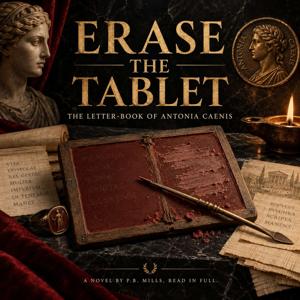


AD 49: Caenis and Sostrata, both forty-one, in the anteroom of Verus, tabularius, on the Argiletum, and a conversation about ink. The only place in either book where the two women are in the same room. Then the ninth hour of the third day before the Ides of October AD 54, a doorway on the Vicus Longus, and a night in the presses: fourteen things touching Narcissus, four touching Burrus, six touching Seneca, and two at the bottom. The largest entry in the private book by a factor of four, and three words added in the margin four years and seven months later.
Chapters Seventeen and Eighteen of the letter-book. The novel is free to read at pbmills.com/books/erase-the-tablet
A work of fiction. The letter-book of Antonia Caenis does not exist.
AD 47: Pallas, at the second room of a house on the Esquiline, and the four occasions across fifteen years on which she was certain he would ask. Four days in January AD 48 and the method by which she decided what a silence was worth, given in the voice she uses for arithmetic. A standing line in the private book, ruled in before each year's other entries for twenty-seven years. Then the third hour of a day in October AD 48, a freedman of Lucius Vettius at her door, a second caller at the seventh hour, and two copies of the same letter in her hand made four hours apart, set one under the other.
Chapters Fifteen and Sixteen of the letter-book. The novel is free to read at pbmills.com/books/erase-the-tablet
A work of fiction. The letter-book of Antonia Caenis does not exist.
The working register, letters counted by month: thirty before, sixty-seven after, and nine weeks between. Spring AD 44 on the Vicus Longus, with Agrippina at twenty-eight on the other side of a wall. Four hundred of her sentences through other people's hands, three of them given and one corrected. Then AD 46, a procurator from Tarraco, three letters on three consecutive mornings about the mines of Asturica, and the fifth leaf of the private book: two hundred thousand in, fifty-three thousand four hundred out, and a valuation. Aglaus on the ruling, the letter forms and the abbreviations.
Chapters Thirteen and Fourteen of the letter-book. The novel is free to read at pbmills.com/books/erase-the-tablet
A work of fiction. The letter-book of Antonia Caenis does not exist.
Spring AD 41. Eleven rooms, thirty-four hands, and Caenis taken in for three months to copy. A petition out of Bithynia about a market, and a sheet that was never meant to be seen, of which she copied the first eighteen lines and the foot. The tally handed in at the door on the last day, and one question. Winter AD 42: nine names on one sheet ruled by a clerk called Doryphorus, four dots in the margin, and the Second Legion. Eleven words from Narcissus in a corridor, and about nine pounds of paper in a cloth.
Chapters Eleven and Twelve of the letter-book. The novel is free to read at pbmills.com/books/erase-the-tablet
A work of fiction. The letter-book of Antonia Caenis does not exist.
Autumn AD 37. Caenis, four months free, with her rates on a card at the top of the stair, takes on a client called Titus Flavius Vespasianus, who is standing for aedile and needs letters. Sixth of six, barely, and a recount on one tribe. The Forum in the aedileship of AD 38, about the fifth hour, at nine paces. An hour and a quarter in her rooms the same afternoon: the Tarracina letter, a lease, and a letter of four lines. Then the only two letters in the archive from her to anybody before AD 51, the marriage to Flavia Domitilla, and what his entries in the working register show for the four years on either side of it.
Chapters Nine and Ten of the letter-book. The novel is free to read at pbmills.com/books/erase-the-tablet
A work of fiction. The letter-book of Antonia Caenis does not exist.
May AD 37. Eleven days blank in a book whose longest other gap in forty years is four. The bedroom on the garden side at the eighth hour of the Kalends, and three things in Caenis's account of it that cannot be true, which Aglaus sets against what can be established. The testament of Antonia Minor, made in AD 26 and unaltered, is read in the hall with eleven standing and Caenis at the back. Then the Vicus Longus, a street, a clerk of the praetor's office, and seven months of learning what a freedwoman may and may not do.
Chapters Seven and Eight of the letter-book. The novel is free to read at pbmills.com/books/erase-the-tablet
A work of fiction. The letter-book of Antonia Caenis does not exist.
Spring AD 34: Caenis is sent to a yard to buy someone, and records what a person costs. The strongroom of the house until it is too dark to read, and the first leaf of a second, private book, ten lines in one ink. Then AD 37, three weeks after the accession: Antonia Minor, seventy-two, receives her grandson Gaius in the small reception room, and five of the fourteen letters that followed are given in the order they stand. Aglaus on a gap of sixty-one days in a run of twenty-eight years.
Chapters Five and Six of the letter-book. The novel is free to read at pbmills.com/books/erase-the-tablet
A work of fiction. The letter-book of Antonia Caenis does not exist.
December AD 31: what the register says about the three children of Apicata, and a conversation in a corridor with a man called Eucaerus. Aglaus counts the private leaves by month and does not raise what he finds. April AD 32: a letter in which the wording matters, and Caenis, at sixty-five, gives the verb and stands by it. A Kalends list with a name added at the foot, and four drafts of one afternoon in AD 33, with Agrippina the Elder on the other side of the table.
Chapters Three and Four of the letter-book. The novel is free to read at pbmills.com/books/erase-the-tablet
A work of fiction. The letter-book of Antonia Caenis does not exist.
The first surviving leaf of the letter-book: Antonia Minor, sixty-seven, to Tiberius Caesar, about eleven letters between her daughter and the man who commands his guard. Four drafts, a courier called Pallas, and the instruction that gives the book its name. Forty-two years later, in a small upper room on the Quirinal, Caenis begins to dictate, and is told to begin with the letter and not with herself. Then the eleven weeks after the fall, a daughter in a locked room, and what the kitchen returns of the house record about how long she was fed.
Chapters One and Two of the letter-book. The novel is free to read at pbmills.com/books/erase-the-tablet
A work of fiction. The letter-book of Antonia Caenis does not exist.
There is a piece of stone in Rome with a mistake on it: six lines for Antonia Caenis, freedwoman of Antonia Augusta, best of patrons, put up by her freedman Aglaus with his children. The translator sets out the four things that are actually known about her, the legal oddity that follows from the third of them, the three layers the book is made of, and why a technical detail about ink is the only place this book and the other one touch.
Front matter of the letter-book. The novel is free to read at pbmills.com/books/erase-the-tablet
A work of fiction. The letter-book of Antonia Caenis does not exist.
From the publisher's feed