
Sign up to save your podcasts
Or



Today I’m discussing something we’ve been talking about a lot on the podcast recently - the definition of a “data product.” While my definition is still a work in progress, I think it’s worth putting out into the world at this point to get more feedback. In addition to sharing my definition of data products (as defined the “producty way”), on today’s episode definition, I also discuss some of the non-technical skills that data product managers (DPMs) in the ML and AI space need if they want to achieve good user adoption of their solutions. I’ll also share my thoughts on whether data scientists can make good data product managers, what a DPM can do to better understand your users and stakeholders, and how product and UX design factors into this role.
Highlights/ Skip to:
Today I’m chatting with Indi Young, independent qualitative data scientist and author of Time to Listen. Indi explains how it is possible to gather and analyze qualitative data in a way that is meaningful to the desired future state of your users, and that learning how to listen and not just interview users is much like learning to ride a bicycle. Listen (!) to find out why pushing back is a necessary part of the design research process, how to build an internal sensor that allows you to truly uncover the nuggets of information that are critical to your projects, and the importance of understanding thought processes to prevent harmful outcomes.
Highlights/ Skip to:
Today I’m chatting with Eugenio Zuccarelli, Research Scientist at MIT Media Lab and Manager of Data Science at CVS. Eugenio explains how he has created multiple algorithms designed to help shape decisions made in life or death situations, such as pediatric cardiac surgery and during the COVID-19 pandemic. Eugenio shared the lessons he’s learned on how to build trust in data when the stakes are life and death. Listen and learn how culture can affect adoption of decision support and ML tools, the impact delivery of information has on the user's ability to understand and use data, and why Eugenio feels that design is more important than the inner workings of ML algorithms.
Highlights/ Skip to:
Today I’m chatting with Iván Herrero Bartolomé, Chief Data Officer at Grupo Intercorp. Iván describes how he was prompted to write his new article in CDO Magazine, “CDOs, Let’s Get Out of Our Comfort Zone” as he recognized the importance of driving cultural change within organizations in order to optimize the use of data. Listen in to find out how Iván is leveraging the role of the analytics translator to drive this cultural shift, as well as the challenges and benefits he sees data leaders encounter as they move from tactical to strategic objectives. Iván also reveals the number one piece of advice he’d give CDOs who are struggling with adoption.
Highlights / Skip to:
Today I’m chatting with Katy Pusch, Senior Director of Product and Integration for Cox2M. Katy describes the lessons she’s learned around making sure that the “juice is always worth the squeeze” for new users to adopt data solutions into their workflow. She also explains the methodologies she’d recommend to data & analytics professionals to ensure their IOT and data products are widely adopted. Listen in to find out why this former analyst turned data product leader feels it’s crucial to focus on more than just delivering data or AI solutions, and how spending more time upfront performing qualitative research on users can wind up being more efficient in the long run than jumping straight into development.
Highlights/ Skip to:
Today I’m chatting with Vin Vashishta, Founder of V Squared. Vin believes that with methodical strategic planning, companies can prepare for continuous transformation by removing the silos that exist between leadership, data, AI, and product teams. How can these barriers be overcome, and what is the impact of doing so? Vin answers those questions and more, explaining why process disruption is necessary for long-term success and gives real-world examples of companies who are adopting these strategies.
Highlights/ Skip to:
Today I’m sitting down with Jon Cooke, founder and CTO of Dataception, to learn his definition of a data product and his views on generating business value with your data products. In our conversation, Jon explains his philosophy on data products and where design and UX fit in. We also review his conceptual model for data products (which he calls the data product pyramid), and discuss how together, these concepts allow teams to ship working solutions faster that actually produce value.
Highlights/ Skip to:
Today I’m chatting with Emilie Shario, a Data Strategist in Residence at Amplify Partners. Emilie thinks data teams should operate like product teams. But what led her to that conclusion, and how has she put the idea into practice? Emilie answers those questions and more, delving into what kind of pushback and hiccups someone can expect when switching from being data-driven to product-driven and sharing advice for data scientists and analytics leaders.
Highlights / Skip to:
Today, I chat with Manav Misra, Chief Data and Analytics Officer at Regions Bank. I begin by asking Manav what it was like to come in and implement a user-focused mentality at Regions, driven by his experience in the software industry. Manav details his approach, which included developing a new data product partner role and using effective communication to gradually gain trust and cooperation from all the players on his team.
Manav then talks about how, over time, he solidified a formal framework for his team to be trained to use this approach and how his hiring is influenced by a product orientation. We also discuss his definition of data product at Regions, which I find to be one of the best I’ve heard to date. Today, Region Bank’s data products are delivering tens of millions of dollars in additional revenue to the bank. Given those results, I also dig into the role of design and designers to better understand who is actually doing the designing of Regions’ data products to make them so successful. Later, I ask Manav what it’s like when designers and data professionals work on the same team and how UX and data visualization design are handled at the bank.
Towards the end, Manav shares what he has learned from his time at Regions and what he would implement in a new organization if starting over. He also expounds on the importance of empowering his team to ask customers the right questions and how a true client/stakeholder partnership has led to Manav’s most successful data products.
Highlights / Skip to:
Today I chat with Chad Sanderson, Head of Product for Convoy’s data platform. I begin by having Chad explain why he calls himself a “data UX champion” and what inspired his interest in UX. Coming from a non-UX background, Chad explains how he came to develop a strategy for addressing the UX pain points at Convoy—a digital freight network. They “use technology to make freight more efficient, reducing costs for some of the nation’s largest brands, increasing earnings for carriers, and eliminating carbon emissions from our planet.” We also get into the metrics of success that Convoy uses to measure UX and why Chad is so heavily focused on user workflow when making the platform user-centered.
Later, Chad shares his definition of a data product, and how his experience with building software products has overlapped with data products. He also shares what he thinks is different about creating data products vs. traditional software products. Chad then explains Convoy’s approach to prototyping and the value of partnering with users in the design process. We wrap up by discussing how UX work gets accomplished on Chad’s team, given it doesn’t include any titled UX professionals.
Highlights:
Re: user research: "The best content that you get from people is when they are really thinking about what to say next; you sort of get into a free-flowing exchange of ideas. So it’s important to find the topic where someone can just talk at length without really filtering themselves. And I find a good place to start with that is to just talk about their problems. What are the painful things that you’ve experienced in data in the last month or in the last week?" - Chad
Re: UX research: "I often recommend asking users to show you something they were working on recently, particularly when they were having a problem accomplishing their goal. It’s a really good way to surface UX issues because the frustration is probably fresh." - Brian
Re: user feedback, “One of the really great pieces of advice that I got is, if you’re getting a lot of negative feedback, this is actually a sign that people care. And if people care about what you’ve built, then it’s better than overbuilding from the beginning.” - Chad
“What we found [in our research around workflow], though, sometimes counterintuitively, is that the steps that are the easiest and simplest for a customer to do that I think most people would look at and say, ‘Okay, it’s pretty low ROI to invest in some automated solution or a product in this space,’ are sometimes the most important things that you can [address in your data product] because of the impacts that it has downstream.” - Chad
Re: user feedback, “The amazing thing about building data products, and I guess any internal products is that 100% of your customers sit ten feet away from you. [...] When you can talk to 100% of [your users], you are truly going to understand [...] every single persona. And that is tremendously effective for creating compelling narratives about why we need to build a particular thing.” - Chad
“If we can get people to really believe that this data product is going to solve the problem, then usually, we like to turn those people into advocates and evangelists within the company, and part of their job is to go out and convince other people about why this thing can solve the problem.” - Chad
From the publisher's feed
Your B2B analytics product does the hard technical work. So why aren't sales and adoption keeping up?
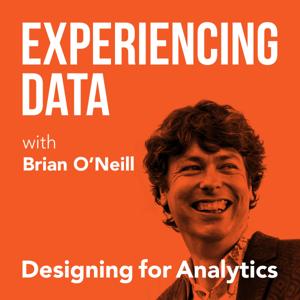
I'm Brian T. O'Neill, and my podcast, Experiencing Data, is a Listen Notes top 2% global podcast for founders, CEOs, and product leaders at B2B analytics companies: the ones whose product should be winning deals on technical sophistication alone, but isn't.
Maybe competitors have caught up on features and prospects say you all look the same, so you end up competing on price. Maybe customers never discover your best features and use you "like Excel." Maybe your value is algorithmic, and buyers can't see what they'd be paying for—something I call the Invisible Intelligence Gap.
Through solo episodes and interviews with CEOs, founders, and the enterprise data leaders who buy these products, I draw on my work as a product designer and strategy consultant to help you translate technical complexity into commercial clarity: connecting what your data product does to the outcomes, value, and human factors that still matter, even in the age of AI.
Experiencing Data is the only non-technical show about why technically impressive products don't sell or get used, and what to do about it.
Subscribe today on all major platforms or browse the episode archive.
Get 1-Page Episode Summaries In your Inbox:
https://designingforanalytics.com/ed
About Brian:
https://designingforanalytics.com/bio/

111,829 Listeners
168 Listeners

5,358 Listeners

1,436 Listeners
707 Listeners

2,110 Listeners