Explore the Symphony

Explore the Symphony

By Canada's National Arts CentreMusicMusic History
Download on the App Store

Explore the Symphony episodes

  • Anton Bruckner’s eighth symphony with the TSO
    Bruckner scholars seem to focus on psychoanalysis rather than closing their eyes and listening to the music. To listen to Anton Bruckner’s eighth symphony is to listen to the summit of his music. The Toronto Symphony Orchestra performs this work with conductor Peter Oundjian on May 7, 2018. Listen to Jean-Jacques van Vlasselaer and Marjolaine Fournier talk about Bruckner’s eighth symphony.
    41 min
  • Kaija Saariaho, Violin Concerto Graal théâtre
    Jean-Jacques van Vlasselaer and Marjolaine Fournier talk about Saariaho’s violin concerto which was featured as part of the 2017 Ideas of North festival produced by the NAC Orchestra. Saariaho is seen as a wonderful and intriguing contemporary composer who will stand the test of time, with master works into the turn of the century.
    57 min
  • Rimsky-Korsakov’s Scheherazade
    This work opens many doors to wonderful and exciting musical study. It is a fine example of Orientalism and our perception of “the other”. Jean-Jacques van Vlasselaer and Marjolaine Fournier talk about who Rimsky-Korsakov was, his 19th-century influences from Mendelssohn to Wagner, and his contributions to the music of the 20th century.
    52 min
  • Shostakovich Violin Concerto No 1 in A minor Op 77
    Your hosts Jean-Jacques van Vlasselaer and Marjolaine Fournier talk about Shostakovich’s Violin Concerto No. 1 in A minor, Op. 77, which will be performed by Guy Braunstein with the NAC Orchestra in January 2018. This work in four movements is technically and emotionally challenging for the soloist. It’s been termed “probing” and “sarcastic” – which may be why it spent time on the shelf after being completed in 1947-48, before seeing the light of day after Stalin’s death in 1953.

    Jean-Jacques and Marjolaine also talk about Shostakovich’s second piano concerto, which appears in the NAC Orchestra program in March 2018 and sees Russia-born Israeli pianist Boris Giltburg at the keyboard. This work was born after Stalin’s death, and was written for the composer’s 19-year-old son, Maxim, a detail that upholds what some have said was the youthful character of the final movement.

    1 hr 15 min
  • Shostakovich Violin Concerto No 1 in A minor Op 77
    Your hosts Jean-Jacques van Vlasselaer and Marjolaine Fournier talk about Shostakovich’s Violin Concerto No. 1 in A minor, Op. 77, which will be performed by Guy Braunstein with the NAC Orchestra in January 2018. This work in four movements is technically and emotionally challenging for the soloist. It’s been termed “probing” and “sarcastic” – which may be why it spent time on the shelf after being completed in 1947-48, before seeing the light of day after Stalin’s death in 1953.

    Jean-Jacques and Marjolaine also talk about Shostakovich’s second piano concerto, which appears in the NAC Orchestra program in March 2018 and sees Russia-born Israeli pianist Boris Giltburg at the keyboard. This work was born after Stalin’s death, and was written for the composer’s 19-year-old son, Maxim, a detail that upholds what some have said was the youthful character of the final movement.

    1 hr 15 min
  • Sibelius’ Symphonic Poems
    Jean-Jacques van Vlasselaer and Marjolaine Fournier present part two of their 2017-2018 podcasts on Sibelius. In this episode, hear them trace the trajectory of Sibelius’ six symphonic poems, all performed by the NAC Orchestra during the 2017 Ideas of North festival. Composed between 1896 and 1927, they delineate the “itinerary of Sibelius, the young composer who wanted to express Finnish worlds.” Drawing from the myths of Northern countries, he “moved from the creation of the world [with the first symphonic poem] to the end of his musical writing.”
    58 min
  • Jean Sibelius' First Symphony

    Jean Sibelius , born Johan Julius Christian Sibelius, was a Finnish composer and violinist of the late Romantic and early-modern periods. He is widely recognized as his country's greatest composer and, through his music, is often credited with having helped Finland to develop a national identity during its struggle for independence from Russia.

    Sibelius started work on his Symphony No. 1 in E minor, Op. 39, in 1898 and completed it in early 1899, when he was 33. The work was first performed on 26 April 1899 by the Helsinki Philharmonic Orchestra, conducted by the composer, in an original, well received version which has not survived. After the premiere, Sibelius made some revisions, resulting in the version performed today. The revision was completed in the spring and summer of 1900, and was first performed in Berlin by the Helsinki Philharmonic, conducted by Robert Kajanus on 18 July 1900. The symphony begins with a highly original, rather forlorn clarinet solo backed by subdued timpani.

    - Wikipedia

    1 hr 1 min
  • Harry Somers - Louis Riel

    The story of the polarizing Métis leader and Canada’s westward expansion is told in this landmark work. Composed by Harry Somers for our nation’s centennial in 1967, this uniquely Canadian contribution to the opera world is returning on the work’s 50th anniversary, and will help mark the 150th anniversary of Canada’s Confederation.

    The National Arts Centre has joined with the Canadian Opera Company to proudly present this new production of Louis Riel.

    Music by Harry Somers

    Libretto by Mavor Moore with the collaboration of Jacques Languirand

    50 min
  • Sibelius' Majestic 2nd and 6th Symphonies

    Jean Sibelius, born Johan Julius Christian Sibelius (8 December 1865 – 20 September 1957), was a Finnish composer and violinist of the late Romantic and early-modern periods. He is widely recognized as his country's greatest composer and, through his music, is often credited with having helped Finland to develop a national identity during its struggle for independence from Russia.

    - Wikipedia

    50 min
  • Robert and Clara: The whirlwind love affair of Robert Alexander Schumann and Clara Josephine Wieck

    Robert Schumann[1] (8 June 1810 – 29 July 1856) was a German composer and influential music critic. He is widely regarded as one of the greatest composers of the Romantic era. Schumann left the study of law, intending to pursue a career as a virtuoso pianist. He had been assured by his teacher Friedrich Wieck that he could become the finest pianist in Europe, but a hand injury ended this dream. Schumann then focused his musical energies on composing.

    In 1840, Schumann married Friedrich Wieck's daughter Clara, against the wishes of her father, following a long and acrimonious legal battle, which found in favor of Clara and Robert. Clara also composed music and had a considerable concert career as a pianist, the earnings from which, before her marriage, formed a substantial part of her father's fortune.

    - Wikipedia

    47 min

About Explore the Symphony

From the publisher's feed

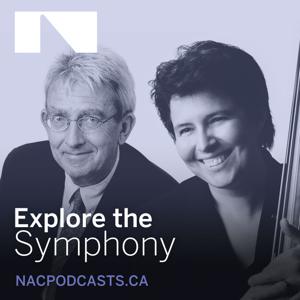
A classical music podcast. Join the National Arts Centre Orchestra's Marjolaine Fournier and one Canada's foremost music journalists, Jean-Jacques van Vlasselaer, as they explore the symphonic form…

More shows like Explore the Symphony

NACOcast: A Classical Music Podcast by Canada's National Arts Centre

NACOcast: A Classical Music Podcast

22 Listeners

Hinterviews by Canada's National Arts Centre

Hinterviews

0 Listeners

Baladodiffusion du Théâtre français du CNA by Canada's National Arts Centre

Baladodiffusion du Théâtre français du CNA

0 Listeners

NAC Dance with Cathy Levy by Canada's National Arts Centre

NAC Dance with Cathy Levy

0 Listeners

Points of View by Canada's National Arts Centre

Points of View

0 Listeners

L'Univers symphonique by Canada's National Arts Centre

L'Univers symphonique

0 Listeners

We Love Canadian Music by Canada’s National Arts Centre

We Love Canadian Music

0 Listeners

Classical Breakdown by WETA Classical

Classical Breakdown

233 Listeners

Stage Advice with Jillian Keiley by Canada's National Arts Centre

Stage Advice with Jillian Keiley

2 Listeners

Insights by Canada's National Arts Centre

Insights

1 Listeners