
Sign up to save your podcasts
Or



You've had an undo button on your email for years. Return policies, apologies, second chances — so much of modern life is fixable that it trains us to be casual. But you can't un-rupture an artery, and you can't un-start a war.
In passage 7.13, Confucius lists the three areas of life where he dropped the casual attitude entirely: ritual cleansing, warfare, and illness. The virtue behind all three is 慎 (shèn) — not just caution, but the refusal to be indecisive when the stakes are permanent.
We trace 慎 across six passages, discover what happens when heedfulness lacks the framework of ritual (spoiler: timidity), and learn why Confucius refused medicine from a nobleman but would have taken it from a doctor.
Along the way: statins and arterial plaque, CPR training as a metaphor for ritual, Mencius on when war becomes liberation, and a first-century BCE commentary from Confucius's own 11th-generation descendant.
Follow along with the episode guide at analects.net.
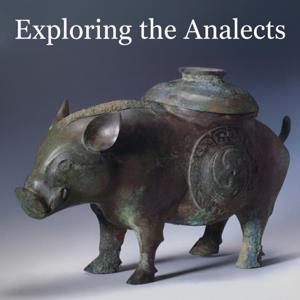
A seven-character riddle about a ritual wine vessel becomes a lesson in why names matter. In passage 6.25, Confucius picks up a 觚 (gū) — a tall, angular bronze cup designed to make you drink slowly — and finds it's lost the very shape that gave it meaning. His complaint isn't really about pottery.
Along the way: Abraham Lincoln's joke about a dog's tail, the cosmological symbolism hidden in a wine cup's dimensions, why China's first emperor 秦始皇 Qin Shi Huang burning the classics was the end of a slippery slope that started with sloppy naming, and the delicious irony of 司馬遷 Sima Qian using the same vessel metaphor to mean the exact opposite of what Confucius intended.
Follow along with the episode guide at analects.net.
What is ritual really for? In this episode, four passages reveal why Confucius cared less about jade, silk, bells, and drums — and more about the bonds that wholehearted participation creates.
We trace the meaning of 禮 (ritual) and 約 (keeping in bounds) through the Analects, take a detour into the 17th-century Chinese Rites Controversy — when Jesuits and the Pope clashed over whether Confucianism was a religion — and put Confucius and Pope Clement XI side by side on what it means to participate in a ritual.
Along the way: why drum machines didn't kill dancing, what a bar mitzvah can teach us about bonds, and how a river without banks becomes a swamp.
Follow along with the episode guide at analects.net.
Is Confucius against profit? Two short passages from Book 4 take on one of the most common misconceptions about Confucianism.
In passage 4.12, Confucius warns that acting purely for personal advantage leads to resentment — but who exactly is he warning, and why? In 4.16, he draws a sharp line between the great and the small, the exemplary and the petty. There are two ways to read it, and both turn out to be right.
Along the way, we dig into the etymology of 利 and 義, revisit the two faces of 君子 and 小人, and find out what Gordon Gekko and Confucius actually agree on.
Follow along with the episode guide at analects.net.
When the ruthless King of Qin demands Zhao's most sacred treasure — the flawless jade disk known as the hé shì bì — in exchange for 15 cities he has no intention of giving, a humble scholar turned royal attendant steps up to answer the call. With the fearless General Lián Pō racing to the border and the kingdom's fate hanging in the balance, Lìn Xiāngrú must outthink a king, outwit an army, and return home with the priceless disk intact.
This is the story of wánbì guī zhào The Jade Disk Returns to Zhao— a tale of cool-headed courage, quick thinking under pressure, and what it means to protect something bigger than yourself. From the pages of Chinese history, told for the next generation.
Part of the Exemplars series — stories for children drawn from the pages of Chinese history.
The Mohists called the Confucians lazy, self-indulgent, and greedy — were they right? In this episode, we explore two passages about wealth, work, and knowing your worth.
Confucius says he'd take an honest job holding a whip before selling his soul to a corrupt boss, and when Zigong asks what to do with a beautiful piece of jade, the Master doesn't hesitate — but he's waiting for the right buyer.
Along the way, we meet the Mohists, ancient China's sharpest critics of the Confucian school, and discover why golden handcuffs and pearls before swine are timeless problems.
Follow along with the episode guide at analects.net.
A retelling of the classic Chinese historical tale of Lord Meng Chang, a generous prince who believed every person had a talent worth cultivating — and whose unlikely band of friends ended up saving his life.
When a powerful king's invitation turns into a trap, it's not brains or brawn that saves the day, but a robe thief and a man who crows like a rooster. A story for kids (and curious grown-ups) about loyalty, resourcefulness, and why you should never underestimate anyone.
Part of the Exemplars series — stories for children drawn from the pages of Chinese history.
Confucius spent his life trying to revive the Way of the ancient sage kings. In this episode, we explore his most famous lament — "Having in the morning heard that the Way was being put into practice, I could die that evening without regret" — and hear how his disciple Zigong explained the Master's approach to learning.
Along the way, we compare the Confucian and Daoist visions of the 道 (dào), meet the legendary kings Wen and Wu, and discover why Confucius never needed a single teacher.
Follow along with the episode guide at analects.net.
Confucius had a front-row seat to one of the messiest love triangles in ancient Chinese history. A prince so beautiful the Duke didn't care he was sleeping with his wife. A priest so smooth-tongued he reshuffled a military alliance's pecking order with nothing but genealogical trivia. These were the people getting ahead — and Confucius was not amused.
In this twelfth episode, host Elliott Bernstein tackles passages 1.3 and 6.16 — a general warning about people whose words and manners aim to please, and a specific lament naming real people whose charm earned them power their character didn't deserve. After being forced out of his home state, Confucius landed in 衛 and watched style win over substance at every turn. He eventually told the Duke he'd never studied military tactics and left the next day.
Along the way: why 佞 (glibness) and 仁 (human-heartedness) are structural near-twins that mean opposite things, the Rollins Band lyrics that open the episode, a father-son war kicked off by a failed assassination attempt, and why "it sure is difficult to get by in today's world" was fifteen years of frustration distilled into a single sentence.
Ever met someone so universally liked that you can't quite figure out what they actually stand for? Someone who's nice to everyone, never ruffles feathers, and somehow has zero enemies? Confucius had a word for that person: thief.
In this eleventh episode, host Elliott Bernstein tackles passages 17.13 and 13.24—a pair of passages about people pleasing, perfectionism, and the so-called Village Worthy (鄉愿), the person whose spotless reputation is actually a sign that something's gone wrong. 17.13 is a six-character gut punch: the Village Worthy is the "thief of moral charisma." 13.24 is the longest passage we've encountered yet, where Zigong tries to puzzle out whether universal approval means you're doing something right—and Confucius tells him it absolutely does not.
But why is being liked by everyone a red flag? How does a perfect reputation "steal" from real morality? And if you can't trust the crowd's opinion—whether they love you or hate you—then how are you supposed to know if you're actually one of the good ones?
Along the way: a personal confession about people pleasing and perfectionism (quitting video games after one mistake, restarting piano pieces from the beginning, and the deep-seated fear of being even mildly disliked by anyone), 12th century commentator 呂伯恭's description of the Village Worthy as someone who wants "to the greatest degree possible, to accord with all people under heaven" (慾盡合天下人), why the Village Worthy's attractive power is more like a black hole than gravity (real substance pulls people close and rectifies them—a void just traps them), the concept of 中庸 or "constantly hitting the mark" (never go to extremes, whether that's universal praise or universal hatred), and why 善 didn't just mean "good" in Confucius's time but something closer to "adept" or "skilled"—making "liked by the good" less of a tautology and more of a specific claim about being recognized by people who've actually put in the work.
Plus: why the character 鄉 was originally a pictograph of two people kneeling and sharing a meal (people who eat together share a community), why "all components of the modern form are empty" according to the Outlier Dictionary (none of the character's parts reference its actual meaning anymore), how 愿 means "cautious and honest" but here it's basically calling someone a try-hard, the character 賊 that's still just "thief" after all these centuries (and also shows up in the Japanese word for pirate—海賊—as in One Piece), the grammatical particle 其 that even scholars can't agree on how to translate (is it "and," "but," or something possessive?—fortunately it doesn't really matter), and the classical negative 未 that means "not yet" and shows up everywhere from 未來 (future: "not yet come") to 未知 (unknown: "not yet known").
From the publisher's feed