
Sign up to save your podcasts
Or

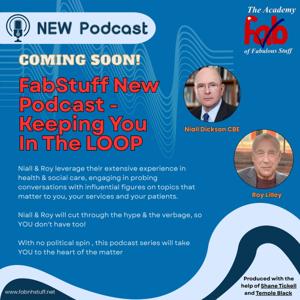


In their latest podcast Niall Dickson & Roy Lilley grapple with the topic many believe is the Holy Grail of effective healthcare – integration.
How do you create a system where physical & mental, hospital & community, health & social care services all collaborate effectively together in the interests of clients & patients rather than institutions or vested interests?
Well one place in the world claims to have – at least for a while – cracked it – the Canterbury region of New Zealand.
Niall & Roy’s guest is the former chief executive in Canterbury David Meates who, with his team, transformed health & care services between 2009 - 2020, & apparently created a single system which achieved so much of what everyone aspires to. That meant preventing unnecessary hospital admissions, enabling patients to be discharged effectively into the community, removing barriers between organisations & professions & much more.
David’s recently published book with health strategist Caroline Gullery, One System: How relationships based on trust and a shared purpose transformed Canterbury's health system is coming out now in paperback & it argues that if introduced in the right way, the model works & , in spite of a political system that has sought to undermine it, David argues that it is still delivering real benefits for Canterbury residents.
Niall & Roy explore with David what really worked during those years & whether it was sustainable? And they probe why so many other healthcare systems, including Scotland, have tried & failed to replicate the Canterbury model. If you want to understand more about integration its potential & the obstacles to delivery, then this podcast is for you!
Send us Fan Mail
Do you regard the NHS as an efficient organisation that provides good value for the huge sums that sustain it?
How much bang do UK taxpayers get for their NHS buck?
In the latest podcast this is the topic discussed, as Niall and Roy consider the controversial and challenging topic of NHS productivity, the subject of new report from the Health Foundation’s NHS Productivity Commission.
Their guest is Anita Charlesworth CBE senior economic advisor at the Foundation and co-chair of its Commission. Anita is one of the most prominent economists focussing on the public sector having been Director of Public Spending at the Treasury under Gordon Brown, and overseeing the seminal Wanless report into NHS funding; in 2018 she co-authored the influential study titled "Securing the future: funding health and social care to the 2030s," with Paul Johnson then of the Institute for Fiscal Studies. She is a member of the advisory panel for the Office of Budget responsibility.
The Commission’s report Breaking the Cycle - how to build a more productive NHS concludes that the NHS in England is simply not set up to deliver sustained productivity growth. The health service, it claims, often obstructs sound decision making and impedes efficient delivery, with local NHS organisations subject to structural instability, competing priorities, and relentless short-term pressures. The commission concludes that significant productivity gains will not come from short term fixes. And it rejects suggestions that our tax funded system is in any way to blame for our performance against other advanced healthcare system in the OECD. Instead it recommends the creation of a system with greater stability, a shared purpose, an engaged workforce, clearer accountability, more freedom at local level and one that can develop the capability to improve care.
Few may disagree with the diagnosis, but as well as exploring why our NHS is not delivering to its potential, the podcast considers the potentially huge impact of AI and technology, the role of professional vested interests and whether Anita and her fellow Commissioners have the right solutions. Crucially, it also considers whether the Commission has worked out how these reforms can be delivered and whether there is the political insight and will to bring them about.
If you want to understand the debate about productivity and how the NHS might be transformed, please do join Niall, Roy and Anita for a fascinating discussion.
Send us Fan Mail
Have you ever wondered what is the reality of working in intensive care?
This is probably one of the most demanding areas of clinical practice, with staff not only having to manage organ failure with patients who are so often at the edge of life and death but also families who are anxious and distressed.
In this their latest podcast Niall and Roy explore the modern reality of this highly pressured environment in a revealing exchange with the President of the Intensive Care Society, Professor Shondipon Laha.
Shond is a critical care consultant at Lancashire teaching Hospitals and this is an encounter full of surprises. While he highlights the continuing shortages of intensive care beds in the UK which was cruelly exposed when Covid hit in 2020 (and remains a challenge today) he also points to the desperate need for social care reform and for rehabilitation services. Both of these he argues are essential if we are to achieve the right outcomes for patients who have been through intensive care.
Shond acknowledges the technical and drug advances that have been made in recent years, ironically helped by the dreadful experience of Covid. Yet for him, the greatest progress in his specialty has been the development of strong multidisciplinary teams in which the key roles of nurses, physios, pharmacists, OTs, dietitians and others are recognised and team working is making care effective.
As for doctors, he sees the development of the intensive care speciality and the move away from it being a branch of anaesthetics as vital with the development of education, training and dedicated intensive care posts.
If you want to validate or challenge your view of intensive care, or just develop a better understanding of a unique area of healthcare, please do join Niall, Roy and Shond - it’s a great listen.
Send us Fan Mail
In one of the most controversial clinical decisions of recent times, the UK National Screening Committee has ruled against the mass screening of men for prostate cancer.
In their latest podcast Niall and Roy question the committee’s Chair, Sir Mike Richards, and seek to understand a decision which has been challenged by former Prime Ministers, high profile patients with prostate cancer such as Sir Chris Hoy, as well as other celebrities. The committee even rejected the idea of screening black men who have double the risk of developing prostate cancer, men with a general family history, & even some with certain genetic factors.
Sir Mike is a former consultant oncologist who became the national cancer tsar & brought about major improvements in the diagnosis & treatment of the disease across the UK. But when it comes to prostate cancer, while he supports the idea that men who want to have a PSA test should be allowed to have one, he argues that, based on current evidence, a screening programme would do more harm than good.
This is a complex area which is developing all the time & he concedes that as our understanding grows & as treatment and testing develop, the case for screening may be made. He is also adamant that this is not one of those clinical decisions based on cost.
If you are with or without a view on this topic, do join Niall, Roy and Mike, & like men all over the country, make up your own mind as they explore this delicate & difficult topic.
It’s a great listen – find it now wherever you find your podcasts.
Send us Fan Mail
In their latest podcast Niall and Roy speak with maternity review Chair, Dr Bill Kirkup following his resignation as an expert advisor to the latest government review of childbirth headed by Lady Amos.
His key reason for quitting was around natural childbirth with Dr Kirkup opposing attempts as he saw it to shut down debate on the issue. But in the podcast he is adamant that while debating the place of so called natural childbirth is essential, it is not the only issue. Instead he focuses on the current training system which sets professionals off to work for different objectives which are in opposition to each other. And that he insists that is never going to produce good, safe practice.
And he backs those who have argued there have been adverse consequences of midwives no longer needing to be trained first as nurses. He says that also means they are often going into midwifery straight from school with no experience of anything outside of the educational system and no experience of the healthcare system. With the best will in the world he suggests it is probably not surprising that ‘some get ideas that are not helpful’
He is adamant that he does not wish to demonise or blame midwives but says we have inadvertently set up a system that produces people who are not necessarily well equipped.
And he claims that until we have a conversation that says it’s no good telling people not to make mistakes, the system will not work. He wants to abolish the current adversarial compensation system and calls on professional regulators to concentrate less on pursuing those who make technical mistakes and more on those who conceal, deny and cover up when mistakes are made.
As for all the reviews – and there are more underway now – Dr Kirkup laments the fact that maternity units have had to cope with around 900 recommendations, which he says makes the whole process unfeasible and he himself pleads guilty to contributing to this, admitting that there were ‘far too many recommendations’ in his Morecambe Bay report.
As for the Amos review, he highlights two vital proposals for reform – in the areas of compensation and clinical education.
Send us Fan Mail
In the last election Jonathan Ashworth lost one of Labour’s safest seats. On New Years Day this year, Jonathan suffered a major stroke, aged just 47.
In this revealing podcast Niall and Roy discover how this former key member of Labour’s leadership views the plight of the government and the Prime Minister he helped to secure the leadership after disastrous Corbyn years
In a frank exchange, Jonathan explains how and why the two party system has collapsed as well as how he warned his colleagues to back a ceasefire in Gaza, but they point black refused to listen, and he lost his seat.
Reflecting on the last two years, he says Starmer lacked charisma and ‘oomph’. But he is also clear Labour badly needs a policy debate. They won the election with a slogan of change - not being Jeremy Corbyn and not being nasty Tories. But that was not enough to create a programme for government, based on hard choices.
Jonathan calls for that debate now and for example to flesh out what Andy Burnham means by bringing health and social care together. ‘Unless we grasp the nettle over social care, ageing and frailty, and preventative health (and what that really means), we are not going to fix the NHS’.
Jonathan wants radical thinking – even exploring whether ending the triple pensions’ lock could be used to fund social care reform. As for Andy Burnham, while he notes how he endeared himself to Labour grassroots with his opposition to private sector tendering , Jonathan notes how the Manchester mayor worked pragmatically with the private sector to promote youth employment.
As for his own stroke and remarkable recovery, he praises the NHS but laments the miserable 6 hours of rehabilitation offered as standard to stroke victims. As a result he claims they are more likely to fall back on health and care services.
This is a great example of a politician freed from office, able even to admit ‘I am the ultimate hypocrite’. That was because he made endless speeches about the need for men to have check-ups but the ignored the text messages invitations himself. ‘If I had bothered.. .maybe I would never have had this stroke in the first place’.
Send us Fan Mail
If there is one clear sign that the NHS is not working, it is the state of its accident and emergency departments. Across the UK, under all sorts of different political regimes, the story is the same. Patients spend hours even days, many waiting for a bed and the incontrovertible evidence that thousands of lives are being lost as a result.
In their latest podcast Niall and Roy hear from Dr Ian Higginson, President of the Royal College of Emergency Medicine, who voices his anger and frustration at a system that is failing patients and staff.
But he argues strongly that this Gordian Knot will not be untangled by discouraging patients from turning up at A and E but by dealing with the ‘back door of the hospital. And on that, he clearly believes that while there is more that hospitals themselves can do to improve discharge procedures, more attention and resources need to be directed at social care and community health services.
As for the former Secretary of State in England, he is determined to make sure that Wes Streeting’s commitment is not forgotten
Send us Fan Mail
Did you know that you are likely to die 20 years younger if you have a learning disability?
Did you know that the great 10 year NHS Plan mentions learning disability 0 times?
In their latest podcast Niall and Roy seek to understand the dire state of health support for individuals with learning disabilities and their families. Their guest is Professor Jim Blair, a nurse and academic who has campaigned relentlessly for the 1.5 million or so people with a learning disability in the UK.
In a fascinating discussion, Jim lets us into a world that is not understood by professionals or the wider public. It is a world where individuals and their families are not seen as having worth and where services are not shaped by those who use them; and where abuse and scandals will persist until this is tackled head on.
Jim also highlights those with profound learning disabilities – who cost millions to look after with 24/7 care and who he describes as the hidden among the hidden.
Learning disability nursing is in sharp decline yet this champion of change says to improve their health, learning disability patients need these advocates as they need services that are developed by them and their families, and staff who are trained by users and their families.
Send us Fan Mail
In the latest Podcast, Greater Manchester Mayor Andy Burnham reveals that the government has agreed to appoint a new Health Commissioner who will be jointly accountable to the Mayor and to the government for health and social care services.
The Mayor said that the Commissioner would have dual accountability, as the ICB chair for NHS purposes and as a health commissioner to the combined Greater Manchester authority.
“I'm really excited about that.” he says. “Finally it feels to me we're getting close here to (an integrated) model of commissioning, priority setting and direction setting. The rest of the Greater Manchester system now is highly integrated, our other public service work as one, but the health service has become an outlier. That's been worrying us greatly and we think this might solve it.”
In a wide ranging discussion with Niall and Roy, Andy Burnham says we will never know whether he could have won the Gorton and Denton byelection, but insists he would never have asked to stand unless he thought he had a good chance, and he rejected the idea that if he had won, the Mayor role would have been at risk. Instead he suggests that if he had won the byelection that would have created a positive momentum for Labour in any Mayoral election.
Among many insights in the podcast, Andy reflects on how he began to move away from the New Labour health agenda while serving as a minister in the Blair administration in the mid-2000s. As for the current government, he commends them for starting to get a grip on the challenges facing the NHS but laments the delay in tackling social care. “How much longer can we keep flinching from that challenge? It’s got to be faced. There will no marked improvement until they grasp the nettle of social care reform.”
There is also a frank assessment of the state of current services, in which he points to the vast number of older people trapped in hospital beds, to their and everyone else’s detriment. Andy’s father has dementia and he talks about his frustration at a care system which seems determined to dial 999 at every opportunity and send his father into A and E, when that is the last place where he should be going.
But he is optimistic that his model of integrated services focussed on prevention can in time release resources and create a much more responsive community based set of services. He claims his ‘LiveWell’ revolution in Greater Manchester will mean doing prevention in a way that has never been tried before, diverting significant resources into voluntary and community organisations and letting them be first port of call. In time he believes it will create services that keep people healthy and create wellbeing, transform health and social care and take pressure of the NHS and other public services.
Send us Fan Mail
In their latest podcast, Niall and Roy have a fascinating exchange with Paul Farmer CBE, the leader of Age UK, Britain’s largest charity campaigning and providing services for older people.
Have older people got it too easy?
Little more than a generation ago, pensioners were seen as among the poorest and most vulnerable groups; today the vast majority have never had it so good. Yet Paul argues that is a dangerous narrative which ignores the two million or so older people who either experience poor health, financial insecurity or loneliness. And he rejects the idea that this is just about deprivation, suggesting we have not faced up to the enormous challenge of living in an ageing society. When challenged on the cost of the triple lock for pensioners, Paul says he welcomes the debate about the future of the state pension, including the possibility of means testing. But he warns that successive governments’ record on means testing has been extremely poor.
On social care another warning - because of chronic and persistent underfunding he suggests something terribly bad could easily happen and that solutions offered in the past will need to be revised given the parlous state of services today. Paul argues not only that social care needs significant extra funding but also a long-term view; the question is who is going to play for these reforms?
As for the NHS, he points to fact that in the last year more than fifty thousand patients in their 80s ended up hospital corridors, and that we need to start looking at the health service through the lens of older people. He is challenged on how much of Age UK’s income actually goes to local branches that provide direct services, as opposed to lobbying and other national activities. Paul responds by saying they have begun to give more to local branches and have plans to do more.
Listen to Niall and Roy’s reflections on this absorbing exchange with one of the most influential leaders advocating for older people in the UK.
Send us Fan Mail
From the publisher's feed
Interviews with leading figures from health and social care