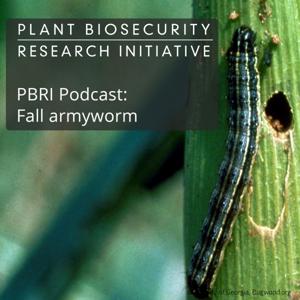
Fall armyworm

Fall armyworm

By Plant Health AustraliaScienceEducationLife Sciences
Download on the App Store

Fall armyworm episodes

  • Episode 7: Field observations of fall armyworm in northern Western Australia

    Following the establishment of fall armyworm populations in the Ord Valley in northern WA, researchers and agronomists have been working together to monitor its behaviour, feeding habits and potential spread throughout cropping areas of WA. Senior research scientist with WA’s Department of Primary Industries and Regional Development, Helen Spafford, and Ord River District Cooperative (ORDCO) agronomists, Penny Goldsmith discuss what they are observing in the Ord Valley and around Broome and the challenges growers are facing as they approach harvest.

    Special Guests: Helen Spafford and Penny Goldsmith.

    22 min
  • Episode 8: Trial observations and laboratory findings on fall armyworm in the Northern Territory

    Since the first detection of fall armyworm in Australia researchers and agronomists have been quick to come together and establish field trials and laboratory experiments to help understand its likely impact on crops and production systems in the top end. NT’s Department of Primary Industry and Resources Senior Principal Entomologist, Brian Thistleton, and Senior Entomologist, Praise Justo-Tadle, give us an insight into what they are recording in some of their field trials and lab experiments on fall armyworm and what growers should be looking out for in the lead up to the wet season.

    Special Guests: Brian Thistleton and Praise Justo-Tadle.

    20 min
  • Episode 6: Scouting, developing thresholds and tips to familiarise yourself with fall armyworm

    We now have some valuable first-hand experience in dealing with fall armyworm in commercial crops in north Queensland. Burdekin agronomist Brent Wilson from Nutien Ag Solutions at Home Hill and Paul McIntosh from Pulse Australia and the Australian Herbicide Resistance Initiative share their insights into the need to manage resistance, developing thresholds, identifying fall armyworm, and where to look for them.

    To see the specific plant symptoms and visual characteristics highlighted in the discussion with Brent, check out his presentation on fall armyworm Q&A for Central Queensland on 6 May 2020 via the link.

    Special Guests: Brent Wilson and Paul McIntosh.

    35 min
  • Episode 5: Field observations of fall armyworm in northern Australia

    Since the recent arrival of fall armyworm in Australia, scientists, growers and agronomists across the north have been on a steep learning curve. Home-grown entomologists Melina Miles and Paul Grundy from the Queensland Department of Agriculture and Fisheries speak about their observations and thoughts on how the pest is behaving in Australia and the likely implications for management.

    Special Guests: Melina Miles and Paul Grundy.

    35 min
  • Episode 4: FAO's global action for fall armyworm control

    On this podcast we speak to FAO’s Elisabetta Tagliati about the risks posed by fall armyworm to global food and feed security and FAO’s efforts to develop international capacity and capabilitiy to manage the pest across 65 countries under a Global Action Plan.

    Important information

    DISCLAIMER

    The content of these podcasts is provided for information purposes only. While reasonable care is taken in its preparation, the Plant Biosecurity Research Initiative and its member organisations do not guarantee or warrant the accuracy, reliability, completeness or currency of the information on the podcasts or its usefulness in achieving any purpose.
    Users of the podcasts are responsible for assessing the relevance and accuracy of its content. The Plant Biosecurity Research Initiative and its member organisations will not be liable for any loss, damage, cost or expense incurred or arising by reason of any person using or relying on the information in these podcasts.
    Products may be identified by proprietary or trade names to help listeners identify particular types of products, but this is not, and is not intended to be, an endorsement or recommendation of any product or manufacturer referred to. Other products may perform as well or better than those specifically referred to.

    PESTICIDE DISCLAIMER

    The Plant Biosecurity Research Initiative and its member organisations seek to avoid including information regarding unregistered pesticides or unregistered use of pesticides in these podcasts. However it is possible that occasionally interviews conducted may unintentionally mention such information. Any research regarding pesticides or their use reported in these podcasts do not constitute a recommendation for that particular use by the authors, the author's organisations or the Plant Biosecurity Research Initiative and its member organisations. All pesticide applications must accord with the currently registered label or permit for that particular pesticide, crop, pest and region.
    Check www.apvma.gov.au and select product registrations listed in PUBCRIS for current information relating to product registration.

    Special Guest: Elisabetta Tagliati.

    15 min
  • Episode 3: Active response to fall armyworm in South Africa

    Working across governments, industry, languages and neighbouring countries was critical in minimise the impact of the fall armyworm outbreak in South Africa. Jan-Hendrik Venter, from South Africa’s Department of Agriculture, Forestry and Fisheries, talks about the approach taken in response to their fall armyworm incursion in 2017.

    Important information

    DISCLAIMER

    The content of these podcasts is provided for information purposes only. While reasonable care is taken in its preparation, the Plant Biosecurity Research Initiative and its member organisations do not guarantee or warrant the accuracy, reliability, completeness or currency of the information on the podcasts or its usefulness in achieving any purpose.
    Users of the podcasts are responsible for assessing the relevance and accuracy of its content. The Plant Biosecurity Research Initiative and its member organisations will not be liable for any loss, damage, cost or expense incurred or arising by reason of any person using or relying on the information in these podcasts.
    Products may be identified by proprietary or trade names to help listeners identify particular types of products, but this is not, and is not intended to be, an endorsement or recommendation of any product or manufacturer referred to. Other products may perform as well or better than those specifically referred to.

    PESTICIDE DISCLAIMER

    The Plant Biosecurity Research Initiative and its member organisations seek to avoid including information regarding unregistered pesticides or unregistered use of pesticides in these podcasts. However it is possible that occasionally interviews conducted may unintentionally mention such information. Any research regarding pesticides or their use reported in these podcasts do not constitute a recommendation for that particular use by the authors, the author's organisations or the Plant Biosecurity Research Initiative and its member organisations. All pesticide applications must accord with the currently registered label or permit for that particular pesticide, crop, pest and region.
    Check www.apvma.gov.au and select product registrations listed in PUBCRIS for current information relating to product registration.

    Special Guest: Jan-Hendrik Venter.

    25 min
  • Episode 2: Applied fall armyworm management in row crops and pastures in Texas

    Exploring the practical control strategies used in row crops and pastures across Texas extension specialist and IPM coordinator David Kerns from Texas A&M University talks about the different strains of fall armyworm, the crops they effect and the tactics for control.

    WARNING:
    This podcast discusses the overseas use of chlorantraniliprole on sorghum for fall armyworm. This use is not approved in Australia - read note below under important information / pesticide disclaimer.
    Please note that an emergency use permit application submitted for the use of chlorantraniliprole in sorghum to control fall armyworm was not approved by the APVMA. Further, the APVMA considered that the proposed use presented an undue risk to trade, based on information received in response to a Trade Advice Notice (TAN) and the trade assessment of the proposed use.

    Important information

    DISCLAIMER

    The content of these podcasts is provided for information purposes only. While reasonable care is taken in its preparation, the Plant Biosecurity Research Initiative and its member organisations do not guarantee or warrant the accuracy, reliability, completeness or currency of the information on the podcasts or its usefulness in achieving any purpose.
    Users of the podcasts are responsible for assessing the relevance and accuracy of its content. The Plant Biosecurity Research Initiative and its member organisations will not be liable for any loss, damage, cost or expense incurred or arising by reason of any person using or relying on the information in these podcasts.
    Products may be identified by proprietary or trade names to help listeners identify particular types of products, but this is not, and is not intended to be, an endorsement or recommendation of any product or manufacturer referred to. Other products may perform as well or better than those specifically referred to.

    PESTICIDE DISCLAIMER

    The Plant Biosecurity Research Initiative and its member organisations seek to avoid including information regarding unregistered pesticides or unregistered use of pesticides in these podcasts. However it is possible that occasionally interviews conducted may unintentionally mention such information. Any research regarding pesticides or their use reported in these podcasts do not constitute a recommendation for that particular use by the authors, the author's organisations or the Plant Biosecurity Research Initiative and its member organisations. All pesticide applications must accord with the currently registered label or permit for that particular pesticide, crop, pest and region.
    Check www.apvma.gov.au and select product registrations listed in PUBCRIS for current information relating to product registration.

    Special Guest: David Kerns.

    25 min
  • Episode 1: Fall armyworm biology and ecology in subtropical and temperate US

    To understanding how fall armyworm behaves in different parts of the US and what this may mean for Australia, we speak with two American researchers on their work over the past 30 years. Greg Nuessly from the University of Florida and Dominic Reisig from North Carolina State University discuss their work under subtropical conditions in southern Florida where it is a primary pest every year in the same crops, and in cool temperate conditions in North Carolina where it is more sporadic.

    Important information

    DISCLAIMER

    The content of these podcasts is provided for information purposes only. While reasonable care is taken in its preparation, the Plant Biosecurity Research Initiative and its member organisations do not guarantee or warrant the accuracy, reliability, completeness or currency of the information on the podcasts or its usefulness in achieving any purpose.
    Users of the podcasts are responsible for assessing the relevance and accuracy of its content. The Plant Biosecurity Research Initiative and its member organisations will not be liable for any loss, damage, cost or expense incurred or arising by reason of any person using or relying on the information in these podcasts.
    Products may be identified by proprietary or trade names to help listeners identify particular types of products, but this is not, and is not intended to be, an endorsement or recommendation of any product or manufacturer referred to. Other products may perform as well or better than those specifically referred to.

    PESTICIDE DISCLAIMER

    The Plant Biosecurity Research Initiative and its member organisations seek to avoid including information regarding unregistered pesticides or unregistered use of pesticides in these podcasts. However it is possible that occasionally interviews conducted may unintentionally mention such information. Any research regarding pesticides or their use reported in these podcasts do not constitute a recommendation for that particular use by the authors, the author's organisations or the Plant Biosecurity Research Initiative and its member organisations. All pesticide applications must accord with the currently registered label or permit for that particular pesticide, crop, pest and region.
    Check www.apvma.gov.au and select product registrations listed in PUBCRIS for current information relating to product registration.

    Special Guests: Dominic Reisig and Greg Nuessly.

    42 min

About Fall armyworm

From the publisher's feed

Welcome to PBRI Podcasts, a series that explores some of Australia's most unwanted plant pests.