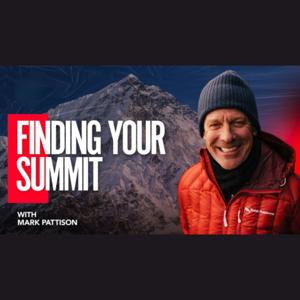
Finding Your Summit

Finding Your Summit

Download on the App Store

Finding Your Summit episodes

  • Jason Piccolo is a former US Border Patrol, Narco Agent and Army vet who also served in Iraq. Listen to his amazing and Jack Ryan type stor
    166: Dr. Jason Piccolo: Former U.S. Border Patrol Agent, Author, and Host of The Protectors that shares stories about law enforcement talks about his adventures protecting the San Diego and El Paso borders and the dangerous situations he survived in the line of duty.
    Dr. Jason Piccolo
    Jason Piccolo was completely shocked after following his friend Chris’ advice to become a U.S. Border Patrol agent: “It is absolutely ‘cat and mouse.’ That is the southern border, and I always tell people, it is like the wild west. It really is. It is so lawless. It is bloody, and by bloody I mean, when I first started out as a border patrol agent in January 2000, so over 20 years ago now. So, when I first got to the border, I was like, ‘this is really the United States?’
    On this episode of Finding Your Summit Podcast, we talk with Jason Piccolo, Former U.S. Border Patrol Agent, Author, and Host of The Protectors, explains the danger that was involved when he started working for the U.S. Border Patrol: “It felt like I was in some weird quasi-movie, where these banditos are down in valleys raping and pillaging people that are trying to cross the border. When you figure out that it is a reality and you have to live this day in and day out, you are kind of like, ‘wow, what did I get myself into? I’m a kid from New Jersey. The closest I got to California was spring break once.”
    What You Will Learn:
    What is the path that someone would have to take if they wanted to become a border agent? “It is a really weird time for me right now because I got into because of my best friend that I had met. I was in the Army in the 1990s, you know? My goal was always to be a soldier and then become a police officer. Then one of my best friends became a border patrol agent when I was living out in Texas. I was like,m what is a border patrol agent? He said, ‘you should apply bro, it is a federal job.’ They will take your military (experience) and it will all tack onto your retirement. So the years I did in service will go into my retirement. So I figured, hey, I could do 20 years in law enforcement, tack on my military time, and boom, great for retirement.”
    Jason shares what it was like having a mentor like his friend Chris. “I get out of the Army, I go to college, get a degree in law enforcement. I get stationed at the same exact station as my best friend Chris and he taught me the ropes and that is how I got into it. But the reason why I bring up Chris is because Chris died in the line of duty two years ago, after he had his 20+ years in. Kind of having that mentor and having someone who did that job and got me into law enforcement and actually know that you could die in the line of duty is crazy man.”
    What is the border patrol up against at the San Diego/Mexico border? “There is so much narcotics and illicit goods coming through that Southwest border that you can’t quite possibly measure it. Because look at it this way, each week we would seize, just in San Diego alone, my 20,000-30,00 pounds of weed, marijuna, and if we were lucky we were getting 200-300 kilos of cocaine. If we were lucky, and that is throughout the whole San Diego sector. Now think about that. That is one of the busiest ports in the United States, one of the busiest ports in the world”
    Are smugglers just sending as much narcotics over the border as they can, knowing that it won’t all make it across? “K9s hit on odor. Marijuana has a ton of odor to it. So, if you only have a finite amount of K9s at the border and a cartel organization just flushes a whole bunch of cars with 40 or 60 kilos marijuana in them, and you end up putting your resources to seize them and investigate them. What is coming behind those cars? So your first wave is going to be marijuana. They know they are going to be picked up.Those people are going to go to jail. The cars behind them have anywhere between 8-20 kilos of cocaine in them and those are the ones that it is really tough to find out unless you have human sources.”
    What has blown Jason Piccolo’s mind about drug smuggling. “I have been through rudimentary tunnels and I actually had to crawl through them myself to document it. One funny story was they wanted someone to crawl through one of these tunnels to the other side and take pictures. Now we were working with the Mexican federales and I ended up crawling through and I popped up on the other side and there were all of these federales there, and I’m like, ‘Hold up!’ I held my camera up and they started taking pictures of me in the tunnel.”
    El Paso vs. San Diego
    Jason Piccolo explains why it is more violent at the El Paso/Mexican border than the San Diego/Mexico border? “My theory is that you have something like a Warez in...
    42 min
  • Dick Couch is a former Navy Seal who led multiple missions overseas including a POW rescue in Vietnam and worked in the CIA talks about what
    165: Dick Couch: Former U.S. Navy SEAL, Author, Speaker, and Professor talks about how he went from being a young in Mississippi, moving to Indiana, not having much exposure to the ocean, and becoming a Navy SEAL and prolific author.
    Dick Couch
    How exactly did today’s guest Dick Couch, who grew up as a kid in Mississippi, become a Navy SEAL? “I can honestly say my mother, who kind of set the adventure in me. She took me to see a movie called, The Silent World, with Jacques Cousteau and I got the book and read it. We are talking about the early 50s. So I was 10 or 11 years old, and I thought, boy, this looks interesting. So, I saved my money and I bought a regulator and I got a fire extinguisher bottle and I made an aqua lung out of it and I started diving.”
    On this episode of Finding Your Summit Podcast, we talk with Dick Couch, Former U.S. Navy SEAL, Author, Speaker, and Professor, and the connection of how his awareness of becoming a Navy Frogman entered his mind when he was younger? “I think I wanted to be a Navy diver. I wanted to do something underwater… We find also, back then, and even today, kids from the Midwest seem to flock to these special operations and the Navy SEALs as opposed to someone who grew in San Francisco or grew up in San Diego or Miami. The sea has an allure. It certainly did for me growing up in Indiana. I never saw the ocean until I went east to school.”
    What You Will Learn:
    In 1967 Dick Couch became a graduate of the U.S. Naval Academy. Did the civil unrest of that time affect his choice to become a Navy SEAL? “Not so much. I grew up in Indiana. I was an average student. But I was a very good high runner. So, I went to Butler University for two years on a track scholarship and then because I was from southern Indiana where not too many people were interested in service academies, a local congressman was looking for somebody to go and I said I would go, and my running helped. I was a good college runner. Vietnam was not on the horizon. It was the late 50s, early 60s.”
    What was Dick Cuch’s transition like into Navy SEAL training? “I graduated in 1967. I didn't get to Seal training until 1968. Back then, you couldn’t leave the academy and go straight into special operations. Even if you could have, my class standing was such that I probably would have had to go aboard ship and transfer. So, I spent a year and a half aboard the ship. I couldn’t have had better preparation, because being a division officer, aboard a Destroyer, in combat, was great training wheels before I went into the Seals and had to undertake those leadership responsibilities.”
    What was Dick Couch physically doing as far as Nay missions? “Gunfire support. We were both in South Vietnam and in North Vietnam doing oncall fire missions, which means we were throwing 5-inch bullets into the beach at certain targets, either call fire from the marines onshore or army onshore, or off North Vietnam engaging targets off of North Vietnam. We got hit once and hurt some people.”
    Why does Dick Couch refer to the Navy SEALs as a little man’s game? “It is a little different today, they’ve got guys who are bigger and stronger, smarter, faster, all of that type of thing. But in my time, you have to run the old course. If you got hurt and you were a big guy, there is no time to rehab. You’ve got to run through the pain or else drop out. And it seems as little guys, we just didn’t get hurt as much.”
    What makes training and opertains different? “There is a difference between training and operations. Training gives you the tools and one thing about SEALs training then and Seals training now, it hardens you up. There is almost no physical hardship. I mean, you can stay up for days. You can be cold. You can be in the worst conditions possible, and you will find a way to get through that type of thing. But also, the training is transitory.”
    Navy Seal Point of View
    After his experiences as a Navy SEAL, does Dick Couch feel that he walks into public places and view his surroundings differently than a typical civilian? “I don’t think so. That’s me. I don’t think that is the case at all, and I’ve been in and out of it for a while and I’ve done a lot of different things. But I don’t think I look at it any differently. I’ve spent more time with special operations components training and in my book work and things like that. I think I have higher than average situational awareness. But I don’t walk in and take the table in the corner with my back to the wall so I can see what goes on.”
    The Makings of a Great Leader
    During this episode of Finding Your Summit Podcast, Dick Couch also chats about the ingredients of a great leader. “I think that that leader has to have a tactical command of what he is doing and what his responsibilities are and be able to look at those he is leading and...
    47 min
  • Mariel Hemingway: Mariel Hemingway talks about navigating the pandemic, her acting career and how self care and mental wellness have become
    163: Mariel Hemingway: Actress and Expert in Mental & Physical Health in the areas of mindfulness, grounding and earthing talks about overcoming her family’s stigma of suicide and becoming a successful actress and mental health advocate.
    Mariel Hemingway
    What have Mariel Hemingway and her significant other Bobby done to anchor themselves in Southern California during the he COVID-19 pandemic? “We are very careful how we spend our time outdoors, whether we are meditating, the kind of food we’re eating, and all of these kinds of things. So, our lifestyle really hasn’t changed that much. Our connections to other people obviously have dramatically changed. I think what has been the most challenging is probably not seeing my daughters enough, or something like that. For us, it’s about staying focused on being the best we can be physically, mentally, emotionally, and spiritually. We focus on our food. We focus on our exercise. We focus on connecting with nature.”
    On this episode of Finding Your Summit Podcast, we talk with Mariel Hemingway, Actress and Expert in Mental & Physical Health in the areas of mindfulness, grounding and earthing. Mariel Hemingway discusses the three main circles of her life, her family life, her acting life, and her self-care around mental illness life. How does Mariel approach self-care and her yoga practices: “When you talk about my family. When you talk about acting. When you talk about mental health, see I think all of those things are kind of interconnected anyway because the first thing that you have to do in life is to look at your story, your history, where you come from. Once you look at your story, your history, your patterns, your heritage, you can then determine the choices that you have been making your entire life.”
    What You Will Learn:
    Mariel Hemingway talks about what the process of earthing means to her. “I’m very big into ‘earthing,’ grounding, literally taking my shoes off and going for hikes every single day out on trails with no shoes on, because I believe it is one of the great ways to stay literally grounded but to also help with anxiety, help with the uncertainty of times.”
    How does self-care play a role in her daily life? “Self-care is health care. More than anything, taking care of ourselves is our responsibility and it also needs to turn into our joy because our lifestyle is everything. What we do in the morning, our morning routines. Whether we watch a sunrise and ground. How we make our coffee in the morning. Whether we make it with intention. Whether we are quiet and still and present doing the things that we are doing.”
    How can we rethink bad memories so they don’t keep getting in our way? “Memories can’t hurt you. They can inform you of what you have been doing and the choices that you have been making. So, once we look at those stories, then we are on the path to our own recovery, and the recovery is from worrying about what has already happened. And you can’t worry about what has already happened, and you can’t worry about what has already happened, because it has already happened, and you can’t worry about is going to happen because we don’t know.”
    Mariel Hemingway’s family has had seven suicides in it, including her paternal grandfather, the great American author Ernest Hemingway. How has she worked with her daughters to prevent them from falling into a similar cycle? “I think there is always somebody in a family that says, ‘I’m done. I’m changing this. We’re not going there anymore,’ and I think I made that choice. I think I made the choice to say, The buck stops here. I don’t want to hand this off to my children. It doesn’t mean that my daughters don’t have problems and don’t have issues.”
    Regarding her documentary “Running from Crazy,” how did she get Oprah Winfrey to produce it? “I have this really close from Lisa Erspamer. She worked for Oprah for years. She had her show on ABC. She was also one of the creative directors over at the OWN Network. We were really close and one day she looked at me and said, ‘We need to do a documentary on your family and your family’s life.’ And I said, ‘What are you crazy? They are nuts. No.’ She goes, ‘That’s just the point.’ She said, ‘We have to do it because everybody has a story. Everybody comes from something imperfect.’”
    Doing the Movie Lipstick
    Mariel talks about her older sister’s drug and alcohol issues and her sister feeling overshadowed by Mariel’s acting success. “She was seven years older than me. I was this young girl and she invited me to play her little sister in a movie, and it was her dream to be an actress. In retrospect, thinking about it, it was heart wrenching because it wasn’t until years later that I realised her whole life she just felt like she was second best. She wasn’t Ernest Hemingway and then I came...
    56 min
  • Coach Gary Pinkel: Former Head Coach Gary Pinkel of Missouri talks about getting cancer & how it ended his football career but overcame to l
    On this episode of Finding Your Summit Podcast, we talk with Gary Pinkel, Head Football Coach at University of Missouri-Columbia, 3-time Coach of the Year in three different conferences, and the third most winnest coaches of all time who was once Mark Pattison’s coach in college at the University of Washington. Gary Pinkel shares the moment when he had to walk away from coaching to fight cancer.
    52 min
  • Kristen Willeumier: Another incredible powerhouse woman who learned the early lessons of competitive horse jumping (and falling) to become a
    161: Kristen Willeumier: Neuroscientist and Author of the book Biohack Your Brain discusses overcoming serious athletic injuries of her own and pushing through to getting her PhD in Neurobiology from UCLA and working to help people fight back against neurological illnesses like Alzheimer’s.
    Kristen Willeumier
    As an athlete, what made Kristen Willeumier gravitate towards ? “I started getting more interested in the mind through sports. So, when I was at Boston College, I studied psychology. But, I was really interested in continuing the thread of athletics, and the brain, and psychology. I thought I wanted to go into sports psychology, and at the time, which was in the early 90s, there weren’t a lot of sports psychologists. I joined an association for sports psychology, learned more about it. I really wanted to work with athletes and Olympic athletes, helping them improve their mental game.”
    On this episode of Finding Your Summit Podcast, we talk with Kristen Willeumier, PhD, Neuroscientist and Author of Biohack Your Brain, which is published by HarperCollins Publishers and will be released December 29th, 2020. How does she fill the gap between diseases that exist today and what traditional medicine knows? “Part of the reason why I ended up first doing the Masters Degree and then continuing to do another Masters and PhD in Neurobiology is that I wanted to study a disease that we think is incurable, whether that is Parkinsons, Alzheimer’s.”
    What You Will Learn:
    How did Kristen Willeumier get involved in competitive show jumping on horses? “I started riding at the age of 7, and like most parents do with their kids, I was doing gymnastics. I was doing ballet. I was taking classes at the Art Institute. You have your kids trying different things to figure out what they are going to excel at. I happened to go to a riding camp, at Kelly’s Riding Camp, and fell in love with riding horses, and I happened to grow up in a suburb outside of Chicago called Barrington which is essentially horse country.”
    Kristen Willeumier explains the ‘hunters’ and jumpers’ areas of competitive show jumping. “I started out very naturally doing what we call the ‘hunters.’ For people who aren’t very familiar with the riding industry, we have ‘hunters’ and we have ‘jumpers.’ Hunter competitions are really judged on the horse, and how well you take the horses around the courses. Jumpers are more about not the actual judging of the horse and the rider, but it’s just how quickly you can get over a course of 10 to 12 to 14 fences. You need to jump them clean and you need to jump them for speed.”
    Did she have her sights set on the Olympics as something you wanted to do? “Absolutely. So, I actually rode for a decade, age 7 all the way to 17. Throughout that time, our family owned five different horses and the kind of training, so I was trained with people who ended up being Olympic show jumpers. Chris Kappler, who went to the Los Angeles Olympics, who is a gold and silver medalist. So, he was training in the barn with us.”
    Kristen opens up about a very serious injury that she sustained when she was younger riding a pony. “I’ve had so many injuries and accidents. But, the one that is truly the most memorable happened when I was 13 and I was at a local horse show riding Razzmatazz, who was a large pony, dapple gray, large pony, and I was in the children’s adult jumper class. So, the fences are between 3-foot 6 inches and 3-foot 9 inches. I was going around a corner with Lee, and he slipped. So, the show ring was wet. So, he slipped. His backend goes down. I go flying over him. He scrambles to get up and he steps on my chest. My ribs end up puncturing my lungs.”
    What makes Kristen Willeumier so passionate about her area of neuroscience? “Alzheimer’s disease, 5 million people in the United States have it. It is expected to triple by 2050. We have zero drugs that actually stop Alzheimer’s disease. Zero. I’m going to pivot off of Parkinson’s and go to Alzheimer’s for a minute. Alzheimer’s is 90% preventable by diet and lifestyle, and it is part of the reason why I’m such an advocate for brain health.”
    Diet Against Alzheimer’s
    What is a natural way of eating that can fight against getting Alzheimer’s disease? “I’m going to do a Mediteranean Diet that is whole food plant-based. For example, on a day-to-day basis you want to be getting two servings of fresh fruit. Fruits and vegetables are at the core of brain health. First of all, most Amercians aren’t eating two servings of fruits and three servings of greens per day. If anyone is going to make one change today that they can take with them for the rest of their lives, that is probably the number one change.”
    Biohack Your Brain
    During this episode of Finding Your Summit Podcast, Kristen Willeumier also talks about the upcoming...
    56 min
  • Meghan Buchanan: This Wonder Woman is a Rocket Science and climbing the Seven Summits but had to overcome her adversities to get there. Now
    160: Meghan Buchanan: Rocket Scientist, Aerospace Engineer, Athlete, and Public Speaker discusses what it was like to overcome dyslexia and a tremendous snowboarding injury, and come out on top thanks to gratitude, growth, resilience, integrity, and tenacity.
    Meghan Buchanan
    Being that Meghan Buchanan was all set to climb Mt. Everest before COVID-19, what was it like to have that massive goal put on hold? “When you are training so hard for it and you feel like you are ready, you look back and you realize that it has been a lifetime of training. Mentally, emotionally, and then there is the physical, and when Nepal made the answer, I literally got my down suit like that night and then I heard that Nepal had shut everything down. I literally felt like I was wearing my wedding dress and my wedding just got canceled.”
    On this episode of Finding Your Summit Podcast, we talk with Meghan Buchanan, Rocket Scientist, Aerospace Engineer, Athlete, and Public Speaker about the aftermath of her Mt. Everest journey being put on hold. “I’m very good at realizing what you can and cannot change, and this was something I absolutely knew I wasn’t going to be able to talk my way around it out through it, and I couldn’t change it. So, I woke up Saturday morning like, alright, let’s make Plan B. So, yeah, it’s disappointing. But everything happened so fast with the pandemic and the lockdowns. Any sadness I was feeling was completely run over by so much worse for so many others. So, how am I doing? I feel so grateful to have a job that allows me to work from home right now. I’m so grateful to be in this country and us not being stuck in Nepal where they couldn’t take care of us if we were there.”
    What You Will Learn:
    Meghan Buchanan discusses how she has benefited from her resilience while having integrity. “The dyslexia, as a child, I think really built my foundation of who I am in the core of having that resilience and the perseverance to push through things. As a kid, we discovered I was dyslexic, because I actually had a second grade teacher who did not like me. He was not a good man and he would yell at me in front of the class. That’s when you’re learning to spell. I actually started reading when I was 3. I started programming a computer when I was 5. But I couldn’t spell and I was having a lot of problems. He would chastise me in front of the class. Call me an idiot. Call me retarded, yell at me to the point that I refused to read.”
    How was Meghan equipped to rebound from her dyslexia? “What my memory is, is my mom looking at me saying, ‘You don’t believe anyone else. You are just going to have to work harder for everything that you want, and we start right now. It was really the foundation then of my parents never letting me use it as an excuse and to just fight harder for what I wanted. I think it just became a way of life for me to push through.”
    Meghan Buchanan talks about some of the adult figures outside of her household that didn’t believe in her dreams. “It is hard as a kid when you know you are smart. But it is not reflected in your writing. It is not reflected in your spelling and you are labeled, and going through high school. I’m also quite bubbly. You can tell, and cheerleading, and all of those types of things. But I remember, I was top 10 in my class in high school and I wanted to be an aerospace engineer. I remember my counselors at the time telling me, ‘Oh honey, you could marry well, or you should go into communications.’ I’m like, ‘I took the highest math class in my junior (year). What? Forget you guys. I’m doing this.”
    What is her advice to others working in highly competitive environments? “Stop tearing each other down. It is hard enough out there. This goes for anyone, there will always be someone prettier, funnier, smarter, faster, whatever it is. There will always be someone. Have those people surround you. Help lift those people. Work together. I think people are so afraid of losing control over their little bubble that they have to just trounce over other people.”
    How should people approach the overwhelming efort that is needed to get involved in mountainclimbing? “When you think of an entire mountain, it is overwhelming. You know how it is when you arrive, remember? You fly over Denali, and you are like, wow, holy crap. But, I teach people, you need to bring it down to, like you said, that one step at a time. When you are in the middle of it, right now, what I’m trying to help friends with is, if you start thinking about the trickle-down effect, months down the road, you are going to get overwhelmed. You need to be concentrating on one step in front of the other and just keep moving forward.”
    G.R.I.T.
    Meghan Buchanan’s mantra, ‘GGRIT’ stands for Gratitude, Growth, Resilience, Integrity and Tenacity. “I really built G.R.I.T. because I realised what...
    44 min
  • Randall Reeves: Inspiring others to do the impossible. Randall Reeves is the 1st person to circumnavigate the America's and Antartica in a
    158: Randall Reeves: Singlehander Ocean Sailor known for his Figure 8 Voyage, talks about his experiences at sea circumnavigated the America and Antarctica,
    Randall Reeves
    Find out what is involved in Randall Reeves’s goal to be the first person to circumnavigate the Americas and sail to Antarctica by himself in one year? “Imagine the globe, if you would, in your hand, and you are looking right down at San Francisco, Figure 8 Voyage is an attempt to sail from San Francisco all the way south, all the way to the bottom of the world, down to the bottom of South America, make a hard left, go all the way around Antarctica, back to South America again, all the way up the Atlantic, way, way up to the Arctic into what we call the NorthWest Passage, make hard left there, across the top of Canada, Alaska. And back home to San Francisco, about 40,000 miles in one year.”
    On this episode of Finding Your Summit Podcast, we talk with Randall Reeves, a Singlehander Ocean Sailor that is known for his Figure 8 Voyage. Randall discusses the trip that inspired his idea for the Figure 8 Voyage. “I invited my lovely wife down to LaPaz and talked to her about what it would be like to do this extra long voyage. How long would it take sweetheart? Well, it is going to take another year given distances and hurricane seasons. So, your one year voyage will become a 2-year voyage. Yes hunny, I’m afraid that’s what it is going to be. She thinks for a moment and says, well I think you should do that, which just shocked the hell out of me.”
    What You Will Learn:
    What was the Drake Passage like? “To sailors, Cape Horn is the Everest of sailing. It is, as you pointed out, the nastiest most difficult bit of water you can find. Part of the reason for that is that it is a very rugged and difficult piece of land sticking way, way, way down in the ocean, 56 degrees south. It is one of the furthest south pieces of land in Antarctica. Then Antarica has a large peninsula facing towards Cape Horn.”
    How hard was it when he attempted his first Figure 8 Voyage? “I met my first really big storm, it was right off of Cape Horn. I was about 500 miles west and got into a gale that had 50 knot winds gusting 70. We did ok through most of the gale but the last part of the storm the boat got knocked down. So, in sailor terms a knockdown is when the boat gets knocked down all the way over, 180 degrees, mast in the water.”
    How do you get a boat upright again after a knock down? ‘Heavy displacement boats, they have a large keele made out of lead .There is a lot of weight underneath that hull, that white hull you can see above the water. The purpose of having all that weig., to keep the boat upright. So, t down there is to keep the boat stable. SO, a boat like mine, when it gets knocked over, it is a matter of seconds before it comes back upright again.”
    Randall Reeves explains one of the big challenges of the Figure 8 Voyage. “One of the challenges of the Figure 8 is I’m trying to do the entire thing in the year. I’m trying to be in the southern parts of the world in the southern summer and the northern part of the world in the northern summer. So, in the southern summer that is the best time to be there and there is no getting through the Arctic in the winter because it is frozen solid.”
    What types of challenges did he experience sailing in Antarctica? “You are in a really alien environment. So, the oceans make up, what, ⅔ of the planet? And you are in a part of the planet where the winds are high all of the time. The wind travels around Antarctica, west-east, it goes around and around and around the globe and it travels fast and it is cold. So, the seas are big. The air is cold. Everything you do is challenging.”
    Witnessing Wildlife
    What has stood out to him during his voyages as just breathtaking beauty? “In the north, during the NorthWest Passage, you will see walruses and polar bears and a lot of the big animals that a lot of people talk about. But, I think one of the most incredible animals for me is, as I alluded to earlier, is seeing the albatross. One of the real breathtaking things about being in the southern ocean is that you are surrounded by wildlife all the time.”
    Life in the Seas
    During this episode of Finding Your Summit Podcast, the talk with Randall Reeves also includes what is needed aboard his boat. “It took me about two years to find the right boat for the Figure 8 Voyage. The boat I had was 30 feet long, plenty strong, but not fast enough and not big enough to carry enough stores and spare parts. Not only do you have to have your own supply of food and water but you're in a hardware store as well. If anything breaks, and a lot of stuff is going to break, you have to fix it with what you have.”
    Links to Additional Resources:
    Mark Pattison: markpattisonnfl.com Emilia’s Everest for the...

    51 min
  • Pastor Alvin Vaughn: Former high school and college basketball star at the University of Washington shares his insights on race relations wi
    157: Pastor Alvin Vaughn: Former Fire Fighter and currently a pastor, discusses how he overcame the racial discrimination he grew up seeing and managed to solidify his love for others in service as a Christian pastor while fighting back against cancer.
    Pastor Alvin Vaughn
    As a high school athlete in Seattle, Pastor Alvin Vaughn remembers witnessing the racial divide in the minds of people, even on the basketball court. “I was sitting on the bench, and I saw one of the players of a different color wouldn’t pass it to another guy who was open. It struck me as odd sitting on the bench, saying, why wouldn’t he pass the ball to him. He’s open. Then I watched another game and I saw it again and it frustrated me because, Mark, because I am a guy who wants to win, and I’m not a person who sees color and says, because a person is a different color he can’t get the basketball.”
    On this episode of Finding Your Summit Podcast, we talk with Pastor Alvin Vaughn about his past as an athlete, a firefighter, the deep-rooted racial issues in the United States, the ways he has strived to bring people together, and his battle with cancer. “When you’re a team, you are a team. There is no color, no racial divide. You're one, and we are going to play as one. I always tried to get everybody to play that way, just coming up through the system and fortunately, we had great players who believed the same way I believed, so we had great times.”
    What You Will Learn:
    How did Alvin Vaughn transition into Pastor Alvin Vaughn? “I did go to the fire service first, and actually after a while and just began to soul search, and when I began to do that, my dad is a pastor, he was. He passed now. I ended up going to his church and then taking the ministry and it just fit. Helping others. Serving others. That is my heart. Trying to bring people together to build things, to keep things going. That is just the way I was. I was always a person who wanted to be treated fair and also treat others fair.”
    Pastor Alvin Vaughn discusses how his fight against cancer began. “Probably about four years ago, I contracted pancreatic cancer. I went through that. I went through chemo for half of it. I went through surgery and then went through chemo again and then after about a year and a half of that I started feeling better. The chemo subsided. Everything started working normal. Then here just recently, things started happening again to my body.”
    What is currently involved in Pastor Alvin Vaughn’s day-to-day routines for his health? “So, now I’m back taking chemo treatment. I will have four chemo treatments going on. The first one just got over last weekend. But, I’m feeling good. Usually after about three or four days my appetite comes back. My nausea goes away. I feel good. Most people tell me, if you wouldn’t say it they wouldn’t know that I have cancer, or battling it. This is my second round and I just thank God you know for the gift that he has given me.”
    What did it feel like to have people galvanized around him in support and pray for him while he has been battling cancer? “People I didn’t even know were religious people sending me shout outs. So, my thing was this, if you are praying for me, I pray this for you, that when you go through your ordeal, because everyone has to go through their ordeal, that you remember the Lord and you ask Him to give you the grace and the strength that you might go through it with the right attitude and with the right mind perspective so that you understand that you aren’t just going through it for yourself. You are going through it to help someone else who is coming through who is struggling.”
    How has the George Floyd murder and the police brutality against black people affected him? “Just because I’m the pastor that doesn’t mean I don’t have issues. I still have issues and I’ve got to work on it daily. I’ve got to work on my attitude daily. I’ve got to work on my frustrations. So, things are happening in my life. When I saw these events happen, man, you talk about frustration. Then it brought about a bunch of history stuff that happened to us as we were growing up. It makes you angry. You go through all of these emotions. Then when it is all said and done, I’ve got to get back to the word of God and see what God’s word says about it.”
    What advice does he have for people who are angry who are looking to change their mindset? “I just pick up The Word (Bible) now. I get in a place, get to myself, start reading The Word, and let the words minster to me and speak to me because I need to quiet my spirit. If I can quiet my spirit, I can hear from The Lord much better than I can when I’m irate.”
    A Source of Joy
    What brings Pastor Alvin Vaughn joy and happiness? “Believe it or not, fellowshipping. What we are doing right now, being able to talk, dialogue, whatever it...
    59 min

About Finding Your Summit

From the publisher's feed

Finding Your Summit with Mark Pattison explores resilience, leadership, peak performance, and overcoming adversity. Mark is a former NFL player, Seven Summits mountaineer, Mount Everest summiter, Emmy…