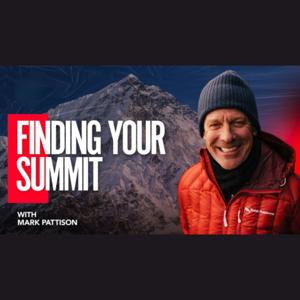
Finding Your Summit

Finding Your Summit

Download on the App Store

Finding Your Summit episodes

  • Leigh Steinberg: CEO and Chairman of the Board at Steinberg Sports and Entertainment in Orange County, California Area talks about reaching
    The First Super Sports Agent who soared to amazing heights representing athletes in the NFL which included the Movie "Jerry McGuire" which was based about the ups and downs of the sports world (Leigh is the real Jerry McGuire) but then his lifewent through an awful period of alcoholism but rebounded in a big way to land the top QB's in the country. Incredible story of coming back..
    57 min
  • Aaron Hale: Former War Hero who was blown up by IED bomb and went blind in Afghanistan discusses his journey of recovery, extraordinary achi
    125: Aaron Hale: Former War Hero who was blown up by IED bomb and went blind in Afghanistan discusses his journey of recovery, extraordinary achievement, and now operating a thriving Fudge business.
    Aaron Hale
    Aaron Hale, before he joined the military, he never saw that lifestyle for himself. “I grew up living a good life, I was a patriot. I loved my country. But didn’t see the military as a career path for me. But a disastrous showing in college, pretty much just living Animal House life. I realised I needed to find direction. I needed discipline and I needed to earn my tuition money back.” Watching friends move beyond him in their progress pushed Aaron towards signing up for military duty. “The problem with natural ability is that eventually it fails you. At some point, your peers in whatever you are doing, surpass you.”
    On this episode of Finding Your Summit Podcast, we talk with Aaron Hale, Former War Hero and Owner of EOD fudge and confections company, discusses the many ways military service pushed him to move beyond his limitations: “Joining the Navy, going into basic training, and the very first thing they said at basic training, it was the instructors, said, ‘Who here has some college experience?’ Only two people, me included, raised their hand. And he pointed at me and said, ‘OK, you are in charge of these 80 recruits.’ On one side of his military experience he learned valuable leadership skills and was able to pursue his passion for cooking. On a more painful level, Aaron lost his eye sight from an IED bomb blast.
    What You Will Learn:
    Aaron Hale talks about cooking on a Navy ship while being a military leader and traveling to Italy: “I would be stationed on-shore in Italy. And when I got off the plane and met my command, I said, ‘Where am I going to be cooking?’ And they didn’t tell me this in school. But, in the Navy, they looked at cooks as the civilian equivalent of hotel restaurant management. They said, ‘No, No, No, on shore we don’t do the cooking. Civilians do that.’ ‘What am I going to be doing?’ ‘You are going to be running the barracks, our version of the hotel.’”
    In 2006, what direction did he want to go to? “I volunteered to be an individual augmentee, basically AirForce and Navy personnel filling in Army roles in Afghanistan. So, I would be cooking, but this time I would be running an Army town hall for a base...So, now instead of the admiral staff of about 25 or so, I was running a huge kitchen of 400, 500, 600, 700 NATO troops.”
    What was it like getting involved in the EOD, Explosive Ordnance Disposal? “The EOD technicians are the military’s bomb squad…I was instantly hooked. The tight-knit brotherhood, the technical aspect of it. The fact that we are first responders. We are there to take hazards off the battlefield. Anything that goes BOOM from bullets to nuclear weapons, we are the first responders.” He was deployed to Iraq, a year later to Afghanistan as an EOD team leader.
    IEDs are explosives are put in the ground with the intention of blowing up vehicles that drive over them, and potentially killing the passengers inside them. Aaron Hale discusses the horrific moment when he was hit with an explosive blast. “It punted me into the sky. I landed on my knees and elbow. Still conscious, but the lights went out. I was tossed into pitch black. Of course, first things first, I wiggled fingers and toes, did a systems, functions check. My knees and elbows seemed to be all intact. The only thing was I couldn’t see a thing.”
    Aaron Hale shares that the IED bomb only hit him in the head. “From the neck down I was virtually unscathed. But, it cracked my skull. I was leaking spinal fluid right out my nose. Blew up both of my ear drums. My right eardrum far worse than my left. There were scars, burns. When an explosion goes off, there is secondary fragmentation, rocks and dirt and everything. That just melted my face. I was pulling rocks out of my gums for days.”
    Learning to be Blind
    How long was Aaron in a place of recovery and did he experience a state of depression? “I thank the powers that be every single day that I didn’t bring back PTSD or depression or those severely traumatic internal wounds of war. And also, in relation to other injuries, I got off pretty easily.”
    Strong family, a lot of support, and being naturally wired to be resistant to depression helped Aaron fight back for his life. He and went to blind school for six months, learning living and manual skills, as well as computer and phone technologies.
    Bacterial Meningitis to EOD Fudge and Confections
    Also during this episode of Finding Your Summit Podcast, Aaron shares how hard it was to overcome bacterial meningitis, “It is a horrible bug. It attacks the brain. To me, it felt like just pouring acid right into your...

    52 min
  • Conrad Anker: Legendary Mountaineer, Filmmaker of Meru, and Discovered George Mallory on Mt Everest
    Host Mark Pattison opens up the show with a quote from his guest Conrad Anker, “We don’t just measure greatest by the peaks that we climb, or the heights we reach, but rather by the positive impact that we create for ourselves, our communities, and our planet. Our goodness to reach each other is what makes us whole, and what endures for generations beyond our physical feats and achievements.”
    53 min
  • Luis Benitez: Challenge yourself and change your world! Pro Mountaing guide, Climbed the 7 Summits multiple times & involved in multiple n
    122: Luis Benitez: Professional Mountain Guide has balanced his life between two countries, Ecuador and the United States, and between mountaineering and being of service to military veterans.
    Luis Benitez
    Host Mark Pattison sums up his new guest Luis Benitez with the quote: “The only thing that isn’t ok is to quit trying.” Luis Benitez grew up in Ecuador and the United States with asthma. But that breathing complication didn’t prevent him from going up the famous Cotopaxi mountain, the second highest summit in Ecuador, which reaches a height of over 19,000 feet: “Spending time in altitude really helps your lungs get stronger. The air is thinner, cleaner, and it forces you to breathe hard.”
    On this episode of Finding Your Summit Podcast, we talk with Luis Benitez, Professional Mountain Guide in Colorado, who takes his role in mountaineering seriously: “You got to put in the work. The thing I love about mountaineering is that it doesn’t matter how big of a check you write to work with a guide in some remote corner of the world, if you are not prepared, and if you haven’t put in the work, it is going to be the biggest waste of money you have ever put on the table. I think one of the things that is so rewarding about mountaineering is, you can’t fake it.”
    What You Will Learn:
    The love of the great outdoors and mountaineering itself began at a young age. It was also connected to his fight against the restrictions of asthma: “The higher we would go, the calmer it would make me. Because those were the things that really kept my breathing in check and kept me calm during an asthma attack as a kid...When I really started getting into mountaineering, it think it was like any other professional athlete that really finds that passion at a young age. It is all consuming. You sleep it, eat it, drink it, live it.”
    Luis Benitez lives up to his own quote: “Challenge yourself and change your world.” But what was it in his life that was the driver behind this message? Luis discusses the importance of human evolution, the need to challenge ourselves to exceed our perceived limitations. “The more advanced we are from a technology standpoint, the more complacent we are with stepping out of our mental and physical comfort zones. It is one of those unique things where technology has brought us so much and has helped so much. But then there is still this thing of human vs. nature.”
    Luis talks about examples of going beyond his limits by talking about his first time on Mount Everest, a mountain he has now been on seven times, with the first blind man to climb it, Erik Weihenmayer. “It was the experience of a lifetime for sure. Thank God for all of us. We said a quiet prayer everyday that, Erik was and is an incredibly capable teammate. So he is not somebody who showed up and expected to be dragged somewhere. He was a very competent and safe climber. Which, we never would have been able to get it done without his level skill.”
    Luis Benitez gets into what it has been like becoming a professional mountain guide who was a part of Adventure Consultants, founded by Rob Hall Into Thin Air who passed away on the top of Mount. Everest. Luis met the successor of the company, Guy Cotter, as well. Into Thin Air is the 1997 bestselling non-fiction book written by Jon Krakauer that covers the 1996 Mount Everest disaster, in which eight climbers were killed on an expedition led by guide Rob Hall.
    Luis Benitez has done the seven summits 32 times. What was the most challenging mountain out of all of them? Find out when he shares it along with picking his hardest trip. He also talks about how no one summited in 2010. “What can makes a mountain challenging varies. The terrain can be great but the team can be awful, and vice-versa.”
    Consulting and Green Space
    Learn about how the consulting side of mountaineering has been like for Luis Benitez, along with his interest in politics and economic development: “I have been lucky enough to grow up within the outdoor industry. I was an outward bound instructor starting when I was 19. My American grandfather owed a sporting goods store. I got into mountaineering in high school, and later on in life, which became my professional career. As you know when you are a guide, you have to be a doctor, lawyer, engineer, priest, rabbi, politician all rolled into one.” Find out how green space can impact are health and daily lives: “Green space does something to your chemical makeup. In your brain and in your body. There is actually direct causality and health benefits to spending time outside. To the point where doctors now in four countries and in three states are legally allowed to prescribe time outside instead of prescribing a course of medication.”
    Warriors to Summits
    Luis Benitez talks about starting his non profit organization Warriors...
    45 min
  • Pastor Richard Dahstrom: His faith was renewed while hiking in the Alps. Now an inspirational Pastor at Bethany Church in Seattle. Big be
    119: Pastor Richard Dahlstrom: Senior Pastor at Bethany Community Church, Author of “The Colors of Hope,” “The Map is not the Journey,” “Breathing New Life into Faith,” and Torchbearer Bible Teacher for Timberline Ministries went from losing his dad at a young age to merging mountains with his ministry. 
     
    Pastor Richard Dahlstrom 
    How exactly did Pastor Richard Dahlstrom develop a love of the mountains? Pastor Richard Dahlstrom grew up right outside of Yosemite in Fresno, California. When he was young, his father experienced severe pneumonia and bronchitis, ultimately taking his life at only 53-years-old. By the time Richard’s father was 40, he had really weak lungs, even after being athletic in his youth and never being a smoker. When he was living, he struggled to elevate beyond 3000 feet without breathing complications. After losing his dad when Richard was only 17, self-care and connecting to the outdoors became even more crucial to him. 
     
    On this episode of Finding Your Summit Podcast, we talk with Pastor Richard Dahlstrom, Senior Pastor at Bethany Community Church, Author of “The Colors of Hope,” “The Map is not the Journey,” “Breathing New Life into Faith,” and Torchbearer Bible Teacher for Timberline Ministries. In fact, “The Map is not the Journey” is about Richard and his wife of 40 years hiking through The Alps for 40 days. He met his wife in a speech class after he relocated to Seattle to study music. “Hiking, rock climbing, and mountaineering are the best teachers of what it means to live a whole life. I really feel like when I’m out there I am learning lessons that can’t be learned anywhere else.” 

    What You Will Learn:
    “My wife and I we started a program, and the best way to describe it would be a blend of bible school and outward bound, where we were integrating bible teaching with rock climbing.” They continued to do this for six years and it just clarified for Pastor Richard Dahlstrom the importance of getting out in the world and directly encountering what God has to say to them through creation and not just by studying text. 
     
    “When God made us, He made us as whole people. We are not just brains. We are not just spirit. We are spirits and we have souls, like a mind and an emotional being and we have a body, and all of those things work together as an ecosystem.” By ignoring the maintenance of either the mind, emotions, or the body, all the others may suffer. We can’t be any good to others if our body is in poor shape. His dad’s death really weighed in on the priority he takes in his health and making the most of each moment. 
     
    “As a pastor, I go, ‘man, both the Jewish tradition and the Christian tradition are filled with passages in the bible that say, ‘we are learning the goodness of God and the glory of God through creation.’ So, that everytime I’m taking a breath it’s gratitude.” He discusses how he has witnessed people skiing that are surrounded by the beauty of nature that God created for us to enjoy. But they were too busy arguing or cursing to allow their spirit to be moved by the experience. 
     
    Pastor Richard Dahlstrom talks about self-care and how he incorporates it into his teachings. “I believe that we are designed to live our life out from a full cup. So, if I have a full cup, and I see you by the side of the road and you are thirsty, then I have the resources to say, ‘Hey Mark, come over here man. There is plenty in my cup. Let me share with you.’ That whole mindset, it creates a mentality of abundance where I go, ‘there is not just enough, there is more than enough.’” In order to live with a full cup with the ability to share requires that we have to live with a full cup emotionally, bodily, and spiritually. 
     
     
    1 hr 1 min
  • Scott Svenson: Co-founder and CEO at MOD Pizza and the Founder and Ex-CEO of Seattle Coffee Company went from creating a coffee company that
    118: Scott Svenson: Co-founder and CEO at MOD Pizza and the Founder and Ex-CEO of Seattle Coffee Company went from creating a coffee company that Starbucks wanted to buy, to starting a pizza company that wants to make the world a better place to live. 
    Scott Svenson 
    Scott Svenson and his wife Ally Svenson are the founders of Seattle Coffee Company that was acquired by Starbucks back in 1998. This company is a company that they grew in the UK, even though they grew up in Bellevue, Washington just outside of Seattle. Scott moved to London with a US investment bank. His wife had a keen sense of everything that London could use, including a Starbucks-style coffee cafe experience. Scott had an investor partner to get involved and soon Seattle Coffee Company was born in the United Kingdom. Over the course of 2 and a half years, Seattle Coffee Company expanded to about 85 locations primarily in the UK, along with partners that opened stores in South Africa, South East Asia, and the Middle East. 
     
    On this episode of Finding Your Summit Podcast, we talk with Scott Svenson, co-founder, and CEO at MOD Pizza and the Founder and Ex-CEO of Seattle Coffee Company. Neither Scott nor his wife and partner Ally had any previous retail or coffee experience when they began Seattle Coffee Company. They just had a really clear vision and a strong belief that failure was not an option. Scott said: “The greatest gift I have had in my personal journey is the fact that I found someone (Ally), we actually went to high school together. We have been together since she was 15 and I was 16. To find that life partner, somebody who is kind of your proverbial better half, who is a great compliment to the way that I look at the world, it has been a total gift.”

    What You Will Learn:
     
    In what ways did Seattle Coffee Company differ from its inspiration, which was Starbucks? Scott explains: “When we decided to do it, we really made it our own and so Seattle Coffee Company really had a very different vibe and personality than Starbucks. We sold a lot more food. It just had a more European, kind of gritty feel to it.” Scott and Ally were initially paranoid about Starbucks coming over to London and taking their market share. They eventually agreed to sell to Startbucks and become their expansion partners in the UK, the Middle East, and Africa. 
     
    What was it like when Starbucks was interested in buying them out? “Orin Smith said to me most directly, he said, ‘we are setting out to build the world’s most loved and enduring brand. And we know to do that we need to be successful in two key markets globally. One is in Tokyo, where we are (they had just expanded into Japan several years before and that was their focus). The other is in London. And that is where you guys (Seattle Coffee Company) are. And so we know if we are going to fulfill our mission, we need to figure out how to work in the UK and we are either going to compete with you or we are going to work with you.”   
     
    There are now over 200 Seattle Coffee Companies licences through Starbucks in South Africa. Scott shares: “I stayed with Starbucks for about 2 years, and while I was here, my primary focus was integrating the businesses, coming up with a plan to transition over all of the sale of coffee companies over to Starbucks, and then putting into place a plan to launch Starbucks into continental Europe.” 
     
    What brought about their move from the UK and to bring their family back to Seattle, Washington? Scott shares: “I will never forget, flying on the plane and looking at my wife Ally and saying, ‘alright, now we have a chance to prove to ourselves whether or not we were just lucky or if we are any good.’ Since we have been back in Seattle has been largely that, bringing to bare all of the things that we learned while we were in the UK.” 
     
     
    51 min

About Finding Your Summit

From the publisher's feed

Finding Your Summit with Mark Pattison explores resilience, leadership, peak performance, and overcoming adversity. Mark is a former NFL player, Seven Summits mountaineer, Mount Everest summiter, Emmy…