
Sign up to save your podcasts
Or

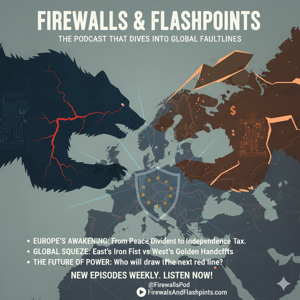


Welcome to Firewall's flashpoints. In "The Day After Forever," we explore a hypothetical 2026 Middle East where a 14-day truce evolves into a grand regional settlement. The episode examines economic integration, shared energy and defense systems, and a corporate-style "Board of Peace" that enforces stability while rebuilding Gaza and rebranding Palestinian territories.
We also analyze the key barriers to this vision: a critical misunderstanding over ceasefire scope, the Hezbollah exception, trust deficits among leaders, and the political incentives shaping the deal. The episode asks whether marketing and economic interdependence can overcome entrenched grievances—or if peace remains a fragile, transactional experiment.
Welcome to Firewall's Flashpoints: this episode explores what it really takes for humans to live in space — from everyday challenges on the ISS like pre-prepared food and precision toilets to the engineering feats that let rockets escape Earth's gravity.
We examine reusable rockets such as SpaceX's Falcon 9, the legacy of Apollo 11, and the prospects for future homes on the Moon and Mars, including recycled air, water, and indoor gardens. Space is shifting from exploration to destination — the episode asks not if, but when, humanity will live off-world.
In this episode we examine the growing U.S.-Iran conflict and how mixed messages from officials—ranging from military objectives to hints at regime pressure—create uncertainty about true strategy.
We explore why ambiguity matters, how it affects markets (especially oil via the Strait of Hormuz), and whether unclear messaging risks escalation or can be managed to achieve political goals.
Firewall's Flashpoints explores shifting AI from military-first uses to human advancement. The episode envisions international cooperation that redirects AI and defense spending toward solving global crises like food security, energy, and disease. Through examples such as precision agriculture, early disease detection, and shared monitoring systems, it argues that true security comes from resilience and open collaboration rather than secrecy and escalation.
Firewall's Flashpoints examines how ordinary people come to commit extraordinary cruelties — step-by-step dehumanization, moral disengagement, shared responsibility, fear, and group pressure that make violence feel normal. It also looks at the rare individuals who refuse: those who keep empathy, trust their moral compass, and risk isolation to save others.
The episode asks a hard question: under pressure, would you follow the crowd or stand alone? Tune in to learn the warning signs of escalation and hear a preview of our next episode on how propaganda creates enemies.
Firewall's Flashpoints examines the shifting global landscape in April 2026: NATO's changing role, the U.S. focus on Iran through Operation Epic Fury, and the risks of relying on bodyguards instead of broader cooperation.
The episode contrasts high-cost military postures with domestic needs—collapsing UK schools, proposed 3.5% defence spending—and argues for redirecting resources toward education, green infrastructure, and equitable international partnerships, including pragmatic engagement with Russia and Africa.
Ultimately it asks who can take the first step toward a less militarized world and whether the United States or Russia is the harder partner to convince in 2026.
In this episode of Firewall's Flashpoints we contrast two uses of human fire—the destructive fires of war that level cities in Sudan, Ukraine and the Middle East, and the creative fires of spaceflight that lift humanity beyond Earth.
We explore how investments in space return economic and humanitarian benefits—moon-driven technologies that became smartphone cameras, water purifiers and medical tools—and argue for redirecting courage and resources toward rebuilding and discovery instead of destruction.
The episode also acknowledges risks like orbital debris and environmental costs, and calls for a new competitive spirit: using lunar-derived tech to rapidly 3D-print hospitals and homes to heal, not shatter, communities.
Firewalls Flashpoints examines the widening gap between political statements and on-the-ground realities in 2026, where international law and institutions are losing authority and conflicts persist despite headlines claiming pauses or peace.
The episode explores multiple theaters—Middle East strikes, Lebanons ground conflict and mass displacement, and Ukraines spring-summer offensive against Russia—highlighting how self-preservation, power politics, and double standards reshape modern warfare.
Welcome to Firewalls & Flashpoints, where we step back from the noise to examine whether current global tensions are leading to World War III.
This episode explains the difference between proxy conflicts and direct great-power warfare, why nuclear deterrence substantially raises the cost of escalation, how the Israel–Iran shadow war and multiple regional flashpoints are being managed, and why strategic neutrality by rising powers matters. Rather than a slide into global war, the real risk today is miscalculation — a single error that could trigger rapid escalation.
Tune in for a concise analysis of the pressures, precautions, and pivotal decisions that will shape whether tensions stay contained or spiral out of control.
Firewall's Flashpoints explores the fault lines created by education policy and student debt in the UK and beyond. This episode examines the 2012 fee hike, the shift from one-time tuition to an inflation-linked repayment system, and the long-term social and economic effects on graduates across generations.
We compare international approaches, reveal how student loans are treated as government assets, and argue that the current system acts like a permanent levy on aspiration—delaying homeownership, family formation, and economic growth. Tune in to understand why this is more than a financial issue: it’s a generational trench war.
From the publisher's feed
Firewalls & Flash-points"is your weekly deep dive into the digital trenches and global fault lines. Hosted by experts who live at the intersection of cyber-security, financial justice, and geopolitical intrigue, this podcast unpacks the stories that shape our connected world.
From dissecting the latest ransomware tactics and zero-day exploits, to exposing the mechanics of charge backs fraud and payment disputes, we bring clarity to the chaos. But we don’t stop at the server room—each episode zooms out to explore how global politics, regulatory shifts, and diplomatic tensions ripple through the tech and finance sectors.
Whether you're a security analyst, policy wonk, or just someone who wants to understand how cyber-crime and international affairs collide, Firewalls & Flash points delivers sharp insights, bold commentary, and actionable takeaways.
🔐 Cybersecurity
💳 Chargebacks & Financial Disputes
🌍 Geopolitics & Current Affairs
🎧 All in one feed