
Sign up to save your podcasts
Or

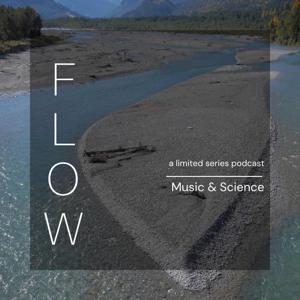


Heather Spence is a marine biologist, musician, and composer based in Washington, DC, who spends much of her research life recording and interpreting underwater soundscapes, work with dolphins and coral reefs among it. Her music draws directly from that world, built around natural sound and what she describes as a celebration of listening to the natural world and finding our place in it. For Flow, that practice found an unexpected match: a river, rather than an ocean, still asking the same questions about water and what moves beneath its surface.
Heather is something of a special case in this project. Rather than one segment, she ended up working on two, and the two pieces she made couldn’t sound more different from each other.
Flow is a project by Dr Martina Cecchetto, with the scientific contribution of Dr Florian Betz and the artistic curation of Riccardo Fumagalli, in collaboration with Cities & Memory, the University of Padua (Italy), and the University of Würzburg (Germany).
TYΦA are Laura Jean Cameron and Matt Rogalsky, a duo based in Kingston, Ontario, Canada. Laura Jean is a sonic geographer and professor at Queen’s University; Matt is a composer and sound artist who leads the Sonic Arts Studio at the same institution. Their practice begins with cattails — the marsh plant whose scientific name, Typha, gives the duo its name — hand-woven into cordage strings that are plucked, bowed, and made audible through contact microphones.
For Flow, they worked on Segment 14 of the River Lech — the Litzauer Schleife, one of the very few remaining stretches of the German Lech that approximates a natural riverscape, and one whose protection carries a history considerably more complicated than it first appears.
Paweł is a musician and sound artist based in Southampton, UK, who records and performs under the name Canis Arboris. His practice moves between electro-acoustic composition, field recording, and a quiet attentiveness to the way places, objects, and time leave traces in sound.
For Flow, he worked on Segment 11 of the River Lech — the stretch passing through Füssen, where the river crosses from Austria into Germany and leaves the mountains behind. Füssen is known to most visitors for Neuschwanstein castle, visible on the hillside above the town. What fewer people know is that it is also home to a centuries-old tradition of violin making — the Geigenbauer, craftsmen who have been shaping wood into instruments in this town since the Renaissance, when Füssen was one of the most important centres of lutherie in Europe.
But Paweł’s connection to this segment of the river predates the project entirely. In our short interview, followed by his music, he will explain how, and why his piece is called Tukan.
Flow is a project by Dr Martina Cecchetto, with the scientific contribution of Dr Florian Betz and the artistic curation of Riccardo Fumagalli, in collaboration with Cities & Memory, the University of Padua (Italy), and the University of Würzburg (Germany).
In this episode we’re talking with Daina Dieva, an artist and anthropologist working between sound, video, performance, and ethnographic fieldwork. Her PhD research, conducted at the University of Tartu, took her to the Roya Valley, on the French-Italian border, in the aftermath of Storm Alex, the storm that tore through the region in 2020. She arrived the following summer, when the debris had mostly been cleared but the damage, in every other sense, was still unfolding.
She had planned to keep her two practices apart. Anthropology on one side, art on the other, a boundary meant to give her somewhere safe to retreat to in an overwhelming field, but it didn’t hold. Over months of fieldwork in a landscape still absorbing the shock of the storm, her artistic practice stopped being a refuge from the research and became a way of doing it.
Flow is a project by Dr Martina Cecchetto, with the scientific contribution of Dr Florian Betz and the artistic curation of Riccardo Fumagalli, in collaboration with Cities & Memory, the University of Padua (Italy), and the University of Würzburg (Germany).
Michael Northam is an American sound artist based in Chino Valley, Arizona, who has been exploring sound-as-art across more than 30 countries for the past 30 years. He describes his practice as “composting sounds” — re-framing surroundings through a combination of natural sound phenomena, synthesis, and found objects to create location-based work that slows down time and listens deeper to what he calls the mysterious otherness lurking under our collective noses. His website is Orogenetics, a word that combines orogeny, the geological process of mountain formation, with genetics: the study of how things inherit what came before them.
For Flow, he worked on Segment 10 of the River Lech — the Lech Falls near Füssen, where the river passes through a gorge on the border between Austria and Germany. What he received was a field recording that contained almost nothing he expected. No water. Only footsteps, handling noise, distant vehicles, a fragment of a human voice. A recording so shaped by human presence that the river itself had disappeared from it entirely.
Flow is a project by Dr Martina Cecchetto, with the scientific contribution of Dr Florian Betz and the artistic curation of Riccardo Fumagalli, in collaboration with Cities & Memory, the University of Padua (Italy), and the University of Würzburg (Germany).
Rocío Colonizt is a sound designer and field recordist based in General Roca, in the province of Río Negro, Argentina. She holds a degree in Sound Engineering and a Bachelor’s in Audiovisual Arts, and works primarily in sound design for film, video art, and video games — alongside a practice in field recording and soundscape composition.
She grew up ten kilometres from the Río Negro, the river that gives both her province and her city their name. It is a place she returns to throughout the year, a landscape she loves and is actively working to protect from pollution. When she encountered the River Lech, that proximity — to a river that is simultaneously beautiful, threatened, and personal — shaped everything about her response.
For Flow, she worked on Segment 3 of the River Lech, near Stockach — a stretch characterised by alternating sediment bars and restoration measures including channel widening for habitat creation. She brought the Lech and the Río Negro into the same composition, layering a recording made inside her own river against the field recording from Bavaria. Two rivers, one piece, a single question about what it means to listen to water from the inside out.
Her composition is called Confluencia lejana — Distant Confluence.
Flow is a project by Dr Martina Cecchetto, with the scientific contribution of Dr Florian Betz and the artistic curation of Riccardo Fumagalli, in collaboration with Cities & Memory, the University of Padua (Italy), and the University of Würzburg (Germany).
Jorge Martínez Valderrama is a Mexican composer and sound artist based in Mexico City. His background is in classical composition, string quartets, chamber ensembles, the discipline of writing for live instruments, but he has moved steadily toward acousmatic work, where fixed media and field recording become the primary material. For Jorge, a recording is never a neutral act. Where to point a microphone, when to press record, what to do with the sound afterwards… these are always conscious choices, and in Mexico City, where certain places carry real political complexity, they are sometimes consequential ones.
For Flow, he worked on Segment 23 of the River Lech, the stretch just beyond Augsburg where the river is split in two: on one side a canal running through a former hydropower station, now a museum; on the other, a channel that is still constrained but visibly alive, moving, breathing, trying to find its own course. The field recording was taken on the more natural half, where a family was playing on the gravel and a child was throwing pebbles into the water, shrieking with excitement.
That child made it into the final composition.
Cuando el cauce recuerda (When the Riverbed Remembers) will be presented at the Sonidario in Mexico City, a dedicated listening space at Los Pinos (the former presidential residence) fitted with 46 speakers in fifth-order ambisonics. The piece that began beside a river in Bavaria will be heard in three dimensions, in a room designed for exactly this kind of listening.
If you’re enjoying this, consider subscribing. I’ll email you the next episodes
Cuando el cauce recuerda (When the riverbed remembers) is a piece created for the Flow project, which focuses on exploring the presence and memories of water in different territories. The work stems from a field recording made on the Lech River, on the outskirts of Augsburg. It is in this stretch of the river where the landscape opens up again: the riverbed reclaims space and its sound expands.The work is situated in a sonic territory that navigates between soundscape and electroacoustic music and suggests, through an everyday moment—a scene of encounter between nature, industrial memory, and community life—that it constitutes the initial material of the composition.The field recording underwent a spectral analysis process that allowed for the separation of different sound components. Each of these layers was subsequently transformed using various sound processing and synthesis techniques, including temporal stretching, filtering, and spectral manipulations. From these operations, new textures, densities, and perspectives of the original material emerged, generating an expanded auditory field.Rather than simply reconstructing the place in a documentary style, the piece seeks to explore its latent resonances. Processed fragments of the river and the sound of voices are transformed into sound currents themselves, revealing invisible or inaudible layers of the environment.In this sense, water appears as a form of song that is heard again after having been silenced. When the river returns, it is thus an invitation to listen attentively, to resonate with the flow of the landscape, and to recover, through play and sonic imagination, our sensitive relationship with rivers.
- Jorge Martínez Valderrama
Flow is a project by Dr Martina Cecchetto, with the scientific contribution of Dr Florian Betz and the artistic curation of Riccardo Fumagalli, in collaboration with Cities & Memory, the University of Padua (Italy), and the University of Würzburg (Germany).
Nick Kuepfer is a musician, field recordist, and sound designer based in Montreal, Canada. His practice moves between nylon string and electric guitar, live-sampled tape loops, field recordings, and analog processing — a methodical, vigilant experimentalism guided by the search for consonance and dissonance with the sounds of the natural world. He has recorded the intimate sounds of Alaska’s permafrost thawing, glacial calving off the coast of Svalbard, the creaking forests of Tierra del Fuego, and the amphibian soundscapes of Costa Rica. He has done sound design for Austrian filmmaker Michaela Grill and is a member of A Common Collective, a Canadian artists’ collective producing immersive audio-visual installations.
Read more on artmusicscience.substack.com
Flow is a project by Dr Martina Cecchetto, with the scientific contribution of Dr Florian Betz and the artistic curation of Riccardo Fumagalli, in collaboration with Cities & Memory, the University of Padua (Italy), and the University of Würzburg (Germany).
Lisa Rae Bartolomei is a composer and sound artist based in Melbourne, Australia. Her work explores the boundaries between acoustic and electronic sound, often using transformation as both method and metaphor — taking a source material and pulling it so far from its origins that something entirely new emerges in its place.
For Flow, she worked on Segment 6 of the River Lech — the hanging bridge at Forchach, a stunning suspension structure that arches over the most braided and dynamic stretch of the entire river, in the heart of the Naturpark Tiroler Lech. People walk across it, and occasionally cycle despite the prohibition, and their passage makes the steel cables vibrate like the strings of a giant instrument.
That image — a bridge as instrument, a crossing as sound — became Lisa’s entry point. Living on the other side of the world, she allowed the River Lech to exist for her as something between a landscape and an abstraction, a place known only through recordings and images. The bridge felt like a liminal space, neither here nor there, suspended between worlds the way the river itself hangs between its alpine origins and its eventual dissolution into the Danube. She used Omnisphere to play the bridge cables like a piano, building a composition in which every sound traces back to the original field recording — transformed, stretched, processed beyond recognition, yet rooted in the same source. The water, she says, is mysteriously absent. Just outside the frame of the piece. Always there, never heard.
Flow is a project by Dr Martina Cecchetto, with the scientific contribution of Dr Florian Betz and the artistic curation of Riccardo Fumagalli, in collaboration with Cities & Memory, the University of Padua (Italy), and the University of Würzburg (Germany).
Karhide and Deep Dive Sound collaborated on Segment 20 of the River Lech, near Königsbrunn — a channelised stretch dammed for hydropower, heavily modified, and without restoration plans. The same paradox that struck Elissa Goodrich in the same segment: a landscape shaped entirely by human intervention that has nonetheless become a refuge for nature.
But where most artists stayed close to the River Lech, Rafa was in Africa when the project arrived. Rather than treating that distance as an obstacle, they turned into a creative advantage. The Lech became a template, a way of thinking about any river, any ecosystem, any place where water gathers life around it. Field recordings from African rivers found their way into the piece: not as decoration, but as a reminder that the questions the project asks about the Lech are not specific to Bavaria. They belong to every river that has ever been dammed, redirected, or simply listened to.
Low-Fi River Flow is the result — a piece built from that expanded geography, and from a shared conviction that a river is never just water.
Flow is a project by Dr Martina Cecchetto, with the scientific contribution of Dr Florian Betz and the artistic curation of Riccardo Fumagalli, in collaboration with Cities & Memory, the University of Padua (Italy), and the University of Würzburg (Germany).
From the publisher's feed