
Sign up to save your podcasts
Or



Send us Fan Mail
Episode 8 explores "Annie's Granddaughter" (Part 2), and delves deeper into the narrative of the protagonist, Zara Vrabel, as she finds herself confronted by her own personal history while trying to unravel the enigmatic past of the lost branches of her family tree.
Zara grapples with her bewildering familial background--and the Eastland Disaster. While doing this, she gains a fresh perspective on her parents' initial struggles—a tale of embarking on a new life armed with 40 dollars, a couple of orange crates, and a dilapidated jalopy.
However, fully comprehending the weight of this complex history proves a lengthy and arduous expedition, leaving Zara uncertain if she is truly prepared to face it all.
Music:
Sojourner - Ardie Son (Artlist)
Send us Fan Mail
Welcome to this special mini-episode of the podcast, where I want to recognize the incredible work of Miblart, a book cover (and more) design company based in Ukraine. Miblart created the cover for my book, Flower in the River, and they did so in the midst of the horrific invasion of their country.
Despite the danger and uncertainty, the team at Miblart worked tirelessly to create a beautiful and compelling book cover that captured the essence of the book.
Their dedication to their craft and their commitment to delivering exceptional work in the face of adversity is beyond inspiring. I cannot thank them enough for contributing to this project, and wanted to acknowledge their efforts publicly.
Thank you, Miblart, for your outstanding work and for reminding us that even in the darkest of times, creativity and beauty can still thrive.
Дякую, Мібларт. Слава Україні!
Links:
Music:
Shchedryk (Carol of the Bells) - Instrumental - Wikimedia Commons Українська: Щедрик (Колядка дзвонів)
Різдво Христове - Колядки.
Send us Fan Mail
Episode 6, Annie's Granddaughter (part 1), opens in 1997-- this is 82 years after the Eastland Disaster of 1915. When we meet the protagonist, Zara Vrabel, she is asleep--literally and figuratively. Since a career as a professional somnambulist wasn't viable, she staggered through each day. However, she's about to get an epic wake-up call when she learns of her family's tragic history.
We'll explore other topics too. For example, what do three seemingly disparate works-- the classic horror film, The Mummy (1932), the popular TV series Charmed (1998-2006), and my book, Flower in the River--have to do with one another? You'd be surprised. I know I was.
And you'll also meet some new characters in this chapter, including a guy who may still be the world's only Slovak-Rusyn Singing Cowboy!
So come along as we explore the intricate web of connections between past and present and discover the deep insights they offer into the eternally mysterious human condition. Let's dive in!
Link:
The Park Bugle. In this episode, I reference the St. Paul community newspaper that I (as well as my fictional counterpart) once wrote for and want to give them a shout-out!
Music:
Send us Fan Mail
This episode spotlights two small towns you probably have never heard of (1) Sycyna, Poland, and (2) Fall Creek, Wisconsin. These locations are featured in Flower in the River (and Fall Creek is called Falling Brook).
Sycyna, Poland, was home to my great-grandmother, Bertha. She was in the middle of a love triangle, an arranged marriage, and an ex who just couldn’t quit her and followed her across the ocean. And they say, “Nothing much ever happens in small towns!”
Bertha’s mother (and yenta-wannabe), Maria, also left Sycyna but immigrated to Fall Creek, Wisconsin (population around 1,200). The residents of this rural community worked the land, built up the town, established schools, churches, and a lot more.
Fall Creek was a happening place in the late 19th century thanks to the railroad and the thriving lumber industries. Then, in the early 20th century, many farmers specialized in dairy farming, and the village became a hub for dairy production and processing. Oh, and they came together and wrote a book-- a 140-page history of their village. That book, Sights and Sounds of the Valley, a history of Fall Creek, seemed to wait patiently for me in a kiosk inside the Fall Creek Bank. I drove there when I realized I had unwittingly moved very close to an ancestral hotbed (or Mothership, as I’ve often called it).
I wondered if every small town in Western Wisconsin came with a book, but so far, Fall Creek is the only one. And, if there’s such a thing as “family historian/writer DNA,” I think I inherited that from this branch of the family tree.
Music from Artlist
The BOOK and more
Send us Fan Mail
"The Pfeiffer children heard it first from neighbors who heard it from other neighbors who heard the Newsies screaming in the streets. What they heard was some version of this story, picnic ship capsized in the river with people aboard!" Chapter 1. A Family Tale Untold. Flower in the River. Natalie Zett
This episode includes two passages from A Family Tale Untold, which opens with the death of Martha Pfeiffer, a victim of the Eastland Disaster of 1915. But don't worry. She doesn't stay dead for long. You'll meet the rest of the family and get a sense of who they were through the lens of earlier times.
Also, some readers and former writing students asked me for the secret sauce of writing a book like this. It's easy! I'm resisting inserting a smiley face emoji, so I'm hoping you know not to take the "easy" reference as literal.
Secret Sauce for Writing a Family History (adapt for your own situation)
This is about as detailed as my Slovak grandmother's recipes ("Put in some of this, a little of that, and make stove hot!"), but if you experiment, you can do it!
Come Back Home, Ardie Son, courtesy of Artlist
Twilight, 8opus, courtesy of Artlist, (Intro and Outro)
Send us Fan Mail
We can't discuss the Eastland Disaster of 1915 without introducing Western Electric--the company that sponsored the ill-fated employee picnic where 844 were killed in the Chicago River.
Western Electric's impact on Chicago was immense during its prime. From providing employment opportunities to stimulating the economy, Western Electric significantly impacted the region. It offered jobs that helped people build better lives for themselves and their families. This not only improved the quality of life in the region but also helped spur economic growth in the area.
Listen in to get a brief overview of Western Electric's history--the company may be gone, but its influence continues.
To learn more:
Send us Fan Mail
"Stories may remain untold, but they are hardly lost, only misplaced for a time. The blood travels like a river through the body, and it remembers, it always remembers." --Flower in the River, Chapter 1, A Family Tale Untold.
This episode opens on the worst day of my maternal grandmother's life--the day of The Eastland Disaster. The day when her nineteen-year-old sister was killed--along with 843 others.
When an epic tragedy seems to disappear from the memories of families, a city's consciousness, and history in general, the question is, why? I promise no answers--easy or otherwise. But, I have some ideas. So, come along with me and let me know what you think.
To learn more about July 24, 1915
Send us Fan Mail
Hello there!
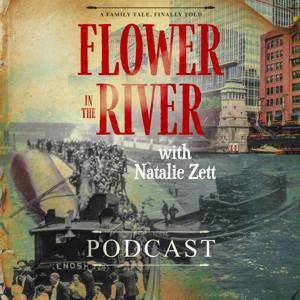
This podcast, or maybe "book-cast," centers around my book, Flower in the River, which opens with the Eastland Disaster of 1915 (in Chicago), where 844 perished.
The book describes how losing a relative during that tragedy affected my family for generations. Although it's historical fiction, it's based on the actual events and the real people who populate my family tree. Sometimes, the truth can be told best via fiction.
The inspiration for the podcast came from the comments and questions I've received since the book was released.
In this first episode, I will share the wacky journey of how I became a family historian -despite being told by a teacher that since my family didn't arrive on the Mayflower, I had no family history. Yep, you read that right.
From the publisher's feed
"Flower in the River" podcast, inspired by my book of the same name, explores the 1915 Eastland Disaster in Chicago and its enduring impact, particularly on my family's history. We'll explore the…