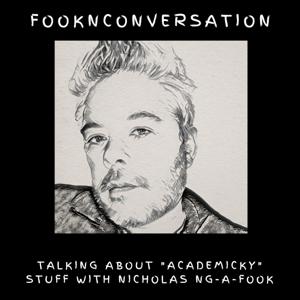
Fookn Conversation - Talking About “Academicky” Stuff

Fookn Conversation - Talking About “Academicky” Stuff

By Nicholas Ng-A-FookEducation
Download on the App Store

Fookn Conversation - Talking About “Academicky” Stuff episodes

  • Dr. Nichole Guillory
    In Episode 45 Dr. Ng-A-Fook interviews Dr. Nichole Guillory, a Professor of Curriculum and Instruction in the Department of Secondary and Middle Grades Education and an affiliated faculty member in the Interdisciplinary Studies Department at Kennesaw State University. She currently teaches courses in family and community engagement in teacher education and Black feminism in interdisciplinary studies. Drawing on Black feminist theory and curriculum theory, her research focuses on Black mothering as a form of justice work. We discussed some of the following issues: Black mothering praxis and legacies, theorizing lament, sustaining our mental health and well-being during a Global Pandemic, working at predominantly white institutions, plantation politics, intersectionality, weaponizing course evaluations, disrupting Black mothering tropes, intergenerational narratives as arcs of resistance and hope, Black mother memoirs and public grieving, hip hop feminist theory, and so much more.
    1 hr 6 min
  • Dr. Amal Madibbo
    In Episode 44 Dr. Ng-A-Fook interviews Dr. Amal Madibbo an Associate Professor in the Department of Social Justice Education at the Ontario Institute for Studies in Education. Dr. Amal Madibbo shares her insights about Blackness and La Francophonie. We discussed some of the following issues: her research projects in Italy, Sudan, and Louisiana, cosmopolitan citizenship, intersectionality of anti-Black racisms, African Francophone immigration, Black feminist theory, critical race theory, critical multicultural theory, linguicism, history of international and Francophonie communities here in Canada, reverse inclusion, intergenerational structural, systemic, and individual racisms, international, national, and local contributions of diasporic Black Canadian scholars’ intellectual and political work, strategic nationalism, negotiating multiple minority identities, living and working as agents of decolonization, social justice, and so much more.

    51 min
  • Dr. Heather McGregor
    In Episode 43 Dr. Ng-A-Fook interviews Dr. Heather McGregor an Assistant Professor within the Faculty of Education at Queen’s University. Dr. Heather McGregor shares her insights about history education, settler colonial studies, urgency for us to address climate change, and the Anthropocene. We discussed some of the following issues: negotiating current contexts of COVID-19 pandemic, RSV, and flu season with our kids, curriculum theory, growing up in Iqaluit, holistic approaches to teaching and learning, wicked problems, decolonizing historical consciousness, witnessing Arctic encounters with the more-than-human world, ethical relationality, continuity and climate change, questioning the role of history education, Students on Ice, historical consciousness and thinking, radical conceptions of hope and pedagogy, addressing truth and then reconciliation with Indigenous and non-Indigenous northern youth, and so much more.
    56 min
  • Dr. Ardavan Eizadirad
    In Episode 42 Dr. Ng-A-Fook interviews Dr. Ardavan Eizadirad an Assistant Professor within the Faculty of Education at Wilfrid Laurier University. He is also the Chair of the Equity, Diversity, Inclusion, and Indigenization (EDI&I) Coalition. He is a community activist with the Youth Association for Academics, Athletics, and Character Education (YAAACE). Dr. Ardavan Eizadirad shares his insights about equity, diversity, and inclusion particularly standardized testing, community engagement, anti-oppressive practices, resistance, subversion, and decolonization. We discussed some of the following issues: Canadian Union of Public Employees political resistance, Ontario government’s (mis)use of “Notwithstanding Clause,” a livable wage, research as advocacy and awareness, centering voices of equity deserving groups, disrupting cultural capital of whiteness, decolonizing assessment, tattoos, immigration, civic protests in Iran, and so much more.
    55 min
  • Dr. Jennifer MacDonald
    In Episode 41 Dr. Ng-A-Fook interviews Dr. Jennifer MacDonald, an Assistant Professor at University of Regina's Faculty of Education. Dr. Jennifer MacDonald shares insights about her research on social change, ecological healing, and wayfinding. We discussed some of the following issues: navigating transitions in life, as a doctoral student to Assistant Professor, and to a new place, teaching with the land, protocols for cultivating relations with place as a living curriculum, walking, wayfinding, mapping, canoeing, attuning to the more than human world, unlearning and learning as non-Indigenous educators with Elders, slowing down, the flow of being together as kin on the land, reconceptualizing relational conceptions of spirituality in outdoor education, rituals of inquiry, gifting, kinship relationships, and so much more.
    1 hr 1 min
  • Dr. Jennifer Tatebe
    In Episode 40 Dr. Ng-A-Fook interviews Dr. Jennifer Tatebe, a senior lecturer at Auckland University’s Faculty of Education and Social Work. Dr. Jennifer Tatebe draws her different sociological and educational research expertise to share insights on hers and others lived experienced during the COVID-19 Pandemic in Aotearoa New Zealand. We discussed some of the following issues: navigating pandemic protocols in Aotearoa New Zealand, rurban sociological studies, educational impacts of immigration and housing policies for rural schools, transitional tensions for school leaders and teachers, social justice, addressing poverty, equity, and inclusion within the financial literacy curriculum, negotiating the gauntlet of tenure and promotion in higher education, and so much more.
    58 min
  • Dr. Jennifer Markides
    In Episode 39 Dr. Ng-A-Fook interviews Dr. Jennifer Markides an Assistant Professor at the University of Calgary. Dr. Jennifer Markides shares her insights as a Métis scholar in relation to the 2013 High River flood and during the current COVID-19 Pandemic. She received the 2021 Dissertation Award from the Canadian Association of Curriculum Studies for her doctoral study, titled “Wisdom and Well-being Post-Disaster: Stories Told by Youth.” We discussed some of the following issues: youth led research, impacts of natural disasters on the mental health and well-being of youth, rethinking the school curriculum, counterstories, radical listening, creating respectful and ethical relations with the more-than-human world, each other, holistic conceptions of living well, Montessori philosophy, sharing power, identity politics, Métis scholarship, and so much more.
    1 hr 7 min
  • Dr. Rob Helfenbein
    In Episode 38 Dr. Ng-A-Fook interviews Dr. Rob Helfenbein a Professor of Curriculum Studies in the Tift College of Education at Mercer University. Dr. Rob Helfenbein draws on research as a critical geographer and curriculum theorist to share his insights on his lived experience during the COVID-19 pandemic. We discussed some of the following issues: American Association for the Advancement of Curriculum Studies (AAACS), transitioning to a new place, Black Lives Matter uprisings in Baltimore implications for scholars, political landscape in Georgia, unsettling beliefs in teacher education, cultural studies, spatial thinking, banning of teaching divisive concepts in public schools, new materialism, posthumanism, intellectual and critical geographies of historical and contemporary racialized and material segregations, time, space, and place, Bergamo Conference, living in the shadows of “freedom,” and so much more.
    57 min
  • Dr. Celia Haig-Brown
    In Episode 37 Dr. Ng-A-Fook interviews Dr. Celia Haig-Brown a documentary filmmaker and Professor at York University. Dr. Haig-Brown draws on decolonizing approaches to share her insights on what we might learn from, and with, different First Nations communities. We discussed some of the following issues: Ukrainian-Russian conflict, COVID-19 Pandemic, lived experiences with Indigenous teacher education programs, teaching and learning with First Nations mothers, challenges of documentary filmmaking as SSHRC-funded research, Listening to the Land, Resistance and Renewal, collaborating with the Naskapi Nation and different filmmakers, film editing, decolonizing university research ethics policy and procedures, troubling non-Indigenous researchers positionalities, future collaborations with families who have intergenerational relations with the Kamloops Residential School, and so much more.
    52 min
  • Dr. Patricia Liu Baergen
    In Episode 36 Dr. Ng-A-Fook interviews Dr. Patricia Liu Baergen an Assistant Professor at Thompson Rivers University. Dr. Patricia Liu Baergen draws on her research in the areas of educational philosophy, curriculum studies, and life history to share her insights on intellectual works of Dr. Ted Tetsuo Aoki. We discussed some of the following issues: negotiating the 4th wave of the Pandemic, impact of the flooding in British Columbia, teaching, her recent book Tracing Ted Tetsuo Aoki’s Intellectual Formation, phenomenology, temporal movements of Dasein, internal and external biographical situatedness, isness of “curriculum-as-lived,” limits of instrumentalism, bridging a bridge that is not a bridge, and so much more.
    58 min

About Fookn Conversation - Talking About “Academicky” Stuff

From the publisher's feed

How are we talking about the “academicky” stuff that informs our lived experiences? In response to such questions, Dr. Nicholas Ng-A-Fook invites you to delve deeper into the lives and thinking of…