
Sign up to save your podcasts
Or

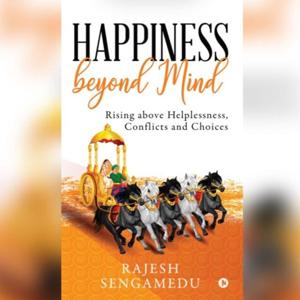


We continue on our musings on what is right, what is wrong. Who would decide? How should we decide?
In this short discussion, we discuss a Q&A about what is ethical living.
How to decide what is right or wrong?
We start with defining desire and understanding the meaning of happiness = no desires.
We then separate out and understand how to reconcile the difference between the end goal of 'no desires' with 'what to do when we have desires'.
We discuss karma yoga concepts again - the idea of 'prasada buddhi' - of acceptance.
Examples from work life, home life and how to handle conflicts, likes & dislikes are discussed from our personal examples.
In short, this is a good discussion on karma yoga, likes & dislikes, desires...
We are connecting the dots...and articulating with solid personal examples to nail down concepts like: desire, attachment /detachment, work without desire, karma, karma yoga, attitude, Prasada Bhavana, pratipakshabhavana, likes/dislikes (I prefer the Sanskrit word - raga & dwesha - attachment & repulsion, as a rough translation).....
We also talk of a way to measure our progress in the form of a formula FIR - Frequency of incidents, Intensity of incidents, the Recovery period from the incidents that cause mental agitation for us as a clear indicator that we are following karma yoga in our lives.
Note: For non-Hindi language speakers, we have used a word, 'karela' in the discussions - it is a vegetable, bitter-gourd.
In these lines, Sankara explains that the entire universe is seemingly real, as much as a snake is 'seemingly real' when we mistakenly look at a rope.
The snake 'manifested' on the rope for our mind because we saw it wrongly - likewise the universe 'manifested' and is 'real' for us when we see it incorrectly. This causes us samsara.
The snake appears not because of the rope - but because of our ignorance. Likewise, the world appears not because of Brahman but because of our ignorance.
And, in the concluding verse 4, Sankara says that the person who recites these three slokas everyday will achieve supreme bliss of knowledge to recognize 'real' from 'unreal'.
Note: My talk starts from time 06:25 after introduction by my company's HR and a colleague who attends my meditation program online.
This is a 30min talk I gave at my company as part of Mindfulness@Work Initiative by our HR. Every Friday, I will be leading a virtual seated yoga, deep breathing & meditation practice to my colleagues (& their family members) during these uncertain and difficult times of Covid 19.
Despite being millionaires (our lungs have ~300million alveoli), we don’t use the ‘wealth’ we have been bestowed by nature.
Our breathing is shallow & we breathe too fast which is inefficient and causes respiratory diseases. This is because of our faulty breathing habits. Stress, type of food we eat, incorrect posture and most importantly, just ‘forgetting’ how to breathe right are the main reasons.
Here are the slides from my #mindfulness at work presentation done to Altran colleagues on Friday.
It will be useful for you to go through them while listening to this talk:
https://drive.google.com/file/d/1uPfBGhdtJakBswWJ-u1BPZRF5LtEKAXp/view?usp=sharing
It’s important for you to note:
1. Peak lung capacity is ~5litres and we normally use ~15% of this capacity!
2. We breathe fast and shallow.
3. Compare the life spans of different species and the corresponding breaths/minute.
Does it make sense to learn how to breathe deeply and take fewer breaths/minute to improve immunity & not only ward off respiratory diseases but also increase our life span?
Every Friday Altran colleagues will learn how to get more flexible, breathe right & meditate and improve immunity & flexibility - all virtually!
I would love to hear your comments,
From the publisher's feed