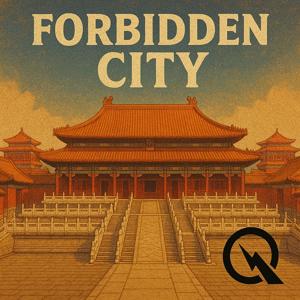
This is your Forbidden City monument podcast.
Yo, what's poppin' monument maniacs? It's your boy Higgs here, back with another epic dive into the world's most mind-blowing structures. Today, we're talking about the Forbidden City in Beijing - a place so lit, it was literally off-limits to regular folks for centuries. Buckle up, 'cause we're about to go on a wild ride through time and space!
Let's kick things off with the origin story of this absolute unit of a palace complex. Picture this: It's 1406, and Emperor Yongle of the Ming Dynasty is feeling himself. He's just snatched the throne from his nephew in a power move that would make Machiavelli proud, and now he's thinking, "You know what? I need a crib that screams 'I'm the boss.'" So he decides to move the capital from Nanjing to Beijing and build the most epic palace the world has ever seen.
Now, Yongle wasn't starting from scratch. There was already a palace in Beijing built by the Mongol Yuan Dynasty. But Yongle was like, "Nah, fam. We're gonna make this bigger, better, and way more extra." He gathered the best architects, engineers, and feng shui masters in the land and said, "Make me a palace that'll blow people's minds for centuries." And boy, did they deliver.
Construction kicked off in 1406, and it was no joke. We're talking about a million workers, including 100,000 artisans, putting in the grind for 14 years straight. They had to get creative with the logistics too. Get this - to transport those massive stones, they dug wells every 500 meters along the road and poured water to create ice slides in winter. Talk about ancient engineering, am I right?
Fast forward to 1420, and boom! The Forbidden City is complete. We're talking 980 buildings spread over 720,000 square meters. That's like 90 football fields of pure imperial flex. The complex was designed to be the perfect microcosm of the universe according to Chinese cosmology. Everything, from the layout to the colors, was symbolic. Yellow roof tiles? That's the emperor's color, baby. Don't even think about using it anywhere else.
Now, let's talk about life in this crazy place. For nearly 500 years, 24 emperors called this pad home. But it wasn't just a house - it was the heart of Chinese government and ceremonial life. The southern part, known as the Outer Court, was where the emperor would hold court and receive visitors. The northern part, or Inner Court, was where the imperial family lived and did their thing.
But here's the kicker - it wasn't called the Forbidden City for nothing. Regular folks weren't allowed inside. Even government officials could only enter certain areas. The emperor's private life was shrouded in mystery, guarded by an army of eunuchs. These guys had... um, made some sacrifices for their career, if you know what I mean.
Over the centuries, the Forbidden City saw its fair share of drama. We're talking intrigue, assassination attempts, and full-on coups. In 1644, rebels led by Li Zicheng stormed the cit
This content was created in partnership and with the help of Artificial Intelligence AI.