
Sign up to save your podcasts
Or

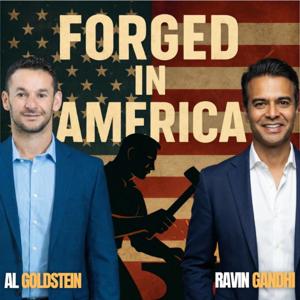


David Hornik & Eric Carlborg: Why Silicon Valley's Biggest VCs Have Lost Their Way
Is venture capital still about backing great entrepreneurs—or has it become a giant money-moving machine?
This week on Forged in America, Ravin Gandhi and Al Goldstein sit down with David Hornik and Eric Carlborg of Lobby Capital, veteran venture capitalists who have spent decades investing in startups, navigating market crashes, and competing against Silicon Valley's biggest firms.
Hornik doesn't hold back. He argues that mega-funds like Andreessen Horowitz have fundamentally changed the venture capital business, questions whether today's AI leaders are using fear to protect their competitive advantages, and reveals why he turned down investments in Facebook, Twitter, LinkedIn, Palantir, and Datadog.
The conversation also gets personal. Hornik and Carlborg recount how they offered to back Al with $50 million before Avant even existed, what happened when the fintech boom collapsed, and how decisive leadership helped the company survive.
In this episode:
Venture capital's identity crisis: Why Hornik believes Silicon Valley's largest funds are no longer practicing traditional venture capital.
The investments that got away: How Hornik passed on Facebook, Twitter, LinkedIn, Palantir, and Datadog—and why he stands by those decisions.
The $50 million bet on Al Goldstein: How two investors backed an entrepreneur before he even had his next business idea.
Surviving the startup death spiral: Why founders must act decisively when capital disappears—and why incremental layoffs can destroy a company.
AI hype and regulatory capture: Hornik's provocative argument that some of AI's loudest warnings come from the people with the most to gain.
The future of education: What AI means for students, universities, and the skills that will matter most.
Small versus giant VC funds: How Lobby Capital competes with Andreessen Horowitz and Sequoia by prioritizing relationships over assets under management.
What makes a great founder: Why obsession, resilience, intellectual honesty, and problem-solving matter more than chasing a billion-dollar valuation.
From billion-dollar exits to painful missed opportunities, this conversation offers an unfiltered look at how Silicon Valley really works—and why the best investors sometimes succeed by refusing to follow the crowd.
About the guests
David Hornik is a longtime venture capitalist, early pioneer of VC blogging and podcasting, and investor at Lobby Capital. He has also taught entrepreneurship and venture capital at Stanford and Harvard.
Eric Carlborg is a veteran investor at Lobby Capital and former partner at August Capital. He has backed numerous technology companies, including Al Goldstein's Avant, and brings extensive experience in finance, governance, and helping startups navigate difficult markets.
Subscribe to Forged in America for candid conversations with entrepreneurs, investors, and leaders about risk, resilience, capitalism, and the decisions that shape success.
Congressman Andy Barr: Can the GOP Survive After Trump?
What happens to the Republican Party when Donald Trump is no longer its defining figure? Can the GOP build a lasting coalition around capitalism, opportunity, and the American Dream—or will it drift toward the same big-government policies it claims to oppose?
On this episode of Forged in America, Ravin Gandhi and Al Goldstein sit down with six-term Kentucky Congressman and U.S. Senate candidate Andy Barr for a wide-ranging conversation about the future of American politics, the rise of socialism, and the economic challenges facing the country.
Barr delivers a provocative warning: if Republicans abandon free markets and limited government in favor of big-government populism, the party could lose its identity.
The conversation tackles America's $40 trillion national debt, why socialism is attracting younger voters, the battle over voter ID and election integrity, and whether artificial intelligence and an American manufacturing renaissance can deliver a new era of prosperity.
Ravin also challenges Barr on a fundamental question: What does the American Dream mean to an 11-year-old born into poverty, with a father in prison and a mother struggling with addiction? Can conservative principles offer real solutions to people who never had a fair start?
The discussion gets personal as Barr reveals which Democrats he actually likes working with, explains why bourbon might be the secret to bipartisanship, and ranks Marco Rubio, JD Vance, Bernie Sanders, Elizabeth Warren, and AOC in a hypothetical Kentucky bourbon drinking contest.
In this episode:
Can the Republican Party survive—and thrive—after Trump?
Why is socialism gaining traction among young Americans?
Is America's $40 trillion debt a greater threat than China?
Why hasn't Congress passed federal voter ID legislation?
Can Republicans and Democrats find common ground?
Will AI create more jobs than it destroys?
How do we restore upward mobility for Americans born into poverty?
Should America abolish the Department of Education?
Can the GOP win back suburban voters without losing its working-class base?
Who wins the ultimate Washington bourbon drinking contest?
From the future of MAGA to the meaning of meritocracy, this is a candid conversation about what comes next for American capitalism, political leadership, and the American Dream.
Subscribe to Forged in America for conversations with the entrepreneurs, investors, innovators, and leaders shaping America's future.
Alex Rampell: AI, Billion-Dollar Founders, and the Future of American Capitalism
What happens when artificial intelligence can outperform the smartest people in the room? And why does America keep producing the world's most valuable companies while other countries struggle to replicate Silicon Valley?
This week on Forged in America, Ravin Gandhi and Al Goldstein sit down with Alex Rampell, serial entrepreneur, co-founder of Affirm, and general partner at Andreessen Horowitz (a16z), one of the world's most influential venture capital firms.
Rampell started coding at age 10, built and sold multiple companies, and now invests in the next generation of technology giants. He brings an unusually candid perspective on what separates extraordinary entrepreneurs from everyone else—and why the AI revolution may fundamentally rewrite the rules of success.
The conversation starts with a provocative idea: the best founders aren't necessarily the most credentialed, experienced, or even well-adjusted. They're obsessive, resilient, original thinkers—sometimes driven more by revenge and redemption than money.
Rampell explains why AI could make traditional technical skills less valuable while creating unprecedented opportunities for entrepreneurs, why most businesses should never raise venture capital, and how he identifies founders capable of building billion-dollar companies.
Then the conversation turns to America itself. Why does Silicon Valley consistently outperform the rest of the world? What makes American capitalism uniquely productive? And could California's proposed wealth taxes, anti-tech politics, and growing enthusiasm for socialism threaten the innovation engine that made the country wealthy?
Rampell doesn't hold back on Bernie Sanders, Ro Khanna, government spending, or the political future of Silicon Valley.
In this episode:
Why AI could disrupt programmers, mathematicians, and elite college graduates
Why original thinking may become the most valuable skill in the world
The four types of entrepreneurs—and which ones generate the biggest returns
Why Rampell believes some of the best founders exhibit sociopathic traits
How revenge, redemption, and obsession drive extraordinary entrepreneurs
The inside story of his investments in Mercury and Propel
Why venture capital is a terrible fit for most businesses
How AI could democratize entrepreneurship, filmmaking, and creative work
The three ingredients behind America's unmatched startup ecosystem
Why Silicon Valley's willingness to reward failure is almost impossible to replicate
California's proposed wealth tax and the political battle over capitalism
Why Rampell believes America's innovation economy is worth defending
From building companies to backing billion-dollar founders to confronting the political forces shaping America's future, this is a wide-ranging conversation about who wins, who loses, and what it will take to succeed in the age of AI.
Subscribe to Forged in America for candid conversations with the entrepreneurs, investors, and leaders shaping the country's future.
What really happened inside Elon Musk's Department of Government Efficiency (DOGE)? And did its effort to overhaul Washington actually work?
This week on Forged in America, Ravin Gandhi and Al Goldstein sit down with Tyler Hassen, former Acting Assistant Secretary for Policy, Management and Budget at the U.S. Department of the Interior and author of Inside DOGE: The Real Story from a Senior Insider.
After building and leading businesses in the private sector, Tyler entered Washington in 2025 and found himself overseeing billions in federal spending. What he discovered challenged his assumptions about how government operates—and how difficult it is to change.
In this candid conversation, we explore:
The $830 million contract: Why Tyler canceled an enormous government contract for customer-service surveys that he says nobody was reading.
Inside DOGE: What it was actually like working alongside Elon Musk and the unconventional team assembled to disrupt Washington.
Fraud vs. waste: The difference between illegal government spending and perfectly legal spending that makes absolutely no sense.
DOGE's biggest mistakes: What Tyler believes the initiative got wrong, including the challenges of communicating change.
The human cost: Death threats, personal sacrifices, and the strain of spending so little time with his young daughter.
Washington vs. Wall Street: Why running a government agency is fundamentally different from running a business.
America's fiscal future: The risks of mounting federal debt and whether meaningful reform is politically possible.
DOGE's legacy: What actually changed, what didn't, and whether the effort was worth it.
Whether you believe DOGE was a long-overdue reckoning or a reckless experiment, this conversation offers a rare firsthand perspective from someone who was actually inside the operation.
Forged in America features unfiltered conversations with entrepreneurs, investors, innovators, and leaders shaping the country's future.
Subscribe for more candid conversations about business, leadership, politics, and the American experiment.
Jason Wilk has lived through one of the wildest round trips in public-market history.
He co-founded Dave to take on the big banks and give everyday Americans a better alternative to overdraft fees and traditional short-term credit. The company went public at roughly a $4 billion valuation—then saw its market cap collapse by about 98%, at one point falling below $60 million.
Jason didn't quit.
He kept his team together, rebuilt the business around profitability, used AI to dramatically improve underwriting, and watched Dave stage an extraordinary comeback—roughly 100x from its bottom.
In this episode of Forged in America, Jason joins Ravin Gandhi and Al Goldstein to talk candidly about what it feels like to watch nearly your entire net worth disappear, why he received bad advice at the bottom, how he kept employees from leaving, and why he still believes going public was the right decision.
Jason also tells the surreal story of meeting Sam Bankman-Fried before FTX collapsed—including visiting the Bahamas, seeing the FTX penthouse, and having SBF cook him dinner. He explains how FTX ended up financing Dave and how Dave later bought back the debt at a discount.
We also get into Mark Cuban backing Jason across multiple companies, the advantages and dangers of venture capital, AI replacing FICO-style underwriting, Bitcoin and crypto, founder stoicism, raising kids, and why Jason believes entrepreneurs should think very carefully before diversifying away from—or remaining completely exposed to—their own companies.
One of the most revealing moments comes near the end: Jason explains that at Dave's lowest point, his stake in the company was worth less than his house—and that the collapse even cost him longtime friendships.
In this episode:
Dave's journey from ~$4 billion to under $60 million—and back into the billions
The 100x rebound from Dave's bottom
The bad advice Jason received when Dave's stock collapsed
How he kept his team together through a 98% drawdown
Mark Cuban's early bet on Jason
Why Jason would try to avoid venture capital if starting again
Why he prefers being a public-company CEO
How AI helped Dave dramatically improve its underwriting
Why Jason believes cash-flow data can outperform traditional FICO scores
The criticism of fintech companies serving lower-income consumers
Jason's firsthand experience with Sam Bankman-Fried and FTX
Dinner with SBF inside the Bahamas penthouse
How Dave bought back its FTX debt at a discount
Golf, grit, stoicism, and the psychology of entrepreneurship
Jason's surprising take on Bitcoin
Losing 99% of your net worth—and getting it back
The friendships that didn't survive Dave's collapse
Why Jason wishes he'd taken some money off the table at the IPO
The advice he'd give his 20-year-old self
His perspective on Elon Musk and founder-led companies
Jason's story is ultimately about something much bigger than fintech: What happens when the market tells you you're wrong, nearly everything you've built appears to disappear, and you have to decide whether you still believe in yourself.
Disclaimer: The Forged in America podcast features personal stories, experiences, and opinions from hosts Al Goldstein and Ravin Gandhi. This content is for informational and entertainment purposes only and is not investment advice, financial advice, solicitation of investments, or any form of professional recommendation.We strive for accuracy, but mistakes can happen and are unintentional. Nothing discussed should be relied upon for making financial, business, or personal decisions. Always consult qualified professionals before acting on anything you hear.Past performance or results mentioned do not guarantee future outcomes. Listeners are responsible for their own choices.
Michele Tafoya spent decades on the biggest stages in sports, becoming one of the most recognizable voices in football as an Emmy-winning sideline reporter for NBC’s Sunday Night Football and covering five Super Bowls.
Then she walked away.
Now, Tafoya is the Republican nominee for Minnesota’s open U.S. Senate seat — and she joins Forged in America to explain why she traded the NFL sidelines for one of the most contentious arenas in America: politics.
Michele talks about the Minnesota fraud scandals that have become central to her campaign, why she believes it took independent voices like Nick Shirley to force national attention onto the issue, and what she thinks the episode reveals about government accountability and the changing media landscape.
The conversation expands into the growing appeal of socialism among young Americans, the cost-of-living pressures fueling that movement, the role of education and culture, immigration, voter ID, government spending, political polarization, and whether the American Dream still works for the next generation.
Michele also discusses navigating politics as a Latina Republican, her relationship with Donald Trump and the Republican Party, what she learned from decades inside the NFL, and why she says she would enter the Senate determined to work with people on both sides of the aisle.
Plus: Brady vs. Montana, Caitlin Clark, the Watt brothers for the White House, the most intimidating NFL players she covered, and the biggest surprise she’s encountered since entering politics.
In this episode:
Why Michele Tafoya left sports and entered politics
Minnesota’s fraud scandals and the Nick Shirley effect
Can a Republican win statewide in Minnesota?
Why younger Americans are increasingly questioning capitalism
Socialism, government spending and the national debt
Immigration, ICE and voter ID
Race, identity politics and being a Latina Republican
Merit, education and the American Dream
What the NFL taught Michele about competition and leadership
Whether Washington can still produce bipartisan solutions
Michele’s NFL lightning round
The cultural and economic forces shaping America’s next decade
Michele Tafoya joins Ravin Gandhi and Al Goldstein on Forged in America.
Disclaimer: The Forged in America podcast features personal stories, experiences, and opinions from hosts Al Goldstein and Ravin Gandhi. This content is for informational and entertainment purposes only and is not investment advice, financial advice, solicitation of investments, or any form of professional recommendation.We strive for accuracy, but mistakes can happen and are unintentional. Nothing discussed should be relied upon for making financial, business, or personal decisions. Always consult qualified professionals before acting on anything you hear.Past performance or results mentioned do not guarantee future outcomes. Listeners are responsible for their own choices.
What separates the venture investments that look insane from the ones that become generational companies?
Shane Neman is a serial entrepreneur and investor who has backed some of the most ambitious companies in technology, including SpaceX, Figure AI, Anthropic, Neuralink, and Liquid Death. In this episode, Shane joins Ravin Gandhi and Al Goldstein to talk about how he evaluates founders, why the best deep-tech investments can initially look impossible, and what he learned from watching one of his early investments go from a multi-billion-dollar valuation all the way to zero.
Shane explains why he invested in Figure when its robot was little more than a partially working arm, why a private tour of SpaceX convinced him to invest regardless of valuation, and why he believes great founders need more than intelligence—they need obsession, emotional fortitude, timing, and the ability to make investors believe in a future that doesn't exist yet.
The conversation also gets personal. Shane discusses losing his father at 13, how that changed his relationship with risk and ambition, the surprising emptiness he felt after his first major financial success, and what he's trying to teach his own children about work, gratitude, and mortality.
Along the way, they debate Bitcoin vs. gold, SpaceX vs. Figure AI, founder vs. idea, the opportunities AI creates for traditional businesses, why VCs and nightclub promoters may have more in common than anyone wants to admit, and whether the journey ultimately matters more than the exit.
In this episode:
If you're interested in venture capital, entrepreneurship, AI, robotics, founder psychology, or what it actually takes to make—and survive—high-risk bets, this conversation is for you.
Disclaimer: The Forged in America podcast features personal stories, experiences, and opinions from hosts Al Goldstein and Ravin Gandhi. This content is for informational and entertainment purposes only and is not investment advice, financial advice, solicitation of investments, or any form of professional recommendation.We strive for accuracy, but mistakes can happen and are unintentional. Nothing discussed should be relied upon for making financial, business, or personal decisions. Always consult qualified professionals before acting on anything you hear.Past performance or results mentioned do not guarantee future outcomes. Listeners are responsible for their own choices.
What if the biggest lie we tell young Americans is that a college degree is automatically worth the price?
Andreas Stamatakis is one of the country’s leading Ivy League admissions advisors—and his advice is surprisingly contrarian: “Go Ivy or go free.”
In this episode of Forged in America, Ravin Gandhi and Al Goldstein sit down with Andreas for a provocative conversation about what elite colleges actually select for, whether the admissions game rewards real talent or manufactured résumés, and why paying hundreds of thousands of dollars for the wrong degree may be a terrible investment.
Andreas explains why he believes students should optimize for talent rather than passion, why math and technical competence are becoming increasingly valuable in an AI-driven economy, and why combining hard skills with social intelligence may be the ultimate career advantage.
The conversation then expands far beyond college.
Are Gen Z kids really entitled—or are they inheriting an economic system stacked against them? Will AI create a new class of extraordinary winners while eliminating millions of traditional white-collar jobs? Is entrepreneurship becoming a necessity rather than a choice? And could large parts of the traditional college system eventually disappear?
They also debate disability accommodations and standardized testing, the value of Ivy League prestige, vocational careers, UBI, wealth inequality, philanthropy, parenting, and what young people should actually be doing to prepare for the next 20 years.
Andreas also faces the Forged in America lightning round: Stanford vs. Harvard, valedictorian vs. class president, varsity athlete vs. Model UN, perfect grades vs. one insane extracurricular, Goldman Sachs internship vs. McDonald’s, and the ultimate choice—Harvard admission, $10 million at age 30, or a happy marriage.
Topics include: Ivy League admissions • “Go Ivy or Go Free” • the $400,000 college problem • SATs and test prep • manufactured extracurriculars • math vs. passion • AI and the future of work • technical skills + EQ • Gen Z economics • entrepreneurship • wealth inequality • UBI • parenting • vocational careers • the future of universities • happiness and success
Disclaimer: The Forged in America podcast features personal stories, experiences, and opinions from hosts Al Goldstein and Ravin Gandhi. This content is for informational and entertainment purposes only and is not investment advice, financial advice, solicitation of investments, or any form of professional recommendation.We strive for accuracy, but mistakes can happen and are unintentional. Nothing discussed should be relied upon for making financial, business, or personal decisions. Always consult qualified professionals before acting on anything you hear.Past performance or results mentioned do not guarantee future outcomes. Listeners are responsible for their own choices.
United States District Judge Roy K. Altman joins Ravin Gandhi and Al Goldstein for a wide-ranging conversation about immigration, American exceptionalism, the legal system, Israel, antisemitism, and why he remains extraordinarily optimistic about America.
Born in Venezuela, Altman came to the United States as a child speaking Spanish and Hebrew but no English. Decades later, after becoming a U.S. citizen, a Division I athlete at Columbia, a Yale Law School graduate, a decorated federal prosecutor, and one of the youngest federal judges in the country, he now has the privilege of swearing in new American citizens himself.
Altman explains why playing high-level sports helped prepare him for the pressure of the courtroom, why juries of ordinary Americans can be remarkably good at finding the truth, and why lifetime tenure for federal judges may actually protect judicial independence rather than undermine it. He also explains a principle of judging that many Americans misunderstand: a judge's job isn't necessarily to reach the outcome he thinks is morally "right"—it's to follow the law.
The conversation then turns to Altman's new book, Israel on Trial, in which he applies the tools of a courtroom—evidence, history, standards of proof, and logic—to some of the most serious accusations made against Israel. Altman discusses the genocide allegation, the distinction between criticism of Israeli government policy and anti-Zionism, and why he believes facts can still change people's minds.
Altman also explains why he is bullish on the emerging relationship between Israel and India and why, despite the pessimism dominating much of American culture, he believes the American Dream remains very much alive.
Finally, Ravin and Al try unsuccessfully to convince Judge Altman that his future belongs in elected office.
In this episode:
• Why Altman's immigrant parents took their children to Civil War battlefields
• Going from speaking no English to becoming a federal judge
• What Division I football teaches that elite schools can't
• Why 12 ordinary jurors can be better at finding truth than experts
• The case for lifetime judicial appointments
• Whether America's legal system encourages too many lawsuits
• Why judges sometimes must enforce laws they personally disagree with
• Putting Israel "on trial" using evidence rather than ideology
• Altman's argument against the genocide accusation
• Criticism of Israel vs. antisemitism and anti-Zionism
• Why the India–Israel relationship could become increasingly important
• Why Altman remains optimistic about young Americans
• Is the American Dream still alive?
• And: Will Judge Roy Altman ever run for office?
This is a conversation about what America asks of its citizens—and what can happen when immigrants embrace the opportunity to contribute, compete, serve, and give something back to the country that gave them a chance.
Disclaimer: The Forged in America podcast features personal stories, experiences, and opinions from hosts Al Goldstein and Ravin Gandhi. This content is for informational and entertainment purposes only and is not investment advice, financial advice, solicitation of investments, or any form of professional recommendation.We strive for accuracy, but mistakes can happen and are unintentional. Nothing discussed should be relied upon for making financial, business, or personal decisions. Always consult qualified professionals before acting on anything you hear.Past performance or results mentioned do not guarantee future outcomes. Listeners are responsible for their own choices.
What if everything you’ve been taught about happiness is wrong?
Tal Tsfany is the President and CEO of the Ayn Rand Institute, a former technology entrepreneur and executive, and the author of Secrets of a Passionate Life. In this episode, Tal joins Ravin and Al for a provocative conversation about Ayn Rand, Objectivism, ambition, parenting, capitalism—and why so many successful people are still deeply unhappy.
Tal argues that money, status, and achievement are poor substitutes for knowing who you actually are and what you value. He explains why many business leaders become “janitors” of their own lives rather than CEOs, why he believes rational self-interest is moral, and how his concept of “value density”—the amount of meaning packed into your time—offers a different way to measure a successful life.
The conversation turns to America’s growing unhappiness, particularly among young people. Tal challenges conventional thinking about education, equality, altruism, welfare, and universal basic income, while Ravin and Al push him on whether Objectivism can adequately account for empathy, people with limited abilities, and those who simply cannot compete economically.
They also debate Elon Musk and Steve Jobs as potential real-world Howard Roarks, whether billionaires have a moral obligation to give their money away, whether Americans have a right to healthcare, whether taxation is theft, and what Ayn Rand would make of Donald Trump and Kamala Harris.
Finally, Tal explains why he is optimistic about AI, how parents can help children develop their own identities rather than imposing their values on them, and why the ultimate scarce resource isn't money—it's time.
In this episode:
Tal's central challenge is simple: stop measuring your life by somebody else's scoreboard. Figure out what you genuinely value, organize your life around it, and maximize the amount of meaning you extract from the limited time you have.
Disclaimer: The Forged in America podcast features personal stories, experiences, and opinions from hosts Al Goldstein and Ravin Gandhi. This content is for informational and entertainment purposes only and is not investment advice, financial advice, solicitation of investments, or any form of professional recommendation.We strive for accuracy, but mistakes can happen and are unintentional. Nothing discussed should be relied upon for making financial, business, or personal decisions. Always consult qualified professionals before acting on anything you hear.Past performance or results mentioned do not guarantee future outcomes. Listeners are responsible for their own choices.
From the publisher's feed