
Sign up to save your podcasts
Or

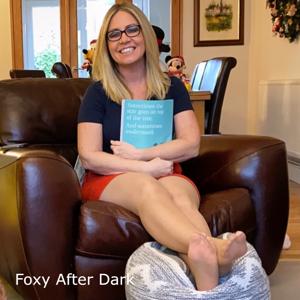

Hello you and welcome to very own late night podcast called Foxy After Dark, I'm sharing my bed time routine with you and I really hope you enjoy it :)
I'm Lucy and I'm recording this from my home in a leafy suburb of Surrey in the United Kingdom where the suns gone down, everything is quiet and we can just relax and prepare to drift off to sleep.
This little podcast is my opportunity to spend some quality time with you guys, have a catch up before we think about heading off to sleep.
I wanted to share with you my love of some great old time radio shows, every night a part of my bedtime routine is to put in the ear pods and listen to some of my favourite shows.
What I’d really love is your feedback and ideas on how the podcast evolves so make sure you keep in touch using my social media, if you check out some of my social media,
I'm on instagram and youtube as Foxy Geek Girl so I'm really easy to find and I've set up an exclusive hangout page at patreon.com/Foxy After Dark
We’ll do plenty of shoutouts for my patreon gang and I'll definitely be keeping you up to date with everything I'm getting up to.
Love you guys xx
#sleep #insomnia #relax #chill #night #nighttime #bed #bedtime #oldtimeradio #drama #comedy #radio #talkradio #hancock #tonyhancock #hancockshalfhour #sherlock #sherlockholmes #radiodrama #popular #viral #viralpodcast #podcast #podcasting #podcasts #podtok #podcastclip #podcastclips #podcasttrailer #podcastteaser #newpodcastepisode #newpodcast #videopodcast #upcomingpodcast #audiogram #audiograms #truecrimepodcast #historypodcast #truecrime #podcaster #viral #popular #viralpodcast #number1 #instagram #youtube #facebook #johnnydollar #crime #fiction #unwind #devon #texas #texasranger #beer #seaton #seaside #smuggler #colyton #devon #seaton #beer #branscombe #lymebay #lymeregis #greatdetectives #greatdetectivesofoldtimeradio #detectives #johnnydollar #thesaint #steptoe #texasrangers #foxy #foxygeekgirl
Between 1966 and 1976, 52 episodes of Steptoe and Son were adapted for radio, these were remakes of the TV episodes specifically tailored for a radio audience, (Note:they are not TV soundtrack recordings), Series 1 & 2 were broadcast on the BBC Light Programme in 1966 and 1967. Series 3-6 and a final Christmas Special were broadcast on BBC Radio 2 between 1971 and 1976.
Steptoe and Son is a British sitcom written by Ray Galton and Alan Simpson about a father-and-son rag-and-bone business in 26a Oil Drum Lane, a fictional street in Shepherd's Bush, London. Four series were broadcast by the BBC in black and white from 1962 to 1965, followed by a second run from 1970 to 1974 in colour. The lead roles were played by Wilfrid Brambell and Harry H. Corbett. The theme tune, "Old Ned", was composed by Ron Grainer. The series was voted 15th in a 2004 poll by the BBC to find Britain's Best Sitcom. It was remade in the United States as Sanford and Son, in Sweden as Albert & Herbert, in the Netherlands as Stiefbeen en zoon, in Portugal as Camilo & Filho, and in South Africa as Snetherswaite and Son. Two film adaptations of the series were released in cinemas, Steptoe and Son (1972) and Steptoe and Son Ride Again (1973).
The series focused on the inter-generational conflict of father and son. Albert Steptoe, a "dirty old man", is an elderly rag-and-bone man, set in his grimy and grasping ways. By contrast, his son Harold is filled with social aspirations and pretensions. The show contained elements of drama and tragedy, such as how Harold was continually prevented from achieving his ambitions.
In 2000, the show was ranked number 44 on the 100 Greatest British Television Programmes compiled by the British Film Institute. In a 2001 Channel 4 poll Albert was ranked 39th on their list of the 100 Greatest TV Characters.
Plot
Albert almost always comes out on top, and routinely proves himself superior to his son whenever they compete, such as when they played snooker into the night and pouring rain in 1970, and Scrabble and badminton in the 1972 series. Harold takes these games extremely seriously and sees them as symbols of his desire to improve himself, but his efforts come to nothing each time. His father's success is partly down to greater skills but is aided by cynical gamesmanship and undermining of his son's confidence. In addition, Albert habitually has better judgement than his son, who blunders into multiple con tricks and blind alleys as a result of his unrealistic, desperate straw-clutching approach. Occasionally the tables are turned, but overall the old man is the winner.
Harold is infuriated by these persistent frustrations and defeats, even going to the extent in "Divided We Stand" (1972) of attempting to partition the house so that he does not have to share with his selfish, uncultured and negative father. His plan ends in failure and ultimately he can see no way out. However, for all the bitterness there is an essential bond between the pair. In bad situations, Harold sticks by his father, and Albert looks out for his son. This protective bond is shown in several episodes, such as "Full House" (1963) when Albert wins back Harold's money in a game of cards against Harold's manipulative group of friends, and "The Seven Steptoerai" (1974) when they are menaced by a local gangster running a protection racket and team up with some of Albert's friends to fight off the gangster's thugs.
The 1974 Christmas special ended the run and it first appears Harold is once again at the bad end of poor planning, when he books a Christmas holiday abroad, but then finds his passport is out of date. His father must go alone, and Harold, tearfully it seems, waves him off to enjoy a potential good time without him. Harold trudges away, only to jump in a car with a woman to drive off on his own holiday, revealing that he had engineered the whole situation from the beginning.
Characters
Production
The show had its roots in a 1962 episode of Galton & Simpson's Comedy Playhouse. Galton and Simpson's association with comedian Tony Hancock, for whom they had written Hancock's Half Hour, had ended and they had agreed to a proposal from the BBC to write a series of 10 comedy shows. The fourth in the series, "The Offer", was born both out of writer's block and budgetary constraints. Earlier shows in the series had cost more than expected, so the writers decided to write a two-hander set in one room. The idea of two brothers was considered but father and son worked best.
Galton and Simpson were not aiming to make a pilot for a series, having worked for seven years with Hancock. However, Tom Sloan, the BBC's head of comedy, told them during rehearsals that "The Offer" was a definite series pilot: he saw that the Steptoe idea had potential. Galton and Simpson were reportedly overwhelmed by this reaction, and the first of what became eight series was commissioned, the first four of which were transmitted between 1962 and 1965. The last four series were broadcast between 1970 and 1974, in colour. At the peak of the series' popularity, it received viewing figures of some 28,000,000 viewers per episode. In addition, the early 1970s saw two feature films and two 46-minute Christmas specials. In 2005, the play Steptoe and Son in Murder at Oil Drum Lane, written by Ray Galton and John Antrobus, brought the storyline to a close.
Casting
The series employed actors rather than comedians in the principal roles; casting for comedy still tended to favour the latter when the series was created in 1962. Galton and Simpson had decided that they wanted to try to write for performers who "didn't count their laughs".
Both of the main actors used voices considerably different from their own. Brambell, despite being Irish, spoke with a received pronunciation English accent, as did the Manchester-raised Corbett. Brambell was aged 49 when he accepted the role of Albert, only 13 years older than Corbett. For his portrayal, he acquired a second set of "rotten" dentures to accentuate his character's poor attitude to hygiene.
Music
Ron Grainer won a second successive Ivor Novello award for the show's theme tune ' Old Ned ', to which he gave a different treatment, one year later, during a Rag-and-Bone Man scene in The Home-Made Car. The series had no standard set of opening titles but the opening sequences would often feature the Steptoes' horse, Hercules. "Steptoe and Son" is the Steptoes' trading name, but as established in the first episode, the "Son" is not Harold as initially believed, but Albert. The name dates from when he and his mother—Mrs. Steptoe—worked the rounds. The first series has the pair as very rough looking and often dirty and wearing ragged clothes, but they were portrayed as cleaner in later series.
Locations
Outside filming of the Steptoes' yard took place at a car-breakers' yard in Norland Gardens, London W11, then changing to Stable Way, Latimer Road, for the later series. Both sites have subsequently been redeveloped with no evidence now remaining of the entrance gates through which the horse and cart were frequently driven.
The pilot episode and the first four series, which aired in 1962–1965, were recorded in the BBC Lime Grove Studios in London. When the show returned in 1970 after a four-year hiatus, the programme was made in the BBC Television Centre studios in west London, as from 1970 the show was recorded in colour.
Notability
During its production in the 1960s and 1970s, Steptoe and Son marked itself out as radical compared to most UK sitcoms. This was an age when the predominant sources of laughter in British comedy were farce, coincidence, slapstick and innuendo. However Steptoe and Son brought greater social realism. Its characters were not only working class but demonstrably poor. The earthy language and slang used were in marked contrast to the refined voices heard on most television of the time: e.g., in "Back in Fashion", Harold warns Albert that when the models arrive, "if you feels like a D'Oyly Carte (rhyming slang for 'fart'), you goes outside." Social issues and debates were routinely portrayed, woven into the humour. The programme did not abandon the more traditional sources of comedy but used them in small doses. The characters, and their intense and difficult relationship, displayed deeper qualities of writing and performance than comedy fans were used to.
Episodes
The original 2" Quad videotapes of all the episodes of the original 1962–65 series were wiped in the late 1960s. However, these episodes mostly survive on film transfers of the original videotapes as 16mm black and white telerecordings. The exceptions to this are "The Stepmother", "The Wooden Overcoats", "The Lodger" and "My Old Man's a Tory", which exist as optical transfers made from domestic 405 line reel to reel videotapes obtained from writers Galton and Simpson.
The BBC has released 10 DVDs of the series—each of the eight series, and two compilations entitled "The Very Best of Steptoe and Son" volumes 1 and 2. Two Christmas specials are also available on DVD, as are two feature films: Steptoe and Son and Steptoe and Son Ride Again. A boxed set of Series 1–8 and the two Christmas specials was released on Region 2 DVD by 2entertain on 29 October 2007.
In addition, 52 episodes were remade for BBC Radio, initially on the Light Programme in 1966–67 and later Radio 2 from 1971 to 1976.
A special one-off remake of the "A Winter's Tale" episode aired on BBC Four on 14 September 2016, as part of the BBC's Lost Sitcom season recreating lost episodes of classic sitcoms.
Sketch appearances
In other media
A number of LPs and EPs featuring TV soundtracks have been released.
Books
To tie in with the original series, two novelisations were written by Gale Pedrick:
Steptoe and Son. Hodder & Stoughton. 1964.
Other countries
In 1965 Joseph E. Levine produced a pilot based on The Offer for the American market with Galton and Simpson. Starring Lee Tracy as Albert and Aldo Ray as Harold, it was unscreened, and did not lead to a series. The pilot was released on DVD in the UK in 2018. The concept was later re-worked as Sanford and Son, a top-rated series that ran for five years (1972–77) on the NBC network.
Sweden; Sten-Åke Cederhök and Tomas von Brömssen starred in Albert & Herbert. The pair lived at Skolgatan 15, an address in a working-class neighbourhood of Haga, Gothenburg.
Main article: Steptoe and Son (film)
Steptoe and Son Ride Again
Main article: Steptoe and Son Ride Again
Spin-offs
The programme reveals how Brambell and Corbett were highly dissimilar to their on-screen characters. Corbett felt he had a promising career as a serious actor, but was trapped by his role as Harold and forced to keep returning to the series after typecasting limited his choice of work. Brambell, meanwhile, was a homosexual, something that in the 1960s was still frowned upon and, until the Sexual Offences Act 1967, illegal and was thus driven underground. The documentary went on to describe an ill-fated final tour of Australia, during which the already strained relationship between Corbett and Brambell finally broke down for good.
The Curse of Steptoe
The screenplay was written by Brian Fillis, also responsible for the similarly themed 2006 drama Fear of Fanny, which is about television personality Fanny Cradock off-screen. The 66-minute film is directed by Michael Samuels and produced by Ben Bickerton.
Both When Steptoe Met Son and The Curse of Steptoe were considered inaccurate by writers Galton and Simpson and Corbett's family.
Theatre
It was not the first time this idea had been considered. When Wilfrid Brambell left the UK after the third series to pursue an eventually unsuccessful Broadway musical career, Galton and Simpson toyed with the concept of 'killing off' Albert in order to continue the show without having to await Brambell's return. The character would have been replaced with Harold's illegitimate son, Arthur (a part thought to be intended for actor David Hemmings). This idea was detested by Corbett, who thought it ridiculous, although the 2008 drama The Curse of Steptoe depicts Corbett as being delighted with the concept, since assuming the role of father would allow Harold's character some development and growth, which he felt was long overdue.
Steptoe and Son
Jack Lane and Michael Simmonds as the duo
Many of the original TV episodes of Steptoe and Son have now been officially adapted to the stage by the original writers Ray Galton and Alan Simpson, with David Pibworth.
Steptoe and Son by Hambledon Productions
Between 2017 - 2022, theatre company Hambledon Productions produced four consecutive tours, based on the original Galton and Simpson scripts. These included Steptoe and Son (2017-2018, featuring the episodes: Come Dancing, Men of Letters and Divided We Stand), Christmas with Steptoe and Son (2018-2019, featuring the episodes: The Party, The Bath and A Perfect Christmas), Steptoe and Son Radio Show: Christmas Edition (2021, a radio play based on the previous tour) and The Steptoe and Son Radio Show (2022) featuring the episodes Is That Your Horse Outside?, Upstairs, Downstairs, Upstairs, Downstairs and A Death in the Family. This recent tour was co-produced with Apollo Theatre Company. Across all these productions, John Hewer played Harold Steptoe and Jeremy Smith played Albert Steptoe.
Steptoe and Son by Kneehigh
 View all episodes
 By foxyafterdark
Hello you and welcome to very own late night podcast called Foxy After Dark, I'm sharing my bed time routine with you and I really hope you enjoy it :)
I'm Lucy and I'm recording this from my home in a leafy suburb of Surrey in the United Kingdom where the suns gone down, everything is quiet and we can just relax and prepare to drift off to sleep.
This little podcast is my opportunity to spend some quality time with you guys, have a catch up before we think about heading off to sleep.
I wanted to share with you my love of some great old time radio shows, every night a part of my bedtime routine is to put in the ear pods and listen to some of my favourite shows.
What I’d really love is your feedback and ideas on how the podcast evolves so make sure you keep in touch using my social media, if you check out some of my social media,
I'm on instagram and youtube as Foxy Geek Girl so I'm really easy to find and I've set up an exclusive hangout page at patreon.com/Foxy After Dark
We’ll do plenty of shoutouts for my patreon gang and I'll definitely be keeping you up to date with everything I'm getting up to.
Love you guys xx
#sleep #insomnia #relax #chill #night #nighttime #bed #bedtime #oldtimeradio #drama #comedy #radio #talkradio #hancock #tonyhancock #hancockshalfhour #sherlock #sherlockholmes #radiodrama #popular #viral #viralpodcast #podcast #podcasting #podcasts #podtok #podcastclip #podcastclips #podcasttrailer #podcastteaser #newpodcastepisode #newpodcast #videopodcast #upcomingpodcast #audiogram #audiograms #truecrimepodcast #historypodcast #truecrime #podcaster #viral #popular #viralpodcast #number1 #instagram #youtube #facebook #johnnydollar #crime #fiction #unwind #devon #texas #texasranger #beer #seaton #seaside #smuggler #colyton #devon #seaton #beer #branscombe #lymebay #lymeregis #greatdetectives #greatdetectivesofoldtimeradio #detectives #johnnydollar #thesaint #steptoe #texasrangers #foxy #foxygeekgirl
Between 1966 and 1976, 52 episodes of Steptoe and Son were adapted for radio, these were remakes of the TV episodes specifically tailored for a radio audience, (Note:they are not TV soundtrack recordings), Series 1 & 2 were broadcast on the BBC Light Programme in 1966 and 1967. Series 3-6 and a final Christmas Special were broadcast on BBC Radio 2 between 1971 and 1976.
Steptoe and Son is a British sitcom written by Ray Galton and Alan Simpson about a father-and-son rag-and-bone business in 26a Oil Drum Lane, a fictional street in Shepherd's Bush, London. Four series were broadcast by the BBC in black and white from 1962 to 1965, followed by a second run from 1970 to 1974 in colour. The lead roles were played by Wilfrid Brambell and Harry H. Corbett. The theme tune, "Old Ned", was composed by Ron Grainer. The series was voted 15th in a 2004 poll by the BBC to find Britain's Best Sitcom. It was remade in the United States as Sanford and Son, in Sweden as Albert & Herbert, in the Netherlands as Stiefbeen en zoon, in Portugal as Camilo & Filho, and in South Africa as Snetherswaite and Son. Two film adaptations of the series were released in cinemas, Steptoe and Son (1972) and Steptoe and Son Ride Again (1973).
The series focused on the inter-generational conflict of father and son. Albert Steptoe, a "dirty old man", is an elderly rag-and-bone man, set in his grimy and grasping ways. By contrast, his son Harold is filled with social aspirations and pretensions. The show contained elements of drama and tragedy, such as how Harold was continually prevented from achieving his ambitions.
In 2000, the show was ranked number 44 on the 100 Greatest British Television Programmes compiled by the British Film Institute. In a 2001 Channel 4 poll Albert was ranked 39th on their list of the 100 Greatest TV Characters.
Plot
Albert almost always comes out on top, and routinely proves himself superior to his son whenever they compete, such as when they played snooker into the night and pouring rain in 1970, and Scrabble and badminton in the 1972 series. Harold takes these games extremely seriously and sees them as symbols of his desire to improve himself, but his efforts come to nothing each time. His father's success is partly down to greater skills but is aided by cynical gamesmanship and undermining of his son's confidence. In addition, Albert habitually has better judgement than his son, who blunders into multiple con tricks and blind alleys as a result of his unrealistic, desperate straw-clutching approach. Occasionally the tables are turned, but overall the old man is the winner.
Harold is infuriated by these persistent frustrations and defeats, even going to the extent in "Divided We Stand" (1972) of attempting to partition the house so that he does not have to share with his selfish, uncultured and negative father. His plan ends in failure and ultimately he can see no way out. However, for all the bitterness there is an essential bond between the pair. In bad situations, Harold sticks by his father, and Albert looks out for his son. This protective bond is shown in several episodes, such as "Full House" (1963) when Albert wins back Harold's money in a game of cards against Harold's manipulative group of friends, and "The Seven Steptoerai" (1974) when they are menaced by a local gangster running a protection racket and team up with some of Albert's friends to fight off the gangster's thugs.
The 1974 Christmas special ended the run and it first appears Harold is once again at the bad end of poor planning, when he books a Christmas holiday abroad, but then finds his passport is out of date. His father must go alone, and Harold, tearfully it seems, waves him off to enjoy a potential good time without him. Harold trudges away, only to jump in a car with a woman to drive off on his own holiday, revealing that he had engineered the whole situation from the beginning.
Characters
Production
The show had its roots in a 1962 episode of Galton & Simpson's Comedy Playhouse. Galton and Simpson's association with comedian Tony Hancock, for whom they had written Hancock's Half Hour, had ended and they had agreed to a proposal from the BBC to write a series of 10 comedy shows. The fourth in the series, "The Offer", was born both out of writer's block and budgetary constraints. Earlier shows in the series had cost more than expected, so the writers decided to write a two-hander set in one room. The idea of two brothers was considered but father and son worked best.
Galton and Simpson were not aiming to make a pilot for a series, having worked for seven years with Hancock. However, Tom Sloan, the BBC's head of comedy, told them during rehearsals that "The Offer" was a definite series pilot: he saw that the Steptoe idea had potential. Galton and Simpson were reportedly overwhelmed by this reaction, and the first of what became eight series was commissioned, the first four of which were transmitted between 1962 and 1965. The last four series were broadcast between 1970 and 1974, in colour. At the peak of the series' popularity, it received viewing figures of some 28,000,000 viewers per episode. In addition, the early 1970s saw two feature films and two 46-minute Christmas specials. In 2005, the play Steptoe and Son in Murder at Oil Drum Lane, written by Ray Galton and John Antrobus, brought the storyline to a close.
Casting
The series employed actors rather than comedians in the principal roles; casting for comedy still tended to favour the latter when the series was created in 1962. Galton and Simpson had decided that they wanted to try to write for performers who "didn't count their laughs".
Both of the main actors used voices considerably different from their own. Brambell, despite being Irish, spoke with a received pronunciation English accent, as did the Manchester-raised Corbett. Brambell was aged 49 when he accepted the role of Albert, only 13 years older than Corbett. For his portrayal, he acquired a second set of "rotten" dentures to accentuate his character's poor attitude to hygiene.
Music
Ron Grainer won a second successive Ivor Novello award for the show's theme tune ' Old Ned ', to which he gave a different treatment, one year later, during a Rag-and-Bone Man scene in The Home-Made Car. The series had no standard set of opening titles but the opening sequences would often feature the Steptoes' horse, Hercules. "Steptoe and Son" is the Steptoes' trading name, but as established in the first episode, the "Son" is not Harold as initially believed, but Albert. The name dates from when he and his mother—Mrs. Steptoe—worked the rounds. The first series has the pair as very rough looking and often dirty and wearing ragged clothes, but they were portrayed as cleaner in later series.
Locations
Outside filming of the Steptoes' yard took place at a car-breakers' yard in Norland Gardens, London W11, then changing to Stable Way, Latimer Road, for the later series. Both sites have subsequently been redeveloped with no evidence now remaining of the entrance gates through which the horse and cart were frequently driven.
The pilot episode and the first four series, which aired in 1962–1965, were recorded in the BBC Lime Grove Studios in London. When the show returned in 1970 after a four-year hiatus, the programme was made in the BBC Television Centre studios in west London, as from 1970 the show was recorded in colour.
Notability
During its production in the 1960s and 1970s, Steptoe and Son marked itself out as radical compared to most UK sitcoms. This was an age when the predominant sources of laughter in British comedy were farce, coincidence, slapstick and innuendo. However Steptoe and Son brought greater social realism. Its characters were not only working class but demonstrably poor. The earthy language and slang used were in marked contrast to the refined voices heard on most television of the time: e.g., in "Back in Fashion", Harold warns Albert that when the models arrive, "if you feels like a D'Oyly Carte (rhyming slang for 'fart'), you goes outside." Social issues and debates were routinely portrayed, woven into the humour. The programme did not abandon the more traditional sources of comedy but used them in small doses. The characters, and their intense and difficult relationship, displayed deeper qualities of writing and performance than comedy fans were used to.
Episodes
The original 2" Quad videotapes of all the episodes of the original 1962–65 series were wiped in the late 1960s. However, these episodes mostly survive on film transfers of the original videotapes as 16mm black and white telerecordings. The exceptions to this are "The Stepmother", "The Wooden Overcoats", "The Lodger" and "My Old Man's a Tory", which exist as optical transfers made from domestic 405 line reel to reel videotapes obtained from writers Galton and Simpson.
The BBC has released 10 DVDs of the series—each of the eight series, and two compilations entitled "The Very Best of Steptoe and Son" volumes 1 and 2. Two Christmas specials are also available on DVD, as are two feature films: Steptoe and Son and Steptoe and Son Ride Again. A boxed set of Series 1–8 and the two Christmas specials was released on Region 2 DVD by 2entertain on 29 October 2007.
In addition, 52 episodes were remade for BBC Radio, initially on the Light Programme in 1966–67 and later Radio 2 from 1971 to 1976.
A special one-off remake of the "A Winter's Tale" episode aired on BBC Four on 14 September 2016, as part of the BBC's Lost Sitcom season recreating lost episodes of classic sitcoms.
Sketch appearances
In other media
A number of LPs and EPs featuring TV soundtracks have been released.
Books
To tie in with the original series, two novelisations were written by Gale Pedrick:
Steptoe and Son. Hodder & Stoughton. 1964.
Other countries
In 1965 Joseph E. Levine produced a pilot based on The Offer for the American market with Galton and Simpson. Starring Lee Tracy as Albert and Aldo Ray as Harold, it was unscreened, and did not lead to a series. The pilot was released on DVD in the UK in 2018. The concept was later re-worked as Sanford and Son, a top-rated series that ran for five years (1972–77) on the NBC network.
Sweden; Sten-Åke Cederhök and Tomas von Brömssen starred in Albert & Herbert. The pair lived at Skolgatan 15, an address in a working-class neighbourhood of Haga, Gothenburg.
Main article: Steptoe and Son (film)
Steptoe and Son Ride Again
Main article: Steptoe and Son Ride Again
Spin-offs
The programme reveals how Brambell and Corbett were highly dissimilar to their on-screen characters. Corbett felt he had a promising career as a serious actor, but was trapped by his role as Harold and forced to keep returning to the series after typecasting limited his choice of work. Brambell, meanwhile, was a homosexual, something that in the 1960s was still frowned upon and, until the Sexual Offences Act 1967, illegal and was thus driven underground. The documentary went on to describe an ill-fated final tour of Australia, during which the already strained relationship between Corbett and Brambell finally broke down for good.
The Curse of Steptoe
The screenplay was written by Brian Fillis, also responsible for the similarly themed 2006 drama Fear of Fanny, which is about television personality Fanny Cradock off-screen. The 66-minute film is directed by Michael Samuels and produced by Ben Bickerton.
Both When Steptoe Met Son and The Curse of Steptoe were considered inaccurate by writers Galton and Simpson and Corbett's family.
Theatre
It was not the first time this idea had been considered. When Wilfrid Brambell left the UK after the third series to pursue an eventually unsuccessful Broadway musical career, Galton and Simpson toyed with the concept of 'killing off' Albert in order to continue the show without having to await Brambell's return. The character would have been replaced with Harold's illegitimate son, Arthur (a part thought to be intended for actor David Hemmings). This idea was detested by Corbett, who thought it ridiculous, although the 2008 drama The Curse of Steptoe depicts Corbett as being delighted with the concept, since assuming the role of father would allow Harold's character some development and growth, which he felt was long overdue.
Steptoe and Son
Jack Lane and Michael Simmonds as the duo
Many of the original TV episodes of Steptoe and Son have now been officially adapted to the stage by the original writers Ray Galton and Alan Simpson, with David Pibworth.
Steptoe and Son by Hambledon Productions
Between 2017 - 2022, theatre company Hambledon Productions produced four consecutive tours, based on the original Galton and Simpson scripts. These included Steptoe and Son (2017-2018, featuring the episodes: Come Dancing, Men of Letters and Divided We Stand), Christmas with Steptoe and Son (2018-2019, featuring the episodes: The Party, The Bath and A Perfect Christmas), Steptoe and Son Radio Show: Christmas Edition (2021, a radio play based on the previous tour) and The Steptoe and Son Radio Show (2022) featuring the episodes Is That Your Horse Outside?, Upstairs, Downstairs, Upstairs, Downstairs and A Death in the Family. This recent tour was co-produced with Apollo Theatre Company. Across all these productions, John Hewer played Harold Steptoe and Jeremy Smith played Albert Steptoe.
Steptoe and Son by Kneehigh