
Sign up to save your podcasts
Or

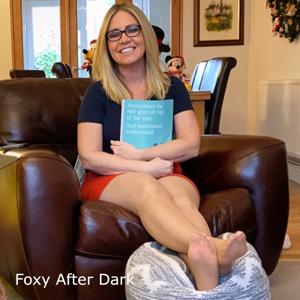


Hello you and welcome to very own late night podcast called Foxy After Dark, I'm sharing my bed time routine with you and I really hope you enjoy it :)
I'm Lucy and I'm recording this from my home in a leafy suburb of Surrey in the United Kingdom where the suns gone down, everything is quiet and we can just relax and prepare to drift off to sleep.
This little podcast is my opportunity to spend some quality time with you guys, have a catch up before we think about heading off to sleep.
I wanted to share with you my love of some great old time radio shows, every night a part of my bedtime routine is to put in the ear pods and listen to some of my favourite shows.
What I’d really love is your feedback and ideas on how the podcast evolves so make sure you keep in touch using my social media, if you check out some of my social media,
I'm on instagram and youtube as Foxy Geek Girl so I'm really easy to find and I've set up an exclusive hangout page at patreon.com/Foxy After Dark
We’ll do plenty of shoutouts for my patreon gang and I'll definitely be keeping you up to date with everything I'm getting up to.
Love you guys xx
#sleep #insomnia #relax #chill #night #nighttime #bed #bedtime #oldtimeradio #drama #comedy #radio #talkradio #hancock #tonyhancock #hancockshalfhour #sherlock #sherlockholmes #radiodrama #popular #viral #viralpodcast #podcast #podcasting #podcasts #podtok #podcastclip #podcastclips #podcasttrailer #podcastteaser #newpodcastepisode #newpodcast #videopodcast #upcomingpodcast #audiogram #audiograms #truecrimepodcast #historypodcast #truecrime #podcaster #viral #popular #viralpodcast #number1 #instagram #youtube #facebook #johnnydollar #crime #fiction #unwind #devon #texas #texasranger #beer #seaton #seaside #smuggler #colyton #devon #seaton #beer #branscombe #lymebay #lymeregis #greatdetectives #greatdetectivesofoldtimeradio #detectives #johnnydollar #thesaint #steptoe #texasrangers #foxy #foxygeekgirl
Anthony John Hancock (12 May 1924 – 25 June 1968) was an English comedian and actor.[1]
High-profile during the 1950s and early 1960s, he had a major success with his BBC series Hancock's Half Hour, first broadcast on radio from 1954, then on television from 1956, in which he soon formed a strong professional and personal bond with comic actor Sid James. Although Hancock's decision to cease working with James, when it became known in early 1960,[2] disappointed many at the time, his last BBC series in 1961 contains some of his best-remembered work (including The Blood Donor and The Radio Ham). After breaking with his scriptwriters Ray Galton and Alan Simpson later that year, his career declined.
Early life and career
After his father's death in 1934, Hancock and his brothers[5] lived with their mother and stepfather Robert Gordon Walker[6] at a small hotel called Durlston Court, in Gervis Road, Bournemouth. He attended Durlston Court Preparatory School, part of Durlston boarding school near Swanage (the name of which his parents adopted for their hotel) and Bradfield College in Reading, Berkshire, but left school at the age of fifteen.[citation needed]
In 1942, during the Second World War, Hancock joined the RAF Regiment.[7] Following failed auditions for the Entertainments National Service Association (ENSA), he joined the Gang Shows, travelling around Europe entertaining troops. After the war, he joined the Ralph Reader Gang Show touring production of "Wings".[8] He later worked in a double act with musician Derek Scott at the Windmill Theatre, a venue which helped to launch the careers of many comedians at the time. A favourable press review of his work at the Windmill was seen in July 1948. "But mention must made of a new young comedian…who with a piano partner, gives some brilliant thumbnail impressions of a “dud” concert party."[9] He took part in radio shows such as Workers' Playtime[10] and Variety Bandbox.[11] In July 1949, he was praised for his work in the summer presentation of "Flotsam's Follies" at the Esplanade Concert Hall, Bognor Regis.[12] Christmas 1949 saw him in the part of "Buttons" in the Cinderella pantomime at the Royal Artillery, Woolwich.[13] In June 1950, he opened in the "Ocean Revue" at the Ocean, Clacton Pier[14] which ran for three months. At Christmas 1950, Hancock was in the "Red Riding Hood" pantomime at the Theatre Royal Nottingham playing the part of Jolly Jenkins, the Baron's page.[15]
In 1951–1952, for one series beginning on August 3, 1951,[16] Hancock was a cast member of Educating Archie,[17] in which he mainly played the tutor (or foil) to the nominal star, a ventriloquist's dummy. His appearance in this radio show brought him national recognition, and a catchphrase he used frequently in the show, "Flippin' kids!", became popular parlance. The same year, he began to make regular appearances on BBC Television's light entertainment show Kaleidoscope, and almost starred in his own series to be written by Larry Stephens, Hancock's best man at his first wedding.[18] In 1954, he was given his own eponymous BBC radio show, Hancock's Half Hour.
Peak years
This section needs additional citations for verification. Please help improve this article by adding citations to reliable sources in this section. Unsourced material may be challenged and removed. (April 2017) (Learn how and when to remove this message)
Sid James featured in both the radio and TV versions, while the radio version also included regulars Bill Kerr, Kenneth Williams and, successively, Moira Lister, Andrée Melly[20] and Hattie Jacques. The series rejected the variety format then dominant in British radio comedy and instead used a form drawn more from everyday life: the situation comedy, with the humour coming from the characters and the circumstances in which they find themselves. Owing to a contractual wrangle with producer Jack Hylton, Hancock had an ITV series, The Tony Hancock Show, during this period, which ran in 1956–57.
During the run of his BBC radio and television series, Hancock became an enormous star in Britain. Unlike most other comedians at the time, he was able to clear the streets while families gathered together to listen to the eagerly awaited episodes. His character changed slightly over the series, but even in the earliest episodes the key facets of "the lad himself" were evident. "Sunday Afternoon at Home" and "The Wild Man of the Woods" were top-rating shows and were later released on an LP record.
As an actor with considerable experience in films, Sid James became more important to the show when the television version began. The regular cast was reduced to just the two men, allowing the humour to come from the interaction between them. James's character was the realist of the two, puncturing Hancock's pretensions. His character would often be dishonest and exploit Hancock's apparent gullibility during the radio series, but in the television version there appeared to be a more genuine friendship between them. Hancock's highly-strung personality made the demands of live broadcasts a constant worry, with the result that, starting from the autumn 1959 series, all episodes of the series were recorded before transmission. Up until then, every British television comedy show had been performed live, owing to the technical limitations of the time. He was also the first performer to receive a £1,000 fee for his performances in a half-hour show.
Hancock became anxious that his work with James was turning them into a double act, and he told close associates in late 1959, just after the fifth television series had finished being recorded, that he would end his professional association with Sid James after a final series.[21] Hancock left others to tell James.[22] His last BBC series in 1961, retitled simply Hancock, was without James. Two episodes are among his best-remembered: "The Blood Donor", in which he goes to a clinic to give blood, contains some famous lines, including "I don't mind giving a reasonable amount, but a pint! That's very nearly an armful!"; in "The Radio Ham", Hancock plays an amateur radio enthusiast who receives a mayday call from a yachtsman in distress, but his incompetence prevents him from taking his position. Both of these programmes were re-recorded a few months later for a commercial 1961 LP, produced in the same manner as the radio episodes.
Returning home with his wife from recording "The Bowmans", an episode based around a parody of The Archers, Hancock was involved in a car accident and was thrown through the windscreen. He was not badly hurt, but suffered concussion and was unable to learn his lines for "The Blood Donor", the next show due to be recorded. The result was that his performance depended on the use of teleprompters, and he is seen looking away from other actors when delivering lines. From this time onwards, Hancock came to rely on teleprompters instead of learning scripts whenever he had career difficulties.
Introspection
Cited as evidence is his gradual ostracism of those who contributed to his success, such as Sid James and his scriptwriters, Galton and Simpson. His reasoning was that, to refine his craft, he had to ditch catch-phrases and become realistic. He argued, for example, that whenever an ad-hoc character was needed, such as a policeman, it would be played by someone like Kenneth Williams, who would appear with his well-known oily catchphrase "Good evening". Hancock believed the comedy suffered because people did not believe in the policeman, knowing it was just Williams doing a funny voice.[24]
Break with Galton and Simpson
His break with Galton and Simpson took place at a meeting held in October 1961, where he also broke with his long-term agent Beryl Vertue. During the previous six months, the writers had developed – without payment and in consultation with the comedian – three scripts for Hancock's second starring film vehicle. Worried that the projects were wrong for him, the first two had been abandoned incomplete; the third was written to completion at the writers' insistence, only for Hancock to reject it. It is believed that he had not read any of the screenplays. The result of the break was that he chose to separately develop something previously discussed, and the writers were ultimately commissioned to write a Comedy Playhouse series for the BBC, one of which, "The Offer", emerged as the pilot for Steptoe and Son. That "something previously discussed" became The Punch and Judy Man, for which Hancock hired writer Philip Oakes, who moved in with the comedian to co-write the screenplay.[24]
In The Punch and Judy Man (1963), Hancock plays a struggling seaside entertainer who dreams of a better life; Sylvia Syms plays his nagging social climber of a wife, and John Le Mesurier a sand sculptor. The extent to which the character played by Hancock had merged with his real personality is clear in the film, which owes much to his memories of his childhood in Bournemouth.[24]
Later years
The ATV series was transmitted in early 1963, on the same evenings as the second series of Steptoe and Son, written by Hancock's former writers, Galton and Simpson. Critical comparisons did not favour Hancock's series. Around 1965, Hancock made a series of 11 television adverts[26] for the Egg Marketing Board. Hancock starred in the adverts with Patricia Hayes as the character "Mrs Cravatte" in an attempt to revive the Galton and Simpson style of scripts. Slightly earlier, in 1963, he had featured in a spoof Hancock Report – hired by Lord Beeching to promote his plan to reduce railway mileage in advertisements. Hancock reportedly wanted to be paid what Beeching was paid annually – £34,000; he was offered half that amount for his services.[27]
Hancock continued to make regular appearances on British television until 1967, including a 50-minute show for BBC2 from the Royal Festival Hall, which was poorly received. By then his alcoholism was seriously affecting his performances. Two unsuccessful variety series for ABC Weekend TV, The Blackpool Show (1966) and Hancock's (1967), were his last work for British television. He tried a role in a Disney film – The Adventures of Bullwhip Griffin – but was sacked after reportedly having trouble with the mock-Shakespearian dialogue. He collapsed with a liver attack on 1 January 1967 and was told he would die within three months if he continued drinking.[28]
In December 1967, while recovering from a broken rib from a drunken fall, he became ill with pneumonia.[29] His final television appearances were in Australia under a contract to make a 13-part series for the Seven Network. However, after arriving in Australia in March 1968, he completed only three programmes, which remained unaired for nearly four years. These shows are the only existing television footage of him in colour, as all his shows up to this point had been made for black-and-white television.
Personal life
Freddie Ross worked as his publicist from 1954 and became more involved in his life, eventually becoming his mistress. He divorced Cicely in 1965 and married Ross in December of that year.[32] This second marriage was short-lived. During these years Hancock was also involved with Joan Le Mesurier (née Malin), the new wife of actor John Le Mesurier, Hancock's best friend and a regular supporting character-actor from his television series. Joan was later to describe the relationship in her book Lady Don't Fall Backwards,[33] including the claim that her husband readily forgave the affair; he is quoted as saying that if it had been anyone else he would not have understood it, but with Tony Hancock it made sense. In July 1966 Freddie took an overdose but survived. Arriving in Blackpool to record an edition of his variety series, Hancock was met by pressmen asking about his wife's attempted suicide. The final dissolution of the marriage took place a few days before Hancock's own suicide.[34]
Cicely developed her own problems with alcohol and died from a fall in 1969, the year after the death of her former husband. Freddie Hancock survived her broken marriage and resumed her career as a prominent publicist and agent in the film and television industry. Based in New York City for many years, she founded the East Coast chapter of BAFTA, the British Academy of Film and Television Arts.
Death
In one of his suicide notes he wrote: "Things just seemed to go too wrong too many times."[37] His ashes were taken to England by satirist Willie Rushton[38] and were buried in St Dunstan's Church in Cranford, London.
Asked by Van Morrison about his relationship with Hancock, Spike Milligan commented in 1989: "Very difficult man to get on with. He used to drink excessively. You felt sorry for him. He ended up on his own. I thought, he's got rid of everybody else, he's going to get rid of himself and he did."[39]
Legacy
Statue in Old Square, Birmingham
Commemorative plaque at the foot of the Birmingham statue
In a 2002 poll, BBC radio listeners voted Hancock their favourite British comedian.[42] Commenting on this poll, Ray Galton and Alan Simpson observed that modern-day creations such as Alan Partridge and David Brent owed much of their success to mimicking dominant features of Tony Hancock's character. "The thing they've all got in common is self-delusion," they remarked, in a statement issued by the BBC. "They all think they're more intelligent than everyone else, more cultured, that people don't recognise their true greatness – self-delusion in every sense. And there's nothing people like better than failure."
Mary Kalemkerian, Head of Programmes for BBC 7, commented: "Classic comedians such as Tony Hancock and the Goons are obviously still firm favourites with BBC radio listeners. Age doesn't seem to matter – if it's funny, it's funny." Dan Peat of the Tony Hancock Appreciation Society said of the poll: "It's fantastic news. If he was alive, he would have taken it one of two ways. He would probably have made some kind of dry crack, but in truth he would have been chuffed."[42]
The last eight or so years of Hancock's life were the subject of a BBC1 television film, called Hancock (1991), starring Alfred Molina. Another drama, Kenneth Williams: Fantabulosa! (BBC Four, 2006), saw Martin Trenaman play the role of Hancock with Michael Sheen as Williams. Hancock's affair with Joan Le Mesurier was also dramatised in Hancock and Joan on BBC Four and transmitted in 2008 as part of the "Curse of Comedy" season. Hancock was portrayed by Ken Stott and Joan by Maxine Peake.
Musician Pete Doherty is a fan of Hancock and named the first album by his band the Libertines Up the Bracket after one of Hancock's catchphrases. He also wrote a song called "Lady Don't Fall Backwards" after the book at the centre of the Hancock's Half Hour episode "The Missing Page".[43] Hancock is also referenced in the lyrics to the Libertines' 2015 song "You're My Waterloo".[44]
Paul Merton, in 1996, appeared in remakes of six of Galton and Simpson's Hancock scripts, which were not critically well received. In 2014, five of the wiped radio instalments of Hancock's Half Hour, chosen by Galton and Simpson, were re-staged for BBC Radio 4 under the umbrella title The Missing Hancocks, with Kevin McNally taking the title role.
Playwright Roy Smiles' play about Tony Hancock, The Lad Himself, was staged at the Edinburgh Festival in 2013 with Mark Brailsford as Tony Hancock.
Recordings
The BBC issued CDs of the surviving 74 radio episodes in six box sets, one per series, with the sixth box containing several out-of-series specials. This was followed by the release of one large box set containing all the others in a special presentation case; while it includes no extra material, the larger box alone (without any CDs) still fetches high prices on online marketplaces like eBay, where Hancock memorabilia remains a thriving industry. There have also been numerous VHS releases of the BBC television series.[citation needed]
While five separate Region 2 DVDs were previously issued, some of the surviving episodes were unavailable until The Tony Hancock BBC Collection (eight DVDs) appeared in 2007. Episodes of the radio series are often broadcast on the digital radio station BBC Radio 4 Extra.
Film appearances
Hello you and welcome to very own late night podcast called Foxy After Dark, I'm sharing my bed time routine with you and I really hope you enjoy it :)
I'm Lucy and I'm recording this from my home in a leafy suburb of Surrey in the United Kingdom where the suns gone down, everything is quiet and we can just relax and prepare to drift off to sleep.
This little podcast is my opportunity to spend some quality time with you guys, have a catch up before we think about heading off to sleep.
I wanted to share with you my love of some great old time radio shows, every night a part of my bedtime routine is to put in the ear pods and listen to some of my favourite shows.
What I’d really love is your feedback and ideas on how the podcast evolves so make sure you keep in touch using my social media, if you check out some of my social media,
I'm on instagram and youtube as Foxy Geek Girl so I'm really easy to find and I've set up an exclusive hangout page at patreon.com/Foxy After Dark
We’ll do plenty of shoutouts for my patreon gang and I'll definitely be keeping you up to date with everything I'm getting up to.
#sleep #insomnia #relax #chill #night #nighttime #bed #bedtime #oldtimeradio #drama #comedy #radio #talkradio #hancock #tonyhancock #hancockshalfhour #sherlock #sherlockholmes #radiodrama #popular #viral #viralpodcast #podcast #podcasting #podcasts #podtok #podcastclip #podcastclips #podcasttrailer #podcastteaser #newpodcastepisode #newpodcast #videopodcast #upcomingpodcast #audiogram #audiograms #truecrimepodcast #historypodcast #truecrime #podcaster #viral #popular #viralpodcast #number1 #instagram #youtube #facebook #johnnydollar #crime #fiction #unwind #devon #texas #texasranger #beer #seaton #seaside #smuggler #colyton #devon #seaton #beer #branscombe #lymebay #lymeregis #greatdetectives #greatdetectivesofoldtimeradio #detectives #johnnydollar #thesaint #steptoe #texasrangers #foxy #foxygeekgirl
The Adventures of Sam Spade, Detective was a radio series based loosely on the private detective character Sam Spade, created by writer Dashiell Hammett for The Maltese Falcon. The show ran for 13 episodes on ABC in 1946, for 157 episodes on CBS in 1946–1949, and finally for 75 episodes on NBC in 1949–1951. The series starred Howard Duff (and later, Steve Dunne) as Sam Spade and Lurene Tuttle as his secretary Effie, and took a considerably more tongue-in-cheek approach to the character than the novel or movie. The announcer was Dick Joy.[1]
The series was largely overseen by producer/director William Spier. In 1947, Spier and scriptwriters Jason James and Bob Tallman[citation needed] received an Edgar Award for Best Radio Drama from the Mystery Writers of America.[2]
Before the series, Sam Spade had been played in radio adaptations of The Maltese Falcon by both Edward G. Robinson (in a 1943 Lux Radio Theater production) and by Humphrey Bogart (in a 1941 Academy Award Theater production), both on CBS.
Dashiell Hammett's name was removed from the series in the late 1940s because he was being investigated for involvement with the Communist Party. Later, when Howard Duff's name appeared in the Red Channels book, he was not invited to play the role when the series made the switch to NBC in 1950.
The 1946–1951 series
The Adventures of Sam Spade (1946, ABC) – 13 30-minute episodes
sleep insomnia relax chill night nightime bed bedtime oldtimeradio drama comedy radio talkradio hancock tonyhancock hancockshalfhour sherlock sherlockholmes radiodrama popular viral viralpodcast podcast east devon seaton beer lyme regis village condado de alhama spain murcia
Hello you and welcome to very own late night podcast called Foxy After Dark, I'm sharing my bed time routine with you and I really hope you enjoy it :)
I'm Lucy and I'm recording this from my home in a leafy suburb of Surrey in the United Kingdom where the suns gone down, everything is quiet and we can just relax and prepare to drift off to sleep.
This little podcast is my opportunity to spend some quality time with you guys, have a catch up before we think about heading off to sleep.
I wanted to share with you my love of some great old time radio shows, every night a part of my bedtime routine is to put in the ear pods and listen to some of my favourite shows.
What I’d really love is your feedback and ideas on how the podcast evolves so make sure you keep in touch using my social media, if you check out some of my social media,
I'm on instagram and youtube as Foxy Geek Girl so I'm really easy to find and I've set up an exclusive hangout page at patreon.com/Foxy After Dark
We’ll do plenty of shoutouts for my patreon gang and I'll definitely be keeping you up to date with everything I'm getting up to.
Love you guys xx
#sleep #insomnia #relax #chill #night #nighttime #bed #bedtime #oldtimeradio #drama #comedy #radio #talkradio #hancock #tonyhancock #hancockshalfhour #sherlock #sherlockholmes #radiodrama #popular #viral #viralpodcast #podcast #podcasting #podcasts #podtok #podcastclip #podcastclips #podcasttrailer #podcastteaser #newpodcastepisode #newpodcast #videopodcast #upcomingpodcast #audiogram #audiograms #truecrimepodcast #historypodcast #truecrime #podcaster #viral #popular #viralpodcast #number1 #instagram #youtube #facebook #johnnydollar #crime #fiction #unwind #devon #texas #texasranger #beer #seaton #seaside #smuggler #colyton #devon #seaton #beer #branscombe #lymebay #lymeregis #greatdetectives #greatdetectivesofoldtimeradio #detectives #johnnydollar #thesaint #steptoe #texasrangers #foxy #foxygeekgirl
Sherlock Holmes (/ˈʃɜːrlɒk ˈhoʊmz/) is a fictional detective created by British author Arthur Conan Doyle. Referring to himself as a "consulting detective" in his stories, Holmes is known for his proficiency with observation, deduction, forensic science and logical reasoning that borders on the fantastic, which he employs when investigating cases for a wide variety of clients, including Scotland Yard.
The character Sherlock Holmes first appeared in print in 1887's A Study in Scarlet. His popularity became widespread with the first series of short stories in The Strand Magazine, beginning with "A Scandal in Bohemia" in 1891; additional tales appeared from then until 1927, eventually totalling four novels and 56 short stories. All but one[a] are set in the Victorian or Edwardian eras, between about 1880 and 1914. Most are narrated by the character of Holmes's friend and biographer Dr. John H. Watson, who usually accompanies Holmes during his investigations and often shares quarters with him at the address of 221B Baker Street, London, where many of the stories begin.
Though not the first fictional detective, Sherlock Holmes is arguably the best known.[1] By the 1990s, there were already over 25,000 stage adaptations, films, television productions and publications featuring the detective,[2] and Guinness World Records lists him as the most portrayed human literary character in film and television history.[3] Holmes' popularity and fame are such that many have believed him to be not a fictional character but a real individual;[4][5][6] numerous literary and fan societies have been founded on this pretence. Avid readers of the Holmes stories helped create the modern practice of fandom.[7] The character and stories have had a profound and lasting effect on mystery writing and popular culture as a whole, with the original tales as well as thousands written by authors other than Conan Doyle being adapted into stage and radio plays, television, films, video games, and other media for over one hundred years.
Inspiration for the character
Sir Arthur Conan Doyle (1859–1930), Sherlock Holmes's creator, in 1914
Conan Doyle repeatedly said that Holmes was inspired by the real-life figure of Joseph Bell, a surgeon at the Royal Infirmary of Edinburgh, whom Conan Doyle met in 1877 and had worked for as a clerk. Like Holmes, Bell was noted for drawing broad conclusions from minute observations.[13] However, he later wrote to Conan Doyle: "You are yourself Sherlock Holmes and well you know it".[14] Sir Henry Littlejohn, Chair of Medical Jurisprudence at the University of Edinburgh Medical School, is also cited as an inspiration for Holmes. Littlejohn, who was also Police Surgeon and Medical Officer of Health in Edinburgh, provided Conan Doyle with a link between medical investigation and the detection of crime.[15]
Other possible inspirations have been proposed, though never acknowledged by Doyle, such as Maximilien Heller, by French author Henry Cauvain. In this 1871 novel (sixteen years before the first appearance of Sherlock Holmes), Henry Cauvain imagined a depressed, anti-social, opium-smoking polymath detective, operating in Paris.[16][17][18] It is not known if Conan Doyle read the novel, but he was fluent in French.[19] Similarly, Michael Harrison suggested that a German self-styled "consulting detective" named Walter Scherer may have been the model for Holmes.[20]
Fictional character biography
A statement of Holmes' age in "His Last Bow" places his year of birth at 1854; the story, set in August 1914, describes him as sixty years of age.[21] His parents are not mentioned, although Holmes mentions that his "ancestors" were "country squires". In "The Adventure of the Greek Interpreter", he claims that his grandmother was sister to the French artist Vernet, without clarifying whether this was Claude Joseph, Carle, or Horace Vernet. Holmes' brother Mycroft, seven years his senior, is a government official. Mycroft has a unique civil service position as a kind of human database for all aspects of government policy. Sherlock describes his brother as the more intelligent of the two, but notes that Mycroft lacks any interest in physical investigation, preferring to spend his time at the Diogenes Club.[22][23]
Holmes says that he first developed his methods of deduction as an undergraduate; his earliest cases, which he pursued as an amateur, came from his fellow university students.[24] A meeting with a classmate's father led him to adopt detection as a profession.[25]
Life with Watson
Detection is, or ought to be, an exact science and should be treated in the same cold and unemotional manner. You have attempted to tinge it [A Study in Scarlet] with romanticism, which produces much the same effect as if you worked a love-story or an elopement into the fifth proposition of Euclid. ... Some facts should be suppressed, or, at least, a just sense of proportion should be observed in treating them. The only point in the case which deserved mention was the curious analytical reasoning from effects to causes, by which I succeeded in unravelling it.[29]
Nevertheless, when Holmes recorded a case himself, he was forced to concede that he could more easily understand the need to write it in a manner that would appeal to the public rather than his intention to focus on his own technical skill.[30]
Holmes's friendship with Watson is his most significant relationship. When Watson is injured by a bullet, although the wound turns out to be "quite superficial", Watson is moved by Holmes's reaction:
It was worth a wound; it was worth many wounds; to know the depth of loyalty and love which lay behind that cold mask. The clear, hard eyes were dimmed for a moment, and the firm lips were shaking. For the one and only time I caught a glimpse of a great heart as well as of a great brain. All my years of humble but single-minded service culminated in that moment of revelation.[31]
After confirming Watson's assessment of the wound, Holmes makes it clear to their opponent that the man would not have left the room alive if he genuinely had killed Watson.[31]
Practice
The Great Hiatus
After resisting public pressure for eight years, Conan Doyle wrote The Hound of the Baskervilles (serialised in 1901–02, with an implicit setting before Holmes's death). In 1903, Conan Doyle wrote "The Adventure of the Empty House"; set in 1894, Holmes reappears, explaining to a stunned Watson that he had faked his death to fool his enemies.[48] Following "The Adventure of the Empty House", Conan Doyle would sporadically write new Holmes stories until 1927. Holmes aficionados refer to the period from 1891 to 1894—between his disappearance and presumed death in "The Final Problem" and his reappearance in "The Adventure of the Empty House"—as the Great Hiatus.[49] The earliest known use of this expression dates to 1946.[50]
Retirement
Personality and habits
Holmes examining a bicycle with Watson standing behind in "The Adventure of the Priory School" from 1904. Sidney Paget's illustrations in The Strand Magazine iconicised both characters.
in his personal habits one of the most untidy men that ever drove a fellow-lodger to distraction. [He] keeps his cigars in the coal-scuttle, his tobacco in the toe end of a Persian slipper, and his unanswered correspondence transfixed by a jack-knife into the very centre of his wooden mantelpiece. ... He had a horror of destroying documents. ... Thus month after month his papers accumulated, until every corner of the room was stacked with bundles of manuscript which were on no account to be burned, and which could not be put away save by their owner.[56]
While Holmes can be dispassionate and cold, during an investigation he is animated and excitable. He has a flair for showmanship, often keeping his methods and evidence hidden until the last possible moment so as to impress observers.[57] His companion condones the detective's willingness to bend the truth (or break the law) on behalf of a client—lying to the police, concealing evidence or breaking into houses—when he feels it morally justifiable.[58]
Except for that of Watson, Holmes avoids casual company. In "The Gloria Scott", he tells the doctor that during two years at college he made only one friend: "I was never a very sociable fellow, Watson ... I never mixed much with the men of my year."[59] The detective goes without food at times of intense intellectual activity, believing that "the faculties become refined when you starve them".[60][61] At times, Holmes relaxes with music, either playing the violin[62] or enjoying the works of composers such as Wagner[63] and Pablo de Sarasate.[64]
Drug use
Watson and Holmes both use tobacco, smoking cigarettes, cigars, and pipes. Although his chronicler does not consider Holmes's smoking a vice per se, Watson—a physician—does criticise the detective for creating a "poisonous atmosphere" in their confined quarters.[72][73]
Finances
Attitudes towards women
But while Watson says that the detective has an "aversion to women",[85] he also notes Holmes as having "a peculiarly ingratiating way with [them]".[86] Watson notes that their housekeeper Mrs. Hudson is fond of Holmes because of his "remarkable gentleness and courtesy in his dealings with women. He disliked and distrusted the sex, but he was always a chivalrous opponent."[87] However, in "The Adventure of Charles Augustus Milverton", the detective becomes engaged under false pretenses in order to obtain information about a case, abandoning the woman once he has the information he requires.[88]
Irene Adler
To Sherlock Holmes she is always the woman. I have seldom heard him mention her under any other name. In his eyes she eclipses and predominates the whole of her sex. It was not that he felt any emotion akin to love for Irene Adler. ... And yet there was but one woman to him, and that woman was the late Irene Adler, of dubious and questionable memory.[90]
Five years before the story's events, Adler had a brief liaison with Crown Prince of Bohemia Wilhelm von Ormstein. As the story opens, the Prince is engaged to another. Fearful that the marriage would be called off if his fiancée's family learns of this past impropriety, Ormstein hires Holmes to regain a photograph of Adler and himself. Adler slips away before Holmes can succeed. Her memory is kept alive by the photograph of Adler that Holmes received for his part in the case.[91]
Knowledge and skills
Knowledge of Literature – nil.
Despite Holmes's supposed ignorance of politics, in "A Scandal in Bohemia" he immediately recognises the true identity of the disguised "Count von Kramm".[37] At the end of A Study in Scarlet, Holmes demonstrates a knowledge of Latin.[97] The detective cites Hafez,[98] Goethe,[99] as well as a letter from Gustave Flaubert to George Sand in the original French.[100] In The Hound of the Baskervilles, the detective recognises works by Godfrey Kneller and Joshua Reynolds: "Watson won't allow that I know anything of art, but that is mere jealousy since our views upon the subject differ."[101] In "The Adventure of the Bruce-Partington Plans", Watson says that "Holmes lost himself in a monograph which he had undertaken upon the Polyphonic Motets of Lassus", considered "the last word" on the subject—which must have been the result of an intensive and very specialized musicological study which could have had no possible application to the solution of criminal mysteries.[102][103]
Holmes is a cryptanalyst, telling Watson that "I am fairly familiar with all forms of secret writing, and am myself the author of a trifling monograph upon the subject, in which I analyse one hundred and sixty separate ciphers."[104] Holmes also demonstrates a knowledge of psychology in "A Scandal in Bohemia", luring Irene Adler into betraying where she hid a photograph based on the premise that a woman will rush to save her most valued possession from a fire.[105] Another example is in "The Adventure of the Blue Carbuncle", where Holmes obtains information from a salesman with a wager: "When you see a man with whiskers of that cut and the 'Pink 'un' protruding out of his pocket, you can always draw him by a bet ... I daresay that if I had put 100 pounds down in front of him, that man would not have given me such complete information as was drawn from him by the idea that he was doing me on a wager."[106]
Maria Konnikova points out in an interview with D. J. Grothe that Holmes practises what is now called mindfulness, concentrating on one thing at a time, and almost never "multitasks". She adds that in this he predates the science showing how helpful this is to the brain.[107]
Holmesian deduction
It is simplicity itself ... my eyes tell me that on the inside of your left shoe, just where the firelight strikes it, the leather is scored by six almost parallel cuts. Obviously they have been caused by someone who has very carelessly scraped round the edges of the sole in order to remove crusted mud from it. Hence, you see, my double deduction that you had been out in vile weather, and that you had a particularly malignant boot-slitting specimen of the London slavey.[111]
In the first Holmes story, A Study in Scarlet, Dr. Watson compares Holmes to C. Auguste Dupin, Edgar Allan Poe's fictional detective, who employed a similar methodology. Alluding to an episode in "The Murders in the Rue Morgue", where Dupin determines what his friend is thinking despite their having walked together in silence for a quarter of an hour, Holmes remarks: "That trick of his breaking in on his friend's thoughts with an apropos remark ... is really very showy and superficial."[112] Nevertheless, Holmes later performs the same 'trick' on Watson in "The Cardboard Box"[113] and "The Adventure of the Dancing Men".[114]
Though the stories always refer to Holmes's intellectual detection method as "deduction", Holmes primarily relies on abduction: inferring an explanation for observed details.[115][116][117] "From a drop of water," he writes, "a logician could infer the possibility of an Atlantic or a Niagara without having seen or heard of one or the other."[118] However, Holmes does employ deductive reasoning as well. The detective's guiding principle, as he says in The Sign of Four, is: "When you have eliminated the impossible, whatever remains, however improbable, must be the truth."[119]
Despite Holmes's remarkable reasoning abilities, Conan Doyle still paints him as fallible in this regard (this being a central theme of "The Yellow Face").[120]
Forensic science
The detective is particularly skilled in the analysis of trace evidence and other physical evidence, including latent prints (such as footprints, hoof prints, and shoe and tire impressions) to identify actions at a crime scene,[123] using tobacco ashes and cigarette butts to identify criminals,[124] utilizing handwriting analysis and graphology,[125] comparing typewritten letters to expose a fraud,[126] using gunpowder residue to expose two murderers,[127] and analyzing small pieces of human remains to expose two murders.[128]
Because of the small scale of much of his evidence, the detective often uses a magnifying glass at the scene and an optical microscope at his Baker Street lodgings. He uses analytical chemistry for blood residue analysis and toxicology to detect poisons; Holmes's home chemistry laboratory is mentioned in "The Naval Treaty".[129] Ballistics feature in "The Adventure of the Empty House" when spent bullets are recovered to be matched with a suspected murder weapon, a practice which became regular police procedure only some fifteen years after the story was published.[130]
Laura J. Snyder has examined Holmes's methods in the context of mid- to late-19th-century criminology, demonstrating that, while sometimes in advance of what official investigative departments were formally using at the time, they were based upon existing methods and techniques. For example, fingerprints were proposed to be distinct in Conan Doyle's day, and while Holmes used a thumbprint to solve a crime in "The Adventure of the Norwood Builder" (generally held to be set in 1895), the story was published in 1903, two years after Scotland Yard's fingerprint bureau opened.[122][131] Though the effect of the Holmes stories on the development of forensic science has thus often been overstated, Holmes inspired future generations of forensic scientists to think scientifically and analytically.[132]
Disguises
Guy Mankowski has said of Holmes that his ability to change his appearance to blend into any situation "helped him personify the idea of the English eccentric chameleon, in a way that prefigured the likes of David Bowie".[134]
Agents
Combat
Other weapons
Personal combat
Holmes is an adept bare-knuckle fighter; "The Gloria Scott" mentions that Holmes boxed while at university.[59] In The Sign of Four, he introduces himself to McMurdo, a prize fighter, as "the amateur who fought three rounds with you at Alison's rooms on the night of your benefit four years back". McMurdo remembers: "Ah, you're one that has wasted your gifts, you have! You might have aimed high if you had joined the fancy."[146] In "The Yellow Face", Watson says: "He was undoubtedly one of the finest boxers of his weight that I have ever seen."[147] In "The Solitary Cyclist", Holmes visits a country pub to make enquiries regarding a certain Mr Woodley which results in violence. Mr Woodley, Holmes tells Watson,[148]
... had been drinking his beer in the tap-room, and had heard the whole conversation. Who was I? What did I want? What did I mean by asking questions? He had a fine flow of language, and his adjectives were very vigorous. He ended a string of abuse by a vicious backhander, which I failed to entirely avoid. The next few minutes were delicious. It was a straight left against a slogging ruffian. I emerged as you see me. Mr. Woodley went home in a cart.[148]
Another character subsequently refers to Mr Woodley as looking "much disfigured" as a result of his encounter with Holmes.[149]
In "The Adventure of the Empty House", Holmes tells Watson that he used a Japanese martial art known as baritsu to fling Moriarty to his death in the Reichenbach Falls.[150] "Baritsu" is Conan Doyle's version of bartitsu, which combines jujitsu with boxing and cane fencing.[151]
Reception
The popularity of Sherlock Holmes became widespread after his first appearance in The Strand Magazine in 1891. This September 1917 edition of the magazine, with the cover story, "Sherlock Holmes outwits a German spy", could be posted to troops free of charge.
Many fans of Sherlock Holmes have written letters to Holmes's address, 221B Baker Street. Though the address 221B Baker Street did not exist when the stories were first published, letters began arriving to the large Abbey National building which first encompassed that address almost as soon as it was built in 1932. Fans continue to send letters to Sherlock Holmes;[153] these letters are now delivered to the Sherlock Holmes Museum.[154] Some of the people who have sent letters to 221B Baker Street believe Holmes is real.[4] Members of the general public have also believed Holmes actually existed. In a 2008 survey of British teenagers, 58 per cent of respondents believed that Sherlock Holmes was a real individual.[5]
Some scholarly discussion of Holmes has occasionally been written (usually facetiously) from the perspective of Holmes and Dr. Watson having existed; an example of this are the five critical essays, "Studies in Sherlock Holmes", by the author and essayist Dorothy L. Sayers in her 1946 non-fiction collection, Unpopular Opinions, including an article examining Watson's signature which was allegedly visible in some original Strand illustrations.[155]
The Sherlock Holmes stories continue to be widely read.[1] Holmes's continuing popularity has led to many reimaginings of the character in adaptations.[7] Guinness World Records, which awarded Sherlock Holmes the title for "most portrayed literary human character in film & TV" in 2012, released a statement saying that the title "reflects his enduring appeal and demonstrates that his detective talents are as compelling today as they were 125 years ago".[3]
Honours
Statue of Sherlock Holmes near 221B Baker Street, London
Blue plaque at The Sherlock Holmes Museum 221b Baker Street, London
A number of London streets are associated with Holmes. York Mews South, off Crawford Street, was renamed Sherlock Mews, and Watson's Mews is near Crawford Place.[157] The Sherlock Holmes is a public house in Northumberland Street in London which contains a large collection of memorabilia related to Holmes, the original collection having been put together for display in Baker Street during the Festival of Britain in 1951.[158][159]
In 2002, the Royal Society of Chemistry bestowed an honorary fellowship on Holmes for his use of forensic science and analytical chemistry in popular literature, making him (as of 2019) the only fictional character thus honoured.[160] Holmes has been commemorated numerous times on a UK postage stamp issued by the Royal Mail, most recently in their August 2020 series to celebrate the Sherlock television series.[161]
There are multiple statues of Sherlock Holmes around the world. The first, sculpted by John Doubleday, was unveiled in Meiringen, Switzerland, in September 1988. The second was unveiled in October 1988 in Karuizawa, Japan, and was sculpted by Yoshinori Satoh. The third was installed in Edinburgh, Scotland, in 1989, and was sculpted by Gerald Laing.[162] In 1999, a statue of Sherlock Holmes in London, also by John Doubleday, was unveiled near the fictional detective's address, 221B Baker Street.[163] In 2001, a sculpture of Holmes and Arthur Conan Doyle by Irena Sedlecká was unveiled in a statue collection in Warwickshire, England.[164] A sculpture depicting both Holmes and Watson was unveiled in 2007 in Moscow, Russia, based partially on Sidney Paget's illustrations and partially on the actors in The Adventures of Sherlock Holmes and Dr. Watson.[165] In 2015, a sculpture of Holmes by Jane DeDecker was installed in the police headquarters of Edmond, Oklahoma, United States.[166] In 2019, a statue of Holmes was unveiled in Chester, Illinois, United States, as part of a series of statues honouring cartoonist E. C. Segar and his characters. The statue is titled "Sherlock & Segar", and the face of the statue was modelled on Segar.[167]
Societies
Legacy
The Sherlock Holmes stories established crime fiction as a respectable genre popular with readers of all backgrounds, and Doyle's success inspired many contemporary detective stories.[175] Holmes influenced the creation of other "eccentric gentleman detective" characters, like Agatha Christie's fictional detective Hercule Poirot, introduced in 1920.[176] Holmes also inspired a number of anti-hero characters "almost as an antidote to the masterful detective", such as the gentleman thief characters A. J. Raffles (created by E. W. Hornung in 1898) and Arsène Lupin (created by Maurice Leblanc in 1905).[175]
"Elementary, my dear Watson"
William Gillette is widely considered to have originated the phrase with the formulation, "Oh, this is elementary, my dear fellow", allegedly in his 1899 play Sherlock Holmes. However, the script was revised numerous times over the course of some three decades of revivals and publications, and the phrase is present in some versions of the script, but not others.[177] The appearance of the line "Elementary, my dear Potson" in a Sherlock Holmes parody from 1901 has led some authors to speculate that, rather than this being an incidental formulation, the parodist drew upon an already well-established occurrences of "Elementary, my dear Watson."[180][181]
The exact phrase, as well as close variants, can be seen in newspaper and journal articles as early as 1909.[177][182] It was also used by P. G. Wodehouse in his novel Psmith, Journalist, which was first serialised in The Captain magazine between October 1909 and February 1910; the phrase occurred in the January 1910 instalment. The phrase became familiar with the American public in part due to its use in the Rathbone-Bruce series of films from 1939 to 1946.[183]
The Great Game
For example, one detail analyzed in the Game is Holmes's birth date. The chronology of the stories is notoriously difficult, with many stories lacking dates and many others containing contradictory ones. Christopher Morley and William Baring-Gould contend that the detective was born on 6 January 1854, the year being derived from the statement in "His Last Bow" that he was 60 years of age in 1914, while the precise day is derived from broader, non-canonical speculation.[187] This is the date the Baker Street Irregulars work from, with their annual dinner being held each January.[188][189] Laurie R. King instead argues that details in "The Gloria Scott" (a story with no precise internal date) indicate that Holmes finished his second (and final) year of university in 1880 or 1885. If he began university at age 17, his birth year could be as late as 1868.[190]
Museums and special collections
In 1969, the Toronto Reference Library began a collection of materials related to Conan Doyle. Stored today in Room 221B, this vast collection is accessible to the public.[192][193] Similarly, in 1974 the University of Minnesota founded a collection that is now "the world's largest gathering of material related to Sherlock Holmes and his creator". Access is closed to the general public, but is occasionally open to tours.[194][195]
In 1990, the Sherlock Holmes Museum opened on Baker Street in London, followed the next year by a museum in Meiringen (near the Reichenbach Falls) dedicated to the detective.[191] A private Conan Doyle collection is a permanent exhibit at the Portsmouth City Museum, where the author lived and worked as a physician.[196]
Postcolonial criticism
Susan Cannon Harris claims that themes of contagion and containment are common in the Holmes series, including the metaphors of Eastern foreigners as the root cause of "infection" within and around Europe.[197] Lauren Raheja, writing in the Marxist journal Nature, Society, and Thought, claims that Doyle used these characteristics to paint eastern colonies in a negative light, through their continually being the source of threats. For example, in one story, Doyle makes mention of the Sumatran cannibals (also known as Batak) who throw poisonous darts, in "The Adventure of the Devil's Foot", a character employs a deadly West African poison, and in "The Speckled Band", a "long residence in the tropics" was a negative influence on one antagonist's bad temper.[198] Yumna Siddiqi argues that Doyle depicted returned colonials as "marginal, physically ravaged characters that threaten the peace", while putting non-colonials in a much more positive light.[199]
Adaptations and derived works
Adaptations have seen the character taken in radically different directions or placed in different times or even universes. For example, Holmes falls in love and marries in Laurie R. King's Mary Russell series, is re-animated after his death to fight future crime in the animated series Sherlock Holmes in the 22nd Century, and is meshed with the setting of H. P. Lovecraft's Cthulhu Mythos in Neil Gaiman's "A Study in Emerald" (which won the 2004 Hugo Award for Best Short Story). An especially influential pastiche was Nicholas Meyer's The Seven-Per-Cent Solution, a 1974 New York Times bestselling novel (made into the 1976 film of the same name) in which Holmes's cocaine addiction has progressed to the point of endangering his career. It served to popularize the trend of incorporating clearly identified and contemporaneous historical figures (such as Oscar Wilde, Aleister Crowley, Sigmund Freud, or Jack the Ripper) into Holmesian pastiches, something Conan Doyle himself never did.[201][202][203] Another common pastiche approach is to create a new story fully detailing an otherwise-passing canonical reference (such as an aside by Conan Doyle mentioning the "giant rat of Sumatra, a story for which the world is not yet prepared" in "The Adventure of the Sussex Vampire").[204]
The first translation of a Sherlock Holmes story into a Chinese variety was done by Chinese Progress in 1896. That publication rendered the name as 呵爾唔斯, which would be 呵尔唔斯 in Simplified Chinese and Hē'ěrwúsī in Modern Standard Mandarin. Theodore Ting Wong (Huang Ding) and Zhang Zaixin (traditional Chinese: 張在新; simplified Chinese: 张在新) translated six Holmes works in 1901. Theodore Wong rendered Holmes's name as 福而摩司, which would be read as Fú'érmósī in Modern Standard Mandarin. Shanghai Civilization Books later issued versions rendering Holmes's name differently, as 福爾摩斯 in Traditional Chinese, which would be 福尔摩斯 in Simplified Chinese and Fú'ěrmósī in Modern Standard Mandarin; this version became the common way of rendering "Holmes" in Chinese languages. Lin Shu from Fujian, along with Wei Yi, later translated A Study in Scarlet in 1908 and used 歇洛克·福爾摩斯, which would be 歇洛克·福尔摩斯 in Simplified Chinese and Xiēluòkè Fú'ěrmósī in Standard Mandarin. The pronunciation of the "f" sound as "h" may have originated from Fujian varieties of Chinese or from Shanghainese, or both.[205]
Related and derivative writings
In terms of writers other than Conan Doyle, authors as diverse as Agatha Christie, Anthony Burgess, Neil Gaiman, Dorothy B. Hughes, Stephen King, Tanith Lee, A. A. Milne, and P. G. Wodehouse have all written Sherlock Holmes pastiches. Contemporary with Conan Doyle, Maurice Leblanc directly featured Holmes in his popular series about the gentleman thief, Arsène Lupin, though legal objections from Conan Doyle forced Leblanc to modify the name to "Herlock Sholmes" in reprints and later stories.[208] In 1944, American mystery writers Frederic Dannay and Manfred B. Lee (writing under their joint pseudonym Ellery Queen) published The Misadventures of Sherlock Holmes, a collection of thirty-three pastiches written by various well-known authors.[209][210] Mystery writer John Dickson Carr collaborated with Arthur Conan Doyle's son, Adrian Conan Doyle, on The Exploits of Sherlock Holmes, a pastiche collection from 1954.[211] In 2011, Anthony Horowitz published a Sherlock Holmes novel, The House of Silk, presented as a continuation of Conan Doyle's work and with the approval of the Conan Doyle estate;[212] a follow-up, Moriarty, appeared in 2014.[213] The "MX Book of New Sherlock Holmes Stories" series of pastiches, edited by David Marcum and published by MX Publishing, has reached over thirty volumes and features hundreds of stories echoing the original canon which were compiled for the restoration of Undershaw and the support of Stepping Stones School, now housed in it.[214][215]
Some authors have written tales centred on characters from the canon other than Holmes. Anthologies edited by Michael Kurland and George Mann are entirely devoted to stories told from the perspective of characters other than Holmes and Watson. John Gardner, Michael Kurland, and Kim Newman, amongst many others, have all written tales in which Holmes's nemesis Professor Moriarty is the main character. Mycroft Holmes has been the subject of several efforts: Enter the Lion by Michael P. Hodel and Sean M. Wright (1979),[216] a four-book series by Quinn Fawcett,[217] and 2015's Mycroft Holmes, by Kareem Abdul-Jabbar and Anna Waterhouse.[218] M. J. Trow has written a series of seventeen books using Inspector Lestrade as the central character, beginning with The Adventures of Inspector Lestrade in 1985.[219] Carole Nelson Douglas' Irene Adler series is based on "the woman" from "A Scandal in Bohemia", with the first book (1990's Good Night, Mr. Holmes) retelling that story from Adler's point of view.[220] Martin Davies has written three novels where Baker Street housekeeper Mrs. Hudson is the protagonist.[221]
In 1980's The Name of the Rose, Italian author Umberto Eco creates a Sherlock Holmes of the 1320s in the form of a Franciscan friar and main protagonist named Brother William of Baskerville, his name a clear reference to Holmes per The Hound of the Baskervilles.[222] Brother William investigates a series of murders in the abbey alongside his novice Adso of Melk, who acts as his Dr. Watson. Furthermore, Umberto Eco's description of Brother William bears marked similarities in both physique and personality to Sir Arthur Conan Doyle's description of Sherlock Holmes in A Study in Scarlet.[223]
Laurie R. King recreated Holmes in her Mary Russell series (beginning with 1994's The Beekeeper's Apprentice), set during the First World War and the 1920s. Her Holmes, semi-retired in Sussex, meets a teenage American girl. Recognising a kindred spirit, he trains her as his apprentice and subsequently marries her. As of 2024, the series includes eighteen base novels and additional writings.[224]
The Final Solution, a 2004 novella by Michael Chabon, concerns an unnamed but long-retired detective interested in beekeeping who tackles the case of a missing parrot belonging to a Jewish refugee boy.[225] Mitch Cullin's novel A Slight Trick of the Mind (2005) takes place two years after the end of the Second World War and explores an old and frail Sherlock Holmes (now 93) as he comes to terms with a life spent in emotionless logic;[226] this was also adapted into a film, 2015's Mr. Holmes.[227]
In the 2004–2012 Fox's show House, the titular character Gregory House is an adaptation of Sherlock Holmes in a medical drama setting. The two characters share many parallels and House's name is a play on Holmes' one.[228][229]
There have been many scholarly works dealing with Sherlock Holmes, some working within the bounds of the Great Game, and some written from the perspective that Holmes is a fictional character. In particular, there have been three major annotated editions of the complete series. The first was William Baring-Gould's 1967 The Annotated Sherlock Holmes. This two-volume set was ordered to fit Baring-Gould's preferred chronology, and was written from a Great Game perspective. The second was 1993's The Oxford Sherlock Holmes (general editor: Owen Dudley Edwards), a nine-volume set written in a straight scholarly manner. The most recent is Leslie Klinger's The New Annotated Sherlock Holmes (2004–05), a three-volume set that returns to a Great Game perspective.[230][231]
Adaptations in other media
The 1899 play Sherlock Holmes, by Conan Doyle and William Gillette, was a synthesis of several Conan Doyle stories. In addition to its popularity, the play is significant because it, rather than the original stories, introduced one of the key visual qualities commonly associated with Holmes today: his calabash pipe;[232] the play also formed the basis for Gillette's 1916 film, Sherlock Holmes. Gillette performed as Holmes some 1,300 times. In the early 1900s, H. A. Saintsbury took over the role from Gillette for a tour of the play. Between this play and Conan Doyle's own stage adaptation of "The Adventure of the Speckled Band", Saintsbury portrayed Holmes over 1,000 times.[233]
Jeremy Brett played the detective in Sherlock Holmes for Granada Television from 1984 to 1994. Watson was played by David Burke (in the first two series) and Edward Hardwicke (in the remainder). Brett and Hardwicke also appeared on stage in 1988–89 in The Secret of Sherlock Holmes, directed by Patrick Garland.[245]
The 2009 film Sherlock Holmes earned Robert Downey Jr. a Golden Globe Award for his portrayal of Holmes and co-starred Jude Law as Watson.[246] Downey and Law returned for a 2011 sequel, Sherlock Holmes: A Game of Shadows.
Benedict Cumberbatch plays a modern version of the detective and Martin Freeman as a modern version of John Watson in the BBC One TV series Sherlock, which premiered on July 25, 2010. In the series, created by Mark Gatiss and Steven Moffat, the stories' original Victorian setting is replaced by present-day London, with Watson a veteran of the modern War in Afghanistan.[247] Similarly, Elementary premiered on CBS on September 27, 2012 and ran for seven seasons, until August 15, 2019. Set in contemporary New York City, the series stars Jonny Lee Miller as Sherlock Holmes and Lucy Liu as a female Dr. Joan Watson.[248] Created by Robert Doherty, the series was filmed primarily in New York City, and, by the end of season two, Miller became the actor who had portrayed Sherlock Holmes the most in television and/or film.[249]
The 2015 film Mr. Holmes starred Ian McKellen as a retired Sherlock Holmes living in Sussex, in 1947, who grapples with an unsolved case involving a beautiful woman. The film is based on Mitch Cullin's 2005 novel A Slight Trick of the Mind.[250][251]
The 2018 television adaptation, Miss Sherlock, was a Japanese-language production and the first adaptation with a woman (portrayed by Yūko Takeuchi) in the signature role. The episodes were based in modern-day Tokyo, with many references to Conan Doyle's stories.[252][253]
Holmes has also appeared in video games, including the Sherlock Holmes series of eight main titles. According to the publisher, Frogwares, by 2017 the series sold over seven million copies.[254]
Copyright issues
In the United States, all works published before 1923 entered public domain by 1998, but, as ten Holmes stories were published after that date, the Conan Doyle estate maintained that the Holmes and Watson characters as a whole were still under copyright.[256][260] On 14 February 2013, Leslie S. Klinger (lawyer and editor of The New Annotated Sherlock Holmes) filed a declaratory judgement suit against the Conan Doyle estate asking the court to acknowledge that the characters of Holmes and Watson were public domain in the U.S. The court ruled in Klinger's favour on 23 December, and the Seventh Circuit Court of Appeals affirmed its decision on 16 June 2014. The case was appealed to the U.S. Supreme Court, which declined to hear the case, letting the appeals court's ruling stand. This resulted in the characters from the Holmes stories being in the public domain in the U.S. The stories still under copyright due to the ruling, as of that time, were those collected in The Case-Book of Sherlock Holmes other than "The Adventure of the Mazarin Stone" and "The Problem of Thor Bridge": a total of ten stories.[259][261][262]
In 2020, although the United States court ruling and the passage of time meant that most of the Holmes stories and characters were in the public domain in that country, the Doyle estate legally challenged the use of Sherlock Holmes in the film Enola Holmes in a complaint filed in the United States.[263] The Doyle estate alleged that the film depicts Holmes with personality traits that were only exhibited by the character in the stories still under copyright. On 18 December 2020, the lawsuit was dismissed with prejudice by stipulation of all parties.
The remaining ten Holmes stories moved out of copyright between 1 January 2019 and 1 January 2023, leaving the stories and characters completely in the public domain in the United States as of the latter date
Hello you and welcome to very own late night podcast called Foxy After Dark, I'm sharing my bed time routine with you and I really hope you enjoy it :)
I'm Lucy and I'm recording this from my home in a leafy suburb of Surrey in the United Kingdom where the suns gone down, everything is quiet and we can just relax and prepare to drift off to sleep.
This little podcast is my opportunity to spend some quality time with you guys, have a catch up before we think about heading off to sleep.
I wanted to share with you my love of some great old time radio shows, every night a part of my bedtime routine is to put in the ear pods and listen to some of my favourite shows.
What I’d really love is your feedback and ideas on how the podcast evolves so make sure you keep in touch using my social media, if you check out some of my social media,
I'm on instagram and youtube as Foxy Geek Girl so I'm really easy to find and I've set up an exclusive hangout page at patreon.com/Foxy After Dark
We’ll do plenty of shoutouts for my patreon gang and I'll definitely be keeping you up to date with everything I'm getting up to.
Love you guys xx
The series focused on the inter-generational conflict of father and son. Albert Steptoe, a "dirty old man", is an elderly rag-and-bone man, set in his grimy and grasping ways. By contrast, his son Harold is filled with social aspirations and pretensions. The show contained elements of drama and tragedy, such as how Harold was continually prevented from achieving his ambitions.
In 2000, the show was ranked number 44 on the 100 Greatest British Television Programmes compiled by the British Film Institute. In a 2001 Channel 4 poll Albert was ranked 39th on their list of the 100 Greatest TV Characters.
Plot
Albert almost always comes out on top, and routinely proves himself superior to his son whenever they compete, such as when they played snooker into the night and pouring rain in 1970, and Scrabble and badminton in the 1972 series. Harold takes these games extremely seriously and sees them as symbols of his desire to improve himself, but his efforts come to nothing each time. His father's success is partly down to greater skills but is aided by cynical gamesmanship and undermining of his son's confidence. In addition, Albert habitually has better judgement than his son, who blunders into multiple con tricks and blind alleys as a result of his unrealistic, desperate straw-clutching approach. Occasionally the tables are turned, but overall the old man is the winner.
Harold is infuriated by these persistent frustrations and defeats, even going to the extent in "Divided We Stand" (1972) of attempting to partition the house so that he does not have to share with his selfish, uncultured and negative father. His plan ends in failure and ultimately he can see no way out. However, for all the bitterness there is an essential bond between the pair. In bad situations, Harold sticks by his father, and Albert looks out for his son. This protective bond is shown in several episodes, such as "Full House" (1963) when Albert wins back Harold's money in a game of cards against Harold's manipulative group of friends, and "The Seven Steptoerai" (1974) when they are menaced by a local gangster running a protection racket and team up with some of Albert's friends to fight off the gangster's thugs.
The 1974 Christmas special ended the run and it first appears Harold is once again at the bad end of poor planning, when he books a Christmas holiday abroad, but then finds his passport is out of date. His father must go alone, and Harold, tearfully it seems, waves him off to enjoy a potential good time without him. Harold trudges away, only to jump in a car with a woman to drive off on his own holiday, revealing that he had engineered the whole situation from the beginning.
Characters
Production
The show had its roots in a 1962 episode of Galton & Simpson's Comedy Playhouse. Galton and Simpson's association with comedian Tony Hancock, for whom they had written Hancock's Half Hour, had ended and they had agreed to a proposal from the BBC to write a series of 10 comedy shows. The fourth in the series, "The Offer", was born both out of writer's block and budgetary constraints. Earlier shows in the series had cost more than expected, so the writers decided to write a two-hander set in one room. The idea of two brothers was considered but father and son worked best.
Galton and Simpson were not aiming to make a pilot for a series, having worked for seven years with Hancock. However, Tom Sloan, the BBC's head of comedy, told them during rehearsals that "The Offer" was a definite series pilot: he saw that the Steptoe idea had potential. Galton and Simpson were reportedly overwhelmed by this reaction, and the first of what became eight series was commissioned, the first four of which were transmitted between 1962 and 1965. The last four series were broadcast between 1970 and 1974, in colour. At the peak of the series' popularity, it received viewing figures of some 28,000,000 viewers per episode. In addition, the early 1970s saw two feature films and two 46-minute Christmas specials. In 2005, the play Steptoe and Son in Murder at Oil Drum Lane, written by Ray Galton and John Antrobus, brought the storyline to a close.
Casting
The series employed actors rather than comedians in the principal roles; casting for comedy still tended to favour the latter when the series was created in 1962. Galton and Simpson had decided that they wanted to try to write for performers who "didn't count their laughs".
Both of the main actors used voices considerably different from their own. Brambell, despite being Irish, spoke with a received pronunciation English accent, as did the Manchester-raised Corbett. Brambell was aged 49 when he accepted the role of Albert, only 13 years older than Corbett. For his portrayal, he acquired a second set of "rotten" dentures to accentuate his character's poor attitude to hygiene.
Music
Ron Grainer won a second successive Ivor Novello award for the show's theme tune ' Old Ned ', to which he gave a different treatment, one year later, during a Rag-and-Bone Man scene in The Home-Made Car. The series had no standard set of opening titles but the opening sequences would often feature the Steptoes' horse, Hercules. "Steptoe and Son" is the Steptoes' trading name, but as established in the first episode, the "Son" is not Harold as initially believed, but Albert. The name dates from when he and his mother—Mrs. Steptoe—worked the rounds. The first series has the pair as very rough looking and often dirty and wearing ragged clothes, but they were portrayed as cleaner in later series.
Locations
Outside filming of the Steptoes' yard took place at a car-breakers' yard in Norland Gardens, London W11, then changing to Stable Way, Latimer Road, for the later series. Both sites have subsequently been redeveloped with no evidence now remaining of the entrance gates through which the horse and cart were frequently driven.
The pilot episode and the first four series, which aired in 1962–1965, were recorded in the BBC Lime Grove Studios in London. When the show returned in 1970 after a four-year hiatus, the programme was made in the BBC Television Centre studios in west London, as from 1970 the show was recorded in colour.
Notability
During its production in the 1960s and 1970s, Steptoe and Son marked itself out as radical compared to most UK sitcoms. This was an age when the predominant sources of laughter in British comedy were farce, coincidence, slapstick and innuendo. However Steptoe and Son brought greater social realism. Its characters were not only working class but demonstrably poor. The earthy language and slang used were in marked contrast to the refined voices heard on most television of the time: e.g., in "Back in Fashion", Harold warns Albert that when the models arrive, "if you feels like a D'Oyly Carte (rhyming slang for 'fart'), you goes outside." Social issues and debates were routinely portrayed, woven into the humour. The programme did not abandon the more traditional sources of comedy but used them in small doses. The characters, and their intense and difficult relationship, displayed deeper qualities of writing and performance than comedy fans were used to.
Episodes
The original 2" Quad videotapes of all the episodes of the original 1962–65 series were wiped in the late 1960s. However, these episodes mostly survive on film transfers of the original videotapes as 16mm black and white telerecordings. The exceptions to this are "The Stepmother", "The Wooden Overcoats", "The Lodger" and "My Old Man's a Tory", which exist as optical transfers made from domestic 405 line reel to reel videotapes obtained from writers Galton and Simpson.
The BBC has released 10 DVDs of the series—each of the eight series, and two compilations entitled "The Very Best of Steptoe and Son" volumes 1 and 2. Two Christmas specials are also available on DVD, as are two feature films: Steptoe and Son and Steptoe and Son Ride Again. A boxed set of Series 1–8 and the two Christmas specials was released on Region 2 DVD by 2entertain on 29 October 2007.
In addition, 52 episodes were remade for BBC Radio, initially on the Light Programme in 1966–67 and later Radio 2 from 1971 to 1976.
A special one-off remake of the "A Winter's Tale" episode aired on BBC Four on 14 September 2016, as part of the BBC's Lost Sitcom season recreating lost episodes of classic sitcoms.
Sketch appearances
In other media
A number of LPs and EPs featuring TV soundtracks have been released.
Books
To tie in with the original series, two novelisations were written by Gale Pedrick:
Steptoe and Son. Hodder & Stoughton. 1964.
Other countries
In 1965 Joseph E. Levine produced a pilot based on The Offer for the American market with Galton and Simpson. Starring Lee Tracy as Albert and Aldo Ray as Harold, it was unscreened, and did not lead to a series. The pilot was released on DVD in the UK in 2018. The concept was later re-worked as Sanford and Son, a top-rated series that ran for five years (1972–77) on the NBC network.
Sweden; Sten-Åke Cederhök and Tomas von Brömssen starred in Albert & Herbert. The pair lived at Skolgatan 15, an address in a working-class neighbourhood of Haga, Gothenburg.
Main article: Steptoe and Son (film)
Steptoe and Son Ride Again
Main article: Steptoe and Son Ride Again
Spin-offs
The programme reveals how Brambell and Corbett were highly dissimilar to their on-screen characters. Corbett felt he had a promising career as a serious actor, but was trapped by his role as Harold and forced to keep returning to the series after typecasting limited his choice of work. Brambell, meanwhile, was a homosexual, something that in the 1960s was still frowned upon and, until the Sexual Offences Act 1967, illegal and was thus driven underground. The documentary went on to describe an ill-fated final tour of Australia, during which the already strained relationship between Corbett and Brambell finally broke down for good.[1]
The Curse of Steptoe
The screenplay was written by Brian Fillis, also responsible for the similarly themed 2006 drama Fear of Fanny, which is about television personality Fanny Cradock off-screen. The 66-minute film is directed by Michael Samuels and produced by Ben Bickerton.
Both When Steptoe Met Son and The Curse of Steptoe were considered inaccurate by writers Galton and Simpson[3][4][5] and Corbett's family.[6][7]
Theatre
It was not the first time this idea had been considered. When Wilfrid Brambell left the UK after the third series to pursue an eventually unsuccessful Broadway musical career, Galton and Simpson toyed with the concept of 'killing off' Albert in order to continue the show without having to await Brambell's return. The character would have been replaced with Harold's illegitimate son, Arthur (a part thought to be intended for actor David Hemmings). This idea was detested by Corbett, who thought it ridiculous, although the 2008 drama The Curse of Steptoe depicts Corbett as being delighted with the concept, since assuming the role of father would allow Harold's character some development and growth, which he felt was long overdue.[8]
Steptoe and Son
Jack Lane and Michael Simmonds as the duo
Many of the original TV episodes of Steptoe and Son have now been officially adapted to the stage by the original writers Ray Galton and Alan Simpson, with David Pibworth.
Steptoe and Son by Hambledon Productions
Between 2017 - 2022, theatre company Hambledon Productions produced four consecutive tours, based on the original Galton and Simpson scripts. These included Steptoe and Son (2017-2018, featuring the episodes: Come Dancing, Men of Letters and Divided We Stand), Christmas with Steptoe and Son (2018-2019, featuring the episodes: The Party, The Bath and A Perfect Christmas), Steptoe and Son Radio Show: Christmas Edition (2021, a radio play based on the previous tour) and The Steptoe and Son Radio Show (2022) featuring the episodes Is That Your Horse Outside?, Upstairs, Downstairs, Upstairs, Downstairs and A Death in the Family. This recent tour was co-produced with Apollo Theatre Company. Across all these productions, John Hewer played Harold Steptoe and Jeremy Smith played Albert Steptoe.
Steptoe and Son by Kneehigh
sleep insomnia relax chill night nightime bed bedtime oldtimeradio drama comedy radio talkradio hancock tonyhancock hancockshalfhour sherlock sherlockholmes radiodrama popular viral viralpodcast podcast east devon seaton beer lyme regis village condado de alhama spain murcia
Hello you and welcome to very own late night podcast called Foxy After Dark, I'm sharing my bed time routine with you and I really hope you enjoy it :)
I'm Lucy and I'm recording this from my home in a leafy suburb of Surrey in the United Kingdom where the suns gone down, everything is quiet and we can just relax and prepare to drift off to sleep.
This little podcast is my opportunity to spend some quality time with you guys, have a catch up before we think about heading off to sleep.
I wanted to share with you my love of some great old time radio shows, every night a part of my bedtime routine is to put in the ear pods and listen to some of my favourite shows.
What I’d really love is your feedback and ideas on how the podcast evolves so make sure you keep in touch using my social media, if you check out some of my social media,
I'm on instagram and youtube as Foxy Geek Girl so I'm really easy to find and I've set up an exclusive hangout page at patreon.com/Foxy After Dark
We’ll do plenty of shoutouts for my patreon gang and I'll definitely be keeping you up to date with everything I'm getting up to.
Let George Do It is an American radio drama series produced from 1946 to 1954 by Owen and Pauline Vinson. Bob Bailey starred as private investigator George Valentine; Olan Soule voiced the role in 1954. Don Clark directed the scripts by David Victor and Jackson Gillis.
History and description
Sponsored by Standard Oil of California, now known as Chevron, the program was broadcast on the West Coast Don Lee network of the Mutual Broadcasting System from October 18, 1946, to September 27, 1954, first on Friday evenings and then on Mondays. In its last season, transcriptions were aired in New York Wednesdays at 9:30 p.m. from January 20, 1954 to January 12, 1955.
Clients came to Valentine's office after reading a newspaper that carried his classified ad:
Personal notice: Danger's my stock in trade. If the job's too tough for you to handle, you've got a job for me. George Valentine. Write full details!
The newspaper ad varied from show to show, but always opened with "Danger is my stock in trade" and closed with "Write full details!"
Characters and actors
John Hiestand was the program's announcer.
Other personnel
Bob Bailey (born Robert Bainter Bailey; June 13, 1913[citation needed] – August 13, 1983) was an American actor who performed mostly on radio but also appeared in films.
Early years
Career
Bailey first worked in radio in Chicago. His mother had left the stage for the newer medium, and she helped him find work on soap operas. He moved to St. Louis when he was offered a job at radio station KWK, but he resumed acting when an executive at KWK made him the head of the station's stock company.
In 1936, Bailey went back to Chicago to get married and to perform with the Chicago Theater of the Air. He remained in Chicago until he had to go to the West Coast for some programs in 1942.
One of Bailey's earliest roles on radio was that of the title character in the comedy serial Mortimer Gooch (1936–37) on CBS.: 366 In the early 1940s Bailey was regularly featured on network radio programs originating from Chicago. He played the boyfriend of the title character's sister in That Brewster Boy and the father of the title character in Meet Corliss Archer. He played Bob Jones in Kitty Keene, Inc..
He was signed in 1943 by 20th Century-Fox and appeared in seven feature films; the first two (in which he was most prominent) starred Laurel and Hardy. After the studio failed to renew Bailey's one-year contract, he returned to radio.
Starting in 1946, Bailey starred as freelance detective George Valentine in the radio drama Let George Do It, but he is best remembered as the title character in the long-running radio series Yours Truly, Johnny Dollar. The program ran from 1949 to 1962 (it and Suspense were the last CBS radio drama series on the air until the CBS Radio Mystery Theater began in 1974) and featured the exploits of "America's fabulous freelance insurance investigator"; Bailey starred as Johnny from 1955 to 1960 and wrote the script for the December 22, 1957 episode "The Carmen Kringle Matter" using the pen name "Robert Bainter".
Along with co-writer Hugh King, Bailey wrote the story, "The Big Rainbow" that became the film, "Underwater!," nine episodes of Hawkeye and the Last of the Mohicans, as well as an episode of the Ford Television Theatre, "The Legal Beagles.". In addition, without King, he wrote two episodes of the 1950s Western TV series, Fury.
With CBS devoting more money to television and wanting to reduce costs, Yours Truly, Johnny Dollar relocated to New York in 1960 and Bailey, unwilling to relocate, was dismissed. Having performed in almost 500 episodes, he had made the role his own.
With the end of his involvement, the show wound down over the following two years (with two different actors) before being taken off the air in 1962.
Bailey made a handful of television guest appearances from 1961-63.
Near the end of the 1962 film Birdman of Alcatraz, he can be seen as one of the reporters gathered around Burt Lancaster and Edmond O'Brien. Bailey's role was only a bit, and most of his dialogue was dubbed by another actor. O’Brien had preceded Bailey in the title role of the “Yours Truly, Johnny Dollar” radio program.
His last film was an uncredited role in the Disney Film, The Tiger Walks.
Personal life
Last years and death
Filmography
sleep insomnia relax chill night nightime bed bedtime oldtimeradio drama comedy radio talkradio hancock tonyhancock hancockshalfhour sherlock sherlockholmes radiodrama popular viral viralpodcast podcast east devon seaton beer lyme regis village condado de alhama spain murcia
Let George Do It is an American radio drama series produced from 1946 to 1954 by Owen and Pauline Vinson. Bob Bailey starred as private investigator George Valentine; Olan Soule voiced the role in 1954. Don Clark directed the scripts by David Victor and Jackson Gillis.
History and description
Sponsored by Standard Oil of California, now known as Chevron, the program was broadcast on the West Coast Don Lee network of the Mutual Broadcasting System from October 18, 1946, to September 27, 1954, first on Friday evenings and then on Mondays. In its last season, transcriptions were aired in New York Wednesdays at 9:30 p.m. from January 20, 1954 to January 12, 1955.
Clients came to Valentine's office after reading a newspaper that carried his classified ad:
Personal notice: Danger's my stock in trade. If the job's too tough for you to handle, you've got a job for me. George Valentine. Write full details!
The newspaper ad varied from show to show, but always opened with "Danger is my stock in trade" and closed with "Write full details!"
Characters and actors
John Hiestand was the program's announcer.
Other personnel
Hello you and welcome to very own late night podcast called Foxy After Dark, I'm sharing my bed time routine with you and I really hope you enjoy it :)
I'm Lucy and I'm recording this from my home in a leafy suburb of Surrey in the United Kingdom where the suns gone down, everything is quiet and we can just relax and prepare to drift off to sleep.
This little podcast is my opportunity to spend some quality time with you guys, have a catch up before we think about heading off to sleep.
I wanted to share with you my love of some great old time radio shows, every night a part of my bedtime routine is to put in the ear pods and listen to some of my favourite shows.
What I’d really love is your feedback and ideas on how the podcast evolves so make sure you keep in touch using my social media, if you check out some of my social media,
I'm on instagram and youtube as Foxy Geek Girl so I'm really easy to find and I've set up an exclusive hangout page at patreon.com/Foxy After Dark
We’ll do plenty of shoutouts for my patreon gang and I'll definitely be keeping you up to date with everything I'm getting up to.
Love you guys xx
#sleep #insomnia #relax #chill #night #nighttime #bed #bedtime #oldtimeradio #drama #comedy #radio #talkradio #hancock #tonyhancock #hancockshalfhour #sherlock #sherlockholmes #radiodrama #popular #viral #viralpodcast #podcast #podcasting #podcasts #podtok #podcastclip #podcastclips #podcasttrailer #podcastteaser #newpodcastepisode #newpodcast #videopodcast #upcomingpodcast #audiogram #audiograms #truecrimepodcast #historypodcast #truecrime #podcaster #viral #popular #viralpodcast #number1 #instagram #youtube #facebook #johnnydollar #crime #fiction #unwind #devon #texas #texasranger #beer #seaton #seaside #smuggler #colyton #devon #seaton #beer #branscombe #lymebay #lymeregis #greatdetectives #greatdetectivesofoldtimeradio #detectives #johnnydollar #thesaint #steptoe #texasrangers #foxy #foxygeekgirl
Dangerous Assignment was an NBC Radio drama starring Brian Donlevy broadcast in the US 1949–1953, a syndicated television series distributed in the US 1951–52 (also starring Brian Donlevy), and an Australian radio series broadcast in 1954-56 as remakes of the original American radio scripts.
Series premise
Dangerous Assignment started out as a replacement radio series broadcast in the US on the NBC radio network in the summer of 1949; it became a syndicated series (produced in Australia) in early 1954. Reportedly, star Brian Donlevy himself was the one who brought the show to NBC.
In the American radio shows, Donlevy was both the protagonist within the action and the narrator, giving the show "a suspenseful immediacy."[2][3] The only other regular actor on the radio shows was Herb Butterfield, who played "The Commissioner." Many stage and screen actors appeared as guest-stars including, among many others, William Conrad, Raymond Burr, Paul Frees, Jim Davis, Dan O'Herlihy, Richard Boone, and Eddie Cantor.
The Australian series was begun as a result of the popularity of the American series—scripts from shows already broadcast in the US were re-done with Australian actors in 1954. The Australian producers re-created and broadcast thirty-nine episodes from 1954 on.
Summer 1949 series
Episodes
Thropp Foundation Stolen Relief Supplies, set in Messina, Sicily, was broadcast July 9, 1949.
The second year of the radio series and the year of the television series were concurrent.
Episodes
1954 Australian series
A syndicated television series named Dangerous Assignment was broadcast in the US in syndication (but mostly on the NBC television network) in the 1951–52 television season. Donlevy formed a production company to convert the radio show to a television show — but, no TV network would invest in the series, so, instead, he produced thirty-nine episodes with his own cash and sold them to individual stations nationwide in First-Run Syndication (though NBC did aid in the distribution) — price per episode ranged from $75 to $2000, depending on the population and demographics in the buyer's region.
Production
Assistant Director: William McGarry
# Episode Name Original air date
Waldo Brian Donlevy (February 9, 1901 – April 6, 1972) was an American actor, who was noted for playing dangerous and tough characters. Usually appearing in supporting roles, among his best-known films are Beau Geste (1939), The Great McGinty (1940) and Wake Island (1942). For his role as the sadistic Sergeant Markoff in Beau Geste, he was nominated for the Academy Award for Best Supporting Actor.
He starred as U.S. special agent Steve Mitchell in the radio/TV series Dangerous Assignment.
His obituary in The Times newspaper in the United Kingdom said, "Any consideration of the American 'film noir' of the 1940s would be incomplete without him".
Early life
Career
He had small roles in the silent films Jamestown (1923), Damaged Hearts (1924), Monsieur Beaucaire (1924), The Eve of the Revolution (1924), and School for Wives (1925). He had a small role on Broadway in the play What Price Glory (1925), which was a big hit and ran for two years, establishing him as an actor.[9] He was in the film A Man of Quality (1926).
On Broadway, he was in the popular musical Hit the Deck (1927–28), which ran for a year; then Ringside (1928), Rainbow (1928), and Queen Bee (1929). He had roles in the films Gentlemen of the Press (1929) and Mother's Boy (1929). On stage, he appeared in Up Pops the Devil (1930–31), Peter Flies High (1931), Society Girl (1931–32), The Inside Story (1932), and The Boy Friend (1932). He was in a film short with Ethel Merman, Ireno (1932); and another short with Ruth Etting, A Modern Cinderella (1932).
He returned to the stage for Three And One (1933) with Lilian Bond, a big personal success; No Questions Asked (1934); The Perfumed Lady (1934); and The Milky Way (1934). The latter led to him receiving a Hollywood offer to reprise his role in the film version, but he was unable to due to a production delay. He had a final Broadway success with Life Begins at 8:40 (1934) with Bert Lahr and Ray Bolger.[9] After that show, Donlevy said "they were all signed for the movies. I thought that if they can make it, I'm going to take a crack too."
Hollywood
"B" leading man
He had a supporting role in an "A" movie, This Is My Affair (1937), with Robert Taylor, Barbara Stanwyck and Victor McLaglen; then starred in another "B", Born Reckless (1937). He was in In Old Chicago (1938) and was teamed with Victor McLaglen in Battle of Broadway (1938) and We're Going to Be Rich (1938). He starred in Sharpshooters (1938), and was the lead villain in the studio's prestigious Jesse James (1939).[citation needed]
Paramount
Donlevy was then given the title role in The Great McGinty (1940) at Paramount, the directorial debut of Preston Sturges. It was not a big hit, but was profitable and received excellent reviews, launching Sturges' directing career. Donlevy later reprised the role several times on radio and television.
At Universal, Donlevy was in When the Daltons Rode (1940), then went into Fox's Brigham Young: Frontiersman (1940). He was fourth-billed in I Wanted Wings (1941); then MGM borrowed him to support Robert Taylor in Billy the Kid (1941). At Universal, he was top-billed in South of Tahiti (1941), and supported Bing Crosby in Birth of the Blues (1942).
Donlevy was given the lead role in An American Romance (1944), directed by King Vidor for MGM, in a role intended for Spencer Tracy. It was a prestigious production, but the film was a box-office and critical disappointment. He had a cameo as himself in Duffy's Tavern (1945), and he was Trampas to Joel McCrea's The Virginian (1946). After playing the male lead in Our Hearts Were Growing Up (1946) he was borrowed by Walter Wanger for Canyon Passage (1946).
Donlevy with Ella Raines in Impact (1949)
Television
In 1952 he produced and starred in a TV series, Dangerous Assignment, which he had performed on radio from 1949 to 1954.
Donlevy focused on television: Robert Montgomery Presents, The Motorola Television Hour, Medallion Theatre, Star Stage, Climax!, Damon Runyon Theater, Kraft Theatre, Studio One in Hollywood, Crossroads, The Ford Television Theatre, The DuPont Show of the Month and Lux Video Theatre.[17]
After a supporting role in The Big Combo (1955), Donlevy appeared in the British science-fiction horror film The Quatermass Xperiment (called The Creeping Unknown in the US) for Hammer Films, in the lead role of Professor Bernard Quatermass. The film was based on a 1953 BBC Television serial of the same name.[18] The character had been British, but Hammer cast Donlevy in an attempt to help sell the film to North American audiences. Quatermass creator Nigel Kneale disliked Donlevy's portrayal, referring to him as "a former Hollywood heavy gone to seed". Nonetheless, the film was a success, and Donlevy returned for the sequel, Quatermass 2 (Enemy From Space in the US), in 1957, also based on a BBC television serial. It made him the only man to play the famous scientist on screen twice (although Scottish actor Andrew Keir later played him both on film and radio).[citation needed]
In between the films, Donlevy was in A Cry in the Night (1956). He had the lead in a "B" western, Escape from Red Rock (1957) and a supporting part in Cowboy (1958). He announced that he had formed his own production company for whom he would make a western, The Golden Spur, but it appears to have not been made.[19] He guest-starred on TV in Rawhide, Wagon Train, Hotel de Paree, The Texan, The DuPont Show with June Allyson, Zane Grey Theater, and The Red Skelton Hour, had supporting roles in Juke Box Rhythm and Never So Few (both 1959), and had the lead in Girl in Room 13 (1960). He toured on stage in a production of The Andersonville Trial.[20] He supported Jerry Lewis in The Errand Boy (1961) and Charlton Heston in The Pigeon That Took Rome (1962), and guested on Target: The Corruptors, Saints and Sinners, and The DuPont Show of the Week.
Later career
Donlevy's last performances included The Fat Spy (1966), an episode of Family Affair, new American footage shot in New York for Gamera the Invincible (1966), Five Golden Dragons (1967) for Harry Alan Towers, and the A.C. Lyles films Waco (1966), Hostile Guns (1967), Arizona Bushwhackers (1968), and Rogue's Gallery (1968).
His last film was Pit Stop, released in 1969.[citation needed]
Personal life
Donlevy supported Thomas Dewey in the 1944 United States presidential election.
Hello you and welcome to very own late night podcast called Foxy After Dark, I'm sharing my bed time routine with you and I really hope you enjoy it :)
I'm Lucy and I'm recording this from my home in a leafy suburb of Surrey in the United Kingdom where the suns gone down, everything is quiet and we can just relax and prepare to drift off to sleep.
This little podcast is my opportunity to spend some quality time with you guys, have a catch up before we think about heading off to sleep.
I wanted to share with you my love of some great old time radio shows, every night a part of my bedtime routine is to put in the ear pods and listen to some of my favourite shows.
What I’d really love is your feedback and ideas on how the podcast evolves so make sure you keep in touch using my social media, if you check out some of my social media,
I'm on instagram and youtube as Foxy Geek Girl so I'm really easy to find and I've set up an exclusive hangout page at patreon.com/Foxy After Dark
We’ll do plenty of shoutouts for my patreon gang and I'll definitely be keeping you up to date with everything I'm getting up to.
Love you guys xx
#sleep #insomnia #relax #chill #night #nighttime #bed #bedtime #oldtimeradio #drama #comedy #radio #talkradio #hancock #tonyhancock #hancockshalfhour #sherlock #sherlockholmes #radiodrama #popular #viral #viralpodcast #podcast #podcasting #podcasts #podtok #podcastclip #podcastclips #podcasttrailer #podcastteaser #newpodcastepisode #newpodcast #videopodcast #upcomingpodcast #audiogram #audiograms #truecrimepodcast #historypodcast #truecrime #podcaster #viral #popular #viralpodcast #number1 #instagram #youtube #facebook #johnnydollar #crime #fiction #unwind #devon #texas #texasranger #beer #seaton #seaside #smuggler #colyton #devon #seaton #beer #branscombe #lymebay #lymeregis #greatdetectives #greatdetectivesofoldtimeradio #detectives #johnnydollar #thesaint #steptoe #texasrangers #foxy #foxygeekgirl
Hello you and welcome to very own late night podcast called Foxy After Dark, I'm sharing my bed time routine with you and I really hope you enjoy it :)
I'm Lucy and I'm recording this from my home in a leafy suburb of Surrey in the United Kingdom where the suns gone down, everything is quiet and we can just relax and prepare to drift off to sleep.
This little podcast is my opportunity to spend some quality time with you guys, have a catch up before we think about heading off to sleep.
I wanted to share with you my love of some great old time radio shows, every night a part of my bedtime routine is to put in the ear pods and listen to some of my favourite shows.
What I’d really love is your feedback and ideas on how the podcast evolves so make sure you keep in touch using my social media, if you check out some of my social media,
I'm on instagram and youtube as Foxy Geek Girl so I'm really easy to find and I've set up an exclusive hangout page at patreon.com/Foxy After Dark
We’ll do plenty of shoutouts for my patreon gang and I'll definitely be keeping you up to date with everything I'm getting up to.
#sleep #insomnia #relax #chill #night #nighttime #bed #bedtime #oldtimeradio #drama #comedy #radio #talkradio #hancock #tonyhancock #hancockshalfhour #sherlock #sherlockholmes #radiodrama #popular #viral #viralpodcast #podcast #podcasting #podcasts #podtok #podcastclip #podcastclips #podcasttrailer #podcastteaser #newpodcastepisode #newpodcast #videopodcast #upcomingpodcast #audiogram #audiograms #truecrimepodcast #historypodcast #truecrime #podcaster #viral #popular #viralpodcast #number1 #instagram #youtube #facebook #johnnydollar #crime #fiction #unwind #devon #texas #texasranger #beer #seaton #seaside #smuggler #colyton #devon #seaton #beer #branscombe #lymebay #lymeregis #greatdetectives #greatdetectivesofoldtimeradio #detectives #johnnydollar #thesaint #steptoe #texasrangers #foxy #foxygeekgirl
sleep insomnia relax chill night nightime bed bedtime oldtimeradio drama comedy radio talkradio hancock tonyhancock hancockshalfhour sherlock sherlockholmes radiodrama popular viral viralpodcast podcast east devon seaton beer lyme regis village condado de alhama spain murcia
Hello you and welcome to very own late night podcast called Foxy After Dark, I'm sharing my bed time routine with you and I really hope you enjoy it :)
I'm Lucy and I'm recording this from my home in a leafy suburb of Surrey in the United Kingdom where the suns gone down, everything is quiet and we can just relax and prepare to drift off to sleep.
This little podcast is my opportunity to spend some quality time with you guys, have a catch up before we think about heading off to sleep.
I wanted to share with you my love of some great old time radio shows, every night a part of my bedtime routine is to put in the ear pods and listen to some of my favourite shows.
What I’d really love is your feedback and ideas on how the podcast evolves so make sure you keep in touch using my social media, if you check out some of my social media,
I'm on instagram and youtube as Foxy Geek Girl so I'm really easy to find and I've set up an exclusive hangout page at patreon.com/Foxy After Dark
We’ll do plenty of shoutouts for my patreon gang and I'll definitely be keeping you up to date with everything I'm getting up to.
Steptoe and Son is a British sitcom written by Ray Galton and Alan Simpson about a father-and-son rag-and-bone business in 26a Oil Drum Lane, a fictional street in Shepherd's Bush, London. Four series were broadcast by the BBC in black and white from 1962 to 1965, followed by a second run from 1970 to 1974 in colour. The lead roles were played by Wilfrid Brambell and Harry H. Corbett. The theme tune, "Old Ned", was composed by Ron Grainer. The series was voted 15th in a 2004 poll by the BBC to find Britain's Best Sitcom. It was remade in the United States as Sanford and Son, in Sweden as Albert & Herbert, in the Netherlands as Stiefbeen en zoon, in Portugal as Camilo & Filho, and in South Africa as Snetherswaite and Son. Two film adaptations of the series were released in cinemas, Steptoe and Son (1972) and Steptoe and Son Ride Again (1973).
The series focused on the inter-generational conflict of father and son. Albert Steptoe, a "dirty old man", is an elderly rag-and-bone man, set in his grimy and grasping ways. By contrast, his son Harold is filled with social aspirations and pretensions. The show contained elements of drama and tragedy, such as how Harold was continually prevented from achieving his ambitions.
In 2000, the show was ranked number 44 on the 100 Greatest British Television Programmes compiled by the British Film Institute. In a 2001 Channel 4 poll Albert was ranked 39th on their list of the 100 Greatest TV Characters.
Plot
Albert almost always comes out on top, and routinely proves himself superior to his son whenever they compete, such as when they played snooker into the night and pouring rain in 1970, and Scrabble and badminton in the 1972 series. Harold takes these games extremely seriously and sees them as symbols of his desire to improve himself, but his efforts come to nothing each time. His father's success is partly down to greater skills but is aided by cynical gamesmanship and undermining of his son's confidence. In addition, Albert habitually has better judgement than his son, who blunders into multiple con tricks and blind alleys as a result of his unrealistic, desperate straw-clutching approach. Occasionally the tables are turned, but overall the old man is the winner.
Harold is infuriated by these persistent frustrations and defeats, even going to the extent in "Divided We Stand" (1972) of attempting to partition the house so that he does not have to share with his selfish, uncultured and negative father. His plan ends in failure and ultimately he can see no way out. However, for all the bitterness there is an essential bond between the pair. In bad situations, Harold sticks by his father, and Albert looks out for his son. This protective bond is shown in several episodes, such as "Full House" (1963) when Albert wins back Harold's money in a game of cards against Harold's manipulative group of friends, and "The Seven Steptoerai" (1974) when they are menaced by a local gangster running a protection racket and team up with some of Albert's friends to fight off the gangster's thugs.
The 1974 Christmas special ended the run and it first appears Harold is once again at the bad end of poor planning, when he books a Christmas holiday abroad, but then finds his passport is out of date. His father must go alone, and Harold, tearfully it seems, waves him off to enjoy a potential good time without him. Harold trudges away, only to jump in a car with a woman to drive off on his own holiday, revealing that he had engineered the whole situation from the beginning.
Characters
Production
The show had its roots in a 1962 episode of Galton & Simpson's Comedy Playhouse. Galton and Simpson's association with comedian Tony Hancock, for whom they had written Hancock's Half Hour, had ended and they had agreed to a proposal from the BBC to write a series of 10 comedy shows. The fourth in the series, "The Offer", was born both out of writer's block and budgetary constraints. Earlier shows in the series had cost more than expected, so the writers decided to write a two-hander set in one room. The idea of two brothers was considered but father and son worked best.
Galton and Simpson were not aiming to make a pilot for a series, having worked for seven years with Hancock. However, Tom Sloan, the BBC's head of comedy, told them during rehearsals that "The Offer" was a definite series pilot: he saw that the Steptoe idea had potential. Galton and Simpson were reportedly overwhelmed by this reaction, and the first of what became eight series was commissioned, the first four of which were transmitted between 1962 and 1965. The last four series were broadcast between 1970 and 1974, in colour. At the peak of the series' popularity, it received viewing figures of some 28,000,000 viewers per episode. In addition, the early 1970s saw two feature films and two 46-minute Christmas specials. In 2005, the play Steptoe and Son in Murder at Oil Drum Lane, written by Ray Galton and John Antrobus, brought the storyline to a close.
Casting
The series employed actors rather than comedians in the principal roles; casting for comedy still tended to favour the latter when the series was created in 1962. Galton and Simpson had decided that they wanted to try to write for performers who "didn't count their laughs".
Both of the main actors used voices considerably different from their own. Brambell, despite being Irish, spoke with a received pronunciation English accent, as did the Manchester-raised Corbett. Brambell was aged 49 when he accepted the role of Albert, only 13 years older than Corbett. For his portrayal, he acquired a second set of "rotten" dentures to accentuate his character's poor attitude to hygiene.
Music
Ron Grainer won a second successive Ivor Novello award for the show's theme tune ' Old Ned ', to which he gave a different treatment, one year later, during a Rag-and-Bone Man scene in The Home-Made Car. The series had no standard set of opening titles but the opening sequences would often feature the Steptoes' horse, Hercules. "Steptoe and Son" is the Steptoes' trading name, but as established in the first episode, the "Son" is not Harold as initially believed, but Albert. The name dates from when he and his mother—Mrs. Steptoe—worked the rounds. The first series has the pair as very rough looking and often dirty and wearing ragged clothes, but they were portrayed as cleaner in later series.
Locations
Outside filming of the Steptoes' yard took place at a car-breakers' yard in Norland Gardens, London W11, then changing to Stable Way, Latimer Road, for the later series. Both sites have subsequently been redeveloped with no evidence now remaining of the entrance gates through which the horse and cart were frequently driven.
The pilot episode and the first four series, which aired in 1962–1965, were recorded in the BBC Lime Grove Studios in London. When the show returned in 1970 after a four-year hiatus, the programme was made in the BBC Television Centre studios in west London, as from 1970 the show was recorded in colour.
Notability
During its production in the 1960s and 1970s, Steptoe and Son marked itself out as radical compared to most UK sitcoms. This was an age when the predominant sources of laughter in British comedy were farce, coincidence, slapstick and innuendo. However Steptoe and Son brought greater social realism. Its characters were not only working class but demonstrably poor. The earthy language and slang used were in marked contrast to the refined voices heard on most television of the time: e.g., in "Back in Fashion", Harold warns Albert that when the models arrive, "if you feels like a D'Oyly Carte (rhyming slang for 'fart'), you goes outside." Social issues and debates were routinely portrayed, woven into the humour. The programme did not abandon the more traditional sources of comedy but used them in small doses. The characters, and their intense and difficult relationship, displayed deeper qualities of writing and performance than comedy fans were used to.
Episodes
The original 2" Quad videotapes of all the episodes of the original 1962–65 series were wiped in the late 1960s. However, these episodes mostly survive on film transfers of the original videotapes as 16mm black and white telerecordings. The exceptions to this are "The Stepmother", "The Wooden Overcoats", "The Lodger" and "My Old Man's a Tory", which exist as optical transfers made from domestic 405 line reel to reel videotapes obtained from writers Galton and Simpson.
The BBC has released 10 DVDs of the series—each of the eight series, and two compilations entitled "The Very Best of Steptoe and Son" volumes 1 and 2. Two Christmas specials are also available on DVD, as are two feature films: Steptoe and Son and Steptoe and Son Ride Again. A boxed set of Series 1–8 and the two Christmas specials was released on Region 2 DVD by 2entertain on 29 October 2007.
In addition, 52 episodes were remade for BBC Radio, initially on the Light Programme in 1966–67 and later Radio 2 from 1971 to 1976.
A special one-off remake of the "A Winter's Tale" episode aired on BBC Four on 14 September 2016, as part of the BBC's Lost Sitcom season recreating lost episodes of classic sitcoms.
Sketch appearances
In other media
A number of LPs and EPs featuring TV soundtracks have been released.
Books
To tie in with the original series, two novelisations were written by Gale Pedrick:
Steptoe and Son. Hodder & Stoughton. 1964.
Other countries
In 1965 Joseph E. Levine produced a pilot based on The Offer for the American market with Galton and Simpson. Starring Lee Tracy as Albert and Aldo Ray as Harold, it was unscreened, and did not lead to a series. The pilot was released on DVD in the UK in 2018. The concept was later re-worked as Sanford and Son, a top-rated series that ran for five years (1972–77) on the NBC network.
Sweden; Sten-Åke Cederhök and Tomas von Brömssen starred in Albert & Herbert. The pair lived at Skolgatan 15, an address in a working-class neighbourhood of Haga, Gothenburg.
Main article: Steptoe and Son (film)
Steptoe and Son Ride Again
Main article: Steptoe and Son Ride Again
Spin-offs
The programme reveals how Brambell and Corbett were highly dissimilar to their on-screen characters. Corbett felt he had a promising career as a serious actor, but was trapped by his role as Harold and forced to keep returning to the series after typecasting limited his choice of work. Brambell, meanwhile, was a homosexual, something that in the 1960s was still frowned upon and, until the Sexual Offences Act 1967, illegal and was thus driven underground. The documentary went on to describe an ill-fated final tour of Australia, during which the already strained relationship between Corbett and Brambell finally broke down for good.[1]
The Curse of Steptoe
The screenplay was written by Brian Fillis, also responsible for the similarly themed 2006 drama Fear of Fanny, which is about television personality Fanny Cradock off-screen. The 66-minute film is directed by Michael Samuels and produced by Ben Bickerton.
Both When Steptoe Met Son and The Curse of Steptoe were considered inaccurate by writers Galton and Simpson[3][4][5] and Corbett's family.[6][7]
Theatre
It was not the first time this idea had been considered. When Wilfrid Brambell left the UK after the third series to pursue an eventually unsuccessful Broadway musical career, Galton and Simpson toyed with the concept of 'killing off' Albert in order to continue the show without having to await Brambell's return. The character would have been replaced with Harold's illegitimate son, Arthur (a part thought to be intended for actor David Hemmings). This idea was detested by Corbett, who thought it ridiculous, although the 2008 drama The Curse of Steptoe depicts Corbett as being delighted with the concept, since assuming the role of father would allow Harold's character some development and growth, which he felt was long overdue.[8]
Steptoe and Son
Jack Lane and Michael Simmonds as the duo
Many of the original TV episodes of Steptoe and Son have now been officially adapted to the stage by the original writers Ray Galton and Alan Simpson, with David Pibworth.
Steptoe and Son by Hambledon Productions
Between 2017 - 2022, theatre company Hambledon Productions produced four consecutive tours, based on the original Galton and Simpson scripts. These included Steptoe and Son (2017-2018, featuring the episodes: Come Dancing, Men of Letters and Divided We Stand), Christmas with Steptoe and Son (2018-2019, featuring the episodes: The Party, The Bath and A Perfect Christmas), Steptoe and Son Radio Show: Christmas Edition (2021, a radio play based on the previous tour) and The Steptoe and Son Radio Show (2022) featuring the episodes Is That Your Horse Outside?, Upstairs, Downstairs, Upstairs, Downstairs and A Death in the Family. This recent tour was co-produced with Apollo Theatre Company. Across all these productions, John Hewer played Harold Steptoe and Jeremy Smith played Albert Steptoe.
Steptoe and Son by Kneehigh
sleep insomnia relax chill night nightime bed bedtime oldtimeradio drama comedy radio talkradio hancock tonyhancock hancockshalfhour sherlock sherlockholmes radiodrama popular viral viralpodcast podcast east devon seaton beer lyme regis village condado de alhama spain murcia
From the publisher's feed