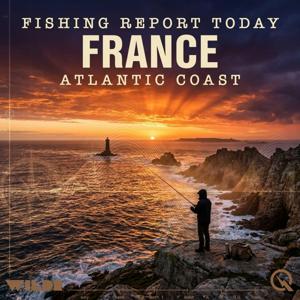
Name’s Artificial Lure, checking in with your Atlantic Coast fishing report for western France, from Brittany down to the Vendée and Charente coast.
Along the Bay of Biscay, a soft low-pressure pattern has kept things mild: light to moderate west–northwest winds, seas running manageable with a bit of leftover chop on the open beaches, and air temps sitting in the comfortable teens to low twenties Celsius through the day. Skies have been mixed cloud and sun, with clearer windows toward evening.
Tides along the French Atlantic are on generous coefficients right now, giving strong movement on the bigger swings. Around Saint‑Malo, Saint‑Nazaire, and La Rochelle, expect plenty of water pulling off the flats at first light and again late in the day. That falling tide has been the key window, especially halfway down to low, when the bait gets flushed off the sandbars and out of the estuaries.
Sunrise along the coast is coming early, just after six in the morning, with sunset after nine at night, giving a long crepuscular bite. The most consistent action has been in the first two hours of daylight and the last two before dark, plus a noticeable push around the stronger tidal phases.
Fish activity has picked up nicely. Shore anglers and small‑boat crews off Brittany and the Vendée have been bending rods on **European sea bass** (loup/bar), school‑size fish with the odd better specimen, plus decent numbers of **pollack**, **mackerel**, and **garfish** on the cleaner water edges. In the estuaries and channels, **gilthead bream** and other sparids are nosing around rocky pockets and mussel beds, while the surf guys are still finding **flatfish**—mostly flounder and the occasional plaice—on the outer bars.
Reports from local tackle shops along Quiberon and Les Sables‑d’Olonne say bass catches have been steady rather than explosive: a handful of fish per session for those who move around and time the tides, with more fish seen boiling on small bait in the evenings just off the breakers. Charter skippers out of La Rochelle and Île de Ré have been putting clients onto mixed bags of bass, pollack, and mackerel on light gear over reefs and wrecks in 15–30 meters.
For lures, keep it simple and local:
– Slim **metal jigs** and casting spoons in 20–40 g for mackerel, garfish, and schoolie bass when birds are working.
– **Soft plastic shads** and finesse minnows in natural sand‑eel and anchovy colors, rigged on 10–30 g jig heads, crawled along reefs, kelp lines, and channel edges for bass and pollack.
– Shallow and mid‑running **hard minnows** in silver, blue, or mullet patterns for dawn patrol on the rocks and along harbour walls.
For bait, the staples still rule: fresh **ragworm**, **lugworm**, and **peeler crab** on the surf and estuary marks for bream and flatfish; small fillets of **mackerel** or **sardine** on simple bottom rigs for opportunistic bass and rays. Where permitted, live **sand‑eel** slow‑trolled or drifted near structure has been the top ticket for better‑grade bass.
Couple of hot spots to keep on your radar:
– **Quiberon Peninsula, Brittany**: Work the outer rock marks and nearby reefs on a dropping tide at first light with soft plastics and slim metal jigs. Bass, pollack, and stray mackerel have all been coming to hand there when the swell is reasonable.
– **Île de Ré and La Rochelle area**: The bridges, channels, and nearshore reefs have produced mixed bags. Fish the moving water around the tide turns with small shads near the bottom and natural baits on simple running rigs for bream and bass.
If you head out, watch that swell on exposed headlands, respect the tides—they’re pulling hard right now—and match your lure size to the bait you’re seeing in the water. Keep mobile, give each mark a fair shot through the best part of the tide, then move on.
Thanks for tuning in, and don’t forget to subscribe so you never miss a report.
This has been a quiet please production, for more check out quiet please dot ai.
Great deals on fishing gear https://amzn.to/44gt1Pn