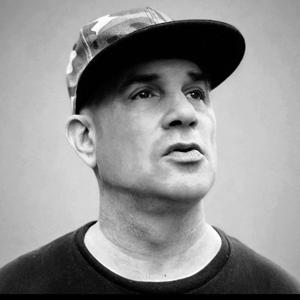
Frankie Bones, born Frank Mitchell, is an American DJ and record producer whose career was central to the emergence of rave culture in the United States during the late 1980s and early 1990s. A Brooklyn native, Bones became known for connecting New York's underground dance-music traditions with the rapidly developing rave culture of the United Kingdom. Through his DJ sets, record labels, productions, and legendary Storm Rave parties, he helped establish the foundations of the American rave scene.
He is widely associated with the "Godfather of American Rave Culture" title and is particularly linked to the development and popularization of the PLUR philosophy—Peace, Love, Unity, Respect—which became one of the defining ideals of rave and electronic dance-music communities.
Early Life
Brooklyn Roots
Frank Mitchell was born in Brooklyn, New York, in 1966 and grew up during a period when disco, early hip-hop, funk, and emerging street culture were transforming New York's musical landscape.
Music was a major part of his childhood. His father, a rock-music enthusiast from the Woodstock generation, maintained a large record collection, while his parents were regulars in New York's nightlife. Radio stations such as KISS-FM exposed Mitchell to disco, electro, funk, and the developing sounds of hip-hop.
His first major connection to dance music came through Brooklyn's roller-disco culture. As a child, he frequented the Roll-A-Palace in Sheepshead Bay, where DJs provided the soundtrack for crowded skating sessions. The experience introduced him not only to dance music but also to the relationship between a DJ, a sound system, and a crowd.
By his teenage years, Mitchell was deeply involved in the street culture surrounding breakdancing, graffiti, and hip-hop. He also began experimenting with turntables and learning how to mix records. The death of his father shortly before Mitchell graduated high school had a profound effect on him, and he inherited his father's record collection, giving him an even deeper musical foundation.
Becoming a DJ
During the early 1980s, Mitchell began playing parties and clubs around Brooklyn and New Jersey. His sets drew from disco, funk, electro, hip-hop, and the emerging house sound. He developed his technique largely through practice and observation, learning how to manipulate records and build momentum on the dance floor.
Rather than treating genres as separate worlds, he increasingly combined them. Breakbeats, house rhythms, electro sounds, and harder-edged New York styles became components of a developing sound that would later become associated with his rave work.
His early experiences also connected him with DJs and producers who were becoming important figures in New York's underground dance scene. Among them was Tommy Musto, with whom Bones eventually formed the production partnership Musto & Bones.
Production and Bonesbreaks
By the late 1980s, Bones had moved beyond DJing into production. His early work included the Bonesbreaks series, which provided DJs with raw, sample-heavy breakbeats and rhythmic tools.
Bonesbreaks Volume 1 and Volume 2 became important underground releases and demonstrated Bones's interest in the kind of hard, percussive sound that would soon become fundamental to rave and techno.
He also worked with producers including Tommy Musto and Omar Santana and became involved with the New York house and techno community surrounding labels such as Nu Groove.
In 1988, Bones released Bonesbreaks Volume 1: Hard, Raw & Raunchy Beats for DJ's, helping establish his reputation as a producer as well as a DJ. His productions combined the rhythmic language of hip-hop and breakbeat music with the emerging electronic sounds of house and techno.
Discovering the British Rave Scene
A defining moment in Bones's career came with his trips to the United Kingdom in the late 1980s.
In 1989, he traveled to Britain to perform for the rapidly expanding acid-house and techno scene. There he encountered a rave culture that was dramatically different from the club-centered nightlife he knew in New York.
One of the most important experiences was his appearance at the Energy rave at Raydon Airfield in Suffolk. The enormous event, staged in an aircraft hangar, attracted tens of thousands of people. Bones was struck by the scale of the gathering and by the sense of community among people from very different social and cultural backgrounds.
The experience convinced him that the rave model could work in the United States. Rather than simply importing British records, he wanted to recreate the atmosphere: enormous spaces, powerful sound systems, all-night dancing, and a sense that the crowd itself was part of the event.
When Bones returned to New York, he began putting that idea into practice.
Storm Rave
The result was Storm Rave.
The first Storm Rave was held on May 11, 1991, at a brickyard in Flatbush, Brooklyn. What began with a relatively small crowd grew into a series of increasingly ambitious underground events.
Storm Rave parties moved through warehouses, industrial spaces, abandoned buildings, and other unconventional locations. The events were built around long, intense DJ sets and the increasingly hard and fast sounds of techno and rave music.
Because many of the parties were unauthorized, organizers frequently had to contend with police intervention, noise complaints, and other logistical problems. Locations could change at the last minute, and the underground nature of the events became part of their identity.
As word spread, Storm Rave became a major gathering point for New York's emerging rave community. Bones's parties helped demonstrate that American audiences could embrace the same large-scale, nontraditional dance culture that had developed in Britain.
Storm Rave was more than a series of parties, however. It helped create a social environment in which DJs, producers, promoters, dancers, and fans could develop a shared identity around electronic music.
PLUR: Peace, Love, Unity, Respect
Perhaps Bones's most enduring cultural legacy is his association with PLUR.
The phrase developed within the New York rave community during the early 1990s. Adam X, Bones's brother, was involved in the early use of "Peace Love Unity," while Bones helped turn those ideas into a broader philosophy for rave culture.
The fourth word—"Respect"—became particularly significant after an incident at a 1993 party known as Back to Basics in the Bronx. A fight broke out during Bones's set, prompting him to address the crowd from the stage and demand that people stop fighting and respect the community around them.
From this culture emerged the familiar formulation:
Peace. Love. Unity. Respect.
PLUR became a shorthand for the social ideals that many ravers wanted their events to embody. Rather than simply being a slogan, it represented an attempt to make underground parties spaces where people from different backgrounds could dance together without violence, discrimination, or unnecessary conflict.
The philosophy eventually spread far beyond New York. It became associated with rave culture around the world and influenced everything from dance-floor etiquette to the tradition of exchanging kandi bracelets.
Bones has described PLUR as a kind of raver manifesto: a set of principles intended to preserve the communal spirit that made rave culture distinctive.
Record Labels and the New York Techno Underground
Bones's influence extended beyond the dance floor.
He founded Underworld Records in the late 1980s, using the label as an outlet for his own productions and music from the New York underground. The label became closely associated with the raw breakbeat and techno sounds developing around the city.
Bones was also involved with Groove Records, a Brooklyn record store that became an important meeting place for New York's emerging techno and rave community. His relationship with his brother Adam X and other figures in the scene helped create a network connecting DJs, producers, record collectors, and promoters.
In the 1990s, Bones and his collaborators were also involved in Sonic Groove, which became one of New York's best-known underground techno institutions. The label and its associated community helped introduce audiences to a new generation of American and international techno producers.
Musical Style and Discography
Bones's productions have always reflected his eclectic background.
His music draws on the breakbeats and sampling techniques of hip-hop, the rhythmic foundations of house, the darker textures of techno, and the speed and intensity of British rave.
Among his best-known early releases are the Bonesbreaks records and the 1990 track "Call It Techno." His collaborations with Adam X, including the Crossbones EP, further explored the increasingly aggressive sound of early-1990s techno.
His later catalog includes the album Technolo-G, released in 1998, as well as numerous DJ mixes, singles, EPs, reissues, and archival collections.
The Bonesbreaks concept has remained particularly important to his legacy. The series captured the raw, functional approach of early DJ-oriented production: records designed not merely to be listened to but to be manipulated, layered, mixed, and used to build energy on a dance floor.
In the 2020s, Bones continued revisiting his archive through digital releases and DJ mixes, allowing younger audiences to discover music originally created during the formative years of American rave culture.
Influence on American Rave Culture
Bones's importance is not limited to the records he produced.
His greatest contribution was cultural. He helped translate the British rave experience into a distinctly American context.
The American rave scene did not simply copy Britain. New York brought its own traditions—hip-hop, disco, graffiti, breakdancing, house, techno, warehouse parties, and street culture. Bones understood how these elements could coexist and used them to build something new.
His Storm Rave events demonstrated that electronic music could function as the center of an entire underground community. His record labels and stores provided infrastructure for that community, while his DJ sets connected American audiences with rapidly evolving international sounds.
He also became an important mentor and collaborator within the New York techno scene, helping create opportunities for younger DJs and producers.
Legacy
Frankie Bones remains one of the key figures in the history of American electronic music.
His legacy rests on several interconnected achievements: helping introduce the British rave model to American audiences, developing the Storm Rave parties, producing influential early breakbeat and techno records, contributing to the growth of New York's underground techno infrastructure, and popularizing the communal philosophy associated with PLUR.
His story is ultimately about more than music. Bones came from the roller rinks, record stores, graffiti-covered streets, and underground clubs of New York and carried those experiences into the emerging international rave movement.
The result was a distinctly American interpretation of rave culture—hard, energetic, rebellious, and deeply communal.
For that reason, Frankie Bones remains an important figure in the story of how rave culture crossed the Atlantic and became a lasting part of American electronic music.