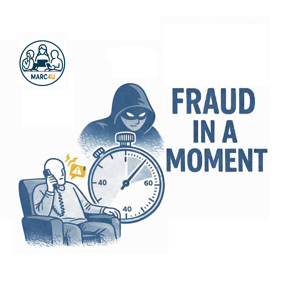
Welcome to Fraud in a Moment - This 8 min story shares the scamming of a senior through Federal "digital arrest" and millions in alleged money laundering.
If you like this story - please click the SHARE button above and share with an important senior in your world!
BE SURE TO SUBSCRIBE TO KEEP MORE STORIES LIKE THIS ONE COMING!
Check out our other stories: www.youtube.com/@FIAM4U00
Check out the https://MARC4U.org website for all things Fraud Awareness for Seniors and Retirees including our full-length episodes of Fraud on the Front Porch http://www.youtube.com/@FraudontheFrontPorch discussing the ocean of fraud plaguing Seniors and Retirees.
Intro Liner: The man on the phone said a package had been intercepted at the Port of Chicago.
It was addressed to Walter. It contained forty-seven thousand dollars in cash and three burner phones.
Walter had never mailed a package to Chicago. He had never owned a burner phone.
But the man on the phone said that did not matter. His name was already on the manifest.
And a federal warrant — he said — had already been issued.
This is Fraud in a Moment and the truth starts now.
LESSONS LEARNED: What Walter's Story Teaches
Walter's experience reveals how digital arrest scammers use shipping notifications, federal impersonation, and enforced isolation to paralyze victims for days or weeks. Share this list with every senior you know.
1. HANG UP ON ANY CALL ABOUT A SUSPICIOUS PACKAGE — If you receive a call claiming that a package bearing your name or address has been intercepted by customs or federal agents, hang up. Then call U.S. Customs and Border Protection directly at their official number (1-877-227-5511) or look up the number yourself at cbp.gov. Do not use any callback number provided by the caller.
2. THE FBI DOES NOT CONDUCT ARRESTS OVER WHATSAPP — Federal law enforcement agencies — the FBI, Homeland Security, the DEA, and all others — do not notify citizens of criminal investigations, issue warrants, or conduct hearings via WhatsApp, Telegram, Zoom, FaceTime, or any consumer video platform. Any video call claiming to be an official federal proceeding is a scam.
3. "DIGITAL ARREST" IS NOT A LEGAL TERM — There is no such thing as a digital arrest under U.S. law. No federal or state statute grants law enforcement the authority to confine a citizen to their home through a phone or video call. If someone uses that phrase, they are not law enforcement.
4. NO GOVERNMENT PROGRAM REQUIRES YOU TO WIRE MONEY TO PROVE INNOCENCE — Legitimate federal investigations never ask private citizens to transfer personal funds to "government escrow accounts" to demonstrate cooperation or avoid indictment. Any request to wire money, purchase gift cards, or send cryptocurrency to a government account is fraud — regardless of how official the request sounds.
5. THE ORDER TO STAY SILENT IS THE SCAM'S MOST POWERFUL WEAPON — If anyone — claiming to be law enforcement or otherwise — tells you not to speak to your family, your attorney, or anyone you trust, that instruction is designed to isolate you and prevent you from getting help. Real law enforcement has no authority to forbid you from contacting your family. Ignore the instruction and make the call.
6. A BACKDROP IS NOT A FEDERAL OFFICE — Professional-looking video backgrounds, official seals, uniforms, and framed credentials can all be purchased, rented, or digitally generated for next to nothing. The visual authority of a video call proves nothing about the identity of the person on screen. Seeing a badge or a seal is not verification.
7. CALL YOUR FAMILY BEFORE YOU DO ANYTHING ELSE — If you receive any call that makes you feel frightened, accused, or legally threatened — stop everything and call a trusted family member before taking any action. One phone call to someone who loves you is the single most effective disruption of the digital arrest scam that exists.
8. LOOK UP THE OFFICIAL NUMBER YOURSELF — Never use a phone number or website link provided by the caller, the email, or the video screen. Independently search for the agency's real contact information on a verified .gov website and call it yourself. This single step stops the vast majority of government impersonation scams.
9. KNOW THE SIGNS OF A SPOOFED NUMBER — Digital arrest scammers frequently spoof the caller ID to show a real government phone number — including the actual number for the FBI, the FTC, or Customs. A caller ID that looks official is not proof of a real call. Hang up and call the agency back using the number you found independently.
10. REPORT IMMEDIATELY AT IC3.GOV — If you have been targeted by a digital arrest scam, report it to the FBI at ic3.gov, the FTC at ReportFraud.ftc.gov, and the AARP Fraud Watch Network Helpline at 1-877-908-3360. If you have wired money, call your bank immediately — wire transfers can sometimes be recalled within hours if reported fast enough.