Free Astronomy Public Lectures

Free Astronomy Public Lectures

By Swinburne University of TechnologyEducation
Download on the App Store

Free Astronomy Public Lectures episodes

  • From grains to planets (Free Astronomy Public Lectures)
    Presented by Catarina Ubach and Francesco Pignatale on 25th May 2012.

    Solar System bodies such as planets, meteorites and comets are all created from small grains during the protoplanetary disk phase. The chemical composition of all these objects is intrinsically related to the chemistry of gas and grains in the parent disk. In the first part of the lecture we will explore the evidence we have to understand grain growth in discs. In the second part of the lecture we will go through the chemistry of discs and how thermodynamics can help us to understand the formation of our Solar System and the bulk composition of exoplanets orbiting stars different from our Sun.
    45 min
  • Learning about the sub-atomic world from observations to the edge of the Universe (Free Astronomy Public Lectures)
    Presented by Assoc. Prof. Chris Blake on 18th April 2012.

    Scientists have been trying to understand the building blocks of matter for millenia. What are the fundamental particles and forces that shape the sub-atomic world? Even today, we are faced with a series of puzzles and challenges that could overturn our view of reality. What particle makes up the dark matter? What are neutrinos, and do they really trave l faster than the speed of light? What caused the slight imbalance between matter and anti-matter, leading to a Universe in the first place? Powerful particle accelerators, such as the Large Hadron Collider, are striving to answer these questions. However, by peering into the distant Universe we can find the ultimate particle accelerator of them all: the Big Bang. In this talk we will explore how observations to the edge of the Universe can test our theories about the smallest particles that exist, and may change our views about the fundamental nature of reality.

    1 hr 1 min
  • Learning about the sub-atomic world from observations to the edge of the Universe (Free Astronomy Public Lectures)
    Presented by Assoc. Prof. Chris Blake on 18th April 2012.

    Scientists have been trying to understand the building blocks of matter for millenia. What are the fundamental particles and forces that shape the sub-atomic world? Even today, we are faced with a series of puzzles and challenges that could overturn our view of reality. What particle makes up the dark matter? What are neutrinos, and do they really trave l faster than the speed of light? What caused the slight imbalance between matter and anti-matter, leading to a Universe in the first place? Powerful particle accelerators, such as the Large Hadron Collider, are striving to answer these questions. However, by peering into the distant Universe we can find the ultimate particle accelerator of them all: the Big Bang. In this talk we will explore how observations to the edge of the Universe can test our theories about the smallest particles that exist, and may change our views about the fundamental nature of reality.
    1 hr 1 min
  • The Dynamic Universe (Free Astronomy Public Lectures)
    Presented by Professor Shri Kulkarni on 28th March 2012.

    That occasionally new sources ("Stella Nova") would pop up in the heavens was noted more than a thousand years ago. The earnest study of cosmic explosions began in earnest less than a hundred years ago. Stella Novae are now divided into two major families, novae and supernovae (with real distinct classes in each). Equally the variable stars have a rich phenomenology. Together, supernovae and variable stars have contributed richly to key problems in modern astrophysics: distances to galaxies, cosmography and build up of elements in the Universe.

    The Palomar Transient Factory (PTF), an innovative 2-telescope system, was designed to explicitly to chart the transient sky witha particular focus on events which lie in the nova-supernova gap.
    1 hr 8 min
  • Dynamics in the solar system (Free Astronomy Public Lectures)
    Presented by Assoc. Prof. Sarah Maddison on 20th October 2011.

    The clockwork-like motion of the planets around the Sun is well understood thanks to Newton's universal law of gravitation. Using Newtonian physics and some simple mathematical equations, we can describe (and predict) the motion of a planet around the Sun. The solution to this "2-body problem" allows us to determine the location of an orbiting body at any time in the future. But when we add just one more body, the situation becomes a lot more complex. Our Solar System hosts a rich variety of dynamics, including the Kirkwood gaps in the asteroid belt, intricate structures in Saturn's rings, and the resonant orbits of Jupiter's Galilean satellites. In this talk we will discuss some of these interesting phenomena and how gravity shapes the Solar System.
    1 hr 3 min
  • The ATLAS Experiment at CERN's Large Hadron Collider - status and outlook (Free Astronomy Public Lectures)
    Presented by Prof. Geoff Taylor on 2nd December 2011

    The Large Hadron Collider is operating beautifully well. Data from the highest energy particle collisions produced in the laboratory is being amassed at rates never before achieved. The big experiments, including the ATLAS experiment, on which Australian scientists collaborate, are operating extraordinarily well considering their complexity. The level of sophistication of analyses achieved with such a short period of operation has surprised the scientific world. Searches for the Higgs boson, Supersymmetry and other exotic phenomena are well underway. This presentation will give the status of these searches in the LHC/ATLAS program.
    The new ARC Centre of Excellence for Particle Physics at the Terascale ("CoEPP") brings together Australian experimentalist and theorists from Melbourne, Adelaide, Sydney and Monash. It will provide the resources and the focus to fully participate in the LHC program. A description of the CoEPP and its key goals will be covered in the presentation.
    1 hr 13 min

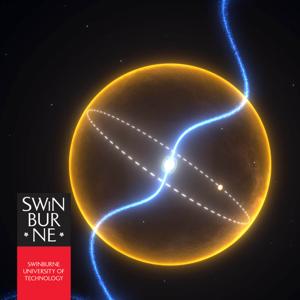
About Free Astronomy Public Lectures

From the publisher's feed

Each month, from February to November, the Centre for Astrophysics & Supercomputing presents a free public lecture at the Hawthorn campus of Swinburne University of Technology.

More shows like Free Astronomy Public Lectures

Chancellor's Lecture Series by Swinburne Commons

Chancellor's Lecture Series

0 Listeners

Talking About ... by Learning Transformations Unit

Talking About ...

0 Listeners

CSIRO Oral Histories by Swinburne Commons

CSIRO Oral Histories

0 Listeners