
Sign up to save your podcasts
Or



The Digital and Innovation Economy is in the midst of a technological revolution—one in which Black people have the best chance of not only getting in the water, but on the front side of the wave. Emerging Black technologists face new terrains as pioneers among pioneers, as well as old habits and beliefs which aren’t welcoming to the possibilities of an inclusive digital landscape. Nevertheless, breakthroughs happen, thanks to trailblazers committed to not being the only Black visionary in a still very undiversified world. Join From Chains to Links and guest Latoya Peterson, Cofounder, CXO, and Director for the Culture at Glow Up Games as her pioneering journey in new media and gaming provides major keys for how rising talent can succeed in the digital economy while still being authentic to themselves and the culture.
The saying “it takes a village to raise a child” doesn’t explicitly factor in how much that village will cost. The price of just “being Black” is expensive. And for many creatives, innovators, and entrepreneurs, the cost of growth and expansion is unaffordable. Although one of the brief responses to the murder of George Floyd was a slight uptick in public and private commitments, data reveals that funding to Black entrepreneurs still severely lagged in comparison to what white spaces received. Institutions gained a lot of clout and exposure being connected to the brand of Black activism and movement, but not that most have departed from their public promises, Black entrepreneurs seeking to build impactful ventures are lumped back into the traditional models of funding and support—which includes tokenizing and the VC quest for the next “unicorn” in tech and business.
Former NYC Deputy Mayor and current CEO of Robin Hood Foundation, Richard Buery, Jr., challenges the From Chains to Links community to question whether these standards yield sustainable results, and how bridging imagination with capital interventions helps us build the villages we deserve
The height of the COVID-19 pandemic made folks aware of a very rare fact: our modern understanding of vaccines is because of an underknown man named Onesimus. Sold into slavery and gifted to a Puritan Minister, it was observed that Onesimus was unscathed by ravenous smallpox, taking the lives of colonizers in the late 1700s. Onesimus shared how in his home country on the continent of Africa, they administered an inoculation, which shielded him from the disease. This precursor to the modern-day vaccine would ultimately save countless lives through the American colonies, and that knowledge still saves lives today.
From medicine to fashion, violence, theft, and erasure have resulted in Black contributions being intentionally invisible, treating Black communities as foreigners to their own innovations. To add insult to injury, Black culture and indigenous and native ways of being—often an offspring of being and survival—are praised when others adopt and appropriate with no attribution to Black genius. Cultural Sustainability Vanguard Dominique Drakeford explores with From Chains to Links how we ensure that the current and future generations of innovators are able to make their mark—and possess it.
We’re celebrating the middle of our launch season with a special conversation with our very own co-host Ifeoma Ike, author of The Equity Mindset. Ifeoma shares why she developed a gumbo of interviews, practical tools, and disruptive strategies to support those invested in building spaces where marginalized communities are ignored and harmed. Providing a vulnerable account of writing with a disability, maneuvering the publishing world, and creating space for underlooked equity architects, Ifeoma’s journey is a must for visionaries and entrepreneurs alike seeking to use words to spark change.
Society makes it hard for Black people to imagine liberation or freedom outside of our experience in White America. Because so much of our existence is a product of resistance and survival, even our creative spaces consciously and subconsciously speak to a relationship with oppression or designing solutions to issues Black people didn’t create. But if we could imagine a “state of nature” outside of racism or white supremacy—one that does not limit our fullness to narrow, exoticized, or romanticized tropes of our African origins or American journey, but rather pays homage to and embodies them—what might that look like? And how might we reverse-engineer back (or forward) into a fresh and compelling vision for ourselves? From Chains to Links sits with the brilliant Intelligent Mischief team—Aisha Shillingford, Artistic Director, and Terry Marshall, Founder & Executive Creative Director—who share how imagining whole, well-Black-beings is a crucial part of visioning and world-building.
How much do we really credit Black people with the innovation of freedom and liberation? The significance of the Underground Railroad is not only how it freed enslaved Black people, but how leaders like Harriet Tubman and unknown conductors innovated safe, trusting and liberatory pathways and spaces for Black bodies. From Chains to Links is joined by Jeff Lindor Founder, CEO of Gentlemen’s Factory, Inc, for a powerful exploration of liberatory practices, the power of spacebuilding, and the ways environment impacts innovation as Black visionaries build out their dreams.
Diversity, Equity and Inclusion (DEI) has been a staple of corporate America for the past several decades, with peak attention at the height of movements challenging the lack of safety of Black lives post the murder of George Floyd and Breonna Taylor in 2020. At an unprecedented rate, Black leadership was visible across industries and as a result, institutions began confronting generations-old practices which created barriers for marginalized communities. But as power concedes nothing, “anti-woke” efforts conspired assaults all the way up to the Supreme Court. Furthermore, many racial justice advocates have long called out the shortcomings of DEI and its cousin affirmative action—neither of which have remedied the second-class citizenry of Black people in America. Thus, our first episode tackles the real question: “what’s next for racial justice advancement?”
From Chains to Links kicks off with policy expert, professor and Senior Fellow at Brookings Institute, Andre M. Perry, author of the book Know Your Price: Valuing Black Lives and Property in America’s Black Cities.
From the publisher's feed
The world moves because of Black innovation and creativity. But in a world where innovation has been sold as a narrative of the elite, the white and the male, how do we reclaim the truth about…
How do we design spaces where Black people live out their birthright as innovators?
When will Black creativity work for Black beyond survival and scarcity? And against us, to divide us or solely for the benefit of systems not designed to respect or protect us?
What are the cultural and indigenous practices, rituals and inventions that will transform our collective struggle into mass abundance?
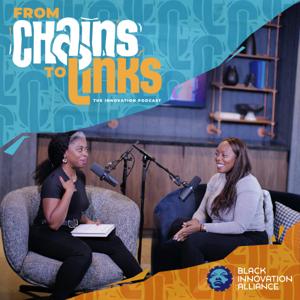
From Chains to Links is a groundbreaking innovation podcast uniting the vast experiences of Black thought leaders who dream abundantly and use their space to create more wealth pathways for Black entrepreneurs. This podcast intentionally acknowledges Black people as the drivers of economic and social change—building upon their complex relationship with capitalism, political movements and the advancements of technology, social media and the digital economy. A true experimentation of truth-telling and fellowship, From Chains to Links will inspire you, make you laugh and make you cry, while challenging you to think bigger, find your tribe and take your rightful place in the broader movement for Black liberation.
This podcast goes beyond traditional entrepreneurial topics by exploring the intersection of culture, identity, and business. Hosted by entrepreneurs, social scientists and activists Dr. Kelly Burton and Ifeoma Ike, Esq., each episode of From Chains to Links features vulnerable and engaging conversations with prominent Black entrepreneurs, luminaries and artists across industries who see the power in sharing journeys, hacks and data to build a safer and more equitable business landscape. A living room parlor vibe, no topic is off-limits: from the definition of success, to impact of trauma, to the role of movements in a digital world. Space is given for the diversity of thought which has always existed in Black communities.
A product of the Black Innovation Alliance, From Chains to Links is a bridge to valuable resources for aspiring Black entrepreneurs and provides practical advice, strategies and actionable insights to help listeners navigate the complexities of starting and scaling their own businesses. Don’t miss out on the provocative space providing tools, innovation and joy through the greatest invention of all: Black love.
Join us as we celebrate the resiliency, creativity, and innovation of Black entrepreneurs, and contribute to a more inclusive and thriving entrepreneurial ecosystem.