
Sign up to save your podcasts
Or

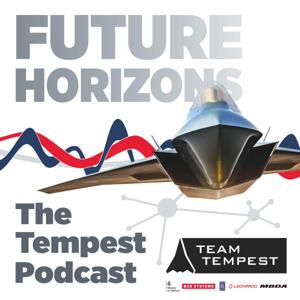


Listen to episode four of Future Horizons, where in part one, we explore the findings of a new report which analyses Tempest’s projected impact on the UK aerospace industry and the wider UK economy. In part two, listeners are given VIP access to an exclusive tour of the Tempest cockpit, to get a pilot’s view of the future of flight.
Part 1 - PWC Report – Powering future economies
After an independent evaluation, analysts at PriceWaterhouseCoopers have issued a report on their estimation of the Tempest programme's value to the UK aerospace industry and the potential investment in highly skilled jobs across all regions of the country. Innovation on the Tempest programme is laying the foundations of aerospace technology for those who will follow far into the future.
It is realistic to state that the work being carried out right now, will have an impact on aerospace innovation for the next 100 years. So what are the most striking features of the report and what can we learn from its findings?
Here to share their views are Jonathan Hawkings, Director of Policy, ADS, Andrew Kinniburgh, Director General, Make UK Defence and Neil Ross, Head of Policy, techUK.
Part 2 - The Pilot’s view – Powering future flight (starting at 30:53)
The podcast begins with Suzy Broadbent, Human Factors Manager, BAE Systems giving listeners a VIP tour of the Tempest cockpit to give them the pilot’s view of the technology.
Suzy then joins a wider discussion with Emma Ulmann, Principal Engineer, MBDA and Jonathan Smith, Head of Capability, Major Air Programmes, Leonardo, to help us understand how this remarkable technology is going to help the pilot think and act in ways that have never been possible before.
Find out more about Team Tempest
Follow us on Twitter for the latest news on Team Tempest
Learn more about the opportunities for #GenerationTempest on Instagram
Catch up our story so far on YouTube
In this third episode of the six-part series, we look beyond the core Tempest partners to shine a spotlight on how the project is becoming a true national endeavor. We meet some of the many high-tech companies and academic minds supporting Team Tempest and discuss how their innovation and ideas are helping transform the way we are developing technology to realise the benefits of Tempest both for and far beyond the military air sector.
Part 1 - Breaking the technology barrier
So, what are these projects and why are they breaking into brand new territory for UK industry?
Host Zevi Watmough is joined by Dr Darrell Jaya-Ratnam, Managing Director of DIEManalytics, Professor Simon Maskell, Professor of Autonomous Systems in Electrical Engineering and Electronics at Liverpool University and Craig Turnbull, Director of Electroimpact.
Part 2 - Tempest radar: a new age of system integration (starting at 34:30)
In part 2 of the podcast, we take you into the fascinating world of Tempest radar technology which is so advanced, it can process a city’s worth of data in a second.
We’re joined by Chief Engineer, Alex at Leonardo and Principal Design Engineer, Sam at MBDA. Alex and Sam have been collaborating on some of the most cutting edge radar innovation and system integration in the world, so they’re going to break down the technology for us, to explain how they’re building innovation from the inside out.
Find out more about Team Tempest
Follow us on Twitter for the latest news on Team Tempest
Learn more about the opportunities for #GenerationTempest on Instagram
Catch up our story so far on YouTube
In this second episode of the six-part series, we discuss the implications of the UK Government's Integrated Review for Tempest and the aerospace industry, and speak with industry experts on the concept of ‘Information Advantage’, where having better information provides an edge in combat.
Part 1 – The impact of the UK Government’s Integrated Review and the UK MOD’s Defence Command Paper
We discuss the implications of these publications for Tempest and the wider aerospace industry.
Host Zevi Watmough is joined by Richard Berthon OBE, Director Future Combat Air at the Ministry of Defence; Tim Ripley, freelance journalist and a prolific author on military and defence subjects; and Phil Townley, Director Future Programmes, Rolls Royce Defence.
Part 2 – Claiming the Informational Advantage in an Information Age (starting at 33:50)
The digital race is on to acquire and process more and more information at lightning speed. With daily advances in digital technology, how do we take the right action to ensure the UK armed forces maintain an informational advantage?
We speak to Steve Formoso, Chief Test Pilot at BAE Systems and Lukas Chamberlain, Tempest Project Chief Engineer at Leonardo.
Find out more about Team Tempest
Follow us on Twitter for the latest news on Team Tempest
Learn more about the opportunities for #GenerationTempest on Instagram
Catch up our story so far on YouTube
In our first episode of this exciting six-part series, we provide an insight into Team Tempest UK - comprising the Royal Air Force Rapid Capability Office, BAE Systems, Leonardo, Rolls Royce and MBDA - who together are develop the technologies, knowledge, skills and expertise needed to deliver a Next Generation Combat Air System capable of operating in the 2040+ environment.
Host Zevi Watmough is joined by Michael Christie, Director, Future Combat Air Systems at BAE Systems, Andrew Howard, Director Major Air Programmes at Leonardo and Defence Journalist, Analyst and Historian, Francis Tusa.
Part 2 – Nurturing Generation Tempest (starting at 30:10)
We speak to BAE Systems Engineering Degree Apprentice, Christian, Leonardo Systems Team Leader, Sophie, Rolls-Royce Design Engineer, Rafael, and MBDA, Principal Systems Engineer Aditi.
From the publisher's feed

398 Listeners

3,031 Listeners