
Sign up to save your podcasts
Or



Śrī Sūta Gosvāmī said: While returning home, the King [Mahārāja Parīkṣit] felt that the act he had committed against the faultless and powerful brāhmaṇa was heinous and uncivilized. Consequently he was distressed. [King Parīkṣit thought:] Due to my neglecting the injunctions of the Supreme Lord I must certainly expect some difficulty to overcome me in the near future. I now desire without reservation that the calamity come now, for in this way I may be freed of the sinful action and not commit such an offense again.I am uncivilized and sinful due to my neglect of brahminical culture, God consciousness and cow protection. Therefore I wish that my kingdom, strength and riches burn up immediately by the fire of the brāhmaṇa’s wrath so that in the future I may not be guided by such inauspicious attitudes. While the King was thus repenting, he received news of his imminent death, which would be due to the bite of a snake-bird, occasioned by the curse spoken by the sage’s son. The King accepted this as good news, for it would be the cause of his indifference toward worldly things. Mahārāja Parīkṣit sat down firmly on the banks of the Ganges to concentrate his mind in Kṛṣṇa consciousness, rejecting all other practices of self-realization, because transcendental loving service to Kṛṣṇa is the greatest achievement, superseding all other methods.The river [by which the King sat to fast] carries the most auspicious water, which is mixed with the dust of the lotus feet of the Lord and tulasī leaves. Therefore that water sanctifies the three worlds inside and outside and even sanctifies Lord Śiva and other demigods. Consequently everyone who is destined to die must take shelter of this river.
Śrī Sūta Gosvāmī said: Due to the mercy of the Personality of Godhead, Śrī Kṛṣṇa, who acts wonderfully, Mahārāja Parīkṣit, though struck by the weapon of the son of Droṇa in his mother’s womb, could not be burned.Furthermore, Mahārāja Parīkṣit was always consciously surrendered to the Personality of Godhead, and therefore he was neither afraid nor overwhelmed by fear due to a snake-bird which was to bite him because of the fury of a brāhmaṇa boy.Furthermore, after leaving all his associates, the King surrendered himself as a disciple to the son of Vyāsa [Śukadeva Gosvāmī], and thus he was able to understand the actual position of the Personality of Godhead, and at last gave up his material body on the bank of the Ganges.This was so because those who have dedicated their lives to the transcendental topics of the Personality of Godhead, of whom the Vedic hymns sing, and who are constantly engaged in remembering the lotus feet of the Lord, do not run the risk of having misconceptions even at the last moment of their lives.
Sūta Gosvāmī said: After reaching that place, Mahārāja Parīkṣit observed that a lower-caste śūdra, dressed like a king, was beating a cow and a bull with a club, as if they had no owner.The bull was as white as a white lotus flower. He was terrified of the śūdra who was beating him, and he was so afraid that he was standing on one leg, trembling and urinating.Although the cow is beneficial because one can draw religious principles from her, she was now rendered poor and calfless. Her legs were being beaten by a śūdra. There were tears in her eyes, and she was distressed and weak. She was hankering after some grass in the field.Mahārāja Parīkṣit, well equipped with arrows and bow and seated on a gold-embossed chariot, spoke to him [the śūdra] with a deep voice sounding like thunder. Oh, who are you? You appear to be strong and yet you dare kill, within my protection, those who are helpless! By your dress you pose yourself to be a godly man [king], but by your deeds you are opposing the principles of the twice-born kṣatriyas
Sūta Gosvāmī said: O learned brāhmaṇas, Mahārāja Parīkṣit then began to rule over the world as a great devotee of the Lord under the instructions of the best of the twice-born brāhmaṇas. He ruled by those great qualities which were foretold by expert astrologers at the time of his birth. King Parīkṣit married the daughter of King Uttara and begot four sons, headed by Mahārāja Janamejaya. Mahārāja Parīkṣit, after having selected Kṛpācārya for guidance as his spiritual master, performed three horse sacrifices on the banks of the Ganges. These were executed with sufficient rewards for the attendants. And at these sacrifices, even the common man could see demigods. Once, when Mahārāja Parīkṣit was on his way to conquer the world, he saw the master of Kali-yuga, who was lower than a śūdra, disguised as a king and hurting the legs of a cow and bull. The King at once caught hold of him to deal sufficient punishment.: Śaunaka Ṛṣi inquired: Why did Mahārāja Parīkṣit simply punish him, since he was the lowest of the śūdras, having dressed as a king and having struck a cow on the leg? Please describe all these incidents if they relate to the topics of Lord Kṛṣṇa.The devotees of the Lord are accustomed to licking up the honey available from the lotus feet of the Lord. What is the use of topics which simply waste one’s valuable life?
Śrī Sūta Gosvāmī said: Arjuna went to Dvārakā to see Lord Śrī Kṛṣṇa and other friends and also to learn from the Lord of His next activities. A few months passed, and Arjuna did not return. Mahārāja Yudhiṣṭhira then began to observe some inauspicious omens, which were fearful in themselves.: He saw that the direction of eternal time had changed, and this was very fearful. There were disruptions in the seasonal regularities. The people in general had become very greedy, angry and deceitful. And he saw that they were adopting foul means of livelihoodAll ordinary transactions and dealings became polluted with cheating, even between friends. And in familial affairs, there was always misunderstanding between fathers, mothers and sons, between well-wishers, and between brothers. Even between husband and wife there was always strain and quarrel.In course of time it came to pass that people in general became accustomed to greed, anger, pride, etc. Mahārāja Yudhiṣṭhira, observing all these omens, spoke to his younger brother. Mahārāja Yudhiṣṭhira said to his younger brother Bhīmasena: I sent Arjuna to Dvārakā to meet his friends and to learn from the Personality of Godhead, Kṛṣṇa, of His program of work. Since he departed, seven months have passed, yet he has not returned. I do not know factually how things are going there.
Śrī Sūta Gosvāmī said: Arjuna went to Dvārakā to see Lord Śrī Kṛṣṇa and other friends and also to learn from the Lord of His next activities.
A few months passed, and Arjuna did not return. Mahārāja Yudhiṣṭhira then began to observe some inauspicious omens, which were fearful in themselves.He saw that the direction of eternal time had changed, and this was very fearful. There were disruptions in the seasonal regularities. The people in general had become very greedy, angry and deceitful. And he saw that they were adopting foul means of livelihood. All ordinary transactions and dealings became polluted with cheating, even between friends. And in familial affairs, there was always misunderstanding between fathers, mothers and sons, between well-wishers, and between brothers. Even between husband and wife there was always strain and quarrel. In course of time it came to pass that people in general became accustomed to greed, anger, pride, etc. Mahārāja Yudhiṣṭhira, observing all these omens, spoke to his younger brother.
Śrī Sūta Gosvāmī said: While traveling on a pilgrimage, Vidura received knowledge of the destination of the self from the great sage Maitreya and then returned to Hastināpura. He became as well versed in the subject as he desired. After asking various questions and becoming established in the transcendental loving service of Lord Kṛṣṇa, Vidura retired from putting questions to Maitreya Muni. When they saw Vidura return to the palace, all the inhabitants — Mahārāja Yudhiṣṭhira, his younger brothers, Dhṛtarāṣṭra, Sātyaki, Sañjaya, Kṛpācārya, Kuntī, Gāndhārī, Draupadī, Subhadrā, Uttarā, Kṛpī, many other wives of the Kauravas, and other ladies with children — all hurried to him in great delight. It so appeared that they had regained their consciousness after a long period. With great delight they all approached him, as if life had returned to their bodies. They exchanged obeisances and welcomed each other with embraces.: Due to anxieties and long separation, they all cried out of affection. King Yudhiṣṭhira then arranged to offer sitting accommodations and a reception. After Vidura ate sumptuously and took sufficient rest, he was comfortably seated. Then the King began to speak to him, and all who were present there listened.
Join our Meta Verified WhatsApp Channel: https://whatsapp.com/channel/0029Var5TSW6RGJMUXDTYb1b
The sage Śaunaka said: The womb of Uttarā, mother of Mahārāja Parīkṣit, was spoiled by the dreadful and invincible brahmāstra weapon released by Aśvatthāmā. But Mahārāja Parīkṣit was saved by the Supreme Lord. How was the great emperor Parīkṣit, who was a highly intelligent and great devotee, born in that womb? How did his death take place, and what did he achieve after his death? We all respectfully want to hear about him [Mahārāja Parīkṣit] to whom Śukadeva Gosvāmī imparted transcendental knowledge. Please speak on this matter.Śrī Sūta Gosvāmī said: Emperor Yudhiṣṭhira administered generously to everyone during his reign. He was exactly like his father. He had no personal ambition and was freed from all sorts of sense gratification because of his continuous service unto the lotus feet of the Lord Śrī Kṛṣṇa. News even reached the celestial planets about Mahārāja Yudhiṣṭhira’s worldly possessions, the sacrifices by which he would attain a better destination, his queen, his stalwart brothers, his extensive land, his sovereignty over the planet earth, his fame, etc.
Join our Meta Verified WhatsApp Channel: https://whatsapp.com/channel/0029Var5TSW6RGJMUXDTYb1b
Sūta Gosvāmī said: Upon reaching the border of His most prosperous metropolis, known as the country of the Ānartas [Dvārakā], the Lord sounded His auspicious conchshell, heralding His arrival and apparently pacifying the dejection of the inhabitants. The white and fat-bowled conchshell, being gripped by the hand of Lord Kṛṣṇa and sounded by Him, appeared to be reddened by the touch of His transcendental lips. It seemed that a white swan was playing in the stems of red lotus flowers.The citizens of Dvārakā, having heard that sound which threatens fear personified in the material world, began to run towards Him fast, just to have a long desired audience with the Lord, who is the protector of all devotees.The citizens arrived before the Lord with their respective presentations, offering them to the fully satisfied and self-sufficient one, who, by His own potency, incessantly supplies others. These presentations were like the offering of a lamp to the sun. Yet the citizens began to speak in ecstatic language to receive the Lord, just as wards welcome their guardian and father.
Join our Meta Verified WhatsApp Channel: https://whatsapp.com/channel/0029Var5TSW6RGJMUXDTYb1b
Śaunaka Muni asked: After killing his enemies who desired to usurp his rightful inheritance, how did the greatest of all religious men, Mahārāja Yudhiṣṭhira, assisted by his brothers, rule his subjects? Surely he could not freely enjoy his kingdom with unrestricted consciousness. Sūta Gosvāmī said: Lord Śrī Kṛṣṇa, the Supreme Personality of Godhead, who is the maintainer of the world, became pleased after reestablishing Mahārāja Yudhiṣṭhira in his own kingdom and after restoring the Kuru dynasty, which had been exhausted by the bamboo fire of anger. Mahārāja Yudhiṣṭhira, after being enlightened by what was spoken by Bhīṣmadeva and Lord Śrī Kṛṣṇa, the infallible, engaged himself in matters of perfect knowledge because all his misgivings were eradicated. Thus he ruled over the earth and seas and was followed by his younger brothers. During the reign of Mahārāja Yudhiṣṭhira, the clouds showered all the water that people needed, and the earth produced all the necessities of man in profusion. Due to its fatty milk bag and cheerful attitude, the cow used to moisten the grazing ground with milk. The rivers, oceans, hills, mountains, forests, creepers and active drugs, in every season, paid their tax quota to the King in profusion.
From the publisher's feed
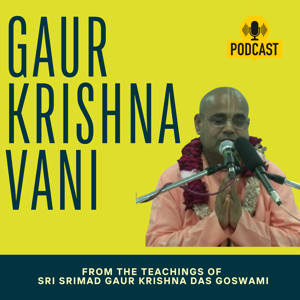
Gaur Krishna Vani is the official podcast of In Service of Srimad Bhagavatam. Gaur Krishna Das Goswami was a very dear disciple of Śrī Śrīmad Rādhā Govinda Goswami…
Early Life:
- Born on January 22, 1964, in Bihar, India.
- Received sannyāsa (renounced monk) initiation from Rādhā Govinda Swami in Haridwar on May 14, 2015.
Known For:
- Delivering Hindi discourses on the Bhagavad Gita, Chaitanya Charitamrita, and Śrīmad Bhāgavatam.