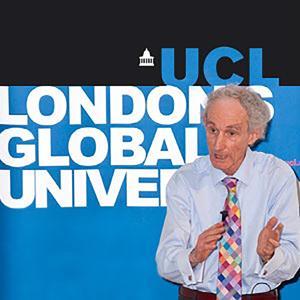
Geoffrey Burnstock - Audio

Geoffrey Burnstock - Audio

By UCL
Download on the App Store

Geoffrey Burnstock - Audio episodes

  • 1. School and university years
    Professor Geoffrey Burnstock was born in London in 1929 and studied theology, maths and physics at King’s College London, before completing a PhD at King’s and University College London (1957) under the supervision of the neurophysiologist, JZ Young. Between 1959 and 1975, Professor Burnstock worked at the University of Melbourne, beginning with a senior lectureship in zoology. Most of his major research has been on the autonomic nervous system, notably autonomic neurotransmission and he is best known for his discovery that ATP is a transmitter in NANC (non-adrenergic, non-cholinergic) nerves and also for the discovery and definition of P2 purinergic receptors, their signaling pathways and functional relevance. Professor Burnstock’s work in this area has had an impact on the understanding of pain mechanisms, incontinence, embryological development, bone formation and resorption, and on skin, prostate and bladder cancer.
    Professor Burnstock returned to London in 1975, becoming Head of Department of Anatomy and Developmental Biology at University College London and Convenor of the Centre of Neuroscience. He has served as editor-in-chief of the journals Autonomic Neuroscience and Purinergic Signalling and has been on the editorial boards of many other journals. He has been elected to the Australian Academy of Science (1971, the Royal Society (1986) and the Academy of Medical Sciences (1998), and was awarded the Royal Society Gold Medal (2000). He was President (1995-2000) of the International Society for Autonomic Neuroscience (ISAN), and was first in the Institute of Scientific Information list (1994-2004) of most cited scientists in Pharmacology and Toxicology.

    4 min
  • 26. Ideas for future research and an offer to young scientists
    Professor Geoffrey Burnstock was born in London in 1929 and studied theology, maths and physics at King’s College London, before completing a PhD at King’s and University College London (1957) under the supervision of the neurophysiologist, JZ Young. Between 1959 and 1975, Professor Burnstock worked at the University of Melbourne, beginning with a senior lectureship in zoology. Most of his major research has been on the autonomic nervous system, notably autonomic neurotransmission and he is best known for his discovery that ATP is a transmitter in NANC (non-adrenergic, non-cholinergic) nerves and also for the discovery and definition of P2 purinergic receptors, their signaling pathways and functional relevance. Professor Burnstock’s work in this area has had an impact on the understanding of pain mechanisms, incontinence, embryological development, bone formation and resorption, and on skin, prostate and bladder cancer.
    Professor Burnstock returned to London in 1975, becoming Head of Department of Anatomy and Developmental Biology at University College London and Convenor of the Centre of Neuroscience. He has served as editor-in-chief of the journals Autonomic Neuroscience and Purinergic Signalling and has been on the editorial boards of many other journals. He has been elected to the Australian Academy of Science (1971, the Royal Society (1986) and the Academy of Medical Sciences (1998), and was awarded the Royal Society Gold Medal (2000). He was President (1995-2000) of the International Society for Autonomic Neuroscience (ISAN), and was first in the Institute of Scientific Information list (1994-2004) of most cited scientists in Pharmacology and Toxicology.
    4 min
  • 10. The Chair of Anatomy at UCL, 1975: the secret of a successful department
    Professor Geoffrey Burnstock was born in London in 1929 and studied theology, maths and physics at King’s College London, before completing a PhD at King’s and University College London (1957) under the supervision of the neurophysiologist, JZ Young. Between 1959 and 1975, Professor Burnstock worked at the University of Melbourne, beginning with a senior lectureship in zoology. Most of his major research has been on the autonomic nervous system, notably autonomic neurotransmission and he is best known for his discovery that ATP is a transmitter in NANC (non-adrenergic, non-cholinergic) nerves and also for the discovery and definition of P2 purinergic receptors, their signaling pathways and functional relevance. Professor Burnstock’s work in this area has had an impact on the understanding of pain mechanisms, incontinence, embryological development, bone formation and resorption, and on skin, prostate and bladder cancer.
    Professor Burnstock returned to London in 1975, becoming Head of Department of Anatomy and Developmental Biology at University College London and Convenor of the Centre of Neuroscience. He has served as editor-in-chief of the journals Autonomic Neuroscience and Purinergic Signalling and has been on the editorial boards of many other journals. He has been elected to the Australian Academy of Science (1971, the Royal Society (1986) and the Academy of Medical Sciences (1998), and was awarded the Royal Society Gold Medal (2000). He was President (1995-2000) of the International Society for Autonomic Neuroscience (ISAN), and was first in the Institute of Scientific Information list (1994-2004) of most cited scientists in Pharmacology and Toxicology.
    3 min
  • 7. Co-transmission in sympathetic and parasympathetic nerves
    Professor Geoffrey Burnstock was born in London in 1929 and studied theology, maths and physics at King’s College London, before completing a PhD at King’s and University College London (1957) under the supervision of the neurophysiologist, JZ Young. Between 1959 and 1975, Professor Burnstock worked at the University of Melbourne, beginning with a senior lectureship in zoology. Most of his major research has been on the autonomic nervous system, notably autonomic neurotransmission and he is best known for his discovery that ATP is a transmitter in NANC (non-adrenergic, non-cholinergic) nerves and also for the discovery and definition of P2 purinergic receptors, their signaling pathways and functional relevance. Professor Burnstock’s work in this area has had an impact on the understanding of pain mechanisms, incontinence, embryological development, bone formation and resorption, and on skin, prostate and bladder cancer.
    Professor Burnstock returned to London in 1975, becoming Head of Department of Anatomy and Developmental Biology at University College London and Convenor of the Centre of Neuroscience. He has served as editor-in-chief of the journals Autonomic Neuroscience and Purinergic Signalling and has been on the editorial boards of many other journals. He has been elected to the Australian Academy of Science (1971, the Royal Society (1986) and the Academy of Medical Sciences (1998), and was awarded the Royal Society Gold Medal (2000). He was President (1995-2000) of the International Society for Autonomic Neuroscience (ISAN), and was first in the Institute of Scientific Information list (1994-2004) of most cited scientists in Pharmacology and Toxicology.
    3 min
  • 4. Discovering that ATP (or related nucleotide) is the potential NANC transmitter, 1970
    Professor Geoffrey Burnstock was born in London in 1929 and studied theology, maths and physics at King’s College London, before completing a PhD at King’s and University College London (1957) under the supervision of the neurophysiologist, JZ Young. Between 1959 and 1975, Professor Burnstock worked at the University of Melbourne, beginning with a senior lectureship in zoology. Most of his major research has been on the autonomic nervous system, notably autonomic neurotransmission and he is best known for his discovery that ATP is a transmitter in NANC (non-adrenergic, non-cholinergic) nerves and also for the discovery and definition of P2 purinergic receptors, their signaling pathways and functional relevance. Professor Burnstock’s work in this area has had an impact on the understanding of pain mechanisms, incontinence, embryological development, bone formation and resorption, and on skin, prostate and bladder cancer.
    Professor Burnstock returned to London in 1975, becoming Head of Department of Anatomy and Developmental Biology at University College London and Convenor of the Centre of Neuroscience. He has served as editor-in-chief of the journals Autonomic Neuroscience and Purinergic Signalling and has been on the editorial boards of many other journals. He has been elected to the Australian Academy of Science (1971, the Royal Society (1986) and the Academy of Medical Sciences (1998), and was awarded the Royal Society Gold Medal (2000). He was President (1995-2000) of the International Society for Autonomic Neuroscience (ISAN), and was first in the Institute of Scientific Information list (1994-2004) of most cited scientists in Pharmacology and Toxicology.
    5 min
  • 25. Directed research or nurturing the creative spirit
    Professor Geoffrey Burnstock was born in London in 1929 and studied theology, maths and physics at King’s College London, before completing a PhD at King’s and University College London (1957) under the supervision of the neurophysiologist, JZ Young. Between 1959 and 1975, Professor Burnstock worked at the University of Melbourne, beginning with a senior lectureship in zoology. Most of his major research has been on the autonomic nervous system, notably autonomic neurotransmission and he is best known for his discovery that ATP is a transmitter in NANC (non-adrenergic, non-cholinergic) nerves and also for the discovery and definition of P2 purinergic receptors, their signaling pathways and functional relevance. Professor Burnstock’s work in this area has had an impact on the understanding of pain mechanisms, incontinence, embryological development, bone formation and resorption, and on skin, prostate and bladder cancer.
    Professor Burnstock returned to London in 1975, becoming Head of Department of Anatomy and Developmental Biology at University College London and Convenor of the Centre of Neuroscience. He has served as editor-in-chief of the journals Autonomic Neuroscience and Purinergic Signalling and has been on the editorial boards of many other journals. He has been elected to the Australian Academy of Science (1971, the Royal Society (1986) and the Academy of Medical Sciences (1998), and was awarded the Royal Society Gold Medal (2000). He was President (1995-2000) of the International Society for Autonomic Neuroscience (ISAN), and was first in the Institute of Scientific Information list (1994-2004) of most cited scientists in Pharmacology and Toxicology.

    2 min
  • 24. The dynamics of purinergic transmission
    Professor Geoffrey Burnstock was born in London in 1929 and studied theology, maths and physics at King’s College London, before completing a PhD at King’s and University College London (1957) under the supervision of the neurophysiologist, JZ Young. Between 1959 and 1975, Professor Burnstock worked at the University of Melbourne, beginning with a senior lectureship in zoology. Most of his major research has been on the autonomic nervous system, notably autonomic neurotransmission and he is best known for his discovery that ATP is a transmitter in NANC (non-adrenergic, non-cholinergic) nerves and also for the discovery and definition of P2 purinergic receptors, their signaling pathways and functional relevance. Professor Burnstock’s work in this area has had an impact on the understanding of pain mechanisms, incontinence, embryological development, bone formation and resorption, and on skin, prostate and bladder cancer.
    Professor Burnstock returned to London in 1975, becoming Head of Department of Anatomy and Developmental Biology at University College London and Convenor of the Centre of Neuroscience. He has served as editor-in-chief of the journals Autonomic Neuroscience and Purinergic Signalling and has been on the editorial boards of many other journals. He has been elected to the Australian Academy of Science (1971, the Royal Society (1986) and the Academy of Medical Sciences (1998), and was awarded the Royal Society Gold Medal (2000). He was President (1995-2000) of the International Society for Autonomic Neuroscience (ISAN), and was first in the Institute of Scientific Information list (1994-2004) of most cited scientists in Pharmacology and Toxicology.
    5 min
  • 23. Therapeutic outcomes - incontinence
    Professor Geoffrey Burnstock was born in London in 1929 and studied theology, maths and physics at King’s College London, before completing a PhD at King’s and University College London (1957) under the supervision of the neurophysiologist, JZ Young. Between 1959 and 1975, Professor Burnstock worked at the University of Melbourne, beginning with a senior lectureship in zoology. Most of his major research has been on the autonomic nervous system, notably autonomic neurotransmission and he is best known for his discovery that ATP is a transmitter in NANC (non-adrenergic, non-cholinergic) nerves and also for the discovery and definition of P2 purinergic receptors, their signaling pathways and functional relevance. Professor Burnstock’s work in this area has had an impact on the understanding of pain mechanisms, incontinence, embryological development, bone formation and resorption, and on skin, prostate and bladder cancer.
    Professor Burnstock returned to London in 1975, becoming Head of Department of Anatomy and Developmental Biology at University College London and Convenor of the Centre of Neuroscience. He has served as editor-in-chief of the journals Autonomic Neuroscience and Purinergic Signalling and has been on the editorial boards of many other journals. He has been elected to the Australian Academy of Science (1971, the Royal Society (1986) and the Academy of Medical Sciences (1998), and was awarded the Royal Society Gold Medal (2000). He was President (1995-2000) of the International Society for Autonomic Neuroscience (ISAN), and was first in the Institute of Scientific Information list (1994-2004) of most cited scientists in Pharmacology and Toxicology.
    2 min
  • 22. Therapeutic outcomes - ATP and pain mechanisms
    Professor Geoffrey Burnstock was born in London in 1929 and studied theology, maths and physics at King’s College London, before completing a PhD at King’s and University College London (1957) under the supervision of the neurophysiologist, JZ Young. Between 1959 and 1975, Professor Burnstock worked at the University of Melbourne, beginning with a senior lectureship in zoology. Most of his major research has been on the autonomic nervous system, notably autonomic neurotransmission and he is best known for his discovery that ATP is a transmitter in NANC (non-adrenergic, non-cholinergic) nerves and also for the discovery and definition of P2 purinergic receptors, their signaling pathways and functional relevance. Professor Burnstock’s work in this area has had an impact on the understanding of pain mechanisms, incontinence, embryological development, bone formation and resorption, and on skin, prostate and bladder cancer.
    Professor Burnstock returned to London in 1975, becoming Head of Department of Anatomy and Developmental Biology at University College London and Convenor of the Centre of Neuroscience. He has served as editor-in-chief of the journals Autonomic Neuroscience and Purinergic Signalling and has been on the editorial boards of many other journals. He has been elected to the Australian Academy of Science (1971, the Royal Society (1986) and the Academy of Medical Sciences (1998), and was awarded the Royal Society Gold Medal (2000). He was President (1995-2000) of the International Society for Autonomic Neuroscience (ISAN), and was first in the Institute of Scientific Information list (1994-2004) of most cited scientists in Pharmacology and Toxicology.

    4 min
  • 21. Therapeutic outcomes clopidogrel
    Professor Geoffrey Burnstock was born in London in 1929 and studied theology, maths and physics at King’s College London, before completing a PhD at King’s and University College London (1957) under the supervision of the neurophysiologist, JZ Young. Between 1959 and 1975, Professor Burnstock worked at the University of Melbourne, beginning with a senior lectureship in zoology. Most of his major research has been on the autonomic nervous system, notably autonomic neurotransmission and he is best known for his discovery that ATP is a transmitter in NANC (non-adrenergic, non-cholinergic) nerves and also for the discovery and definition of P2 purinergic receptors, their signaling pathways and functional relevance. Professor Burnstock’s work in this area has had an impact on the understanding of pain mechanisms, incontinence, embryological development, bone formation and resorption, and on skin, prostate and bladder cancer.
    Professor Burnstock returned to London in 1975, becoming Head of Department of Anatomy and Developmental Biology at University College London and Convenor of the Centre of Neuroscience. He has served as editor-in-chief of the journals Autonomic Neuroscience and Purinergic Signalling and has been on the editorial boards of many other journals. He has been elected to the Australian Academy of Science (1971, the Royal Society (1986) and the Academy of Medical Sciences (1998), and was awarded the Royal Society Gold Medal (2000). He was President (1995-2000) of the International Society for Autonomic Neuroscience (ISAN), and was first in the Institute of Scientific Information list (1994-2004) of most cited scientists in Pharmacology and Toxicology.
    2 min

About Geoffrey Burnstock - Audio

From the publisher's feed

Professor Geoffrey Burnstock was born in London in 1929 and studied theology, maths and physics at King’s College London, before completing a PhD at King’s and University College London (1957) under the supervision of the neurophysiologist, JZ Young. Between 1959 and 1975, Professor Burnstock worked at the University of Melbourne, beginning with a senior lectureship in zoology. Most of his major research has been on the autonomic nervous system, notably autonomic neurotransmission and he is best known for his discovery that ATP is a transmitter in NANC (non-adrenergic, non-cholinergic) nerves and also for the discovery and definition of P2 purinergic receptors, their signaling pathways and functional relevance. Professor Burnstock’s work in this area has had an impact on the understanding of pain mechanisms, incontinence, embryological development, bone formation and resorption, and on skin, prostate and bladder cancer.

More shows like Geoffrey Burnstock - Audio

#MadeAtUCL by UCL

#MadeAtUCL

1 Listeners

elsa podcast by English Longitudinal Study of Ageing

elsa podcast

0 Listeners

What Darwin got wrong - Audio by UCL

What Darwin got wrong - Audio

0 Listeners

Angels & Demons: The Real Physics - Audio by UCL

Angels & Demons: The Real Physics - Audio

0 Listeners

Angels, Putti, Dragons and Fairies: A Biological Dissection - Video by UCL

Angels, Putti, Dragons and Fairies: A Biological Dissection - Video

0 Listeners

Climate Change: The biggest global threat of the 21st century? - video by UCL

Climate Change: The biggest global threat of the 21st century? - video

0 Listeners

UCL-China Research Festival - Audio by UCL

UCL-China Research Festival - Audio

0 Listeners

City Visions: UCL Urban Laboratory Launch - Audio by UCL

City Visions: UCL Urban Laboratory Launch - Audio

0 Listeners

UCL Grand Round - Bench to Bedside - Audio by UCL

UCL Grand Round - Bench to Bedside - Audio

0 Listeners

Boxing: A Cultural History - Video by UCL

Boxing: A Cultural History - Video

0 Listeners

Cosmological significance and Detection of Gravitational Waves - audio by UCL

Cosmological significance and Detection of Gravitational Waves - audio

0 Listeners

Conversations in Applied Studies and Global Citizenship - Audio by UCL

Conversations in Applied Studies and Global Citizenship - Audio

0 Listeners

UCL: The Provost’s View - Audio by UCL

UCL: The Provost’s View - Audio

0 Listeners

Genomics, Identity and Health: Challenges and Opportunities for Interdisciplinary Discussion - Video by UCL

Genomics, Identity and Health: Challenges and Opportunities for Interdisciplinary Discussion - Video

0 Listeners

Practicing 18th-Century Science Today - Audio by UCL

Practicing 18th-Century Science Today - Audio

0 Listeners

Seedcamp 2008 - Audio by UCL

Seedcamp 2008 - Audio

0 Listeners

The Fragile Democracy of Somaliland - Audio by UCL

The Fragile Democracy of Somaliland - Audio

2 Listeners

Patent Claim Interpretation - Audio by UCL

Patent Claim Interpretation - Audio

0 Listeners

Emotion in Literature and the Brain - Audio by UCL

Emotion in Literature and the Brain - Audio

0 Listeners

Pragmatic Approaches to the Problems of the Homeless - Making Things Better - Audio by UCL

Pragmatic Approaches to the Problems of the Homeless - Making Things Better - Audio

0 Listeners