
Sign up to save your podcasts
Or



In this episode, we talk with Devah Pager, Professor of Sociology at Harvard University and Professor of Public Policy at Harvard Kennedy School. Dr. Pager studies institutions affecting racial stratification, including education, labor markets, and the criminal justice system. Pager’s recent research has involved a series of field experiments studying discrimination against minorities and ex-offenders in the low-wage labor market. Her book, Marked: Race, Crime, and Finding Work in an Era of Mass Incarceration (University of Chicago, 2007), investigates the racial and economic consequences of large scale imprisonment for contemporary U.S. labor markets. You can read the study we discuss here.
“It’s a nice blend between experimental methods that are heavily controlled and that isolate a causal mechanism, but it’s an experiment that’s taking place in real world settings. The devil is in the details. Keep in mind that it sounds like a very simple approach, but there are a lot of complexities to carry it out effectively.”
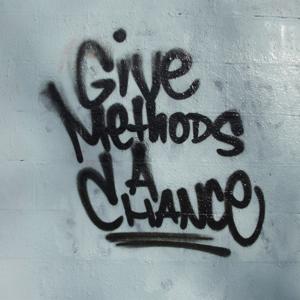
On this episode of the Give Methods a Chance podcast , we are joined by Dr. Andrew Billings. Andrew is the Ronald Reagan Endowed Chair in Broadcasting in the College of Communication and Information Sciences at The University of Alabama. He has authored books on a range of topics including Fantasy Sport and coverage of the Olympic games. His scholarship has also attracted interest outside academic walls from mainstream outlets ranging from the The Boston Globe to the Los Angeles Times to ESPN.com. We talk to Andrew about his use of quantitative content analysis to study traditional and social media coverage of NBA player Jason Collins’ coming out as gay.
“One barrier, and this is certainly true with more and more social media, is that there is an incredible amount of, it is not really negativity, of course there is negativity out there…Coding for sarcasm can be really tricky. And that is the reason we can’t use, with most of the work I do, I can’t send it through a content analysis software program because inevitably it is going to code things differently than the way they come out.”
Helen B. Marrow is Assistant Professor of Sociology at Tufts University, with affiliations in American Studies, Latino Studies, Latin American Studies and the Center for the Study of Race and Democracy. Helen’s research interests include immigration, race and ethnicity, social class, health,and inequality and social policy. She is the author of New Destination Dreaming: Immigration, Race, and Legal Status in the Rural American South and has published in journals including the American Sociological Review, Ethnic and Racial Studies, and Perspectives on Politics. Today we discuss her tripartite methodological design for studying immigrant/native relations as well as her experience conducting collaborative, interdisciplinary research. For more information, visit the project website.
“One of the things we have learned, and we have incorporated into our survey and interview data, is that a lot of the fierce debates about whether more contact between groups reduces prejudice and produces positive outcomes or whether it leads to greater feelings of threat and more negative outcomes, has to do with the fact that the different disciplines are operationalizing and measuring contact differently. Psychologists think about contact as direct, face-to-face contact. But often in sociology and political science, we are thinking about contact at a broader and more macro level.”
Keith N. Hampton is an Associate Professor in the Department of Communication, School of Communication and Information, and an affiliate member of the Graduate Faculty in Sociology at Rutgers University. His research interests focus on the relationship between new information and communication technologies, social networks, democratic engagement, and the urban environment. Today we discuss his project, “Social Interaction in Public Spaces: A Longitudinal Study.” The goal of this study is to understand change in the social life of urban public spaces over the past 30 years, using visual content analysis.
“This is truly the only way to do a longitudinal study of public space. We can hang out in a public space for months, or maybe even a year, but doing that for two or three decades is simply impossible. So, for any large scale, longitudinal study of urban public spaces, I think this is probably the only method that is available to us.”
In this episode, guest host Sarah Shannon interviews Daniel Sui, Chair of the Department of Geography and Distinguished Professor of Social and Behavioral Science at The Ohio State University. Daniel has published extensively on the use of volunteered geographic information as well as the use of social media as a new data source for geographic and social science research. He joins us to share his thoughts on big data, the methodological challenges, and the methodological advantages.
“In terms of the applications of big data, it is limited by only your imagination. That is why big data has attracted interest by industry, government agencies all over the world, and, of course, academics and scholarly researchers.”
In this episode, we talk with Dale C. Spencer, Assistant Professor of Sociology at the University of Manitoba. Dale joins us to discuss ethnographic research. In particular, Dale explains the value of observant participation in understanding the sensory and phenomenological experiences of becoming a mixed martial artist.
“When you are an observant participant, you are at stake. You have a vested interest in succeeding. But the reality of the matter is, you are also open, very clearly, to fail in that world.”
In this episode we are joined by Matthew Hughey. Matthew is an Associate Professor of Sociology at the University of Connecticut. He is the author of number books including the White Savior Film: Content, Critics and Consumption, The Wrongs of the Right: Language, Race, and the Republican Party in the Age of Obama, and White Bound: Nationalists, Antiracists, and the Shared Meanings of Race. Matt joins us to discuss his multi-methods approach to studying film, film criticism, and film consumption.
“I’m a methodologically promiscuous sociologist, so I dabble with different methodologies depending what types of questions I ask. So for example, If I wanted to know something about the ways that audience members develop, nurture, and deconstruct—in their everyday lived experiences—a film genre such as this, it would call for a kind of ethnographic strategy in which I would need to embed myself with a community of avid film goers. That type of immersion would be necessary to gain a sociologically informed view of what really figure out the relationship between people lived experiences and their cinematic evaluations. But since I was interested in a different question—notably, what kinds of demographic and interactive setting influenced how audiences make meaning of just a handful of these films, then interviews and comparisons between focus groups fit the bill for my question.”
In this episode, we talk with Naomi Sugie on using smartphones to collect data from research participants. Naomi is an Assistant Professor of Law, Criminology & Society at the University of California-Irvine. She shares findings from a study of recently released prisoners as they seek for work in Newark, New Jersey.
“Smartphones are exciting data collection tools. They can collect real time data on peoples’ experiences while they are going about their every day lives. Smartphones have their limitations, but they open up a whole new area of research and the ability to just document peoples experiences. They can expand the realm of empirical investigation for researchers to consider questions and ideas we just weren’t able to think about before, using other methods.”
In this episode, we talk with Amy Schalet, Associate Professor of Sociology at the University of Massachusetts Amherst. We use her work on teenage sexuality to discuss in-depth interviews and cross-cultural research.
“You take them back to their comfort zone. Or you say, ‘why did that feel so wrong’? You have to stay with them. You have to make them feel that even though they just had an explosion, emotionally, that you are with them and willing to listen to that.”
In this episode, we talk with David Knoke, Professor of Sociology at the University of Minnesota. We discuss the uses and benefits of network analysis, drawing upon his work on terrorist networks.
Though podcasting is at the heart of our project, we also plan to publish our episodes in a book of edited transcripts, making them even more accessible to students and instructors. You can download the edited transcript here. We’d love to hear your feedback on the multi-delivery format, and plan to release even more of these written versions on the site.
GMAC: We are here to talk about network analysis. If you were to introduce this method to an undergraduate class who had never heard of it, how would you describe it?
DK: If you go into a room full of people and ask how many people are “networkers,” they all raise their hand. They all know about Facebook and LinkedIn. So, intuitively, we all have a sense of social networks. We know who Mark Zuckerburg is. But, what most people don’t know is how to treat networking in a more systematic fashion. And this is what network analysis can do.
For instance, you can look at centrality of a network or do a core/periphery analysis. You can take a set of data and sort it by density clusters – high density, clustered folks who interact with each other, and then a periphery of folks who are less connected among themselves. There’s ego-centric networks, there’s complete networks, and there’s network change over time if you have longitudinal data.
There are many different foci. A classic example is a study of clique of women in the Mississippi Delta in the 1930’s. This study looked at a set of women who went to a series of parties. The question was, which women showed up at which parties? There was two modes: a set of folks, and a set of events.
What has most impressed me – and I’ve been doing this for close to 40 years – is how many different disciplines have been picking up network analysis. Anthropology and Sociology were there in the beginning, in the 1940s, but the real takeoff was the 1970s where a whole series of other disciplines begin to use it, such as Political Science. They even have an annual conference on network analysis. The students who take my course also come from a wide variety of disciplines, coming from departments you wouldn’t think of – like Forestry, Conservation Biology, and Rhetoric. It’s a real multi-disciplinary methodology.
We will use your recent research on terrorist networks as a way to understand how this method works. What were your central research questions?
This project is called “Three Modes of Al-Qaeda.” I ask, what are the lines of authority among a set of actors engaged in violent terrorist activities against Western targets?.
Instead of taking the narrative, historical approach of journalists, I formalized the study of Al-Qaeda by taking a network data collection approach. That meant reading a lot of online documents over a nearly twenty year span. I found 25 operations between 1992-2010 that had Western targets.
Continue Reading