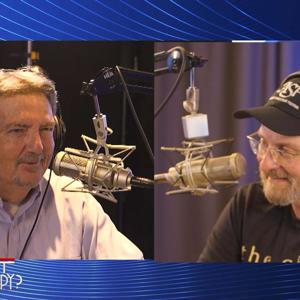
What makes therapy work — before any technique? In Episode 82, Dr. Michael Baltimore and Dr. Dan Rose start drafting the opening chapter of a book on good therapy and land on a bigger question: what does a good therapist actually do beneath the manual?
Dan calls it the "music of therapy" — the nonspecific, relational factors that carry any intervention's real effect. Together they trace how therapy begins before the first word (proto-transference), how the same sentence can open a person up or shut them down, how confrontation becomes an invitation rather than an attack, and why "unconditional positive regard" may work better as a verb than a noun.
A conversation for clinicians, students, and anyone curious about how change really happens in the room.
Chapters: 00:00 Cold open 02:29 The cookie-cutter problem 05:00 What manualized treatment leaves out 08:00 The music of therapy — common factors 11:11 When does therapy begin? Proto-transference 14:08 The unconscious & the "unthought known" 17:00 Co-creation and the free-jazz model 19:26 The corrective emotional experience 20:56 The music behind the words 30:11 Relationship as the oxygen 36:09 From Pokémon to the real problem 39:08 Binocular vision & powerlessness 42:36 Setting the stage — a cure through love 44:36 Unconditional positive regard: noun to verb 48:37 Closing & sign-off
Got Therapy? — a conversation about the mind, the relationship, and the work of change, with Dr. Michael Baltimore and Dr. Dan Rose. New episodes regularly; subscribe to follow along.
Got Therapy? makes complex psychological concepts accessible and practically applicable. New episodes weekly.
00:00 Cold open (4th of July)
02:00 Self-esteem as accepting your complexity
03:30 Not-me states — Sullivan, Bromberg, and George Costanza
07:00 Self-compassion and giving yourself a break
09:00 Rigidity vs. flexibility — the stick that bends
10:00 Normative narcissism, Kohut, and the Porsche 911
15:00 Microtrauma and social comparison
18:00 Ethical codes and holding your neighbor
24:00 Ideology, the real, and conflict "all the way down"
27:00 Narcissism on a spectrum; the "phallic" type
30:00 Mirroring and validation in therapy
41:00 Countertransference and owning what's in you
45:00 Self-esteem, validation, and the classroom
49:00 Internalizing the therapeutic moment
51:00 Having vs. being — Fromm, and "cultivate life"