
Sign up to save your podcasts
Or

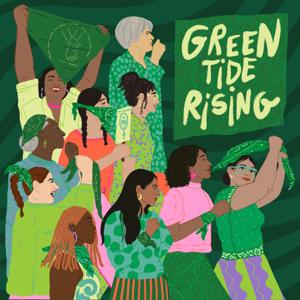


Hosts Asha Dahya and Monica Morales Garcia reflect on the 2024 election results, from the presidential outcome to ballot measures in ten U.S. states. They are joined by feminist lawyer and researcher Ximena Casas, Charo Valero of the Latina Institute for Reproductive Justice, Maria Di Franco Quinonez at Equis, and a chorus of feminist leaders from throughout Season One. As always, they turn to the Green Wave for guidance. These experts remind listeners that our tools include evidence and data, grassroots movement building, storytelling, education, and legal and policy strategies. Because, as Ximena says, “Governments pass, but movements remain.” Join our movement at www.greentiderising.com, listen back to Season One for a blueprint on where we go from here, and watch our accompanying video series ENTONCES.
Hosts Asha Dahya and Monica Morales Garcia reflect on the 2024 election results, from the presidential outcome to ballot measures in ten U.S. states. They are joined by feminist lawyer and researcher Ximena Casas, Charo Valero of the Latina Institute for Reproductive Justice, Maria Di Franco Quinonez at Equis, and a chorus of feminist leaders from throughout Season One. As always, they turn to the Green Wave for guidance. These experts remind listeners that our tools include evidence and data, grassroots movement building, storytelling, education, and legal and policy strategies. Because, as Ximena says, “Governments pass, but movements remain.” Join our movement at www.greentiderising.com, listen back to Season One for a blueprint on where we go from here, and watch our accompanying video series ENTONCES.
In the final episode of Season One, we’re on the U.S.-Mexico border, meeting some of the women at the forefront of bringing the Green Wave to this country. On the cusp of an election that could change the course of reproductive rights for generations, their stories show us that the fight for bodily autonomy has no borders. In the face of extreme anti-abortion policies spearheaded by the religious right, that are actively harming pregnant people in Texas and many other States, the stories we feature in this episode show us a roadmap of how to reclaim our individual power by being part of a community. Our powerhouse guests include Verónica Cruz Sánchez, founder of Las Libres, an organization that helps women all over the globe have medication abortion; Dr. Roopan Gill, OBGYN and CEO and co-founder of Vitala Global, whose new app Aya Contingo - created with the help from the feminist movement in Latin America - provides resources for obtaining and using abortion pill; Nancy Cárdenas Peña, campaign director for Abortion On Our Own Terms, a national campaign advocating to make safe, effective, self-managed abortion accessible to all; Lourdes Rivera, the president of Pregnancy Justice, a national legal organization that advocates for and defends the rights of pregnant people in the U.S; Maria Consuelo Mejia, a devout Catholic who co-founded and became the Executive Director of Católicas por el Derecho a Decidir México; and Maria de Franco Quiñonez, Research Director and Nery Espinosa, Senior VP or Communications from Equis, a set of organizations that work to engage Latino voters in the U.S. Join us as we get ready to head to the polls!
Visit greentiderising.com to learn more about the series, watch our accompanying Youtube video series Entonces, subscribe to and download the series wherever you get your podcasts, and join the movement by following us on social media @greentiderising.
If it’s policy change we want, narrative change is the tool. In this episode, we are highlighting stories of people in the United States who are being harmed by restrictive abortion laws, and how storytelling can be the spark that creates change. Joining the conversation are Green Wave leaders who are bringing the movement to the U.S. - Colombian-American filmmaker, author and activist Paola Mendoza, who is catalyzing the movement through storytelling, specifically with her new short film “Romina”; Danielle Rodriguez, the Georgia Coordinator at at Sistersong who explains how reproductive restrictions in the U.S. have been harming Black and Brown women for generations including her own family; and Ximena Casas, our resident Green Wave expert and feminist lawyer who shares how her own upbringing in Colombia shaped her lifelong desire to advocate for abortion rights. As Ximena often reminds us, the Green Wave has many different tones where each of us can play a role in the fight for bodily autonomy, especially when we build community with one another.
Visit greentiderising.com to learn more about the series, watch our accompanying Youtube video series Entonces, subscribe and download the series wherever you get your podcasts, and join the movement by following us on social media @greentiderising.
In this episode, we dive into Brazil’s fight for abortion rights as the country faces increasing Evangelical influence and restrictive laws which aim to pin homicide charges on people seeking abortions. Abortion is allowed in three exceptions, but Evangelical lawmakers are working to advance a landmark case that could make it illegal for victims of rape to seek abortions, and face even more punishment than their perpetrator/abuser. We follow the powerful story of Rebeca Mendes, a mother of two and law student, who in 2017 became the first Brazilian woman to request a legal abortion through the Supreme Court. With no response from the court, she crossed borders to Colombia to access a safe abortion, and started an accompaniment organization to help other women in similar situations.
Joining the conversation is activist and documentarian Debora Diniz, founder of feminist advocacy organization Anis, who has been at the forefront of Brazil’s reproductive rights movement. Together, they discuss the broader inequality that forces poor women to rely on unsafe methods while wealthy women access private care. Our resident Green Wave expert, Ximena Casas, reflects on Brazil’s ongoing legal battles, why access to medicated abortion is so important, how crossing borders for abortion is risky for the most vulnerable, and the growing momentum for reproductive justice in the largest country in Latin America.
Visit greentiderising.com to learn more about the series, watch our accompanying Youtube video series ‘Entonces’, and find out how you can join the movement by following us on social media @greentiderising.
In this episode, we head to the Dominican Republic, which shares an island with Haiti in the Caribbean. We highlight the movement for Las Tres Causales, or The Three Exceptions, hearing different perspectives from activists and organizers about why these exceptions are not enough, but are an important first step in a longer fight. With a focus on intersectionality, we explore how abortion access and decriminalization is interwoven with the freedoms of many varying communities. We meet Cristina Francisco, founder of the Circle of Women with Disabilities (CIMUDIS), who talks about how she advocates for women with disabilities to have the right to choose. Estefanny Molina shares the story of Esperancita, whose mother Rosa Hernandez sparked a movement with WomenLink. We speak with NY Assemblywoman Amanda Septimo, a Dominicana who has been part of U.S.-based protests forcing DR President Luis Abinader to reform the penal code. And we learn how anti-racism and anti-Blackness is a much-needed component of the fight in order to advocate for Afro-Latina and Haitian women, from El Comité de América Latina Y El Caribe Para La Defensa De Los Derechos De Las Mujeres (CLADEM).
Visit greentiderising.com to learn more about the series, watch our accompanying Youtube video series ‘Entonces’, and find out how you can join the movement by following us on social media @greentiderising.
The Green Wave picks up momentum in Colombia, when in 2022, the country went from having only three exceptions to the abortion to decriminalizing abortion on all grounds up to 24 weeks of pregnancy - one of the most progressive abortion policies in the world. This all happened in the same year the U.S. Supreme Court overturned Roe v. Wade, where it had been the law of the land for nearly 50 years. How did they manage this? Our guests include communications expert Carolina Dueñas and lawyer Mariana Ardila who made history with the organization Women’s Link Worldwide. Women’s Link played a pivotal role in the iconic Causa Justa movement as the organization who filed the case that would decriminalize abortion. The duo share the story of how they initially began working on this issue in 2006, and eventually took the case to the Constitutional Court of Columbia, in the midst of a global pandemic. This was a modern day movement at its finest, that took years in the making. Our resident Green Wave expert and native Colombian, Ximena Casas shares the strategy behind Colombia’s success and the biggest differences between Latin America’s progress and the fight for reproductive rights in the U.S.
Visit greentiderising.com to learn more about the series, watch our accompanying Youtube video series ‘Entonces’, and find out how you can join the movement by following us on social media @greentiderising.
From the publisher's feed