
Sign up to save your podcasts
Or



In this episode we spend some time looking at the earthquake’s impacts on Te Whanganui-a-Tara Wellington. Our capital city sustained quite a bit of damage in this earthquake. Why was this, when the epicentre was some distance away? And what is the ‘basin effect’? Liam Wotherspoon is back to explain all that.
But for Wellington, this earthquake wasn’t the ‘big one’. We know Wellington will sustain a much bigger earthquake, likely in our lifetimes or our children’s lifetimes….so it’s important to confront this. Caitlin has a conversation with social scientist Lauren Vinnell about what we can do to reduce our risks, and get ready.
Finally, we bring all our researchers back to hear their final reflections. How far have we come in the last ten years...and what do we still need to do if we are to truly absorb the lessons from this earthquake?
Here’s the cool video where Bill Fry talks about his ‘earthquake cycle simulator’ research (Credit: Resilience National Science Challenge).
Many thanks to Lauren Vinnell, Liam Wotherspoon, Lucy Kaiser, Bill Fry and Jo Fountain.
Thanks to RNZ for permission to use broadcast audio.
Music by PedroDuvall on Pond5.
Cover art by Caitlin Carew. Photo credit: Kiwi_Lisa on Pixabay.
What happened when the tourists left Kaikōura, and the media packed up and went home? How did this isolated rural town go about getting back on their feet? In this episode Caitlin speaks with Associate Professor Jo Fountain, who spent years visiting the township, building relationships, and following their social and economic recovery. What are tourism-dependent businesses to do when there are no tourists? Feed the road workers of course! Jo also tells Caitlin about the most surprising finding to come out of her research, and how this has shaped her research in the years since.
Recommended reading: One year on by Deborah Nation, from Te Karaka magazine (2017).
Many thanks to Jo Fountain.
Music by PedroDuvall on Pond5.
Cover art by Caitlin Carew. Photo credit: Kiwi_Lisa on Pixabay.
Many of us probably think we know what an emergency response to something like a big earthquake looks like. But behind the scenes is a lesser-known aspect of response – the scientists who are rapidly assessing hazards and risks, and getting critical information to decision-makers.
In this episode Caitlin speaks with Bill Fry about what it’s like to work under that kind of pressure. We also hear from Liam Wotherspoon about the major damage to infrastructure networks, and from Lucy Kaiser about the experiences of the Takahanga marae community who stepped up to support locals and tourists in the initial aftermath.
Check out the GeoNet Felt Report map from the Kaikōura earthquake
Many thanks to Dr Bill Fry, Prof Liam Wotherspoon and Dr Lucy Kaiser.
Music by PedroDuvall on Pond5.
Cover art by Caitlin Carew. Photo credit: Kiwi_Lisa on Pixabay
Just after midnight on Monday 14 November 2016, a powerful M7.8 earthquake struck the northeastern part of New Zealand’s South Island. It became known as the Kaikōura earthquake, and is thought to be one of the most complex earthquakes ever recorded on modern instruments. But what was so complicated about it?
In this episode Caitlin steps through how the earthquake unfolded, the initial impacts…and what was going through the mind of a seismologist who was woken up by the quake, and got straight to work.
Check out this cool computer simulation of the Kaikōura earthquake unfolding (Credit: Earth Sciences NZ).
Many thanks to Dr Bill Fry.
Thanks to RNZ for permission to use broadcast audio.
Earthquake rumble sound effect: earthquake3.wav by zatar on freesound. License: Creative Commons 0
House shaking sound effect: Large Earthquake by LoafDV on freesound. License: Creative Commons 4.0
Music by PedroDuvall on Pond5.
Cover art by Caitlin Carew. Photo credit: Kiwi_Lisa on Pixabay
From the publisher's feed
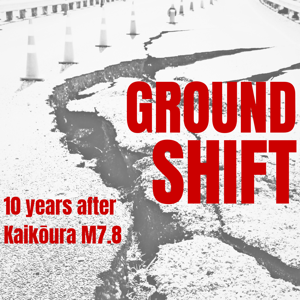
Ground Shift marks the tenth anniversary of the Kaikōura earthquake.
Just after midnight on Monday 14 November 2016, a magnitude 7.8 earthquake hit the north-eastern part of New Zealand’s…
This famously complex earthquake sparked a lot of scientific research. Research teams studied the fault ruptures, the hazards they unleashed, and the significant damage to infrastructure networks. Others looked at the emergency management response, the long-term recovery, and the influence on earthquake awareness and preparedness in Wellington.
Host Caitlin Carew shines a light on some of this research, and what we’ve learned from it. Natural hazards researchers talk about their experiences, their findings, and the changes that followed.
But have we made enough of a shift?
Ground Shift is a chance to talk about what Aotearoa New Zealand still needs to do to reduce our risks and get ready for big earthquakes.
This podcast was made with the support of the Natural Hazards and Resilience Platform Te Pae Tūroa, the School of Science in Society at Te Herenga Waka Victoria University of Wellington, and Earth Sciences New Zealand Te Whatu Ao.
We acknowledge the people who were most impacted by this earthquake, and who experienced loss, trauma and disruption. Ngā mihi aroha.