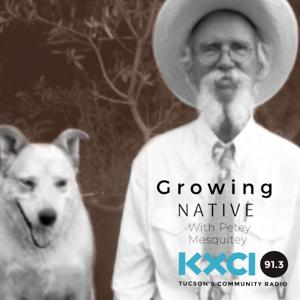
Growing Native with Petey Mesquitey

Growing Native with Petey Mesquitey

By Petey MesquiteySociety & CultureEducation
Download on the App Store

Growing Native with Petey Mesquitey episodes

  • Ageratina herbacea
    This episode is about a fall blooming plant called Ageratina herbacea. Ageratina means a small or smaller Ageratum… another beautiful blooming plant….herbacea means herbaceous. Duh. It’s probably just me, but I think ageratina makes for a nice common name. How about fragrant ageratina? Oh yeah. The photos are mine.
    5 min
  • Heuchera sanguinea
    I was looking though some old notes of episodes and realized that I have talked about coral bells (Heuchera sanguinea) many times over the years. Like a favorite trail or dirt road I keep coming back to it. There are six species of Heuchera found in Arizona and they’re among the 40 to 50 species found in North America, not to mention numerous cultivars. The photos are mine and taken along the trail that my partner, lover and significant other and I keep coming back to.
    5 min
  • Jackass Clover and Clammy Weed
    Both jackass clover (Wislizenia refracta) and clammy weed (Polanisia dodecandra) are in the Cleome family Cleomaceae, having left the caper family Capparaceae due to DNA analysis. A crime is solved! But listen, many of the plants in Cleomaceae can be quite aromatic or foetid smelling. Both jackass clover and clammy weed live up to that description and it’s your choice. By the way, I want you to know that I showed great restraint in not shouting jackass several times during this episode. I’ve matured over the years. The photos are mine of the flowers of both species jabbered about in…
    5 min
  • Hummingbird Trumpet
    Hummingbird trumpet (Epilobium canum) is a favorite late summer and fall wildflower in the wild or in a nursery. Well, in the wild is wonderful, but then get one for your personal habitat to remind you of the wild one you saw. The photos are mine.
    5 min
  • Autumnal Acorns
    Though I didn’t talk about it in this episode, some of the great things about gathering acorns out in habitat are the encounters with wild creatures. Ms. Mesquitey and I have some great oak and wildlife stories that include, bears, deer, turkeys, javelinas, porcupines, jays, pigeons, woodpeckers, caterpillars. Hang out by an oak and you will be surrounded by life from the bottom to the top. Oaks are trees of life. I love growing them. The photos are mine of acorns and some very young Arizona white oaks (Quercus arizonica)

    5 min
  • Borderlands Mulberry
    I walk by a native mulberry every day when I go to my office, the Books and Bones Retreat. I planted that Morus microphylla years ago and actually grew it from seed we had collected. That may be the subliminal reason I felt the need to talk about mulberry trees in this episode. I don’t think I did all the mulberry species justice and I will no doubt hear from my botanist horticulturist son-in-law Jared who is a big fan of mulberry species and selections. That’ll be cool. The photos are mine of the fruit and the variable leaves of…
    5 min
  • America's Onion
    The genus Allium has had quite a taxonomic journey and is at this time (stay tuned!) in the amaryllis family, Amaryllidaceae, where it had once been, so welcome back Allium. There are over 400 species of Allium native to the Northern Hemisphere. Arizona has 13 of those and nodding onion, Allium cernuum is one of them. Yay! Oh, And I know, I know, it’s unlikely that an onion will usurp the rose as the national plant of the United States. Allow me to dream. The photos are mine.
    5 min
  • Lunch in an Open Shady Forest
    I like this paragraph from The Vascular Plants of the Gila Wilderness: “Psacalium decompositum is a distinctive plant that apparently reaches its most northern distribution here in New Mexico and Arizona. The mainly basal leaves are highly dissected with linear ultimate segments, and are quite large. The inflorescence is scapose and two to three feet tall. Psacalium decompositum is found in openings in the Ponderosa Pine forest.” What they said! By the way, in your favorite old flora or field guide this plant may be found under the genus Cacalia. Oh, and the botanists that changed the genus to Psacalium…
    5 min
  • Flora, Fauna, Friends and Butterfly Weed
    Butterfly weed (Asclepias tuberosa) makes up for its lack of milky sap with the copious amount of nectar found in the flowers. Stand back and let the pollinators in! The photos are mine of the “clusters of golden yellow flowers” and taken on the day described in this episode.
    5 min
  • Shrine for the Desert Box Turtle
    The better common name for Terrapene ornata luteola is the ornate box turtle. The name desert box turtle is old like me….not Miocene old…maybe early Holocene. Hey, I recently read some nice essays about shrines in the borderlands written by the Tucson desert rat and artist Linda Victoria. Below is a link to her writing. https://substack.com/@lacorua The photos are mine. Oh, and I’ve talked about box turtles before, so here is a link to another episode: Turtles, Dogs, Plants
    5 min

About Growing Native with Petey Mesquitey

From the publisher's feed

Petey Mesquitey is KXCI’s resident storyteller. Every week since the spring of 1992 Petey has delighted KXCI listeners with slide shows and poems, stories and songs about flora, fauna, and family and…

More shows like Growing Native with Petey Mesquitey

On the Media by WNYC Studios

On the Media

9,188 Listeners

The Daily by The New York Times

The Daily

111,852 Listeners

Up First from NPR by NPR

Up First from NPR

56,432 Listeners