HackedSelf

HackedSelf

By
Download on the App Store

HackedSelf episodes

  • How to Recover From a Bad Night's Sleep and Protect Tonight
    The one-rule summary: every dose either clears or masks adenosine, times the circadian clock, or borrows from tonight. A fix doing none of those three is decoration.
    ## Morning Dose: Light First, Caffeine Second
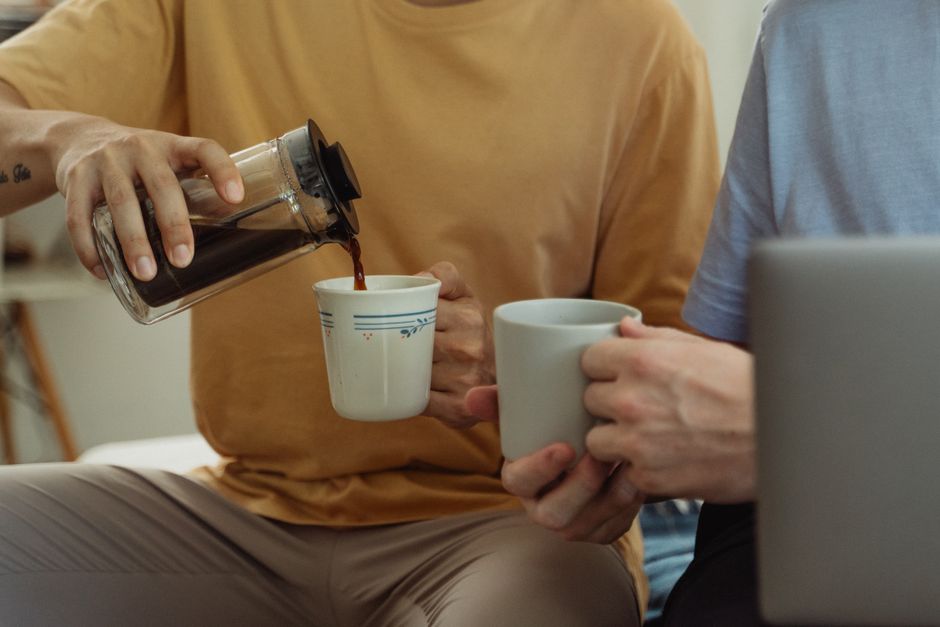
    ![Caffeine timing and sleep remain coupled after a short night, so the first coffee arrives early and the last cup lands hours before bedtime.](https://images.pexels.com/photos/4670662/pexels-photo-4670662.jpeg?auto=compress&cs=tinysrgb&h=650&w=940)
    ### The best time for morning light after a bad night
    Get outside within the first hour of waking, before or alongside your first coffee, for 10 to 15 minutes. Timing beats gear: early light lands when the circadian clock is most responsive to a timing cue, and a consistent morning anchor is what keeps the clock stable night after night.
    The reason to go outside rather than stand at a window is raw illuminance. [Measured lux levels](https://www.engineeringtoolbox.com/light-level-rooms-d_708.html) put a bright indoor room around 500 lux and a typical evening living room below 200, while an overcast morning outside sits around 1,000 lux. Even gray daylight is several times brighter than a typical indoor scene, and full daylight by ten times or more. Sunglasses off, prescription glasses fine, face the open sky. Fifteen minutes of that is the cheapest reliable alertness dose available, and it costs tonight nothing.
    ### When to stop caffeine after poor sleep
    Caffeine blocks adenosine receptors rather than clearing adenosine, so on a rescue day the crash is deferred, not deleted. That single fact rewrites the dosing rules, because caffeine timing and sleep quality are coupled: what you take this afternoon is still partially on board tonight.
    Keep total intake flat or lower than a normal day, front-load it into the first half, and pull the last dose earlier, to roughly 8 to 10 hours before bedtime. Caffeine's average half-life sits near 5 hours with wide individual variation, and the evening cost is not hypothetical. In one [caffeine timing trial](https://pmc.ncbi.nlm.nih.gov/articles/PMC3805807/), a 400mg dose taken six hours before bed still shortened measured sleep. On a 10:30pm bedtime, that puts the cutoff between 12:30 and 2:30pm.
    The temptation after a bad night runs the opposite way: more coffee, later, all afternoon. It works until roughly 3pm, then you are wired and wrecked at the same time, and the debt moves to tonight with interest.
    ## Midday Dose: The 20-Minute Nap Ceiling
    ### How long should a nap be after a bad night?
    Nap duration is what sets sleep inertia risk. About 10 to 20 minutes, taken before mid-afternoon, with a hard ceiling near 30: below that line you stay in lighter sleep stages, wake cleanly, and spend very little of the sleep pressure you need tonight. Push past it and you enter slow-wave sleep, and waking from slow wave produces the groggy, worse-than-before state that can linger for half an hour.
    Aviation ran the experiment for us. NASA's [cockpit rest study](https://ntrs.nasa.gov/citations/19950006379) gave long-haul pilots a planned rest opportunity in flight; the average nap lasted about 26 minutes, and NASA reported roughly a third better performance and about half again higher alertness afterward versus no-rest controls. Short, planned, early: that is the dose.
    Two naps make the trade-off concrete:
    - **Nap A, 1:00pm, 20 minutes.** Lands inside the natural post-lunch dip, stays in light sleep, minimal inertia, only a small dent in tonight's pressure. Largely free.
    - **Nap B, 4:00pm, 60 minutes.** Plows into slow-wave sleep, costs 20 to 30 groggy minutes on waking, drains real sleep pressure hours before bed, and pushes bedtime later. A loan against tonight at a bad rate.
    When the long nap is still right: if you must drive far or work into the night, take the deeper nap, treat it as fatigue management rather than recovery, and defend that evening's bedtime more strictly, not less.
    ## The Sunset Walk Dose

    ![Circadian light timing in practice through a brief sunset walk that lifts evening alertness while barely delaying melatonin onset.](https://images.pexels.com/photos/10180651/pexels-photo-10180651.jpeg?auto=compress&cs=tinysrgb&h=650&w=940)
    This is the dose almost nobody schedules, and it is the mechanism behind that Reddit turnaround.
    ### Does sunset light delay melatonin?
    Some, but typically very little, and the reason is dose timing. Light's circadian impact scales with intensity, spectrum, and duration, and circadian light timing is above all about proximity to melatonin onset. [Melatonin suppression dose-response](https://pmc.ncbi.nlm.nih.gov/articles/PMC8933063/) work shows sensitivity rising steeply with brightness and duration, which cuts both ways: dim, short exposures do little, and that is exactly what a sunset is by the time you are walking in it.
    Put rough numbers on it:
    | Light scene | Approximate illuminance at eye level |
    |---|---|
    | Midday summer sun | 50,000 to 100,000 lux |
    | Overcast afternoon | 1,000 to 10,000 lux |
    | Golden hour | A few hundred lux, up to low thousands |
    | Bright office | Around 500 lux |
    | Evening living room | 100 to 200 lux |
    | Phone held at your face in the dark | Roughly 10 to 50 lux |
    Two things fall out of that table. First, golden-hour outdoor light commonly out-illuminates your evening living room, so it retains enough intensity for the acute effects of light exposure on alertness and mood, which [acute alerting studies](https://www.sciencedirect.com/science/article/pii/S0166432817311002) register as faster reaction times and better mood ratings. Second, the exposure ends when the sun does. It arrives before melatonin onset, delivers its lift, and is gone.
    Contrast the default evening: hours of blue-rich screen light, held a hand-span from your eyes, running past dusk into the window when the circadian system is most sensitive to delay. The sunset walk and the doomscroll are both evening light. The difference is dose: intensity, duration, and timing relative to melatonin onset. On all three factors, they point in opposite directions. That is how 20 minutes of the right light can lift a wrecked day's mood while barely touching tonight's melatonin, and it is plausibly much of what moved that poster's recovery score from 51 to 58. Activity and expectation did some of the work. The light did the rest, cheaply.
    Run it as a dose: 15 to 20 minutes in the hour before sunset, no phone, eyes on the open sky rather than the ground. If the walk would push dinner and wind-down uncomfortably late, skip it. A dose that wrecks the schedule stops being a dose.
    ## Should You Train on a Wrecked Recovery Score?
    Usually you should move, lightly. Short, easy aerobic work (20 to 30 minutes at a conversational pace), mobility work, or a walk all tend to raise alertness and mood acutely after sleep loss, and the sunset walk can double as today's movement dose.
    What loses on a suppressed score is the hard session. High-intensity training adds significant strain at the moment the resources that convert strain into adaptation are exactly what a short night depleted, so you typically collect the fatigue and blunted returns. If progress is the goal, the wrecked day is a bad day to chase it.
    A simple decision rule:
    - **Gentle movement sounds good.** Dose it easy and short, ideally outside.
    - **Only intensity sounds satisfying.** That is usually sleep-deprived judgment talking. Park it for a normal-recovery day.
    - **Everything sounds awful.** Full rest is a legitimate dose, not a failure.
    Treat the tracker numbers as direction, not gospel. A recovery score moving from 51 to 58 is a nudge, not a diagnosis. The trend across days matters more than any single morning's digit.
    ## Evening Dose: Why Two Hours Early Backfires
    After a bad night the instinct is to cash in early: bed at 8:30pm instead of 10:30. It usually backfires, and the reason has a name. In the one to two hours before your habitual bedtime, circadian alerting reaches one of its highest points of the day, a window called the [wake maintenance zone](https://www.nature.com/articles/s41598-018-29380-z), which is why an early bedtime often buys ceiling-staring instead of sleep. Climbing in two hours early drops you into the middle of it, where you lie awake computing your remaining hours and try harder. That trying carries a cost: [sleep effort research](https://onlinelibrary.wiley.com/doi/full/10.1111/jsr.14206) links striving for sleep with slower onset and more fragmented nights, a mechanism long implicated in insomnia.
    So should you go to bed early after no sleep? A little, or not at all. The worked example, for a 10:30pm habitual bedtime:
    - **8:30pm bed.** Wake maintenance zone plus sleep effort, fragmented first hours, frustration. Usually a second bad night.
    - **10:00pm bed (30 minutes early), dim hour before it.** Extra sleep pressure still partially banked, clock undisplaced. The safer dose.
    - **10:30pm normal bed with a strong wind-down.** Equally defensible, especially if you skipped the nap.
    Then set the alarm for the normal time, within about an hour at most. Holding tomorrow's wake time is what anchors the clock. Sleeping in two hours drifts it, and the drift seeds the next short night.
    ## Five Mistakes That Turn One Bad Night Into Two
    Each of these starts as a fix and runs past its break-even point. The math is already on the table:
    1. **All-day coffee.** Caffeine's roughly 5-hour half-life means a 4pm cup still has a quarter to a half of its dose on board at a 10:30pm bedtime, and the caffeine timing trial above showed six-hours-before-bed caffeine still shortening sleep. At noon, the same cup is mostly cleared by bed. Past early afternoon, coffee buys tonight's problem.
    2. **The long late nap.** The 20-minute, 1pm version wakes you clean and dents tonight's pressure slightly. The 60-minute, 4pm version buys 20 to 30 groggy minutes, drains sleep pressure hours before bed, and pushes bedtime later. The break-even sits near 30 minutes and mid-afternoon.
    3. **Dark-room screens all evening.** A light dose is intensity times duration times timing. A phone at 10 to 50 lux, a hand-span from your eyes, for hours past dusk, points every factor the wrong way; a few hundred lux of sunset for 20 minutes before melatonin onset barely delays anything.
    4. **Alcohol as a sedative.** The one mistake that disguises itself as a fix. It tends to speed sedation, then fragment the night's second half and suppress REM. You sleep worse while feeling helped.
    5. **Sleeping in.** A wake time more than about an hour late drifts the clock and hands tonight a weaker sleep-pressure start. The fixed wake time is the least popular and most effective rule on this list.
    ## When One Bad Night Becomes a Pattern
    A dosed day is for the occasional wreck. When bad nights arrive three or more times a week and persist for months, the clinical picture of chronic insomnia, the problem is no longer a rescue-day failure, and no amount of sunset walking fixes it. It needs treatment, and the recommended first-line option is cognitive behavioral therapy for insomnia. The American College of Physicians [recommends CBT-I first](https://www.acponline.org/acp-newsroom/acp-recommends-cognitive-behavioral-therapy-as-initial-treatment-for-chronic-insomnia), before medication, for chronic insomnia in adults. Notably, several core CBT-I tools already live in this protocol: a fixed wake time, a constrained sleep window, and naps that stay short.
    Knowing how to recover from a bad night's sleep is half the practice. The other half is protecting tonight, so the protocol stays an occasional tool rather than a daily one. The Reddit poster's ring nudged them into 20 minutes of the right light at the right time. You now have the entire clock.]]>

    0 min
  • Thymus Rejuvenation, What Actually Works in Humans
    What it is not: a therapy, a protocol, or support for anything currently sold to healthy adults. The recipients were mice with essentially no thymus, the opposite problem from a 55-year-old whose thymus is mostly fat, and no human can access this procedure today.
    ## What Thymic Involution Costs You, Decade by Decade
    The thymus begins shrinking at puberty and never stops. As a [Science Advances involution review](https://www.science.org/doi/10.1126/sciadv.aeb2970) details, functional epithelial tissue is progressively replaced by fat, and the export of new naive T cells falls along with it. The consequences compound quietly, because the naive T cells you already own have to last.
    | Decade | Thymus state | What it tends to mean for you |
    |---|---|---|
    | Teens to mid-20s | Peak output, involution already starting | Large naive T-cell pool, brisk responses to pathogens you have never met |
    | 30s | Meaningful fat conversion begins | Slow drawdown of the naive pool, vaccine responses still robust |
    | 40s | Gland increasingly adipose | First measurable declines in naive cells and T-cell diversity for many people |
    | 50s to 60s | Thymic tissue substantially replaced by fat | Naive output a fraction of youth, blunted responses to novel pathogens and some vaccines |
    | 70s and beyond | Minimal output, counts maintained by peripheral proliferation | Repertoire gaps, reactivation risks such as shingles, weaker vaccine take |
    The strongest human evidence that this organ still matters in adulthood comes from people who lost it. A large [NEJM thymectomy cohort](https://www.nejm.org/doi/full/10.1056/NEJMoa2302892) followed adults who had the thymus removed during heart surgery and reported elevated long-term risks of cancer and death compared with matched controls who kept the organ, alongside measurable immune differences such as reduced naive T-cell counts and altered inflammatory signaling. The long-term immune effects of thymectomy in adults vary with age at surgery, reason for surgery, and study design, so treat the magnitude as provisional. The direction, though, is hard to wave away: an adult thymus is not vestigial.
    The practical takeaway is that your decade locates you on a cost curve, and unlike most aging processes, this one has partially measurable levers. Which brings us to the strange case of the intervention that started the modern conversation.
    ## The rhGH Paradox and the TRIIM Nine
    ![Low-dose growth hormone as used in the TRIIM trial, where careful titration plus DHEA and metformin regenerated thymic tissue in nine middle-aged men.](https://images.pexels.com/photos/7653670/pexels-photo-7653670.jpeg?auto=compress&cs=tinysrgb&h=650&w=940)
    Growth hormone reads as lifespan-negative in the models longevity researchers trust most. Mice without growth hormone receptor live notably longer in several studies, growth-hormone-overexpressing lines die early, and dampened GH/IGF-1 signaling extends lifespan across worms, flies, and dwarf mice. Then the [TRIIM trial paper](https://onlinelibrary.wiley.com/doi/full/10.1111/acel.13028) arrived: nine men, one year, low-dose recombinant human growth hormone plus DHEA and metformin, with MRI showing thymic fat replaced by regenerated tissue and epigenetic clocks averaging roughly 1.5 years lower by the end.
    How can rhGH shorten lifespan in animals yet regrow thymic tissue in humans? The reconciliation runs through four variables:
    1. **Dose and target range.** TRIIM titrated rhGH to restore youthful IGF-1 levels rather than push supraphysiological ones. The lifespan-shortening animal data involve sustained, high GH/IGF-1 signaling, a different physiological neighborhood.
    2. **Co-agents.** Metformin was added to blunt the insulin resistance growth hormone induces, and DHEA to round out the hormonal mix. The metabolic risk profile of the cocktail is not the risk profile of GH alone.
    3. **Target tissue.** The thymus is unusually responsive to GH and IGF-1 signaling. A regenerative effect on one densely receptive organ does not translate into a systemic longevity claim.
    4. **Scope of evidence.** One year, nine self-selected men, no control group. The TRIIM protocol's thymus results are a signal, not proof, which is exactly why the extension matters.
    That extension is TRIIM-X, whose [trial listing](https://clinicaltrials.gov/study/NCT04375657) covers broader and older cohorts including women and multi-arm dosing. It is the single most informative thing to watch in this space.
    The verdict on rhGH: supervised-prescription tier, monitoring-heavy, expensive, with thin but real human evidence. Nothing in the paradox licenses recreational GH dosing, and the reconciling variables (low dose, co-agents, youthful IGF-1 targets) are precisely the ones DIY protocols skip.
    ## Grading Thymus Rejuvenation Levers, Zinc to Thymosin Alpha-1
    ![Zinc supplementation for thymus function in older adults is the cheapest tier-one lever, restoring thymic hormone activity mainly in those with marginal zinc status.](https://images.pexels.com/photos/13013778/pexels-photo-13013778.jpeg?auto=compress&cs=tinysrgb&h=650&w=940)
    Five studies do most of the work in this debate: the graft paper, TRIIM, the IL-7 program, the Prasad zinc trials, and the thymectomy cohort. Spread across them is a clean three-tier map of thymus rejuvenation interventions.
    | Lever | Human evidence | Tier | Action |
    |---|---|---|---|
    | Zinc repletion | Controlled trials in deficient older adults restored thymic hormone activity and T-cell function | 1 | Test, then correct if low |
    | Resistance training, sleep, lean mass | Consistent associations with healthier immune parameters in aging adults | 1 | Standard practice |
    | TRIIM-style rhGH + DHEA + metformin | Nine men, MRI regeneration, epigenetic age down ~1.5 years, uncontrolled | 2 | Physician-supervised only |
    | IL-7 | Human trials show naive T-cell expansion in specific clinical populations | 2 | Trial enrollment only |
    | Sex-steroid blockade (GnRH agonist) | Human data show renewed thymic output in specific patient groups | 2 | Only with a medical indication |
    | Thymus grafting | Mouse-only proof of concept | 3 | Track, do not buy |
    | Thymosin alpha-1 | Approved in some countries for hepatitis B, no controlled trial in healthy aging | 3 | Skip |
    ### Tier 1, cheap and measurable now
    [Prasad's zinc trial](https://www.sciencedirect.com/science/article/pii/S0002916522065820) work is the best-studied cheap lever. In older adults with marginal zinc status, supplementation restored activity of thymulin, the zinc-dependent thymic hormone, toward youthful levels and improved T-cell measures. The effect lives in the deficient: if your serum zinc is already midrange, more is not better, and chronic doses above the commonly cited 40 mg per day upper intake level can skew copper status. Test, replete modestly, retest. Zinc supplementation for thymus function in older adults is the rare immune-aging claim with direct human data behind it and a cost measured in pennies per day.
    ### Tier 2, supervised protocols with thin but real human data
    [Recombinant IL-7 trials](https://pmc.ncbi.nlm.nih.gov/articles/PMC6545488/) have expanded CD4 and naive T-cell counts in patients with immune depletion from infection or treatment. What IL-7 T-cell repletion has not shown is aging, infection-outcome, or longevity endpoints, and the therapy is not available outside research settings. Sex-steroid blockade sits in the same tier: GnRH agonist treatment in prostate cancer and around stem-cell transplant has been associated with renewed thymic output and naive T-cell recovery, but the side-effect profile is nontrivial and the populations studied were sick. Neither belongs in a self-directed stack.
    ### Tier 3, mouse-only or marketing-only
    Does thymosin alpha-1 work for immune rejuvenation in healthy adults? No controlled trial says so. It is approved in some countries for specific conditions such as hepatitis B and studied as an immune adjunct in serious illness, which is a different claim from the "immune reset" peptide clinics sell. Thymus grafting, as covered above, is a mouse proof of concept. Tier 3 items are worth tracking in the literature and worth exactly zero dollars today.
    ## Labs You Can Order to Estimate Immune Age
    How to measure immune age with blood tests, without a research grant, comes down to a direct panel rather than a single magic number:
    - **CBC with differential** for the cheap baseline picture
    - **T-cell subset panel** reporting total, naive, and memory CD4 and CD8 counts, such as [Mayo's T-cell subset panel](https://www.mayocliniclabs.com/test-catalog/Overview/89319)
    - **CD4 to CD8 ratio**, a classic immunosenescence marker
    - **Recent thymic emigrant markers**, CD4+CD31+ cells and TREC-based assays where offered, which estimate actual thymic output rather than peripheral counts, as a [review of thymic output markers](https://link.springer.com/article/10.1007/s11357-025-01555-3) explains
    - **Serum zinc and copper**, plus hsCRP, to catch the fixable deficiency and the background inflammation
    ### How to read retests
    > Trends, not snapshots. Use the same lab, same time of day, and 3 to 6 month spacing, and judge the direction of naive CD4 and CD8 counts and the ratio rather than any single value.
    A single low naive count means little without a trend and clinical context, and reference ranges differ between platforms. Algorithmic "immune age" clocks can be interesting, but a direct subset panel is what you can actually act on and retest against.
    ## A 90-Day Sequence and What to Watch Next
    1. **Days 1 to 14.** Order the baseline panel: CBC, T-cell subsets with naive and memory fractions, zinc, hsCRP. Add IGF-1 only with a physician if you are seriously evaluating anything in the rhGH tier.
    2. **Weeks 2 to 8.** Correct what is actually low. Zinc only if deficient, modest doses with food, periodic copper check. Train, because resistance work and sleep are the Tier 1 levers nobody monetizes.
    3. **Day 90.** Retest the same panel at the same lab. Compare naive CD4 and CD8 counts and the ratio against your own baseline, which is the only comparison that means anything.
    4. **Decide.** Deficiencies fixed and trends flat is your Tier 1 ceiling. Anything beyond it is Tier 2 territory, pursued with a physician or not at all.
    Put three things on the watchlist. TRIIM-X results, which will either strengthen or sink the thymus-regeneration story in humans. The intrasplenic organogenesis line of work, whose human-fragment arm is the seed of future tissue engineering, and the mouse graft study explained here is its opening chapter rather than its conclusion. And IL-7 or sex-steroid blockade trials that finally carry aging-relevant endpoints.
    The mouse work earns your attention, not your payment. Thymus rejuvenation in humans starts with a lab panel, a zinc level, and a barbell, and the nine men of TRIIM will keep earning their asterisk until the next trial reports.]]>
    0 min
  • Cortisol Rhythm as an Early Brain-Aging Signal
    **See a physician before any protocol if you have:** rapid weight gain concentrated in the face, neck, and midsection; wide purple stretch marks; new difficulty rising from a chair or climbing stairs from muscle weakness; easy bruising; or unexplained high blood pressure with high glucose. That cluster warrants evaluation for Cushing syndrome, and late-night salivary cortisol is a standard screening step in the [Endocrine Society Cushing guidelines](https://www.endocrine.org/clinical-practice-guidelines/diagnosis-of-cushing-syndrome).
    The mirror image also belongs to a doctor: persistent fatigue, unintended weight loss, dizziness on standing, or unusual skin darkening can point toward adrenal insufficiency, which is dangerous to self-manage. Glucocorticoids, megestrol, licorice, and high-dose biotin can all distort results enough to mislead you.
    One last misread, a composite case seen repeatedly in self-tracking communities: a "terrifying" 10 pm cortisol value that turned out to be a swab taken 90 minutes after a hard evening spin class. Acute exercise spikes look identical to a pathological nadir failure unless your log shows the training. The log is not optional; it is half the test.
    The 11-year finding is a correlation, but the action plan stands on its own mechanics. You now know what a healthy curve looks like in numbers, which panel measures it, five timed levers that move it, and a retest cadence that separates real change from assay noise. Measure the rhythm, not the moment, and let the cortisol and brain aging literature catch up to you.]]>
    0 min
  • Autoregulation Training Only Works Once You Calibrate RIR
    The drill's non-negotiables: call before the final rep, out loud, on camera. The camera is the referee. Memory edits effort calls almost every time.
    One caveat matters. Grinding to failure is a poor calibration tool on technique-limited lifts such as the deadlift, the snatch, and the clean, where the cost of a collapsed rep is positional chaos rather than a simple missed lift. Keep RIR bands looser there, RIR 2 to 4, and calibrate them indirectly from your squat and bench numbers. If you want an objective signal on those lifts instead, [velocity loss threshold research](https://onlinelibrary.wiley.com/doi/10.1111/sms.12678) has examined cutting sets when bar speed drops by a set percentage, an approach that appears able to preserve much of the strength adaptation while trimming the fatigue of deeper grinding, though the cutoffs are still being refined.
    ## Converting RIR Targets Into Working Loads
    Once you know your error, RIR becomes doseable.
    > Working rule for the main barbell lifts: one rep of RIR error is worth roughly 2.5 percent of 1RM at moderate rep ranges. Treat it as a dial, not physics. The exact per-rep value varies by lift and drifts as rep counts climb past eight.
    Prescription targets by block:
    | Block or goal | Top set RIR | Back-off RIR |
    |---|---|---|
    | Strength, 1 to 5 reps | 1 to 2 | 2 to 3 |
    | Strength, 6 to 10 reps | 2 to 3 | 3 to 4 |
    | Hypertrophy accumulation | 1 to 3 | 2 to 4 |
    | Technique or deload week | 3 to 4 | 4 or more |
    Corrections when a set misses its target, assuming your calibration is current:
    | You targeted | You actually hit | Miss | Next session |
    |---|---|---|---|
    | RIR 2 | RIR 1 | 1 rep heavy | Cut load ~2.5% |
    | RIR 2 | RIR 0 | 2 reps heavy | Cut load ~5% |
    | RIR 2 | RIR 3 | 1 rep light | Add ~2.5% |
    | RIR 2 | RIR 4 | 2 reps light | Add ~5% |
    Worked example: a bench top set of 100 kg for 5, targeted at RIR 2, that hits failure at rep 5 is a two-rep miss. Two reps times 2.5 percent points to roughly 95 kg the following week, with the target unchanged at RIR 2. Correct the load, never the effort target, because the target is the stimulus and the load is only the delivery vehicle.
    For a first-ever session with no history, anchor to a rep max instead of guessing. Five reps at RIR 2 lands near 95 percent of your 5RM, and three reps at RIR 2 near 95 percent of your 3RM, by the same per-rep rule read in reverse.
    ## Two-Tier Autoregulation Training, Readiness Gate Then RIR
    ![Training readiness signals such as sleep, soreness, and warm-up bar speed decide whether to run the full session or cut working sets.](https://images.pexels.com/photos/4793225/pexels-photo-4793225.jpeg?auto=compress&cs=tinysrgb&h=650&w=940)
    The design error that gives autoregulation a bad name is using one noisy signal, how a set feels, to answer two different questions: how much training should today hold, and how heavy should this set be. Split them into tiers and give each tier its own input.
    ### Tier One, the Readiness Gate
    Before the first working set, run our baseline readiness protocol: sleep hours versus your normal, soreness, resting heart rate or HRV if you track it, and bar speed on the last warm-up. The gate outputs one of three verdicts.
    - **Green.** Full plan as written.
    - **Amber.** Cut working sets roughly in half, hold the top set load target, widen the RIR band by a rep.
    - **Red.** Main lifts at RIR 3 to 4 for technique, skip accessories, leave.
    Sleep deserves real weight in the gate. [A review of sleep restriction](https://pubmed.ncbi.nlm.nih.gov/29422383/) and resistance training suggests performance and recovery markers can take a measurable hit, while individual responses vary enough that some poor-sleep sessions still surprise you. That argues for a reactive gate, plan the normal session and let the signals move you, rather than pre-sandbagging the day from the alarm clock alone.
    Example: you slept five hours before a heavy squat day. The gate reads amber, so working sets drop from four to two and the target widens to RIR 2 to 3, while the top set keeps its load target. If the first set moves like a true RIR 2, you finish close to plan. If it grinds at RIR 0, the set count was already cut, and next week's load correction is already defined by the table above. At no point did you guess a lighter weight from a bad feeling.
    ### Tier Two, Set-Level RIR Inside the Gate
    Once the gate fixes the ranges, RIR dials the load inside them. Top sets at the target, back-offs one rep looser, corrections applied between sessions rather than mid-session. Two inputs, two decisions, zero conflation.
    > The gate answers how much training today holds. RIR answers how heavy this set is. Swap either answer for the other and autoregulation takes the blame.
    ## Where Fixed Percentages Still Win
    Calibrated autoregulation training is not the right default for everyone, and pretending otherwise is how the method oversells itself.
    ### Novice Lifters
    A month-two novice's RIR calls swing wildly because perception of effort is untrained, and the calls barely matter because progress is nearly linear. Every stimulus works, adaptation outpaces daily fluctuation, and a fixed increment of 2.5 to 5 kg per session captures gains that no readiness signal improves on. [Novice progression research](https://pmc.ncbi.nlm.nih.gov/articles/PMC7575491/) in early-phase trainers generally supports simple pre-planned increments during exactly this window. Calibrating RIR as a novice mostly calibrates you into your own noise.
    ### Peaking Blocks
    Meet prep is the second forfeit. In the final weeks before a powerlifting meet, loads climb toward openers and attempts that were decided as percentages weeks earlier. Reviews of tapering and peaking, including [a powerlifting peaking review](https://www.researchgate.net/publication/344178845_Tapering_and_Peaking_Maximal_Strength_for_Powerlifting_Performance_A_Review), generally describe maximal-strength peaking as deliberately pre-planned loading paired with fatigue reduction, not day-to-day modulation. Daily readiness signals get noisier precisely as loads get heavier, and RIR itself degrades, since a target of RIR 1 or 0 on a third attempt can only be verified by failing it. Lock the block to percentages and let the taper do its job.
    ### Where Autoregulation Earns Its Keep
    The method pays for itself with intermediate and advanced lifters in hypertrophy and accumulation blocks, where readiness genuinely varies day to day, the cost of one misjudged set is low, and volume decisions matter as much as load. The strength evidence is modest but real: [an eight-week powerlifting trial](https://pubmed.ncbi.nlm.nih.gov/29786623/) found autoregulated load selection outgained fixed percentages on squat strength, and [Mann's APRE study](https://pubmed.ncbi.nlm.nih.gov/20543732/) reported larger strength improvements for autoregulatory progressive resistance training over fixed percentages in collegiate athletes. Both differences were small and both used trained populations, which fits the theory that autoregulation won partly by letting recovered lifters load slightly heavier on average than the fixed plan allowed.
    ## Rollout Checklist and Recalibration
    1. Pick two lifts to calibrate first. Squat and bench cover most programs.
    2. Film two or three top sets per lift over the next two weeks.
    3. Compute error per set, then average per lift. Direction matters as much as size.
    4. Write the bias into your log, for example "squat calls run two reps conservative."
    5. Apply the 2.5 percent rule to correct loads, never to change RIR targets.
    6. Define your green, amber, and red gate criteria in the program notes before you need them.
    7. Keep deadlift and Olympic lifts on loose RIR bands, with no failure calibration.
    8. Recalibrate every six to eight weeks, once per training block, and after any layoff or bodyweight shift.
    9. When a peaking block starts, hand the wheel back to percentages.
    Drop autoregulation entirely if your error stays above two reps after two recalibration cycles, if the daily decisions create second-guessing that outweighs the precision, or if you are still inside your first few months of barbell training.
    Dan's ending is the whole argument in miniature. Two filmed sessions established a consistent plus-two bias. Three weeks later his calls land within a rep, his "RIR 2" finally contains two reps of meaning, and his top sets carry weights a percentage table written months ago could no longer guess. Measure the ruler first. Autoregulate second.]]>
    0 min
  • Best Sleeping Temperature for Couples Is a Dose, Not a Deal
    Dose card: water at 104 to 108.5 F, 10 to 20 minutes, finish 1 to 2 hours before lights out. Wondering how long before bed you should take a warm shower? Count backward ninety minutes from lights out as the default.
    Timing is where people ruin it. End the bath ninety minutes before bed and the initial heat load has dissipated while the vasodilation persists, so your core falls on schedule, only faster. Shower ten minutes before bed and you climb in with a core still elevated, delaying the very drop you meant to trigger. If you are a strict morning-shower person, a warm foot bath works through the same distal pathway with a smaller effect, a fair trade for smaller effort.
    For couples this dose is personal. Each partner takes it independently, and neither needs the room to change to benefit, which makes it the cleanest first test.
    ## Dose Two: Warm Feet, Cool Core
    The cheaper nightly lever attacks the same pathway, and it matters most for the cold sleeper who is about to inherit a cooler room. Pre-warm the extremities instead of pre-warming the bedroom:
    - Loose, breathable socks (merino or thin cotton), because tight bands constrict the very vessels you are trying to open
    - Hands outside the duvet or resting on top of it, since palms dump heat efficiently
    - A warm water bottle at the foot of the bed for 20 to 30 minutes before you get in, then removed so it does not heat you all night
    Watch for the overdose signature. The goal is warm feet under a cool torso; if you wake at 2 a.m. with sweaty feet or a flushed face, you added too much heat and need a lighter sock or no bottle. This lever is a pre-sleep primer rather than an all-night fixture, because it exploits the onset drop specifically and contributes nothing useful after you are asleep.
    ## Dose Three: Set the Room Toward the Hotter Sleeper
    The rule that ends the negotiation is asymmetric. Overheating fragments sleep and suppresses deep sleep more reliably than mild coolness does, so it deserves priority. A slightly cold sleeper fixes the problem in ninety seconds with socks or a layer; an overheated sleeper in a shared bed has no escape and spends the night surfacing from broken sleep. The shared air goes to whoever tolerates heat worse.
    A concrete starting procedure:
    1. Find the coolest setting the hotter sleeper can sleep through without waking sweaty or kicking covers
    2. Set the room there, within or near the usual 60 to 67 F band, and give the colder sleeper bedding plus warm feet
    3. If the hotter sleeper still overheats, fix duvet weight before dropping degrees; insulation is usually the real culprit
    4. If the colder sleeper still shivers after a week, add a layer, not a degree
    In practice, the best sleeping temperature for couples is the coolest setting the hotter sleeper tolerates, no warmer. That band from the articles is a sane place to start searching for it, but it is the beginning of the protocol rather than the whole answer to what temperature the bedroom should be if one partner sleeps hot.
    ## Asymmetric Bedding: Separate Duvets, Dual Zones, Side Selection
    ![The Scandinavian sleep method gives each partner a separate duvet on a shared mattress, so a hot sleeper and a cold sleeper no longer share one microclimate.](https://images.pexels.com/photos/7142795/pexels-photo-7142795.jpeg?auto=compress&cs=tinysrgb&h=650&w=940)
    Once the air is set cold, the cold sleeper needs their own climate. Three configurations decouple the two microclimates, in ascending order of cost.
    ### Two Duvets, One Bed
    The [Scandinavian sleep method](https://www.sleepfoundation.org/sleep-hygiene/scandinavian-sleep-method) replaces the shared duvet with two singles, each partner choosing their own weight, and it is an established norm across Scandinavia and much of northern Europe rather than a hack. The mechanism is what matters here: a hot sleeper under a light duvet beside a cold sleeper under a heavy one share a bed without sharing a microclimate. Do separate duvets help couples sleep? Architecturally, yes, because nobody's insulation depends on anybody else's, and it is the cheapest fix in this article. Duvet theft ends as a side effect.
    ### Dual Zone Systems
    A dual zone mattress topper or active climate system heats or cools each half of the bed independently, and a [dual zone cooling comparison](https://liveworksleep.com/best-bed-cooling-two-people/) walks through the options built for two-person setups. This is the upgrade path when bedding alone cannot close the gap, typically when one partner needs active cooling rather than just less insulation.
    ### Side Selection
    Beds are not thermally uniform. The cold sleeper should claim the side away from the window, the AC vent path, and any exterior wall, leaving the airflow side to the hot sleeper. If a pet or child sleeps in the bed, treat them as a heat source when you pick sides.
    The takeaway: the best bedding for a hot sleeper and a cold sleeper is simply two different beddings on one mattress.
    ## Verification: Read Skin Temperature Against Your Own Baseline
    You already own the measurement instrument. Both major trackers report overnight skin temperature, and the critical detail is that neither number means anything in absolute terms. Oura reports a deviation from your personal rolling baseline, as the [Oura temperature deviation explainer](https://support.ouraring.com/hc/en-us/articles/360025587493-Body-Temperature) documents, and WHOOP takes the same baseline-relative approach in its [WHOOP skin temperature guide](https://www.whoop.com/us/en/thelocker/how-whoop-tracks-skin-temperature/). A reading of +0.2 C is not "warm"; it is warmer than you usually are, and that distinction is the entire method.
    Single nights are noise. Alcohol, illness, menstrual cycle phase, a late meal, and a hot room all move skin temperature, so one night confirms nothing. Judge conditions in blocks:
    1. Change exactly one variable (shower timing, socks, setpoint, or duvet)
    2. Hold it for one to two weeks
    3. Compare that block against your previous stable period
    4. Read two signals separately: onset latency and awakenings measure whether the dose worked, while skin temperature deviation works as your overshoot alarm
    The interpretation trips people up. A well-timed shower ends 1 to 2 hours before bed, so the acute heat spike is over before sleep and a correctly dosed night often shows a deviation near zero. Persistent positive deviations across a whole condition mean the room or bedding is overheating you, and that is your cue to drop a degree or lighten the duvet before blaming the protocol. This is why skin temperature sleep tracking earns its place in a couples protocol: it tells each partner separately whether their own dose is right.
    ## Troubleshooting: Hot Flashes, Staggered Schedules, and Heat Loads
    ### Menopause and Hot Flashes
    Nighttime vasomotor symptoms collide with the protocol's core assumption, a gradual pre-sleep drop, because a hot flash is a sudden uncontrolled dump. The bias toward a cool room gets stronger, not weaker; wicking sleepwear beats heavy layers; and a half-duvet arrangement you can kick free in seconds helps more than any setpoint change. [Research on hot flashes](https://www.sciencedirect.com/science/article/pii/S0002937824007658) and the nighttime environment points the same direction, with heat exposure at night worsening the disruption.
    ### Staggered Bedtimes
    When one partner arrives an hour later, the room has already been set for the sleeper in it. The late arriver should not touch the thermostat. They run their own distal warming routine, timed to their own bedtime, and get in with minimal disturbance. Their warm shower is a personal lever that needs no shared resource.
    ### Late Heat Loads
    Intense evening exercise elevates core temperature for hours and can leave you climbing into bed with the drop delayed, so shift the water dose later on training nights. Alcohol does something sneakier: peripheral vasodilation that raises skin temperature while blunting deep sleep, which also pollutes your tracker readout for that night. If you are mid-verification, treat a drinking night or a hard 9 p.m. session as missing data rather than evidence.
    ## The Couples Temperature Protocol Card
    | Lever | Dose | Timing | Primarily for | Signal it worked |
    |---|---|---|---|---|
    | Warm bath or shower | 104 to 108.5 F, 10+ min | Finish 1 to 2 h before bed | Either partner | Shorter onset latency |
    | Feet warming | Loose socks; bottle 20 to 30 min, then out | Before getting in | Cold sleeper | Faster onset, no sweaty wake-ups |
    | Room setpoint | Coolest setting the hot sleeper tolerates | Set once, adjust weekly | Hot sleeper | Overnight deviation near zero |
    | Separate duvets | Light duvet plus heavy duvet | Static | Both | Fewer mid-night awakenings |
    | Dual zone topper | Independent halves | Nightly | Gaps bedding cannot close | Each partner's deviation trends separately |
    | Bed side | Cold sleeper away from window and vents | Once | Cold sleeper | Fewer cold wake-ups |
    Run it as written for two weeks before tuning anything, one variable at a time, judged against your own baseline rather than the population's. The number on the thermostat stops being the score in an argument and becomes what it should have been all along: one input to a system you can actually control.]]>
    0 min
  • 4 to 6 Whole Grain Servings Per Day, Dosed in Grams
    The displacement rule is absolute: grain replaces refined starch or added fat. Never protein.
    If it displaces the chicken, you have traded a satiety lever for a fiber lever and will lose the exchange. Swap the post-dinner nuts, the sushi rice, the second pour of olive oil.
    The stronger argument for the half dose is the shape of the curve. In [the dose-response meta-analysis](https://www.bmj.com/content/353/bmj.i2716) pooling cohort data, risk gradients rise fastest over the first two to three daily servings and flatten beyond roughly 90 g per day. That is observational and suggestive rather than proven, but it rhymes with the trial data, and it means 2 to 3 whole grain servings per day of oats and barley placed around training plausibly captures most of the cardiometabolic benefit at a third of the carb cost.
    | Your carb budget | Verdict |
    |---|---|
    | Under 50 g (keto) | Skip, or run a 1-serving oat or barley test for the fiber and blood pressure effects |
    | 100 to 150 g | Half dose fits cleanly, post-training |
    | 150 g and up | Full dose fits, split between breakfast and dinner |
    ## When to Skip the Protocol Entirely
    ![A CGM device tracking the postprandial glucose response to whole grains, a personal tolerance test before committing to the full dose.](https://images.pexels.com/photos/17947693/pexels-photo-17947693.jpeg?auto=compress&cs=tinysrgb&h=650&w=940)
    ### ApoB or LDL already at goal
    If diet or a statin already has your ApoB where you want it, the marginal lipid effect of whole grains is modest relative to the levers you are already pulling. Pooled beta-glucan trial estimates commonly land around 5 to 10 mg/dL of LDL at the full 3 g dose, an order of magnitude less than pharmaceutical levers. Opting out is rational. The honest case for running it anyway is waist, blood pressure, and glycemic control, not cholesterol.
    ### Strict low-carb with clean markers
    If weight, waist, and fasting glucose are already dialed and extra starch threatens ketosis or your CGM targets, skip without guilt. The fiber mechanisms survive elsewhere: psyllium covers viscous soluble fiber, legumes cover bulk fermentation, and neither costs meaningful carbohydrate.
    ### CGM wearers with poor grain tolerance
    Whole grains postprandial glucose CGM response varies enormously between people. Run a clean self-experiment before deciding: same grain, same dry weight, one version intact (steel-cut, whole kernels) and one milled (flour, instant), each paired identically with protein and fat, two or three repetitions, standardized timing. If intact kernels plus protein pairing still push you past your tolerance band, drop the grains and keep the fiber targets through other sources. Your CGM is a legitimate inclusion criterion even when it disagrees with a meta-analysis, because the meta-analysis estimates a population average and your monitor estimates you.
    ## Markers to Retest After 8 to 12 Weeks
    Run the protocol 8 to 12 weeks before judging it, and retest under matched conditions: same lab, same time of day, same fasting window.
    | Marker | Direction if working | Realistic expectation |
    |---|---|---|
    | ApoB and LDL-C | Down | Small; single-digit to about 10 mg/dL, mostly from beta-glucan |
    | Blood pressure | Down | Whole grains and blood pressure trials generally show modest systolic shifts, often on the order of 1 to 2 mmHg in pooled analyses |
    | Fasting glucose, HbA1c | Down | Largest with elevated baselines; small if yours is already normal |
    | Waist circumference | Down | [The pooled weight analysis](https://www.sciencedirect.com/science/article/pii/S0002916523052553) supports the direction; measure at the navel, morning, fasted |
    | CGM averages | Flatter excursions | Compare two matched weeks, before versus on-protocol |
    Two calibration points. Blood pressure is home-measurable and cheap, so average seven mornings rather than trusting one reading. And if nothing moves at a real dose after 12 weeks, you have your answer, and the opt-out logic above takes over.
    ## Where the Protocol Fails in Practice
    ### Flour fraud
    Whole-grain labeling is gameable. [FDA's whole grain claim](https://www.fda.gov/food/nutrition-food-labeling-and-critical-foods/health-claim-notification-whole-grain-foods) does not require purity, only that the food carry a majority of its grain as whole grain, which leaves a large minority of refined flour in legal good standing. Multigrain means nothing. "Made with whole grain" means almost nothing. Read the ingredient list and ask one question: can I see the kernel, or is this flour? Build the protocol from identifiable kernels, oat groats, steel-cut oats, pearled barley, rye kernels or honest crispbread, quinoa, buckwheat.
    ### Pulverized structure
    Grain structure changes physiology. [Kernel versus flour trials](https://pmc.ncbi.nlm.nih.gov/articles/PMC7372063/) show intact and coarsely cut grains producing lower postprandial glucose excursions than the same grains finely milled, which compresses much of the whole grains vs refined grains blood sugar difference the moment you pulverize the kernel. Steel-cut beats rolled beats instant, roughly, and pairing with protein and fat beats all three. Your CGM can rank these on yourself within a week.
    ### Calorie creep
    Six servings is roughly 350 kcal of dry grain. Added on top of maintenance intake, that is on the order of a pound every week or two, and the weight gain will erase the cardiometabolic benefit you ran the protocol for. The dose must displace, never stack.
    ### Edge cases
    Barley and rye contain gluten; celiac readers substitute purity-protocol oats, quinoa, buckwheat, and brown rice. Wheat and rye fructans are FODMAPs, and a sudden jump to six servings can generate enough fermentation to mimic grain intolerance when it is really a ramp problem. Halve the dose for two weeks and reassess.
    ## The Verdict
    Run the half dose, 2 to 3 whole grain servings per day, roughly 32 to 48 g of oats and barley placed around training, if your waist, blood pressure, or glycemic control have room to improve and your carb budget holds 25 to 40 g of slack. Skip it, rationally and without ceremony, if your ApoB is already optimized and your CGM hates even intact kernels. The serving was always the variable hiding inside this headline. Now it is a number you can put on a food scale.]]>
    0 min
  • Build a Hydration Protocol From Your Sweat Rate
    An 85 kg lifter weighs in at 85.0 kg before a 90-minute session, drinks 0.6 L during it, and weighs 83.8 kg after. That is 1.2 kg lost plus 0.6 L drunk, or 1.8 L of fluid, over 1.5 hours: a sweat rate of **1.2 L per hour**. A schedule of roughly 250 mL every 15 to 20 minutes delivers 0.75 to 1.0 L per hour in-session, keeps the gut comfortable, and leaves a small deficit to fix with food and fluid afterward.
    [Validation studies of the method](https://link.springer.com/chapter/10.1007/978-1-0716-4370-9_15) note one bias worth knowing: the weigh-in slightly overestimates true sweat output, because body mass also drops through respiratory water loss and through burned substrate leaving as carbon dioxide. For dosing purposes that is a feature. You are trying to replace total fluid lost, and the calculation captures total fluid lost.
    Treat the number as conditional, not permanent. Sweat rate shifts with heat, humidity, fitness, and acclimation, so retest when the season changes or when a new training block starts. Two or three tests across different conditions give you a personal range instead of a single fragile point.
    ## Estimate Your Sodium Loss Per Liter of Sweat
    Volume is half the dosing problem. Sodium is the other half, and it varies even more than sweat rate.
    Patch data summarized in a [2022 review of sweat testing](https://journals.physiology.org/doi/full/10.1152/japplphysiol.00391.2022) shows sweat sodium concentration commonly spanning roughly 200 to 1,700 mg per liter between individuals. Two athletes with identical 1.5 L per hour sweat rates can lose 0.3 g of sodium in an hour, or 2.6 g, from the same training. That is the difference between a salted meal and a deliberately dosed bottle.
    You likely sit toward the high end if dark shirts come out with white streaks, your eyes sting mid-session, dried sweat leaves a crust on your skin or hat brim, or you cramp in long sessions even when fit and fueled. Salty sweater signs and cramping together are the classic fingerprint of a concentrated sweater.
    | Sweat sodium concentration | Sodium lost at 1.5 L per hour |
    | --- | --- |
    | 300 mg per liter (low) | about 0.45 g per hour |
    | 950 mg per liter (mid-range) | about 1.4 g per hour |
    | 1,700 mg per liter (high) | about 2.6 g per hour |
    For how much sodium per hour of exercise you should actually ingest, sports medicine guidance for sessions lasting an hour or more commonly lands at **0.5 to 0.7 g of sodium per liter** of fluid consumed, per [ACSM's position stand](https://www.osaa.org/docs/wre/acsmfluid.pdf). Typical commercial sports drinks sit near the bottom of that range at around 0.45 g per liter, so a heavy sweater usually needs a stronger drink mix, a packet with real sodium numbers on the label, or about a quarter teaspoon of table salt per liter, which adds roughly 0.55 g. Most sodium for athletes advice stops at "take electrolytes." The numbers on the label are what matter.
    None of this contradicts sodium guidance for sedentary adults, which [NIH's resources for professionals](https://ods.od.nih.gov/HealthInformation/healthprofessional.aspx) summarize. Heavy sweating is simply a second, training-driven sodium sink that standard intake advice never models, which is why electrolyte dosing has to be personal.
    ## Dose Fluid and Sodium by Context
    ![Water intake timed around a sauna session, where hydration for sauna use depends more on when you drink than how much.](https://images.pexels.com/photos/39244984/pexels-photo-39244984.jpeg?auto=compress&cs=tinysrgb&h=650&w=940)
    With a sweat rate and a sodium estimate in hand, the hydration protocol reduces to three short templates.
    ### Heavy Training Sessions
    Defend the 2 percent line. Fluid deficits around 2 percent of body mass are commonly where performance measurably declines, which for an 85 kg lifter means keeping the in-session deficit **under roughly 1.7 kg**. Sessions under an hour in a cool gym rarely need in-session sodium if you eat salted food normally; scheduled plain water is enough. Past 60 minutes, or in any heat, apply the 0.5 to 0.7 g per liter rule: the 1.2 L per hour lifter drinking 0.8 L per hour wants 0.4 to 0.55 g of sodium with it. Afterward, a common rehydration guideline is **1.25 to 1.5 L of fluid per kg of body mass lost**, spread over the following hours with meals.
    ### Hydration for Sauna and Heat Sessions
    The weigh-in works identically in the sauna: weigh before entering, weigh after exiting, add anything drunk, divide by hours. Timing is what changes. How much water to drink in a sauna matters less than when you drink it. About 200 to 300 mL before entering is plenty, because a liter chugged pre-session mostly sits in the stomach and gets filtered out before you ever sweat it.
    > A 90 kg athlete weighs 90.0 kg before a 60-minute sauna block and 89.2 kg after, drinking nothing inside: **0.8 L lost**. Replace about 1.2 L across the rest of the day, roughly 1.5 times the deficit, with 0.5 g or so of sodium attached, and treat regular sauna use as a standing sodium drain on par with training days.
    ### Low-Carb Cutting and Water Weight
    Cutting carbs changes both sides of the ledger. Each gram of glycogen is stored with roughly 3 g of water, a ratio confirmed in [human muscle biopsy work](https://link.springer.com/article/10.1007/s00421-015-3175-z), so a trained person carrying 400 to 500 g of glycogen who drains those stores in week one loses 1.2 to 1.5 kg of water with them. Water weight loss the first week of low carb is real, fast, and almost entirely not fat.
    Meanwhile, falling insulin signals the kidneys to excrete sodium and water, a well-described natriuresis that raises sodium needs exactly when lifters often cut salt hardest to please the scale. During the first week or two of a cut, adding 1 to 2 g of sodium per day with meals is a reasonable starting dose. Expect the morning weight to fall, do not slash water in response, and know that the flat look and weak pump commonly reported around day four are fluid and glycogen. The low-carb water weight drop is scale drama, not body change.
    ## Can You Drink Too Much Water While Training?
    Yes, and it has a name and a documented body count. Exercise-associated hyponatremia occurs when plain water is consumed well beyond sweat losses, diluting blood sodium below 135 mmol/L. [A consensus statement on EAH](https://bjsm.bmj.com/content/49/22/1432) records symptomatic cases and fatalities in endurance events, and its core conclusion is blunt: **overdrinking, not sodium loss alone, is the main driver**.
    The simplified math shows how thin the margin is. Take a 70 kg adult with about 42 L of body water and serum sodium of 140 mmol/L. Accumulate a 3 L net surplus of plain water across a slow five-hour effort, beyond what the kidneys can excrete, and the same sodium now floats in 45 L: roughly 131 mmol/L, squarely in hyponatremic range. This model deliberately ignores sweat sodium losses, exercise hormones that further suppress urine output, and NSAID use, which impairs the kidneys' ability to dump water. Every ignored factor pushes the same direction.
    The risk profile is specific: events longer than about four hours at slow paces, aggressive pre-drinking, drinking to "stay ahead" of thirst with plain water, NSAIDs, and smaller bodies. Warning signs during an event include bloating, nausea and vomiting, headache, confusion, and visibly swollen hands or fingers, with seizures possible in severe cases. A 75-minute lifting session is very unlikely to get there. A slow half marathon, an ultra, or a long hot hike floated on plain water is exactly where it happens. The defense is the same card this article builds: drink to your measured sweat rate with sodium attached, never to a maximization rule, and remember that salt tablets do not rescue an already-overdiluted bloodstream.
    ## Reading Fluid Status in HRV and Readiness Data
    Deficits around 2 percent of body mass are commonly where measurable costs appear, with declines in endurance performance and cognition documented in [a review of mild dehydration](https://www.cambridge.org/core/journals/proceedings-of-the-nutrition-society/article/effect-of-mild-dehydration-on-cognitive-function-mood-and-exercise-performance/42A9CCDB9FE842479CE567FC7F1F2178). Wearables often show the dip before you feel it.
    Does dehydration lower HRV and readiness scores? Commonly, yes. Mild hypohydration reduces plasma volume, so the heart beats faster at any given output: resting heart rate drifts up, and the volume stress and sympathetic tilt tend to dampen HRV. The morning after a heavy sweat session, a readiness score can look like a bad night of sleep when the real story is fluid.
    A morning triage routine separates the two:
    - Weigh in after the bathroom, before food, and compare against your 7-day average rather than yesterday.
    - If weight is down about 1 percent or more from baseline, resting heart rate is up a few beats, and HRV is suppressed, suspect fluid and sodium first: take in 1 to 2 L with sodium across the day and recheck the next morning.
    - Sleep debt, alcohol, and stress move the same metrics, which is exactly why the scale reading matters: it separates a hydration dip from genuine fatigue.
    - First-void urine color is the coarse third check. Pale straw is the target, dark means catch up, and clear all day every day suggests you are overdrinking.
    ## Your Weekly Hydration Protocol Card
    | Cadence | Check | Action |
    | --- | --- | --- |
    | Every morning | Weight vs 7-day average, urine color, RHR and HRV | If weight is down ~1% with RHR up, dose 1 to 2 L plus sodium and recheck tomorrow |
    | Every session past 60 min | Fluid on schedule, about 250 mL per 15 to 20 min | 0.5 to 0.7 g sodium per liter consumed |
    | After any heavy sweat session | Post-session weight change | 1.25 to 1.5 L per kg lost over the following hours |
    | Once per week | Morning weight against RHR, HRV, readiness log | Watch the relationship emerge in your own data |
    | Seasonal or new block | Retest sweat rate, note conditions | Update the dosing schedule |
    Two habits close the loop. Retest sweat rate whenever the season or training block changes, because the January number will lie about July. And run the logging experiment once: one week of morning weight, resting heart rate, HRV, readiness, and sodium dose in one place. Watching readiness fall the morning after a big sweat session, then recover after a salted rehydration day, is what converts a hydration protocol from an article you read into a lever you control.]]>
    0 min
  • Growth Hormone and Aging Pull in Opposite Directions
    Treat every gate as a stop condition, not a negotiation. IGF-1 and glucose move before symptoms do, which is the entire point of measuring them.
    There is no validated optimal IGF-1 range for longevity, and anyone quoting a single number is guessing. The human evidence is directional: higher circulating IGF-1 within the normal range associates with elevated risk of several cancers in a large prospective cohort meta-analysis ([IGF-1 cancer risk meta-analysis](https://aacrjournals.org/cancerres/article/76/8/2288/616215/A-Meta-analysis-of-Individual-Participant-Data)), while lower IGF-1 and FOXO3 variants associate with exceptional longevity in some centenarian cohorts. Associations, not proven causation for a healthy supplement user, and still the only human signal available. Gates and stop rules exist so you can act on uncertain evidence without pretending it is settled.
    On timing, favor whatever preserves pulsatility, a GHRH analog paired with a short-acting ghrelin agonist at night, over a flat daily drive. The axis evolved with troughs, and mechanistically the flatter the drive, the tighter your gates should be.
    ## What the Evidence Cannot Tell You Yet
    - **Mouse-to-human translation is unproven.** If 10 percent scaled linearly it would be roughly eight human years, and no serious researcher makes that arithmetic. Mice age on a compressed clock and die of different pathologies.
    - **Sex effects are real and unresolved.** Antagonism extended maximal lifespan further in female mice (265 days) than males (186 days), and somatotropic signaling is broadly sex-dimorphic. Human data across menopause and andropause is thin.
    - **Lifetime mutation is not adult intervention.** Laron patients and dwarf mice are adapted to their signaling state from conception. Flipping the switch in a 40-year-old with a healthy axis is a different experiment with no control group.
    - **Human IGF-1 disease data are associational,** confounded, and sometimes reverse-causal. They set guardrails, not verdicts.
    - **The nulls cut both ways.** No secretagogue has been shown to extend human lifespan, and none has been shown to shorten it. Both confident claims are marketing.
    So, the direct answer for a 40-year-old with a CJC vial in the fridge: the growth hormone and aging literature does not license GH stimulation as an open-ended anti-aging supplement, at any dose, taken indefinitely. It licenses bounded use for a defined composition or repair goal, behind an IGF-1 ceiling and a glucose tripwire, with a stop date you actually honor. Get the baseline labs, write the gates, run the course, then get out. The difference between that protocol and the vendor version is that this one has an exit.]]>
    0 min

About HackedSelf

From the publisher's feed

Practical biohacking to live longer and stronger, with protocols, supplement stacks, and gear reviews across longevity, sleep, nutrition, fitness, and recovery.
