
Sign up to save your podcasts
Or

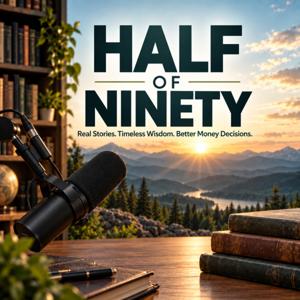


What did your parents and grandparents teach you about money—without ever actually sitting you down and teaching you?
In Episode 17 of Half of Ninety, I sit down with my mother-in-law to preserve some of the financial stories that have been passed down through her family.
Her grandparents lived through the Great Depression and didn’t trust banks. Her grandmother hid money around the house—including a coffee can filled with cash that was eventually discovered in the cellar.
Her father had his own unusual relationship with banks. Before depositing a paycheck, he would ask the teller to give him the entire amount in cash. He would count it, make sure every dollar was there, and then hand it back to be deposited.
Her parents were incredibly frugal. They gardened, canned food, avoided waste, lived within a strict household budget, and eventually owned their home outright.
Then we talk about her own financial journey.
She started earning money babysitting for 25 cents an hour, opened a savings account, worked through school, and saved enough to pay her own college tuition.
And when she got married, one of her first financial lessons came almost immediately when her new husband needed to buy an alarm clock—and didn’t have the money.
These aren’t stories about complicated investment strategies.
They’re stories about saving, providing, sacrifice, security, and the way our experiences with money shape how we handle it.
Most of us were never formally taught how to manage money.
We watched.
We listened.
We experienced.
And then we figured it out.
That’s why these stories are worth preserving—and why we should probably talk about money more than we do.
What would it take to pay off your house in just 3½ years?
In Episode 16 of Half of Ninety, I’m sitting down with a couple who actually did it.
They bought their home for $255,000 with a $110,000 down payment and originally set a goal to have the mortgage gone within five years.
They beat their goal by a year and a half.
But this conversation isn’t just about making extra mortgage payments.
We talk about how they became savers, why they were willing to rent longer instead of rushing into homeownership, and how living below their means gave them options later.
We also get into the tension between investing and paying down a low-interest mortgage.
They heard the same arguments many homeowners hear:
Why pay off a low-rate mortgage when you could invest the money?
What about the tax deduction?
For them, the answer came down to something that couldn’t be measured entirely by a spreadsheet: peace of mind.
Owning their home gave them security—and now it’s giving them the freedom to think about what’s next.
And interestingly, paying off the house wasn’t quite the celebration either of them expected. Achieving a huge financial goal created another question:
Now what?
This is exactly why I wanted to start having these conversations on Half of Ninety.
There isn’t one perfect way to handle money.
But there is a lot we can learn from hearing how real people made their decisions, what worked for them, and why.
Their story is proof that owning your home is possible.
And if that’s one of your financial goals, it may be worth pursuing.
You work eight hours a day.
What are you doing with the other 16?
In Episode 15 of Half of Ninety, we wrap up Arnold Bennett’s How to Live on 24 Hours a Day and look back at the ideas that stood out to me most.
Written in 1910, this little book is more than 100 years old, yet its message feels surprisingly relevant today.
Every one of us gets the same 24 hours.
You can’t save them. You can’t borrow tomorrow’s hours. You can’t buy more of them.
You can only decide what you’re going to do with the time you have today.
That doesn’t mean filling every spare minute with work or turning your life into a productivity contest. Bennett’s challenge is much simpler: become more intentional.
Start small.
Make time for things that actually matter to you.
Spend time learning—not just consuming information, but thinking about what you’re learning.
Practice controlling your attention instead of allowing every distraction to control it for you.
And don’t wait until you magically “have more time.”
This book started our Half of Ninety journey with something even more fundamental than money: time.
Because before we decide how to spend our money, maybe we should think about how we’re spending our lives.
So if you remember only one question from this book, make it this:
How are you spending your 16 hours?
Book: How to Live on 24 Hours a Day
Author: Arnold Bennett
Final Book Recap
Can becoming more productive actually make your life worse?
In Episode 14 of Half of Ninety, we continue How to Live on 24 Hours a Day by Arnold Bennett with Chapter 13: “Dangers to Avoid.”
After spending the book encouraging us to use our time more intentionally, Bennett ends with an important warning: Don’t become a slave to the system.
A schedule can be useful.
But it isn’t a religion.
Bennett warns against becoming so proud of your new habits that you start judging everyone else for how they spend their time. He also warns against filling every minute so tightly that your life becomes a constant rush from one task to the next.
The goal isn’t to create the perfect schedule.
The goal is to create a better life.
That means leaving room for flexibility, rest, interruptions, and even the occasional few minutes intentionally doing nothing.
And when you’re starting something new, Bennett says to go slower than you think you need to.
Choose something you actually enjoy. Make the goal small enough that you can succeed. Then build from there.
Your schedule should serve your life.
Your life shouldn’t serve your schedule.
Book: How to Live on 24 Hours a Day
Author: Arnold Bennett
Chapter 13: Dangers to Avoid
When was the last time you read something that actually made you work?
In Episode 13 of Half of Ninety, we continue How to Live on 24 Hours a Day by Arnold Bennett with Chapter 12: “Serious Reading.”
Bennett makes an interesting distinction between reading for enjoyment and reading for growth.
He isn’t against novels. In fact, he recognizes that some of the world’s greatest literature is fiction. But when it comes to the time we’ve intentionally set aside for developing ourselves, Bennett believes we should choose something that challenges the mind.
Something that requires concentration.
Something that makes us stop and think.
And most importantly, something we reflect on after we’ve read it.
Bennett has some strong opinions about what we should read—including a passionate argument for poetry—but the larger lesson goes beyond any particular kind of book.
Reading isn’t automatically learning.
Sometimes the most valuable part happens after you close the book and begin thinking about what you just read.
What did you learn?
What challenged you?
What do you believe differently because of it?
And what are you going to do with it?
Don’t just read.
Think.
Book: How to Live on 24 Hours a Day
Author: Arnold Bennett
Chapter 12: Serious Reading
What if the boring parts of life aren’t actually boring?
Maybe we just haven’t learned enough about them yet.
In Episode 12 of Half of Ninety, we continue How to Live on 24 Hours a Day by Arnold Bennett with Chapter 11: “Nothing in Life Is Humdrum.”
Bennett argues that one of the ways to live a fuller life is to become curious about the world already around us.
Everything has a cause. Everything has a history. And everything connects to something else.
A change in transportation can affect where people choose to live. That increased demand can change property values and rents. Something that appears ordinary on the surface becomes fascinating once you start asking why it happened.
And Bennett’s point goes far beyond economics.
You don’t have to love literature or art to become a lifelong learner. Study your profession. Study your neighborhood. Study nature. Study something you encounter every day but have never taken the time to understand.
Curiosity can transform the ordinary.
Maybe you don’t need a more interesting life.
Maybe you need to become more interested in the life you already have.
Book: How to Live on 24 Hours a Day
Author: Arnold Bennett
Chapter 11: Nothing in Life Is Humdrum
What if learning something new didn’t have to feel like work?
In Episode 11 of Half of Ninety, we continue How to Live on 24 Hours a Day by Arnold Bennett with Chapter 10: “Interest in the Arts.”
Bennett pushes back against the idea that using your free time wisely means forcing yourself to study subjects you’re supposed to care about.
Instead, start with something you already enjoy.
Maybe it’s music. Maybe it’s art, architecture, sailing, or something completely different.
You don’t have to become an expert. You don’t even have to know how to play an instrument to develop a deeper understanding of music. Simply learning how an orchestra works can completely change the way you experience a concert.
That’s Bennett’s larger point.
Knowledge can deepen enjoyment.
When you understand more about something you already love, you begin noticing details you never noticed before. What was once simply entertaining becomes more interesting, more meaningful, and more alive.
And a few intentional hours each week can eventually turn a casual interest into genuine knowledge.
You don’t have to learn everything.
Start by learning more about something you already love.
Book: How to Live on 24 Hours a Day
Author: Arnold Bennett
Chapter 10: Interest in the Arts
When was the last time you stopped and really examined your life?
In Episode 10 of Half of Ninety, we continue How to Live on 24 Hours a Day by Arnold Bennett with Chapter 9: “The Reflective Mood.”
Bennett argues that after learning to control our attention, one of the most important things we can turn that attention toward is ourselves.
Where is your life going?
What actually makes you happy?
What principles do you believe in?
And perhaps most importantly: Does the way you live match what you say you believe?
Bennett believes we don’t spend enough time reflecting on these questions. We move through our days reacting to circumstances, habits, frustrations, and emotions without stopping to examine why we behave the way we do.
His solution is a regular, honest examination of our own lives—looking at what we’ve done, what we’re about to do, and whether our actions align with our principles.
Books can teach us. Other people can teach us.
But neither can replace honestly looking at ourselves.
Maybe living better isn’t only about finding more time.
Maybe it’s about taking the time to ask better questions.
Book: How to Live on 24 Hours a Day
Author: Arnold Bennett
Chapter 9: The Reflective Mood
Can you control what you think about?
Arnold Bennett says you can—and learning how may be one of the most valuable ways to use your time.
In Episode 9 of Half of Ninety, we continue How to Live on 24 Hours a Day with Chapter 8: “Controlling the Mind.”
Bennett argues that concentration isn’t simply something you’re born with. It’s something you can practice.
His exercise is remarkably simple: Pick a subject and concentrate on it. Your mind will wander. Bring it back. It will wander again. Bring it back again.
The goal isn’t perfection. It’s training.
Bennett compares it to exercising the body, except you don’t need a gym, equipment, or even a book. You can practice while walking, commuting, waiting, or during the small pieces of time we normally throw away.
And he believes the benefits go beyond productivity.
Learning to direct your thoughts can change how you experience worry, distraction, and everyday life.
We spend a lot of time thinking about how to control our schedules.
Maybe we should spend a little more time learning how to control our attention.
Book: How to Live on 24 Hours a Day
Author: Arnold Bennett
Chapter 8: Controlling the Mind
What could you change with just 7½ hours a week?
In Episode 8 of Half of Ninety, we continue How to Live on 24 Hours a Day by Arnold Bennett with Chapter 7: “Remember Human Nature.”
After challenging us to make better use of our time, Bennett adds an important reminder: We’re human.
We need rest. We have habits that are difficult to change. Life doesn’t always go according to schedule. And trying to overhaul everything at once can actually work against us.
So Bennett proposes something surprisingly modest: find just 7½ hours each week to intentionally invest in yourself.
That’s it.
He argues that using those few hours well can add energy and interest to the rest of your week—much like a small amount of regular exercise can affect how you feel throughout the entire day.
But those hours won’t magically appear. Making room for something new means changing something old.
Start quietly. Leave room for life to happen. Protect your confidence by setting a goal you can actually keep.
You don’t have to change all 168 hours of your week.
Start with 7½.
Book: How to Live on 24 Hours a Day
Author: Arnold Bennett
Chapter 7: Remember Human Nature