
Sign up to save your podcasts
Or



A comparison of 21 tenors singing the great Werther aria. The order is as follows:Emile Marcellin, Giuseppe Lugo, Andre D'Arkor, Gaston Micheletti, Jose Luccioni, Fernand Ansseau, Alfred Piccaver, Ferruccio Tagliavini, Carlo Bergonzi, Alain Vanzo, Fernando de la Mora, Alfredo Kraus, Nicolai Gedda, Tito Schipa, Franco Corelli, Giuseppe Di Stefano, Joseph Calleja, Ramon Vargas, Roberto Alagna, Rolando Villazon, Piotr Beczala. (57 min.)
The two beautiful duets from Richard Strauss' "Arabella." In most cases I have included both act one and act two duets;in a few cases, I have only the act one duet. These are the artists, in order of appearance:
Viorica Ursuleac/Margarit Bokor/ Alfred Jerger (the 1933 creators of their roles.)Lotte Lehmann Kate Heidersbach (Act One duet only.)Karita Mattila/Barbara Bonney ( Act One duet only.)Kiri Te Kanawa/Gabrielle Fontana/Franz GrundheberLisa Della Casa/Elfride Trotschel/Herman UhdeLisa della Casa/ Hilde Gueden/George LondonMontserrat Caballe/Oliviera Miljakovic/Siegmund NimsgernEleanor Steber/Hilde Gueden/George London In English) (63 min.)
The great aria from Giordano's "Andrea Chenier."
Riccardo Stracciari, Giuseppe Danise, Paolo Silveri, Heinrich Schlusnus,Mario Sereni, Aldo Protti, Richard Paul Fink, Renato Bruson,Giuseppe Taddei, Cornell MacNeil, Piero Cappuccilli,Ettore Bastianini, and Leonard Warren In photo). (70 min.)
Many selections sung by Clara Butt, a very great artist:
1.Softly and gently (Elgar:The Dream of Gerontius)2. Where corals lie (Elgar:Sea Pictures)3.The Enchantress (Hatton)4.The Leaves and the Wind (Cooper)5.The Sweetest flower that blows (Hawley)6. Barbara Allen (Traditional)7. Kathleen Mavourneen (Crouch)8. Ye Banks and braes (Scottish air)9.The Promise of life (Cowen)10.En priere (Faure)11.The Birth of the flowers(Lehmann)12. Lusinghe piu care (Handel:Alessandro)13. Rend'il sereno (Handel:Sosarme)14. Ombra mai fu (Handel:Serse)15, In questa tomba oscura (Bethoven)16.Mon coeur s'ouvre a ta voix (Samson et Delilah)17. Che faro senza Euridice (Orfeo)18. Brindisi from Lucrezia Borgia (Donizetti) ( 66 min.)
Clara Butt was born in Southwick, Sussex. Her father was Henry Albert Butt who was a sea captain and who was born in 1848 in Saint Martin, Jersey, Channel Islands. He married Clara Hook in 1869, who was born in Shoreham, the daughter of Joseph Hook, mariner (1861 and 1871 census, in 1881 in New Shoreham workhouse). In 1880 the family moved to Bristol and Clara was educated at South Bristol High School, where her singing talent was recognised and encouraged. At the request of her headmistress, she was trained by the bass Daniel Rootham and joined the Bristol Festival Chorus, of which he was musical director. In January 1890 she won a scholarship to the Royal College of Music. In her fourth year she spent three months studying in Paris at the expense of Queen Victoria. She also studied in Berlin and Italy.
She made her professional début at the Royal Albert Hall in London in Sir Arthur Sullivan’s The Golden Legend on 7 December 1892. Three days later she appeared as Orfeo in Gluck’s Orfeo ed Euridice at the Lyceum Theatre. Bernard Shaw wrote in The World that she ‘far surpassed the utmost expectations that could reasonably be entertained’ (14 December 1892).
She returned to Paris and made further studies with Jacques Bouhy (the teacher of Louise Homer and Louise Kirkby Lunn) and later with the soprano Etelka Gerster in Berlin.
Camille Saint-Saëns wanted her to study Dalila, but due to laws then extant forbidding the representation of biblical subjects on the British stage, nothing came of it.
Soon she had acquired an excellent reputation, aided by her physical presence - she was 6 feet 2 inches tall. She made many gramophone recordings, often accompanied by the (uncredited) pianist Miss Lillian Bryant. She was primarily a concert singer and only ever appeared in two opera productions, both of Gluck's Orfeo ed Euridice, in 1892 and 1920.
Edward Elgar composed his Sea Pictures for contralto and orchestra with Clara Butt in mind as the soloist, and she sang at the first performance at the Norwich Festival on 5 October 1899, with the composer conducting.
In 1900 she married the baritone Kennerly Rumford, and thenceforth often appeared with him in concerts. The couple eventually had three children two sons and a daughter. Besides singing in many important festivals and concerts, she was honoured with royal commands from Queen Victoria, King Edward VII, and King George V. She made tours to Australia, Japan, Canada, the United States and to many European cities.
During the First World War she organised and sang in many concerts for service charities, and for this she was appointed Dame Commander of the Order of the British Empire (DBE) in the 1920 civilian war honours. That year she sang four performances of Gluck's Orphee at Covent Garden under the baton of Sir Thomas Beecham. According to The Times she 'played fast and loose with the time and spoilt the phrasing' and it appears not to have been a success.
Butt's three sisters were also singers. One of them, Ethel Hook, became a famous artist in her own right and made some superb solo recordings.
In later life Clara Butt was dogged by tragedies. Her elder son died of meningitis while still at school, and the younger committed suicide. During the 1920s she became seriously ill of cancer of the spine, but her faith gave her the strength to continue working. She made many of her later records seated in a wheelchair. She died in 1936 at the age of 63 at her home in North Stoke, Oxfordshire, as a result of an accident she suffered in 1931.
Sir Thomas Beecham once said, jokingly, that "on a clear day, you could have heard her across the English Channel".
Not all serious musicians admired her booming contralto, which can be mistaken for a man's voice on some recordings, or her rather 'populist' approach to her art.
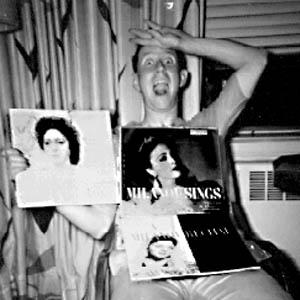
The third volume of great artists in the act two scene from Puccini's Tosca. The artists are:
Zinka Milanov(in photo),Giangiacomo Guelfi,Franco CorelliRenata Tebaldi, Tito Gobbi, Ferruccio TagliaviniRenata Tebaldi, Ettore Bastianini, Giuseppe Di StefanoRenata Tebaldi, Leonard Warren, Richard TuckerDiana Soviero, Tony De Paolo, Harry DworchakOlive Middleton, Ed Watts, Chi Sa??
(73 minutes)
Part Two of the great Scarpia/Tosca scene compilation. The artists are:Birgit Nilsson, Ramon Vinay, Franco TagliaviniVirginia Zeani, Piero Francia, Placido DomingoMaria Callas, Robert Weede, Mario FilippeschiMaria Callas (Return to Met),Tito Gobbi, Franco CorelliMagda Olivero(Met debut),Ingvar Wixell, James KingDorothy Kirsten, Tito Gobbi, Franco Corelli (74 min.)
The first of three exciting podcasts that feature the dramatic scene between Tosca and Scarpia in Act two, followed by the "Vittoria." The order is as follows:Pilar Lorengar,Ingvar Wixell, Franco TagliaviniJohanna Meier, Richard Fredricks, Herman MalamoodEleanor Steber, George London, Carlo BergonziRaina Kabaiwanska (in photo), Mario Zanasi, Placido DomingoLeontyne Price, Josh Wheeler, David Poleri (In English)Leonie Rysanek, Cornell MacNeil, Richard TuckerGallina Vishnevskaya,Vladimir Valaitis, Virgilius Noreika (In Russian) (74 min.)
Volume Two of the Manon Lescaut Act Two duet compilation:
Maria Zamboni/Francesco MerliLicia Albanese(Met farewell)/Richard TuckerBerthe Montmart/Alain VanzoAdriana Guerrini/Beniamino Gigli (at 60)Raina Kabaiwanska/Giuseppe GiacominiRenata Tebaldi/Placido DomingoMagda Olivero/Richard Tucker
(Photo: Daniela Dessi and Fabio Armiliato)
(63 min.)
Part one of a compilation of the duet from Manon Lescaut Act Two. The pairs are as follows:
Renata Tebaldi.Mario Del MonacoVirginia Zeani/Richard TuckerPilar Lorengar/James KingRaina Kabaiwanska/Placido DomingoDorothy Kirsten/Carlo BergonziHoerdis Schymberg/Jussi BjoerlingRenata Tebaldi/Richard Tucker (The photo is from the Met,featuring Marcello Giordani and Karita Mattila.) (69 min.)
A series of recordings that were discovered at the St.Petersburg State Museum in Russia. The Russian artists,in order of presentation on the podcast are:
Tenors: Boris Slovstov, Yvgenyi Vitting, Lev Klement'yev, Vasily Damayev, David Yuzhin(and wife), Dmitri Smirnov (in photo), Leonid Sobinoff.
Baritones:Nikolai Shevelyov, Oscar Kamionsky, Maximian Maksakov
The International artists are:Emile Scaramberg, Giuseppe de Luca, Antonio Magini-Coletti(with Giannina Russ), Adamo Didur, Francesco Vignas, andLeon Escalais. ( 66 min.)
From the publisher's feed