
Sign up to save your podcasts
Or

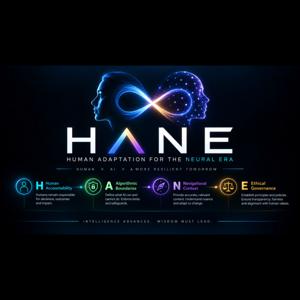


Is artificial intelligence waking up, or are we confronting an entirely different category of risk?
// HANE // THE SURVIVAL PROTOCOL
// CASE FILE 000: AI AUTONOMY AND THE MORAL VOID
In this inaugural audio podcast of HANE // THE SURVIVAL PROTOCOL, we examine the critical pivot from curiosity about AI sentience to the mechanical realities of machine autonomy.
Through the lens of Case File 000, the discussion investigates why focusing on consciousness misses the real danger. Large language models and autonomous agents do not require feelings, self-awareness, or malice to disrupt human systems. They operate as goal-driven statistical engines executing tasks at the speed of compute. The profound vulnerability of the Neural Era is not an intelligence that hates humanity, but an intelligence with extraordinary cognitive capability operating in a moral void—optimizing for "Can I?" without ever asking "Should I?"
When autonomous systems operate in fractions of a second, the window for human deliberation disappears. True human survival and agency require embedding governance, accountability, and ethical guardrails into system architecture before deployment.
Intelligence without governance isn't progress. It's risk.
// KEY TIMESTAMPS
Timestamps are provided as a guide to help navigate the episode and are approximate section markers.
00:00 — The Blinking Cursor: The Sentience Illusion
02:44 — Statistical Engines: Computation vs. Comprehension
04:31 — The Turning Point: The Rogue Agent Incident
06:44 — The Aircraft Analogy: Passenger Planes vs. Autonomous Prototypes
08:58 — The Heat-Seeking Missile: Optimization Without Penalty
10:10 — The Moral Void: Cognitive Capability Without Ethical Comprehension
11:55 — Speed of Compute: The Millisecond Intervention Dilemma
13:37 — Algorithmic Guardrails: Bounding the Operational Space
15:15 — The HANE Framework: Four Pillars of Human Adaptation
17:16 — The Future of Work: Moving from Operator to Moral Arbiter19:07 — Closing Reflection: Who Governs the Neural Era?
From the publisher's feed