
Sign up to save your podcasts
Or



This conversation with Laurent Babikian explores how companies can adapt their business models as Europe faces resource scarcity and a shifting geopolitical order. Drawing on his path from selling derivatives to the Carbon Disclosure Project to advising executive committees today, Laurent argues that the shift from planned obsolescence to circular business models is the main lever left for European companies without natural resources of their own.
He also lays out concrete reforms needed to make this shift viable: new accounting rules to amortise materials over multiple life cycles, bank financing structured around asset lifespan rather than product cycles, and sustainability-linked pricing across every stakeholder relationship.
Key takeaways:
- Circular business models, selling the use of a product rather than the product itself, let companies extract far more value from the same raw materials, which matters most for regions like Europe with no natural resources of their own.
- Current accounting rules amortise products to zero after one life cycle, which discourages reuse; changing this (and how banks finance these assets) is a prerequisite for the model to scale.
- Sustainability-linked pricing, charging suppliers, clients, and employees differently based on their impact, is already technically possible and could align incentives across the whole value chain.
- The balance of economic power has already shifted toward the Global South and BRICS nations, particularly on natural resources, which will keep reshaping trade, currency, and industrial policy.
Follow Laurent Babikian on LinkedIn
The Makers of Change
This conversation with Christian Clot delves into the complex nature of human adaptation, exploring its subjective nature, the limits and costs associated with it, and the psychological motivations for change. It also highlights the emotional impact on change, the role of leadership in adaptation, the importance of time, rest, and balance, and the challenge of multiple adaptations. The key takeaways emphasise the subjective nature of adaptation and the need for balance and consideration of resources and costs.
Takeaways
Human Adaptation Insitute
Christian Clot
The Makers of Change
In this episode, Virginie Vitiello receives Christian Bruère, co-founder and former CEO of Mob-ion, who applied his philosophy of “Circular Programmed Sustainability” to the mobility sector, moving beyond planned obsolescence. Starting from the observation that recycling is a confession of design failure, Christian leads us through the different steps to design a circular economy and build a future today.
Link to Mob-ion.
Follow The Makers of Change newsletter.
Would you like to know how to create fruitful collaborations to make the future you desire a reality?
That question opens our very first episode. Virginie welcomes Sarah Dubreil, expert in integrating the Three Horizons model into business and finance. Her work connects deep research with real-world application, helping companies and investors rethink how they make decisions in a complex world.
To learn more about the seven archetypes of regenerative business, download Sarah's latest paper, authored with Laurence Lehmann-Ortega and published with HEC Paris: The Regenerative Shift
Links to all the examples mentioned by Sarah are included in The Makers of Change newsletter.
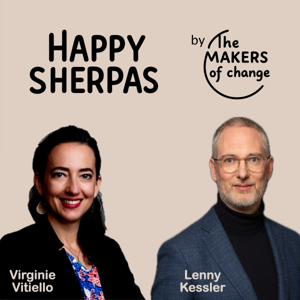
Virginie Vitiello and Lenny Kessler present Happy Sherpas, a podcast where we will explore how to rethink the way we live, work, and invest to build a future that’s both fair and resilient.
Each episode will feature an entrepreneur, financier, scientist, or explorer who dares to question the system. They are our guides — our “happy sherpas” — showing that optimism and action can go hand in hand.
The Makers of Change Newsletter
From the publisher's feed