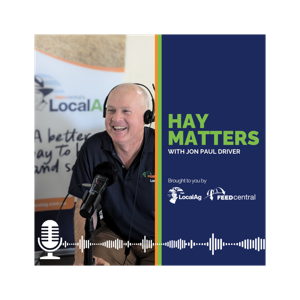
Hay Matters

Hay Matters

Download on the App Store

Hay Matters episodes

  • Cattle, Hay and Hard Conversations with Gillian Fennell

    In the latest Hay Matters Podcast, brought to you by LocalAg and Feed Central, Jon Paul Driver is joined by cattle producer, advocate and agfluencer Gillian Fennell.

    Gillian has spent time serving on industry boards and committees at a local, state and national level, and has a special interest in on-farm succession planning and the impact that it has on farming families and communities.

    With over 20 years in the beef industry and a base in one of the most remote parts of Australia, Gillian brings insight and lived experience to this episode, covering everything from succession and farm management to social media, leadership and the realities of modern ag life.

    • Gillian and her husband operate a family-run cattle station spanning a million acres, running around 5,000 breeders.
    • They’ve recently expanded into fodder production on a newly acquired irrigation block in the Flinders Ranges.
    • Producing their own hay has added flexibility, reduced reliance on freight and provided new opportunities for cattle marketing and logistics. A new hay shed at the home station marks one of their biggest infrastructure investments to date.
    • Gillian discusses how social media—especially Twitter—has become an important space for connection, advocacy, and countering negative perceptions of agriculture.
    • She highlights innovations like no-till cropping and improved chemical use as major steps towards sustainable production.
    • Three core messages for agricultural advocacy are: producers are skilled, already sustainable, and deeply connected to the environment that supports them.
    • Gillian sees succession as less of a legal or accounting challenge and as more of a people problem; it needs to start early, with open and long-term business conversations, not last-minute decisions.
    • Gender dynamics also play a role; many women feel excluded from farm leadership, even when they bring training, ideas, and experience.
    • There need to be more pathways into the Ag industry, beyond university or tech roles—especially for those with strong work ethic and practical skills.

    Gillian's upcoming podcast "Suck-session" explores succession breakdowns, featuring real stories to help others avoid common pitfalls.

    32 min
  • Mixing Family & Business in Ag with Megan Ford

    In the latest Hay Matters Podcast, brought to you by LocalAg and Feed Central, Jon Paul Driver sits down with Megan Ford to discuss her journey in agriculture, the evolution of Feed Central, and the role of women in the industry.

    From the early days of building a business while raising a young family to the challenges of expansion and the launch of LocalAg, Megan shares her experiences and the lessons learned along the way.

    • Tim and Megan started Feed Central with big ideas and a hands-on approach, balancing business growth with raising a young family.
    • Strong family support was essential, with relatives stepping in to help, allowing the business to grow during the tough early years.
    • Business discussions didn’t always happen in an office; late-night board meetings, car conversations, and stolen moments between school runs often shaped key decisions.
    • A major hay shed fire in 2014 was a defining moment, testing resilience and reinforcing the importance of a strong team and community.
    • Women’s networks, including the Queensland Rural Women’s Network and Australian Women in Agriculture, played a key role in providing mentorship, connections, and opportunities for leadership.
    • LocalAg wasn’t an overnight decision; it was shaped by years of conversations with farmers and customers, identifying gaps in the market and building a platform that gives users more control.
    • The introduction of LocalAg reflects a shift in how farmers want to do business, offering more flexibility while maintaining the trust built over decades.
    20 min
  • The Changing Face of Ag Trade with Dave Clothier

    Podcast Highlights

    In the latest Hay Matters Podcast, brought to you by LocalAg and Feed Central, Jon Paul Driver and National Sales Manager Dave Clothier explore the early days of Feed Central's LocalAg and the wider impact it will have on Australian agriculture.

    They discuss how extreme weather, from drought and scorching heat in the south to heavy rains and flooding in the north, is reshaping feed supply and market dynamics. Real-time feedback and market adaptability are charting a new course for ag across the country with customers asking for more flexibility and transparency with their purchase decisions.

    • The platform presents two distinct options: traditional full-service account management and a flexible, direct interaction model.
    • Early feedback indicates that buyers and sellers value the choice to adopt a transaction style that best meets their individual needs.
    • Sellers can now showcase their entire range of offerings with free listings, allowing potential customers to discover additional products and services.
    • Customisable features let users tailor transactions to specific requirements, such as negotiating part truck loads or managing customised deals.
    • Overall, the platform is fostering more direct and transparent communication in the agricultural market, enhancing both efficiency and customer engagement.
    • On the market front, despite extreme weather including drought in some regions and heavy rains in others, buyers are proactively securing quality feed ahead of winter.
    17 min
  • The Science Behind Better Oats with Dr Allan Rattey

    In this episode of the Hay Matters Podcast brought to you by LocalAg and Feed Central, host Jon Paul Driver is joined by Dr Allan Rattey, National Oat Breeder at InterGrain, to explore the future of Australian hay and forage production.

    They discuss how cutting-edge technology is accelerating oat breeding, the importance of balancing yield with quality, and why fibre digestibility is a game changer for both sustainability and livestock performance.

    Dr Rattey also shares insights into how InterGrain is delivering practical solutions to Australian farmers, including varieties tailored to unpredictable weather and dual-purpose crops that maximise flexibility and profitability.

    • Breeding times for new oat varieties are now as short as 9-10 years, thanks to innovations like speed breeding and advanced trait selection tools.
    • Fibre digestibility is a key focus, improving both livestock nutrition and sustainability by reducing waste.
    • The integration of new technologies, including drone imaging, has streamlined the process of selecting high-performing crops, helping farmers achieve better results faster.
    • InterGrain bred for speciality Hay and Grain oat varieties. They also heavily select for dual-purpose oat varieties that improve growers in season flexibility to decide whether to harvest for hay or grain, depending on market conditions and seasonal challenges.
    • Curing time is key for hay production, ensuring farmers can work within limited weather windows.
    • Collaboration with farmers and feedback from processors are central to breeding programs, ensuring new varieties deliver real-world value across the industry.

    InterGrain leads Australia’s barley and oat breeding programs, developing high-yield, disease-resistant varieties that are adaptable to diverse conditions.

    51 min
  • Special Edition: Feed Central's Next Chapter with Tim Ford

    To start the new year on the Feed Central Hay Matters podcast, Jon Paul Driver sat down with Tim Ford, Director of Feed Central, to pull back the curtain on Local Ag - a bold new marketplace that’s been 22 years in the making. Born from decades of experience, countless conversations with farmers, and a relentless drive to innovate, Local Ag is set to revolutionise how Australian agriculture connects and trades.

    • Local Ag launches 29th January 2025, offering a fresh and modern way for Australian farmers and agribusinesses to trade hay, grain, seed, fertiliser, livestock, machinery, and more.
    • Built to simplify transactions while keeping them secure, Local Ag combines decades of Feed Central expertise with cutting-edge tech tailored for agriculture.
    • Tim describes the platform as the handshake deal reinvented; buyers and sellers connect directly, chat through the platform, and close deals seamlessly with payment, contracts, and logistics all managed along the way.
    • At the heart of it all is Kev, an AI chatbot who’s part junior trader, part contract genius, and always learning to keep transactions running smoothly. He’s friendly, practical, and distinctly local - just like the team that built him.
    • Kev isn’t just a bot; he’s a tribute to Tim Ford’s late father, a man who brought wisdom, warmth, and a deep love for rural life. That legacy is built into the platform itself.
    • Farmers can build their own profiles, showcase their products, and connect with buyers in a way that feels modern but rooted in trust.
    • Unlike generic marketplaces, Local Ag is designed specifically for rural Australia; it's built to balance the no-nonsense practicality of farming with the convenience of online tools.
    • Every detail has been shaped by 20+ years of Feed Central’s experience, from the AI chat to the quality assurance options and the human support team that’s always a phone call away.
    • Built locally in Toowoomba, Local Ag stands apart from off-the-shelf solutions with tech designed and coded right here in Australia.
    • Local Ag reflects how today’s farmers do business: building their brands, taking control of supply chains, and stepping into the digital world on their own terms.
    • The platform is as much about relationships as it is about transactions. Farmers will be able to connect with buyers, get direct feedback, and build trust in ways that go far beyond selling a product.
    • Whether it’s a small batch of seed, a truckload of hay, or a piece of second-hand machinery, Local Ag will make the process simpler, safer, and more personal.
    • Feed Central isn’t going anywhere. The team you know and trust remains the backbone of this new venture, ensuring continuity for hay services while opening doors to new opportunities.
    • Launching just after Australia Day, Local Ag celebrates the heart of rural Australia: family, community, and innovation wrapped up in one trusted platform.

    Don't get left behind; register now for early access.

    34 min
  • The year in review and preparing for 2025: a Market Wrapup with Dave Clothier

    Podcast Highlights

    In the final Feed Central Hay Matters Podcast for 2024, Jon Paul Driver catches up with National Sales Manager Dave Clothier to discuss the challenges and market shifts faced by hay producers during the 2024 season and what we can expect in the year ahead.

    Early in the year, drought cleared stockpiles of low-grade hay, but wet weather later reduced overall production and caused quality deterioration. Strong demand continues, driven by record feedlot numbers and booming beef exports, while the sheep flock declines and the dairy sector remains cautious. Looking ahead, hay prices are expected to rise, with limited availability of high-quality supply for key demand periods. Forward planning is essential as 2025 brings new opportunities and challenges.

    The Year that's Been:

    • Early drought in southern Australia cleared stockpiles of low-grade hay from previous seasons.
    • Variable spring and summer conditions has either reduced hay yields or impacted quality, while frost events produced some high-quality hay in far smaller volumes than expected.
    • Current stockpiles are mostly mid-grade hay, with limited availability of premium fodder needed for the March–April weaning period.
    • Feedlot numbers are at record highs of 1.4 million cattle, with strong confidence feedlots will remain full throughout 2025.
    • Australian beef exports reached a record-breaking 1.3 million tonnes, driven by strong demand from Japan, Indonesia, and the US.

    Looking Ahead:

    • National sheep flock is declining due to drought, live export policy changes in Western Australia, and challenging weather conditions across southern production regions.
    • The dairy sector faces reduced milk production, fluctuating weather, and budget pressures, leading to more cautious fodder purchasing decisions.
    • Hay prices are predicted to rise by at least 10% in early 2025 due to limited supply, grower cash flow priorities, and strong demand.
    • Forward contracting is recommended to secure quality hay and manage costs before peak demand periods.
    18 min
  • 2024 Harvest Insights from the Road: a discussion with Steve Page

    In the latest Feed Central Hay Matters Podcast, Host Jon Paul Driver talks to Steve Page, Grower Services Manager, about the challenges faced by hay producers during a season marked by wet weather, frost events, and fluctuating market dynamics. Steve, who has recently been on the road visiting growers, shares insights into what the season looked like and the impact of these challenges across Australia.

    • Southern Queensland and northern New South Wales experienced a wet baling period, resulting in quality deterioration.
    • The Riverina faced frost damage, while Wimmera-Mallee growers shifted to 100% hay production but reported reduced yields.
    • South Australia endured one of its toughest seasons in decades, with little surplus hay available for domestic markets.
    • Of the cereal hay inspected, only 1% achieved FCAA grade, while most fell into high FCB or FCC grades due to weather impacts.
    • Lucerne hay production is increasing as growers shift away from seed due to weak global markets, filling gaps left by a shortage of protein hays.
    • Many growers are storing high-quality hay to sell in early 2025, while FCC-grade hay is being sold to avoid further deterioration.

    Steve recommends growers monitor their hay quality, wait for the right market conditions, and consider Feed Central’s quality certification services to optimise sales opportunities.

    21 min
  • Farming Tomorrow: an Ag2050 discussion with Dr Sabrina Greenwood

    Podcast Highlights

    In this episode of the Feed Central Hay Matters Podcast, host Jon Paul Driver welcomes Dr. Sabrina Greenwood from CSIRO to discuss the AG2050 initiative.

    From farms equipped with digital farming and precision agriculture technologies to systems that provide real-time data optimising everything from soil health to water use, AG2050 envisions a sustainable and technologically advanced future for Australian agriculture by 2050.

    CSIRO, Australia’s national science agency known for significant contributions like the invention of Wi-Fi and advanced polymer banknotes, is spearheading this strategic initiative. Dr. Greenwood provides an in-depth overview of AG2050's ambitious goals, designed to reshape farming practices across the nation through innovation and strategic foresight, hand-in-hand with industry partnerships.

    • AG2050, a strategic initiative within CSIRO’s Agriculture and Food research unit, envisions what Australian agriculture could and should look like by 2050, aiming for sustainability and resilience.
    • In AG2050, hay and other forage-based commodities, influenced by climate factors and groundwater availability, are essential for enhancing productivity across diverse regions.
    • Over 100 community partners were involved in initial AG2050 workshops to discuss major stressors and drivers in their industries, aiding the development of four future scenarios for Australian agriculture.
    • These four scenarios - Regional Ag Capitals, Landscape Stewardship, Climate Survival, and Systems Decline - each provide a different vision of what could happen based on current trends and potential interventions.
    • The ongoing need for community engagement is crucial for refining and implementing strategies that will drive Australian agriculture towards the desired futures outlined in AG2050.

    If you'd like to get involved, you can visit the AG2050 website.

    13 min
  • Harvest Wrap Up: a Market Update with Dave Clothier

    In this market update episode of the Feed Central Hay Matters Podcast, host Jon Paul Driver and Dave Clothier discuss the Australian hay market as the harvest season winds down. They cover how recent weather has impacted hay quality, with a mix of grades now available, and look at the impact on yields in regions like South Australia and Western Victoria. With high demand from the beef sector, and steady prices across most areas, this episode provides timely insights for buyers navigating this season’s unique challenges.

    • Hay production in Queensland is mostly complete, with limited shed availability there is a higher proportion of paddock stacks.
    • New South Wales and Victoria are nearing completion, although recent rain has affected quality, resulting in variable quality and the majority of sheds now full.
    • In South Australia and Western Victoria, drought and frost have reduced yields by 30-50% compared to last year, causing significant losses for some growers.
    • Recent storms and wet conditions have delayed harvests in the north, leading to bleached, lower-grade hay with thicker stems and higher NDF. Overall, high-quality hay volumes are down, as adverse weather and frost have pushed many high-yielding crops toward grain production instead of hay.
    • High canola prices mean fewer frosted canola crops were turned into hay, contrary to initial expectations.
    • Limited vetch planting this season has reduced supply, driving up demand for lucerne and other protein-rich hays, with prices expected to remain firm.
    • Prices are steady across regions, with FCA grade cereal hay around $250 per tonne, likely holding through Christmas. Many producers are holding back supply in anticipation of stronger demand and firmer prices in early 2025.
    • The beef sector’s demand for hay is strong due to herd growth and export opportunities, while the dairy sector is purchasing more cautiously given the variable hay quality and limited protein-rich options.
    • Buyers are advised to secure supplies now to access the broadest quality selection at stable prices, avoiding potential price increases and compromised quality in early 2025.
    • With high-demand periods likely through the summer and autumn periods, it’s important to factor in both quality and location to optimise the best delivered pricing.
    23 min
  • Hay Meets AI & Innovation: a discussion with Dr Andrew Walters

    In the latest episode of the Feed Central Hay Matters podcast, our host, Jon Paul Driver, caught up with Dr. Andrew Walter for a deep dive into agricultural research and innovation. Dr. Walter has extensive experience across government, business, and academia, which has positioned him to lead projects that are reshaping hay production in Australia. His role has included leading the development of Australia's levy system, which funds agricultural research, and his practical experiences with advanced technologies such as AI to improve hay baling schedules and crop management. In addition to agricultural technology, the discussion includes pragmatic strategies that effectively manage carbon while maintaining agricultural productivity.

    • Australia's cutting-edge agricultural R&D includes the new hay levy, uniquely positioning Australian fodder on the global market through structured research funding that advances practices and sustainability.
    • A detailed comparison between Australia's agricultural technology and global standards shows how Australia’s proactive levy system has been instrumental in driving forward-looking research for over two decades.
    • The Australian Fodder Industry Association (AFIA) effectively consolidates the entire supply chain from seed companies to exporters, ensuring a unified voice in global discussions.
    • Challenges and opportunities in implementing agricultural technology, including AI and automation, are set to redefine farming practices and efficiency.
    • Climate change impacts on agriculture highlight the need for practical carbon management strategies and realistic goals towards achieving net-zero emissions in farming.
    • The future of farming is being shaped by advancements in AI, with current projects utilising AI for precise crop and animal management, marking significant progress in precision agriculture.
    • Despite being misconceived by some as a 'sunset industry', agriculture is vibrant and innovative, playing a crucial role in economic and technological advancement.
    • The dynamics of international fodder markets demonstrate the importance of balancing competitive spirit with cooperative strategies for research and development.
    55 min

About Hay Matters

From the publisher's feed

Stay up to date and learn more about the industry with the Feed Central Hay Matters Podcast – your portal to the intricate world of hay, brought to life through real stories and expert…