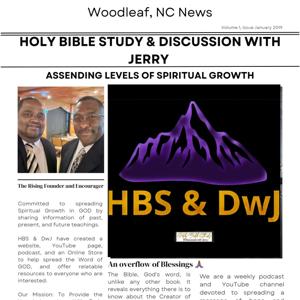
HBS & DwJ Podcast

HBS & DwJ Podcast

By Jerry M. JoyceReligion & Spirituality
Download on the App Store

HBS & DwJ Podcast episodes

  • The First Sabbath - The Day GOD Rested Discussion
    Our Scripture Of The Week Is:

    Psalm 91:1-2 KJVS
    [1] He that dwelleth in the secret place of the most High shall abide under the shadow of the Almighty.
    [2] I will say of the Lord, He is my refuge and my fortress: my God; in him will I trust.

    We cannot be sure who wrote this psalm, but its author was well acquainted with the importance and benefits of trusting in the Lord. A "shelter" provides safety from a storm or enemy.
    The term "Most High" comes from the Hebrew el'yon' and specifically implies something "upper," "above," or "highest."

    The implication is that God is superior to all other powers and supreme above any other deity.
    There is no safer shelter than what the Most High provides! The reference to God as "Most High" is seen elsewhere in Scripture.

    Genesis 14:21–24 famously records Abram's response to the king of Sodom when he offered Abram a reward for rescuing hostages. Abram said he had sworn to the Lord, God Most High, promising not to accept anything from the ruler of that infamously depraved kingdom. The psalmist refers to the "shadow" of God.

    In literal terms, a shadow provides little protection, itself. The imagery, however, is of someone who is close enough, and protected enough, that the shadow of their protector is on them. Further, the psalmist will "abide" there, implying a committed, consistent closeness with the Lord.

    The writer testifies that God is his refuge and fortress, using words that imply places of safety and security (Psalm 91:1–2). This continues the theme of God's protection and provision. The psalmist refers to the Lord as both a "refuge" and a "fortress." A "refuge" is a place people can fall back to in times of hardship or danger.

    A fortress is similar, but the typical "fortress" is a building designed for battle. It provides safety from an attacking enemy and gives those inside the means to withstand an assault. The ultimate security offered by God is eternal.

    Jesus promises His followers eternal life, without any possibility of being taken away from God (John 10:28–30).

    The apostle Paul wrote that nothing can separate the Lord's people from the love of Christ (Romans 8:35–39).

    He added that we are more than conquerors over all kinds of trouble, including intense persecution and deprivation, "through him who loved us" (Romans 8:37). Here, the psalmist declares that the Lord is his God, and he trusts in Him. As our refuge and fortress, the Lord merits our full confidence.

    We will now get deep into today’s discussion:

    A great principle of revelation occurs for the first time in this chapter, but it will be found again and again in the Word of God. It is one of the fingerprints of inspiration. It is the law of recurrence or the law of recapitulation.

    In other words, the Spirit of God, in giving the Word of God, has a practice of stating briefly a series of great facts and truths; then He will come back and take out of the series that which is all–important, and He will elucidate and enlarge upon that particular thing.

    He is going to do this now in chapter 2 with the six days of creation which were given in chapter 1.
    This same principle is seen in the Book of Deuteronomy. Deuteronomy is the interpretation of the Law after forty years of experience with it in the wilderness. Deuteronomy is not just a repetition of the Law, but rather an interpretation of it.

    Likewise, we are given not only one but four Gospels. Again and again, this procedure is followed throughout the Word of God.

    In chapter 2 that which is lifted out of the six days of creation is that which pertains to man, and we begin with the Sabbath Day.
    40 min
  • The First Sabbath - The Day GOD Rested
    A great principle of revelation occurs for the first time in this chapter, but it will be found again and again in the Word of God.

    It is one of the fingerprints of inspiration. It is the law of recurrence or the law of recapitulation.

    In other words, the Spirit of God, in giving the Word of God, has a practice of stating briefly a series of great facts and truths; then He will come back and take out of the series that which is all–important, and He will elucidate and enlarge upon that particular thing.

    He is going to do this now in chapter 2 with the six days of creation which were given in chapter 1.

    This same principle is seen in the Book of Deuteronomy.

    Deuteronomy is the interpretation of the Law after forty years of experience with it in the wilderness.

    Deuteronomy is not just a repetition of the Law, but rather an interpretation of it.

    Likewise, we are given not only one but four Gospels.

    Again and again, this procedure is followed throughout the Word of God.

    In chapter 2 that which is lifted out of the six days of creation is that which pertains to man, and we begin with the Sabbath Day.


    It is time to open our hearts, minds, and souls to the Word Of GOD.


    Our scripture will be coming from:


    Genesis 2:1-3 KJV

    [1] Thus the heavens and the earth were finished, and all the host of them.

    [2] And on the seventh day God ended his work which he had made; and he rested on the seventh day from all his work which he had made.

    [3] And God blessed the seventh day, and sanctified it: because that in it he had rested from all his work which God created and made.


    Now it is time for our verse break down:


    Genesis 2:1
    Thus the heavens and the Earth were finished, and all the host of them.

    This proclaims the fact that when the heavens and the Earth were completed, they were a brilliant array.

    The narrative of the six days‘ creation continued.

    The course of the narrative is improperly broken by the division of the chapter.

    The heavens — referring to the firmament or atmosphere.

    Host — referring to a multitude, a numerous array, usually connected in Scripture with heaven only, but here with the earth also, meaning all that they contain.

    Were finished — means it was brought to completion.

    No permanent change has ever since been made in the course of the world, no new species of animals have been formed, no law of nature repealed or added to.

    They could have been finished in a moment as well as in six days, but the work of creation was gradual for the instruction of man, as well, perhaps, as of higher creatures (Job 38:7).


    Genesis 2:2
    And on the seventh day God ended His Work which He had made; and He rested on the seventh day from all His Work which He had made.

    Do not miss the importance of the Sabbath Day.

    What does it mean when it says that God rested from His work?

    Does it mean that God got tired, sat down to rest on the seventh day, and said that he had had a big week—that He had worked more than forty hours, and that He wanted to rest?

    If you look at it like that, it is perfect nonsense.

    And he rested on the seventh day — Not to repose from exhaustion with labor (see Isaiah 40:28), but ceased from working, an example equivalent to a command that we also should cease from labor of every kind.

    God rested from His work.

    When God finished His six days of work, He looked upon it and it was very good, and there was nothing else to do.


    Genesis 2:3
    And God blessed the seventh day, and sanctified it: because that in it He had rested from all His Work which God created and made.

    The Sabbath, or seventh day, or Saturday, the last day of the week, is meant by God to be a Type of the Salvation Rest which one finds in Christ; that’s the reason it was a part of the Ten Commandments.

    The Book of Hebrews tells us that as believers we enter into “rest”—that is, we enter into His sabbath; we enter into His perfect redemption.

    He died on the cross almost two thousand years ago for you and I, and He offers us a redemption that we can enter into.

    Blessed and sanctified the seventh day —A peculiar distinction put upon it above the other six days, and showing it was devoted to sacred purposes.

    The institution of the Sabbath is as old as creation, giving rise to that weekly division of time which prevailed in the earliest ages.

    It is a wise and beneficent law, affording that regular interval of rest which the physical nature of man and the animals employed in his service requires, and the neglect of which brings both to premature decay.

    Moreover, it secures an appointed season for religious worship, and if it was necessary in a state of primeval innocence, how much more so now, when mankind has a strong tendency to forget God and His claims?

    Thus Paul can write: “Therefore being justified by faith, we have peace with God through our Lord Jesus Christ” (Rom. 5:1).

    I do not even have to lift my little finger in order to be saved—Jesus did it all.


    All right get those phone lines buzzing by the mighty dozens and let us know what you think of today's episode.

    đŸ“±(704) 471-8526

    To GOD Goes The Glory
    The Glory
    GloryđŸ‘ƒđŸŸ
    13 min
  • Creation Of Man Disscussion
    Our Scripture Of The Week Is:

    Romans 12:2 KJVS
    And be not conformed to this world: but be ye transformed by the renewing of your mind, that ye may prove what is that good, and acceptable, and perfect, will of God.

    Paul is urging Christians to respond to God's mercy, His forgiveness of our sin, and His inclusion of us in His family. The appropriate reaction would be offering to Him our entire lives as a form of living, breathing sacrifice.

    Next, Paul writes that we must no longer be conformed to the world. The word "world" is often used in the New Testament to refer to the "world system," or the way that every human being lives by default.

    John described this worldly way of living as "the desires of the flesh and the desires of the eyes and pride of life" (1 John 2:16).

    By instinct, all of us chase those things in pursuit of happiness and meaning. Paul tells us to abandon the chase for pleasure, possessions, and status—to stop living like everyone else.

    Instead, he urges us to be transformed from the inside out. Specifically, he writes that we must be changed in how we think, to have our minds renewed so that we can begin to understand God's will for our lives.

    God may continue to provide us with pleasure, possessions, and status in various forms, but he urges us to learn how to look at life with a new question:

    What does God want for me?

    What is truly a good, acceptable, and perfect use of my life for His purposes and not just for my own?

    We will now get deep into today’s discussion:

    By now we have seen that God separated plant life and animal life from mankind, and He said, “Let us make man in our image.”

    The Bible clearly distinguishes between man and beast—something evolution does not do. According To Evolution as Carsten Bresch describes it:

    “Evolution is defined as the development of all things in all spheres of our world—including the descent of man from apelike ancestors.”

    The so-called proofs for evolution based on homologies emphasize the idea of descent from common ancestors. Man is supposed to have descended directly from the animal kingdom by means of the same processes involving the same evolutionary factors which caused animals to evolve.

    For this reason, the differences between man and beast are not regarded as fundamental, but as a difference in degree only. Man has only developed to a higher level.

    Let's talk about Scientific Objections:

    Even on the purely biological plane there is a wide, unbridgeable chasm between man and beast, as illustrated by the following four considerations:

    The human brain possesses qualities that have no parallel in the animal world. One consequence is man’s explicit mental capabilities.

    Man possesses the faculty of speech, and his creative communication by means of his vocal system is completely different from those of animals.

    He has the unique ability to pay attention to various matters at will; he has an inconceivably wide range of interests and observation, because it is possible to consider spatially [spay·shuh·lee] and temporally [ tem·pr·uh·lee ] remote objects; he is able to make abstractions and to use his system of signs for meta-lingual purposes.

    Only man is fully bipedal; he can walk upright because of the special structure of the spine. Thus, our hands are not required for locomotion and are available for other purposes. Only man is able to express emotions (such as joy, sadness, hope, laughter, shyness).

    Some animals seem to have similar abilities, but they cannot be compared with human emotions.

    Now,

    Back to The Holy Bible: The Holy Bible, without question, clearly distinguishes between man and beast:

    On the sixth day, Adam was created “in the image of God” and quite apart from the land animals through a clearly distinguished separate act of creation.

    Man was made last of all the creatures: this was both an honor and a favor to him. Yet man was made the same day that the beasts were; his body was made of the same earth with theirs; and while he is in the body, he inhabits the same earth with them.

    God forbid that by indulging the body, and the desires of it, we should make ourselves like the beasts that perish!

    The Hebrew word bara (create) is used three times in Genesis 1:27 to emphasize this act of creation. Only man received the breath of God. In this way, he was given a spirit (Eccles. 12:7; 1 Thess. 5:23) so that he transcends the world of the animals.

    Only when Adam was created, did God “use his hands”: “The Lord God formed [Hebrew yatsar] the man from the dust of the ground and breathed into his nostrils the breath of life” (Gen. 2:7). In the Old Testament, the Hebrew word yatsar is used to describe the actions of a potter who skillfully and imaginatively forms his vessels. In the same way, God used earthly matter for Adam’s physical parts.

    Only man can actually communicate with God. Only he possesses the gift of speech and of prayer by means of which he can express all his thoughts before his Creator. Man was created to be near and close to God. He is dependent on communion with God.

    Only man has a free will and possesses the faculty of creative thought. According to Psalm 8:5, man was made “a little lower than the heavenly beings.” Human beings possess gifts such as freely developing personalities, inventiveness, and the capacity for cultural development (such as writing, music, historical awareness, so on and so forth).

    Even the difference in flesh is mentioned in the Bible: “All flesh is not the same: Men have one kind of flesh, animals have another, birds another and fish another” (1 Cor. 15:39). This finding has consequences for molecular biology: Proteins comprise the major part of the body. The human body contains approximately fifty thousand different kinds of proteins, each fulfilling its own specific functions. They have different amino acid sequences.

    All organisms have certain amino acids in the same positions in the polypeptide [ paa·lee·pep·tide ] chain, and they serve to establish and preserve the characteristic functions of the specific protein.
    In contrast to this precise positioning, there are other positions where the amino acids clearly differ from one kind to the other.

    It is said only about man that he was not only created “by God,” but also “for Him” (Col. 1:16).
    This high purpose is only ascribed to man. Animals are also creatures of God, but they did not receive the calling to become children of God (John 1:12).

    In contrast to the animals, man is an eternal being; this means that his existence never ends, even after the death of the body (Luke 16:19–31). An imperishable body will be raised from the perishable one (1 Cor. 15:42). Man was to be a creature different from all that had been hitherto made.

    Flesh and spirit, heaven and earth, must be put together in him. God said, "Let us make man."
    Man, when he was made, was to glorify the Father, Son, and Holy Ghost. Into that great name we are baptized, for to that great name we owe our being. It is the soul of man that especially bears God's image.

    Man was made upright. His understanding saw Divine things clearly and truly; there were no errors or mistakes in his knowledge; his will consented at once, and in all things, to the will of God.

    His affections were all regular, and he had no bad appetites or passions. His thoughts were easily brought and fixed to the best subjects. Thus Holy, thus happy, were our first parents in having the image of God upon them.

    May the Lord renew it upon our souls by his grace!
    43 min
  • Creation Of Man
    Now we will see that God separates plant life and animal life from mankind, and He says, “Let us make man in our image.”

    This creature is of great interest to us because they happen to be our great-great, grandancester, and he is mine, also.

    This means that you and I are cousins, although maybe not kissing cousins.

    But the whole human family is related.

    Man was made last of all the creatures: this was both an honor and a favor to him.

    Yet man was made the same day that the beasts were; his body was made of the same earth with theirs; and while he is in the body, he inhabits the same earth with them.

    God forbid that by indulging the body, and the desires of it, we should make ourselves like the beasts that perish!

    Man was to be a creature different from all that had been hitherto made.

    Flesh and spirit, heaven and earth, must be put together in him.

    God said, "Let us make man." Man, when he was made, was to glorify the Father, Son, and Holy Ghost.

    Into that great name we are baptized, for to that great name we owe our being.

    It is the soul of man that especially bears God's image.

    Man was made upright.

    His understanding saw Divine things clearly and truly; there were no errors or mistakes in his knowledge; his will consented at once, and in all things, to the will of God.

    His affections were all regular, and he had no bad appetites or passions.

    His thoughts were easily brought and fixed to the best subjects.

    Thus Holy, thus happy, were our first parents in having the image of God upon them.

    But how is this image of God upon man defaced?

    May the Lord renew it upon our souls by his grace!


    Our scripture will be coming from:


    Genesis 1:26-31 KJV

    [26] And God said, Let us make man in our image, after our likeness: and let them have dominion over the fish of the sea, and over the fowl of the air, and over the cattle, and over all the earth, and over every creeping thing that creepeth upon the earth.

    [27] So God created man in his own image, in the image of God created he him; male and female created he them.

    [28] And God blessed them, and God said unto them, Be fruitful, and multiply, and replenish the earth, and subdue it: and have dominion over the fish of the sea, and over the fowl of the air, and over every living thing that moveth upon the earth.

    [29] And God said, Behold, I have given you every herb bearing seed, which is upon the face of all the earth, and every tree, in the which is the fruit of a tree yielding seed; to you it shall be for meat.

    [30] And to every beast of the earth, and to every fowl of the air, and to every thing that creepeth upon the earth, wherein there is life, I have given every green herb for meat: and it was so.

    [31] And God saw every thing that he had made, and, behold, it was very good. And the evening and the morning were the sixth day.


    Now it is time for our verse break down:


    Genesis 1:26
    And God said, Let us make man in our image, after our likeness: and let them have dominion over the fish of the sea, and over the fowl of the air, and over the cattle, and over all the earth, and over every creeping thing that creepeth upon the earth.

    Something new and significant is happening as God now speaks in a new manner.

    Up to this point, His words on each new day have begun with “Let there be . . .” or “Let the . . .”.

    But now His creation declaration is more reflective in nature: Let us make man in our image, after our likeness.

    The last stage in the progress of creation being now reached - God said, Let us make man — words which show the peculiar importance of the work to be done, the formation of a creature, who was to be God‘s representative, clothed with authority and rule as visible head and monarch of the world.

    Many new-covenant believers have understood these plural pronouns as trinitarian in nature.

    But the original audience lacked the revelation we have to understand them that way.

    The Old Testament is essentially silent on the triune nature of God.

    It is the New Testament record that ultimately reveals God as being three-in-one.

    That record will make it possible for believers in the first century and later to contemplate a plurality in the oneness of God’s essence.

    That leaves open the question of how the earliest readers interpret the plural pronouns.

    One proposal is that God is speaking to angelic beings in His heavenly court.

    Another view is that the plurals are to be understood as a “plural of majesty” by which God refers to the fullness of His power and identity.

    An illustration of this type of plural is the quotation “We are not amused,” supposedly uttered by Queen Victoria after hearing a story that was not as funny as the storyteller thought it to be.

    An enduring issue is determining what it means to be created in God’s image, after His likeness.

    That the words image and likeness refer to different things is unlikely.

    First, there is no and between image and likeness in the original text.

    Second, the same Hebrew words translated image and likeness appear in Genesis 5:3 to refer to the same thing.

    Thus the two words should be seen as synonyms combined to add intensity.

    It is problematic to identify the image of God with one of God’s specific qualities.

    God is complex, so His image must also be complex.

    But we are able to get a better grasp if we approach the topic from two angles: those of form and content.

    The form of the image of God is person-hood.

    This speaks to the intellectual, volitional, moral, creative, and religious capacities that animals do not have.

    As God exercises His creative will, so also human beings alone among earth’s creatures have the ability to think of complex things that don’t exist, then take deliberate steps to make them a reality.

    This was a peculiar distinction, the value attached to which appears in the words being twice mentioned.

    And in what did this image of God consist?

    Not in the erect form or features of man, not in his intellect, for the devil and his angels are, in this respect, far superior.

    Not in his immortality, for he has not, like God, a past as well as a future eternity of being.

    But in the moral dispositions of his soul, commonly called original righteousness .

    As the new creation is only a restoration of this image, the history of the one throws light on the other.

    And we are informed that it is renewed after the image of God in knowledge, righteousness, and true holiness.

    A beaver may go through a sequence of steps to make a dam, but stacking a pile of sticks is not the same as building a hospital!

    Content, for its part, speaks to relationship with God (in terms of servants-in-fellowship) and relationship to the world (in terms of dominion-in-stewardship).

    It is the form part of the image that makes the content part of the image possible.

    Regarding the servant aspect, the portrayal of God in the creation narrative highlights a certain correspondence between humans and God that allows us to have a relationship with Him.

    God bids us to rule over His creation, a task elegantly described as having dominion.

    “And let them have dominion.” God gave him dominion over the earth, and I do not think this means that God made him a sort of glorified gardener of the Garden of Eden.

    Adam had tremendous authority given to him.

    Regarding the dominion part of the content part of the image, that’s addressed in our next verse.

    We will find out a little later that God says to him that he is to do certain things relative to this creation that God has given to him.

    David will reflect further on this centuries later in Psalm 8:6–8.

    In creating, the Lord worked and exercised dominion, and He invites us to participate with Him in exercising that dominion as we ourselves work.

    This is an issue of stewardship.

    The first question that arises is: How was man created?

    The next chapter will tell us that.


    Genesis 1:27
    So God created man in his own image, in the image of God created he him; male and female created he them.

    The image of God in which humanity is created includes male and female.

    We have here just the simple fact of the creation of man.

    That we exist in community reflects the communal nature of God that we see taught more clearly in the New Testament.

    The Father, Son, and Spirit are one, yet they are clearly distinct persons.

    And though male and female together form one humanity, there is a clear, God-intended distinction between male and female.

    God’s statement identifying us as being in His image points to humanity’s exalted place.

    Some students also see the triple-usage of the verb created as significant.

    The word in the original language being translated thus occurs only eight times between Genesis 1:1 and 5:1, and fully half of those are connected with the final and most significant aspect of creation: the creation of God’s image bearers (three times here and once in 5:1).

    It is difficult to over
    37 min
  • Day Five - Animal Life Discussion
    Our Scripture Of The Week Is:

    Proverbs 3:5-6 KJVS
    [5]Trust in the Lord with all thine heart; and lean not unto thine own understanding.
    [6] In all thy ways acknowledge him, and he shall direct thy paths.

    (5) This is among the more often-quoted verses of the entire Bible. Solomon offers sound advice for life. Human understanding is always subject to error. What appears to be the right choice may be the wrong choice.

    But the Lord sees the big picture and He always knows what is best for us. The point here is not to be mindless or naĂŻve.

    Rather, we need to recognize our own limitations. Just because we're in over our heads does not mean God is no longer in control. The following verses add insights to this instruction (Proverbs 3:6–12).

    Abraham could not see how everything would work out for the best when the Lord commanded him to slay his son Isaac on Mount Moriah (Genesis 22:1–2), but he trusted in the Lord with all his heart.

    The Lord had promised Abraham that He would establish His covenant with Isaac and his descendants (Genesis 17:19), so Abraham believed that, if necessary, the Lord would raise Isaac from the dead (Hebrews 11:17–19).

    At Mount Moriah, Abraham tied Isaac to an altar and raised a knife to plunge into Isaac's chest, when the Lord intervened and substituted a ram for Isaac (Genesis 22:9–14).
    The Lord did not disappoint Abraham's wholehearted trust, nor will He disappoint us if we trust Him with all our heart.

    Our understanding may need time to catch up with His will, but in the end we'll see how He is always working for good.

    (6) If we want perfect direction in life, whether we are buying a house or looking for a spouse, choosing a vocation or planning a vacation, in all our ways we should acknowledge the Lord.

    He will not only guide us in the right way but also remove obstacles from our path.
    The apostle James admonishes us to consult the Lord's will when we need to plan our days (James 4:13–15).

    This doesn't mean we'll get answers to every question we might ever have. A blunt figure of speech used in English points out that life is already hard, and it's only harder when one makes foolish choices.

    Following God's plan and His will is a good way to avoid added struggle.We find a good example in Genesis 24 of a person who acknowledged the Lord and received perfect guidance.

    He was Abraham's servant who was on a mission to find a suitable bride for Abraham's son Isaac.
    The servant went to Nahor, a city in Mesopotamia, and rested his camels beside a spring of water when the women of the city approached to draw water.

    He prayed to the Lord for success in finding the right woman for Isaac (Genesis 24:12–14). The Lord answered his prayer, and Rebekah would soon become Isaac's bride.

    Abraham's servant praised the Lord for directing him to Rebekah. He said, "Blessed be the LORD, the God of my master Abraham, who has not forsaken his steadfast love and his faithfulness toward my master. As for me, the LORD has led me in the way to the house of my master's kinsmen" (Genesis 24:27).

    We will now get deep into today’s discussion:

    Day Five—Animal Life Discussion

    We do have a certain amount of development. This does not mean that everything came from one little cell but that God made one of each creature and there has been development from each one.

    God commanded the fish and fowl to be produced.

    How many types of fish are there?
    Fish biologists have described more than 30,000 species of fish in the whole world.

    What are the main types of fish?
    Scientists group fish into three main types.
    They are divided into these groups because of the structure of their mouths and the types of skeletons they have.
    There are jawless fishes, cartilaginous (kaar · tuh · la · juh · nuhs) fishes, and bony fishes.

    What are Popular Types of Fish?
    Tuna
    Salmon
    Tilapia
    Catfish
    Cod
    Alaskan Pollock
    Trout
    Bass
    Anchovies
    Halibut
    Sardines

    What are fowl?
    Fowl are birds belonging to one of two biological orders, namely the gamefowl or landfowl and the waterfowl.

    Anatomical and molecular similarities suggest these two groups are close evolutionary relatives.

    How many fowl are there?
    This number is unknown, however, it has been said that there were some 25.8 billion chickens in the world.

    What are Popular Types of fow you askl?
    Chickens contribute 90 percent of world poultry meat production,
    followed by turkeys with 5 percent,
    ducks with 4 percent
    and geese and guinea fowl with 2 percent.
    The rest comes from other poultry species.

    What are the main types of fowl?
    “Fowl” is used to refer to waterfowl, such as ducks, swans, and geese;
    game fowl, such as turkey or pheasant;
    or domesticated barnyard birds like chickens.

    In the food industry, “fowl” is often used to reference birds that are commonly eaten or the meat of these birds in a way that's synonymous with “poultry.”

    creatures are a result of the command GOD himself executed. Insects, which are more numerous than the birds and beasts, and as curious, seem to have been part of this day's work as well.

    The Creator's wisdom and power are to be admired as much in an ant as in an elephant.
    The power of God's providence preserves all things, and fruitfulness is the effect of his blessing.


    33 min
  • Day Five - Animal Life
    We do have a certain amount of development.

    This does not mean that everything came from one little cell but that God made one of each creature and there has been development from each one.

    God commanded the fish and fowl to be produced.

    This command He Himself executed.

    Insects, which are more numerous than the birds and beasts, and as curious, seem to have been part of this day's work.

    The Creator's wisdom and power are to be admired as much in an ant as in an elephant.

    The power of God's providence preserves all things, and fruitfulness is the effect of His blessing.


    Our scripture will be coming from:


    Genesis 1:20-25 KJV

    [20] And God said, Let the waters bring forth abundantly the moving creature that hath life, and fowl that may fly above the earth in the open firmament of heaven.

    [21] And God created great whales, and every living creature that moveth, which the waters brought forth abundantly, after their kind, and every winged fowl after his kind: and God saw that it was good.

    [22] And God blessed them, saying, Be fruitful, and multiply, and fill the waters in the seas, and let fowl multiply in the earth.

    [23] And the evening and the morning were the fifth day.

    [24] And God said, Let the earth bring forth the living creature after his kind, cattle, and creeping thing, and beast of the earth after his kind: and it was so.

    [25] And God made the beast of the earth after his kind, and cattle after their kind, and every thing that creepeth upon the earth after his kind: and God saw that it was good.


    Now it is time for our verse break down:


    Genesis 1:20
    And God said, Let the waters bring forth abundantly the moving creature that hath life, and fowl that may fly above the earth in the open firmament of heaven.

    The ancient person sees the world in three parts: the watery world of seas, lakes, and rivers; the habitable world of dry ground; and the above-ground world of the atmosphere.

    The word “kind” does not mean species, but it means more than that.

    The word is phylum.

    Phylum is a synonym for “kind.”

    If you will look up that word in the dictionary, you will see that it means a direct line of descent within a group.

    For instance, it would include not just one horse but every animal in the horse family.

    God created one like that, and there has been development from each one, tremendous development.

    Also there has been devolution—that is, there has been development, then later there has been degeneration.

    Day five of creation begins, as the others have, with God speaking.

    On this day, God speaks into existence the living animals for the watery world and the sky.

    As before, this is presented from an observational perspective—what the author or any reader could see.

    The signs of animal life appeared in the waters and in the air.

    moving creature meaning, all producing young by means of eggs that are hatched after they have been laid by the parent.

    Animals, both among the finny and the feathery tribes - remarkable for their rapid and massive increase.


    Genesis 1:21
    And God created great whales, and every living creature that moveth, which the waters brought forth abundantly, after their kind, and every winged fowl after his kind: and God saw that it was good.

    The unpolluted and unfished waters of the ancient world teem with life.

    This includes water creatures of massive size, something the author (Moses) is aware of on some level.

    Has he heard of great whales that have breached the surface of the ocean or washed up on a beach?

    God’s creation has variety that is barely imaginable for us.

    After hundreds of years of study, scientists are still discovering and classifying new water creatures.

    The author also acknowledges creation of the creatures of the atmospheric world, the birds.

    He knows that most creatures do not have the capability of flight—only those with wings.

    These make up a special and wonderful category of God’s good created animals.

    The author also gives another insight into the wonder and awe of the ancient person when it comes to beholding God’s created order: the reproductive capability of water creatures and birds.

    This is their ability to produce offspring after his/their kind.

    Why does a sparrow always reproduce sparrows, not eagles sometimes?

    Why does a trout always reproduce trout, not barracudas sometimes?

    This is part of God’s created order as observed by the author, and it is marvelous for Him.

    As we appreciate the enormous variety of God’s creatures, we should also understand the boundaries for variation He has built into each one.

    fowl, meaning every flying thing: The word rendered “whales,” includes also sharks, crocodiles, etc..

    So that from the countless shoals of small fish to the great sea monsters, from the tiny insect to the king of birds, the waters and the air were suddenly made to swarm with creatures formed to live and sport in their respective elements.


    Genesis 1:22
    And God blessed them, saying, Be fruitful, and multiply, and fill the waters in the seas, and let fowl multiply in the earth.

    How many of each type of fish or bird does God create to get things started?

    We don’t know, but we do see that His plan includes multiplication of these creatures.

    He intends that the salt waters and fresh waters be filled with appropriate creatures.

    God intends that His created variety of birds multiply and spread throughout the earth.

    It is a tragedy when a species becomes extinct because of human behavior.


    Genesis 1:23
    And the evening and the morning were the fifth day.

    As the day ends by marking the cycle of the evening and the morning, the sustaining earth has been stocked in its waters and its air.


    DAY SIX—FERTILITY OF ANIMAL LIFE

    A farther advance was made by the creation of terrestrial animals, all the various species of which are included in three classes:

    (1) cattle, the herbivorous kind capable of labor or domestication.

    (2) wild animals, whose ravenous natures were then kept in check, and

    (3) all the various forms of creeping things — from the huge reptiles to the insignificant caterpillars.


    Genesis 1:24
    And God said, Let the earth bring forth the living creature after his kind, cattle, and creeping thing, and beast of the earth after his kind: and it was so.

    God speaks again, on day six, to call into existence specific components of His overall created order.

    On this day God addresses the dry land, the earth itself.

    This will be the home of God’s ultimate creation, human beings, later in this same day (Genesis 1:26–30).

    There are three general categories of land animals presented.

    The first, cattle, is a generic term that means more than cows.

    It generally refers to herded animals, and here it has the sense of domesticated livestock as distinct from wild animals (see below; also see the distinction in Leviticus 25:7).

    This may include goats and sheep, which are popular choices among cultures dependent on herding.

    Later in the history of Israel, it will be animals from this category that are considered ritually clean for food or sacrifice (see Leviticus 11).

    The second category, the creeping thing, refers to creatures that live on the ground, including reptiles and snakes.

    Such animals will not be considered clean when the food laws are instituted for Israel (Leviticus 11:42).

    It is also likely that the tempting serpent of a coming story (Genesis 3:1) is included in this category.

    The third category, the beast of the earth, refers to wild animals.

    We might divide these into carnivores (example: lions), herbivores (example: gazelles), and omnivores (example: bears).

    Such animals might be hunted for food, but they are not part of a nomadic herd or a located farm.


    Genesis 1:25
    And God made the beast of the earth after his kind, and cattle after their kind, and every thing that creepeth upon the earth after his kind: and God saw that it was good.

    As with the creatures of the sea and air, the land creatures are made with the capacity to reproduce after his/their kind.

    Again, God finishes creating these three categories and sees His work as good.

    We should notice there are many missing, undiscussed animals.

    These categories are quite general and not intended to be exhaustive.

    What about rodents—are they creeping things?

    What about insects?

    What about worms?

    Or, some might ask, what about dinosaurs?

    The silence of the text on such matters is just that: no information.

    It does not imply ignorance or avoidance.

    The author tells the story he wants to tell; and just as he does not divide the “stars” into planets, comets, meteors, and distant suns, he does not give more than a brief description of the creative activities of God on each of the days.


    All right get those phone lines buzzing by the mighty dozens and let us know what you think of today's episod
    18 min
  • Day Four - Sun, Moon, Stars Appear Discussion
    God didn’t create the sun and the moon at this time.

    They were already up there.

    God just brought them around into position.

    The atmosphere being completely purified, the sun, moon, and stars were for the first time unveiled in all their glory in the cloudless sky; and they are described as “in the firmament” which to the eye they appear to be, though we know they are really at vast distances from it.

    In the fourth day's work, the creation of the sun, moon, and stars is accounted for.

    All these are the works of God.

    The stars are spoken of as they appear to our eyes, without telling their number, nature, place, size, or motions; for the Scriptures were written, not to gratify curiosity, or make us astronomers, but to lead us to God, and make us saints.

    The lights of heaven are made to serve Him; they do it faithfully, and shine in their season without fail.


    Our Scripture Of The Week Is:

    Psalm 1:1 KJVS
    Blessed is the man that walketh not in the counsel of the ungodly, nor standeth in the way of sinners, nor sitteth in the seat of the scornful.

    Psalm 1 begins by identifying the man who is blessed.

    The word "blessed" in the Hebrew Old Testament is actually a plural noun.

    Therefore, the words, "Blessed is the man," may be rendered, "Blessings to the man."
    Also, the word for "man" in this context refers to human beings in general.

    Blessings come to anyone who refuses to be influenced by the ungodly, those whose lives are governed by evil passions.

    The blessed person refuses to align with sinners: those who choose to do wrong.

    Further, they refuse to join the ranks of those who mock God, mock the righteous, or oppose whatever is virtuous.

    This verse describes a downward spiral.

    First is willingness to be influenced by the ungodly, followed by entering into fellowship with them, followed by joining in their scornful attitudes and behavior.

    Christians today need to lead a righteous life, refusing to be influenced by godless attitudes.

    Despite the temptations of popularity or comfort, believers should not side with those who disdain God's standards of righteousness.

    Ephesians 5:7–8 commands: "Therefore do not become partners with [the sons of disobedience]; for at one time you were darkness, but now you are light in the Lord. Walk as children of light."


    We will now get into today’s discussion:

    We are set as lights in this world to serve God; but do we in like manner answer the end of our creation?

    We do not: our light does not shine before God, as His lights shine before us.

    We burn our Master's candles, but do not mind our Master's work.

    Just as a candle cannot burn without fire, men cannot live without a spiritual life.

    In Genesis, Jacob clearly understood that he was the sun, his wife was the moon, and his twelve children were the stars.

    This is the root of the nation of Israel.

    In Revelation, these symbols are used for two reasons.

    One is to signify the root of the woman portrayed there, that she is Israelitish: sun, moon, stars—Jacob, Rachel, and the twelve sons.

    But the sun, moon, and stars also have a secondary meaning: to indicate glory.

    She is a glorious woman—one that can be associated with the glorious things in the heaven—the sun, moon, and stars.

    Note this allusion to glory because, as God is looking at Israel at this time—that is, in the prophetic sense, in the time within the prophecies—Israel is glorious.

    Israel's beginning was glorious—glorious as the heavenly bodies.
    30 min
  • Day Four - Sun, Moon, Stars Appear
    God didn’t create the sun and the moon at this time.

    They were already up there.

    God just brought them around into position.

    The atmosphere being completely purified, the sun, moon, and stars were for the first time unveiled in all their glory in the cloudless sky; and they are described as “in the firmament” which to the eye they appear to be, though we know they are really at vast distances from it.

    In the fourth day's work, the creation of the sun, moon, and stars is accounted for.

    All these are the works of God.

    The stars are spoken of as they appear to our eyes, without telling their number, nature, place, size, or motions; for the Scriptures were written, not to gratify curiosity, or make us astronomers, but to lead us to God, and make us saints.

    The lights of heaven are made to serve Him; they do it faithfully, and shine in their season without fail.

    We are set as lights in this world to serve God; but do we in like manner answer the end of our creation?

    We do not: our light does not shine before God, as His lights shine before us.

    We burn our Master's candles, but do not mind our Master's work.


    Our Scripture will be coming from:


    Genesis 1:14-19 KJV


    [14] And God said, Let there be lights in the firmament of the heaven to divide the day from the night; and let them be for signs, and for seasons, and for days, and years:

    [15] And let them be for lights in the firmament of the heaven to give light upon the earth: and it was so.

    [16] And God made two great lights; the greater light to rule the day, and the lesser light to rule the night: he made the stars also.

    [17] And God set them in the firmament of the heaven to give light upon the earth,

    [18] And to rule over the day and over the night, and to divide the light from the darkness: and God saw that it was good.

    [19] And the evening and the morning were the fourth day.


    Genesis 1:14
    And God said, Let there be lights in the firmament of the heaven to divide the day from the night; and let them be for signs, and for seasons, and for days, and years:

    As with the other days of creation, this one, the fourth, begins with God speaking.

    Having created “light” (singular) on the first day, God now creates lights.

    These are physical objects that serve specific purposes.

    For them to divide the day from the night speaks to the need for cyclical illumination of the earth.

    This illumination goes hand in hand with the lights’ being signs: things that attest to divine power at work.

    The idea is to give credit to God for His active role in the world.

    This is the word used to state the significance of the rainbow, given as a sign in the sky that God will not again destroy the earth by a flood.

    While there might be the occasional extraordinary sign, the ordered nature of earthly cycles is a daily reminder of God’s provision and presence.

    Beyond the signs, we now see three derivative manifestations of God’s order.

    First, the celestial lights also give us seasons.

    We may naturally think of seasons in terms of spring, summer, fall, and winter.

    That idea may be included, but the idea as it develops throughout the Old Testament is more along the lines of time periods longer than 24 hours in general and the religious festivals of Israel’s calendar in particular.

    These become appointed times as determined by phases of the moon.

    Hand in hand with such periods of time are the days and years.

    These are the familiar periods of 24 hours and 365 days, respectively.

    The yearly cycle is what gives us the seasons of fall, winter, spring, and summer (or, in some areas, the rainy season and the dry season).

    All these provide order and regularity.

    We are created to thrive within this system.

    For example, astronauts who leave the earth still try to regulate their activities in 24-hour cycles.

    God has designed a world to fit us and created us to fit His world.


    Genesis 1:15
    And let them be for lights in the firmament of the heaven to give light upon the earth: and it was so.

    One of them was to take charge of the day, and the sun does that pretty well.

    Also the moon does a good job by night.

    We should catch a little of the wonder and awe of the ancient author here.

    He understands the value and purpose of light (created on day one), of heavenly lights (created on day four), and of the need for light upon the earth.

    We are created to be creatures of light, both physically and spiritually.

    The more science learns about sunlight, the more we realize our dependence on it for life.

    Without the God-provided light that bathes our world on a regular basis, we would lead a sad existence—if any existence at all.

    The lighting of our world is a testimony to God’s love and care for us.

    It is an exciting comparison, then, for Jesus to take the role of “light of the world” (John 8:12), God’s loving answer to our spiritual darkness.


    Genesis 1:16
    And God made two great lights; the greater light to rule the day, and the lesser light to rule the night: he made the stars also.

    The created order has three classifications of observable heavenly lights.

    First we have the greater light, the sun, which rules the day.

    This does not imply that the sun comes out when there is daylight.

    Rather, it’s the other way around: the sun defines and causes the day.

    Likewise, the lesser light, the moon, defines a darker period, the night.

    Nights are not without some light, given the shadows we observe when the moon is bright.

    Even on nights of a new moon, the stars provide light, although dimly.

    While we see God’s intentional patterns in creation here, we should also notice that the descriptions are observational, from the perspective of the author or any other human.

    It is silly to criticize this portrayal by saying that some of the stars we see are far bigger and brighter than our sun.

    It doesn’t appear that way from the author’s viewpoint, nor from any other unaided human viewpoint today.

    Stars are tiny in the amount of light they shed on the earth.

    This is the point.

    In consequence of the day being reckoned as commencing at sunset - the moon, which would be seen first in the horizon, would appear “a great light,” compared with the little twinkling stars.

    While its pale benign radiance would be eclipsed by the dazzling splendor of the sun.

    Which is attractive and impressive through being richly colorful or sumptuous orb rose in the morning and gradually attained its meridian blaze of glory, it would appear “the greater light” that ruled the day.

    Both these lights may be said to be “made” on the fourth day - not created, indeed, for it is a different word that is here used, but constituted, appointed to the important and necessary office of serving as luminaries to the world, and regulating by their motions, and their influence, the progress, and divisions of time.


    Genesis 1:17
    And God set them in the firmament of the heaven to give light upon the earth,

    That is, the heaven of the stars.

    These celestial lights—sun, moon, and stars—are placed in the firmament of the heaven by God to provide various degrees of light upon the earth.

    Their intensity causes the distinction between daytime and nighttime.

    All of them counteract darkness, the absence of light.

    In this sense, they are testimonies to the presence of God in our world, for we are never without a heavenly light source.


    Genesis 1:18
    And to rule over the day and over the night, and to divide the light from the darkness: and God saw that it was good.

    As at the end of the previous day of creation, the author notes that God observes what He has created and approves by designating it as good.

    It is pleasing to Him and beneficial to us.

    You will notice that it is God who does the dividing here, “to divide the light from the darkness.”

    Well, you know, He still does that right?

    There are those today who ask, “What’s the difference between right and wrong?”

    God has drawn all the lines.

    How can we know what is right?

    God says what is right. God has put down certain principles.

    God divides the light from the darkness and there is just that much distinction between right and wrong.

    He is the One who makes the difference, and He still does it.


    Genesis 1:19
    And the evening and the morning were the fourth day.

    As before, the cycle of what makes up a day is noted.

    The Bible’s way of marking a day begins with sundown, a pattern still observed by Jews.

    It is not so much that night commences the new day as that the setting of the sun ends the old day.


    All right get those phone lines buzzing by the mighty dozens and let us know what you think of today's episode.

    đŸ“±(704) 471-8526

    To GOD Goes The Glory
    The Glory
    GloryđŸ‘ƒđŸŸ
    19 min
  • Day Three - Dry Land And Plant Life Discussion
    Our Scripture Of The Week Is:

    Hebrews 11:1 KJVS
    Now faith is the substance of things hoped for, the evidence of things not seen.

    This often-quoted verse gives a direct definition of faith, meant to be read in the context of the rest of this letter.

    At the end of chapter 10, the writer of Hebrews finished describing why the new covenant in Jesus Christ was superior to the old covenant of animal sacrifices (Hebrews 10:1–18).

    This concluded with a reassuring reminder not to "shrink back," but to "have faith" (Hebrews 10:39).

    The definition given here is meant to tie this command to the examples given later on.

    After this verse, the writer will explain how the actions of various biblical figures proved both the existence and validity of their faith.

    Those contexts—former evidence and future expectation—are essential when interpreting the meaning of these words.

    In the following verses, the writer of Hebrews will point out examples of believers who demonstrated real, saving faith in God.

    Each example of faith demonstrates trust, based on what that person knew and held as reassurance that God would act according to His promises.

    The "assurance" and "conviction" of faith is not blind belief, or gullibility, or wishful thinking.

    Study of the various characters mentioned in this chapter shows that they all had good reasons to trust in God.

    Their "faith" was not naively accepting fairy tales; it was acting in full confidence that God would do as He had promised, based on those experiences.

    As the rest of this chapter demonstrates, that kind of faith—trust which produces obedience—results in God's blessings and approval.

    Our perspective, looking back on their example, should inspire confidence that God will make good on His promises, even if our earthly lives don't last long enough to see them come to fruition.

    God "creates" out of things we cannot see—both in a literal, physical sense, as well as a spiritual sense.

    Just because we don't understand how God will act does not mean He cannot, or will not act.


    We will now get into today’s discussion:

    On the third day of creation God separated land and sea.
    He caused the dry land to appear.

    God also created vegetation on the third day.

    The creation must have begun to take on a beauty and majesty.

    The creation of our world was done in an orderly fashion leading up to its completion.

    God was building a beautiful and healthy place that would eventually be ready for humanity.

    Have you ever thought about what the appearance of dry land would have involved?

    Mountains, valleys, boulders, springs, rivers, waterfalls, caves, beaches, gravel, clay, sand.

    Well the list goes on and on.

    Every time we take a step we can remember the power of an awesome God.

    With the formation of land the water could now begin the cycles of evaporation and condensation.

    Not only was the creation of plants miraculous.

    It is a wonderful miracle of God that each living plant was created in such a way that it could reproduce itself through seeds, pollination, etc.

    Think of all of the things associated with vegetation: roots, stems, leaves, grass, pollen, bark, vines, seaweed, fruits, vegetables, flowers, oxygen, etc.

    Think of the smells and colours that existed by the end of the third day.

    There is often discussion as to whether or not the seven days of creation were literal days as we know twenty-four hour days.

    One thought from the third day is that plants need the sun to survive.

    How many hours do you think they could have survived until the sun was created on day four?

    What else can we discuss involving Dry Land And Plant Life?
    26 min
  • Day Three - Dry Land And Plant Life
    The world was to be rendered Consisting or formed of land and water, and this was effected by a volcanic convulsion on its surface, the upheaving of some parts, the sinking of others, and the formation of vast hollows, into which the waters quickly rushed, as is graphically described (Psalm 104:6-9).

    Thus a large part of the earth was left “dry land,” and thus were formed oceans, seas, lakes, and rivers which, though each having its own bed, or channel, are all connected with the sea.


    Our Scripture will be coming from:


    Genesis 1:9-13 KJV

    [9] And God said, Let the waters under the heaven be gathered together unto one place, and let the dry land appear: and it was so.

    [10] And God called the dry land Earth; and the gathering together of the waters called he Seas: and God saw that it was good.

    [11] And God said, Let the earth bring forth grass, the herb yielding seed, and the fruit tree yielding fruit after his kind, whose seed is in itself, upon the earth: and it was so.

    [12] And the earth brought forth grass, and herb yielding seed after his kind, and the tree yielding fruit, whose seed was in itself, after his kind: and God saw that it was good.

    [13] And the evening and the morning were the third day.


    Genesis 1:9
    And God said, Let the waters under the heaven be gathered together unto one place, and let the dry land appear: and it was so.

    The gathering of the waters . . . unto one place refers to the seas on the surface of the earth. The result is that land-forms appear.

    Again, the account does not say how, or how quickly, God does this.

    It simply happens at His command.

    Now there is a horizontal division made of the waters.

    First the waters above were separated from the waters beneath.

    Now the water is separated from the land, from the earth.

    May I say to you, there is nothing unscientific about this.

    They tell us that every spot on topside of this earth on which we live today was completely covered with water at one time.

    That was evidently a judgment that had come upon the earth way back sometime in the distant eternity of the past, and we know practically nothing about it.

    Anything we say is completely speculation.

    God has really told us very little here.

    But He has told us enough so that we can believe Him, that’s all.


    Genesis 1:10
    And God called the dry land Earth; and the gathering together of the waters called He Seas: and God saw that it was good.

    One of the deities of the ancient world was Yam, a name equivalent to the Hebrew word for seas.

    The verse before us stands in sharp contrast with such a myth as it credits the one, true God as Creator of the seas.

    The seas are simply inanimate water, neither sentient nor divine.

    “God called the dry land Earth.”

    What is He getting ready to do?

    Well, it looks like He is getting ready to make a place where He can put mankind, a place that is habitable.

    Mankind is not a water creature, even though there are evolutionists who think we came from the sea and from seaweed, as we mentioned before, and others who think we came from apes.

    How absurd can they possibly be?


    Genesis 1:11
    And God said, Let the earth bring forth grass, the herb yielding seed, and the fruit tree yielding fruit after his kind, whose seed is in itself, upon the earth: and it was so.

    Various kinds of plant life appear.

    This continues the preparation of the earth for human habitation, for now there is renewable sustenance of the earth necessary for survival of humans and animals.

    Now God is putting plant life here because man, until the Flood, was a vegetarian.

    Man will eat nothing but fruit and nuts.

    The bare soil was clothed with lush green vegetation, and it is noticeable that the trees, plants, and grasses - the three great divisions of the vegetable kingdom here mentioned - were not called into existence in the same way as the light and the air.

    They were made to grow, and they grew as they do still out of the ground - not, however, by the slow process of vegetation, but through the divine power, without rain, dew, or any process of labor - sprouting up and flourishing in a single day.

    The forming of the plant life completed the third day.


    Genesis 1:12
    And the earth brought forth grass, and herb yielding seed after his kind, and the tree yielding fruit, whose seed was in itself, after his kind: and God saw that it was good.

    The phrase after his kind is important and remarkable in indicating that watermelon seeds result in watermelons, so on and so forth.

    If we pause to consider the consistency of this, it is remarkable yet today.


    Genesis 1:13
    And God saw that it was good. And the evening and the morning were the third day.

    The account of the third day concludes with a refrain found throughout the first chapter of Genesis: God approves of what He has created.


    All right get those phone lines buzzing by the mighty dozens and let us know what you think of today's episode.

    đŸ“±(704) 471-8526

    To GOD Goes The Glory
    The Glory
    GloryđŸ‘ƒđŸŸ
    14 min

About HBS & DwJ Podcast

From the publisher's feed

I have created this podcast to help spread the Word of GOD to everyone who may be interested.

Our Mission:
To Provide the Knowledge that Will Train Sisters and Brothers in Christ To Spread