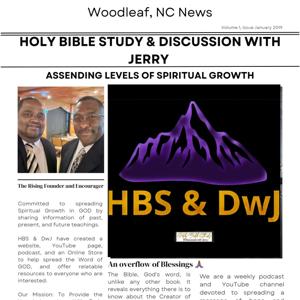
HBS & DwJ Podcast

HBS & DwJ Podcast

By Jerry M. JoyceReligion & Spirituality
Download on the App Store

HBS & DwJ Podcast episodes

  • From Shem To Abraham part-2
    Now we will continue to take up the line of Shem since it is the line which will be followed throughout the Old Testament.

    The second section of the chapter provides a simple genealogy from Noah's son Shem to Abram, showing specifically how God's people descended in a direct line from one to the other.

    This genealogy also shows that the lifespans of men quickly decreased after the flood, from nearly a thousand years, to several centuries, to roughly a century by the time of Abram.

    It is time to open our hearts, minds, and souls to the Word Of GOD.

    Our scripture will be coming from:

    Genesis 11:22-32 KJV
    41 min
  • From Shem To Abraham part-1 Discussion
    Welcome to HBS & DwJ Podcast.
    I am Jerry Joyce, your host.

    Our Scripture Of The Week Is:

    Genesis 4:1 KJV:
    [1] And Adam knew Eve his wife; and she conceived, and bare Cain, and said, I have gotten a man from the LORD.

    Now begins the story of human history apart from the perfection of the Garden of Eden, as the first generation born into sin comes to earth.

    Adam and Eve slept together, conceived, and named their firstborn son Cain. Eve's statement of gratitude reflects her continued faith in God's goodness and provision. Even outside of the garden, Eve understood she owed her life and every good gift to the Lord.
    In a way, this is remarkable.

    Eve doubtlessly experienced great pain in bearing and giving birth to Cain, something she would have expected after hearing God's curse for her (Genesis 3:16). Instead of resenting God for that, she gives Him credit for helping her through the process of receiving this gift of a son.

    His birth is a happy occasion, and a fulfillment of God's intent to keep the human race alive.
    38 min
  • From Shem To Abraham part 1
    Now it is time for our verse break down:

    Genesis 11:10
    These are the generations of Shem: Shem was an hundred years old, and begat Arphaxad two years after the flood:

    The Tower of Babel incident of Genesis 11:1–9 is tied to the genealogical table of chapter 10 by the reference to Nimrod, a grandson of Noah’s son Ham, at 10:8–12.

    The Babel narrative serves to explain what has preceded and what will follow by connecting the development of distinct nations and cultures to the corresponding distribution of languages.

    Following this story, the author resumes the account of the line of Noah’s son Shem. The list in Genesis 11 shows that God’s earlier promise in 3:15—that Eve’s “seed” would bruise the head of the serpent, an allusion to Christ’s victory on the cross—ultimately could not be stopped by the chaos following Babel.

    Even though Noah’s descendants are scattered and divided, God’s purpose to redeem His creation through a chosen line is not compromised. This verse begins a genealogy that will directly link Noah's son Shem with Abram, whom God will re-name Abraham (Genesis 17:5).

    This sets up the origins of the people of Israel. Unlike the broad, nation-spanning genealogies in chapter 10, this passage tracks a straight line from each man to one of his sons to the next in the line.

    This description begins with Shem. Of the three sons of Noah, Shem is the one who is overtly blessed by God (Genesis 9:26). We are told here that Shem fathered Arpachshad two years after the flood when he was 100 years old.

    This is the last mention of the flood in Genesis, marking the beginning of a new era. The birth of Arpachshad so quickly after God's command to multiply and fill the earth shows that Shem was living in obedience.

    Genesis 11:11
    And Shem lived after he begat Arphaxad five hundred years, and begat sons and daughters.

    The present genealogy, moreover, being that of Shem, also serves as an adept literary-theological transition to the next thematic “half” of Genesis. The expectation is thus laid that the present genealogy of Shem will likewise be followed by a narrative episode involving the making of a shem (“name”) for a man.

    The previous verse began this genealogy linking Shem to Abraham and the Israelites. Shem fathered Arpachshad two years after the flood when Shem was 100 years old. This verse now establishes the pattern for the rest of the genealogy, revealing how long Shem lived after the birth of the next in the line.

    Putting the two ages together, Shem lived to be 600 years old, allowing him many years to have other sons and daughters as humanity set about refilling the earth with people. Verse 10 was the last mention of the flood found in Genesis, setting this passage up as a milestone. In the same vein, this genealogy does not focus on phrases such as "and then he died," as did the genealogy of chapter 5.

    Genesis 11:12
    And Arphaxad lived five and thirty years, and begat Salah:

    Observe here, That nothing is left upon record concerning those of this line, but their names and ages; the Holy Ghost seeming to hasten thro' them to the story of Abraham. How little do we know of those that are gone before us in this world, even those that lived in the same places where we live!

    Or indeed of those who are our contemporaries, but in distant places. That there was an observable gradual decrease in the years of their lives. Shem reached to 600 years, which yet fell short of the age of the patriarchs before the flood; the three next came short of 500.

    The line from Noah to Abraham follows through Shem to Arpachshad and now to Shelah. This is a noteworthy point in Genesis due to the age of Arpachshad when he fathers Shelah: "only" 35 years old. This is a drastic reduction in the age of having children when compared to the pre-flood era (Genesis 5).

    Of course, the genealogies listed prior to the flood don't demand those children were the first-born, so those patriarchs might well have had other, earlier children. And yet, it's significant that the ages associated with children are decreasing, as are the lifespans.

    Whether as a result of the world being damaged by the flood (Genesis 7:22–24), or by God's direct intervention (Genesis 6:3), humanity's lifespans will taper off very quickly in the generations following Noah. To multiply and fill the earth, people had to start having children at much younger ages.

    Genesis 11:13
    And Arphaxad lived after he begat Salah four hundred and three years, and begat sons and daughters.

    In all, he lived four hundred and thirty eight years; Not mentioned by name: he died, as the above and a Jewish writer says he died in the forty eighth year of Isaac, and who also says, that in his days they began to build the city of Babel.

    After fathering Shelah, Arpachshad lived another 403 years and had other children. Adding the numbers together, Arpachshad lived to be 438 years old.

    As with other verses, this statement supports a rapid decline in human lifespans after the flood. While ancient figures such as Noah lived nearly a thousand years (Genesis 5), the generations following Abram (Genesis 11:19–26) will be lucky to live beyond a century.

    Genesis 11:14
    And Salah lived thirty years, and begat Eber:

    He had a son born to him five years sooner than his father had. This man was the progenitor of the Hebrews (i.e., Eber’s descendants). The line from Noah to Abraham follows through Shem to Arpachshad to Shelah and now to Eber.

    The Eberites and their descendants became a well-known people (Numbers 24:24). As compared to the generations listed prior to the flood (Genesis 5), this verse presents an earlier age of fatherhood, and a shorter lifespan. This is a trend which will continue through the genealogy, as man's life rapidly shortens leading up to the birth of Abram (Genesis 11:19–26).

    Genesis 11:15
    And Salah lived after he begat Eber four hundred and three years, and begat sons and daughters.

    In all, he lived four hundred and thirty three years. After fathering Eber, Shelah lived another 403 years and had other children. Adding the numbers together, Shelah lived to be 433 years old. Patriarchs of the pre-flood world lived close to a thousand years (Genesis 5), and aren't directly said to have had children until having lived more than a century (Genesis 5:3).

    As mankind spreads after the flood, these lifespans rapidly decrease. By the time of Abram, a person would be lucky to live beyond a century. And, in stark contrast to the pre-flood world, the prospect of having children near the age of 100 would become incredible (Genesis 17:17).

    This might have been due to God's direct influence (Genesis 6:3), or simply as a consequence of living on a harsher, less-ideal planet after the flood.

    Genesis 11:16
    And Eber lived four and thirty years, and begat Peleg:

    Eber lived a total of 464 years. This distinguishes him as the longest living person who was born after the flood. The line from Noah to Abraham follows through Shem to Arpachshad to Shelah to Eber and now to Peleg.

    Peleg's name apparently comes from a word that means "to divide." Genesis 10:25 tells us that in Peleg's time the earth was divided, likely referring to the dispersion of the peoples that happened after God confused the languages in Babel (Genesis 11:1–9).

    If so, the generations to come after Peleg will live in a drastically divided world. This verse also continues a trend seen in the genealogy of Genesis 11: decreasing lifespans. Children are mentioned at younger ages, and years of life are much shorter.

    This change takes a particularly dramatic jump in the time between Eber and Peleg—those living after the Tower of Babel seem to have lifespans around half of what they were prior to that incident (Genesis 11:17–19).

    Genesis 11:17
    And Eber lived after he begat Peleg four hundred and thirty years, and begat sons and daughters.

    All the years of his life were four hundred and sixty four: One of which is elsewhere mentioned, whose name is Joktan, Genesis 10:25 according to the above Jewish writer, he died in the seventy ninth year of Jacob.

    After fathering Peleg, Eber lived another 430 years and had other children. Adding the numbers together, Eber lived to be 474 years old.

    Peleg is noteworthy for his connection to the incident at the Tower of Babel (Genesis 11:1–9).

    His name is associated with earth being "divided" (Genesis 10:25).

    This link also helps to make sense of the sudden drop in lifespans. While post-flood lives are already shortening, compared to the patriarchs of chapter 5, Peleg and those who follow him will live half as long as his father Eber. Within a few more generations, man's days are cut down again by half (Genesis 11:19–24).

    Genesis 11:18
    And Peleg lived thirty years, and begat Reu:

    He was 30 years old when he fathered Reu. The line from Noah to Abraham follows through Shem to Arpachshad to Shelah to Eber to Peleg and now to Reu. The name Reu appears only here in the Old Testament, though it may be a variation on other names.

    This verse is otherwise interesting for mentioning Peleg, a name associated with the division of humanity at the Tower of Babel (Genesis 10:25; Genesis 11:1–9).

    ...
    40 min
  • One Language - The Building Of The Tower Of Babel Discussion
    Our Scripture Of The Week Is:

    1 John 2:3 KJVS
    [3] And hereby we do know that we know him, if we keep his commandments.

    One way in which we display evidence of saving faith in Jesus is through obedience. However, as believers, we always have a choice whether to obey or disobey. This particular sense of "knowledge" comes at more than one level.

    First, is that of salvation. Behavior is a reflection of belief. Actions, however, in and of themselves, are not an infallible test of one's salvation. This is especially true in regards to other people; only God knows exactly what happens in another person's heart (1 Samuel 16:7).

    However, obedience to the commands of Christ is a primary marker, both for others and ourselves, which at least confirms our place in Christ.

    The other, more immediate level of this "knowledge" is in fellowship with God. Even in an existing parent-child relationship, the level of fellowship depends on obedience and communication. A lack of communication does not prove that there is no relationship, but it is certainly not the way things "ought" to be (1 John 2:6).

    A person who has put trusting faith in Christ is expected to obey (1 John 2:5), but whether or not they do is still up to them. Critical to understanding this passage is the connection between "knowing" and "keeping" as seen in the Old Testament.

    The Jewish people were called to show their belief in God through obedience to the Mosaic Law. Even during that time, obedience was the result of faith, not the object of faith. Hebrews chapter 11 offers clear evidence of those godly people throughout the Old Testament who lived by faith, obeyed the Lord, and were recognized for it.

    Faith was, and is, essential to knowing the Lord. Here, John places the condition at the end of the sentence. He emphasized knowing Christ as exemplified by obedience.

    This is in contrasts to verses 5–10, where the conditions will come first.

    Our topic today is:

    One Language – The Building Of The Tower Of Babel Discussion

    Genesis 11 contains three sections: the story of the Tower of Babel, the genealogy from Shem to Abram, and a description of the life of Terah, Abram's father. Abram will later be renamed Abraham and he will become one of the most important figures in Israel's history.

    The events surrounding the building of the city and Tower of Babel are breathtaking. God exercises His power, authority, and creativity to confuse the languages of all the peoples of the earth and then to disperse them geographically around the known world. God's reason for doing so is equally fascinating.

    As the families of Noah's children Shem, Ham, and Japheth grew, they continued to live together as a community with one language and one culture. Eventually, they moved to the area known as Shinar and began to build a massive city with a huge tower. To avoid separating from each other, they planned to make themselves great and powerful on the earth.

    Not only did the people disobey God's command to "fill the earth," they apparently did not acknowledge God or seek His help. They became arrogant in their self-reliance and accomplishments. Some scholars think the building of the tower was an attempt to evade a future flood from God, or possibly as a symbol of man's power.

    God acknowledged that nothing would be impossible if they continued to operate as one people with one language. This comment has been interpreted in various ways, but seems to follow the same line of thought God used prior to the flood: left alone, mankind can find a way to commit any act of evil imaginable.

    To prevent this, God confused and dispersed the people. The section involving the Tower of Babel is composed as a chiasm, meaning a literary mirror-image. Everything mankind attempts in the first half of the narrative is undone in the second half.

    The building of the city, Babel, later to be called Babylon, ceases. Later, when the Israelites came into conflict with the powerful Babylonians, the name of this city was a reminder that God's power was far greater than the plans and might of mere human beings.

    Genesis 11 returns to a narrative where the world of man has not yet scattered across the earth into the nations, tribes, and languages described in chapter 10. Chapter 10's focus was broad, and looking far into the future, many generations from the end of the flood.

    The actual division of nations, as described in the Bible, will not happen until after humanity is divided by language and scattered across the globe. This event happens here, in chapter 11, at the Tower of Babel.

    The descendants of Noah's three sons, Shem, Ham, and Japheth, remained together for a while, then migrated away from the region around Ararat, where the ark settled. It makes sense, given this context, that humanity continued to have one language and to share the same words, or common speech.

    Only one people group existed on the earth, and they all shared the same culture. Unfortunately, this led to almost the same problem which happened prior to the flood: a unified humanity can use that unity for sin, something God does not plan to allow (Genesis 11:6).

    Here, we're told that this growing extended family migrated away from the region where the ark settled to the land of Shinar. Shinar is the region where Babylon will be established. Thus, at this point in the history of the earth, all the peoples of the world were gathered together in one region.

    While it sounds wonderful for mankind to be united in culture and language, human sin makes this a dangerous condition.

    As shown prior to the flood, mankind's natural habit is towards depravity (Genesis 6:5).

    The need to restrict man's cooperation with man, at least to some extent, is a major reason for God's actions in this passage (Genesis 11:7–8).

    Here, we're told that together these people made plans to build a huge structure in their new homeland. This verse seems oddly specific in describing their building materials: bricks hardened by burning—or baking—and mortar made from tar.

    Scholars suggest there is wordplay going on in these verses, connecting the words for these building materials to the name of Babel. In addition, Israelite readers would have likely been interested to know that these ancient people used bricks while they themselves often used stone for building.

    The descendants of Shem, Ham, and Japheth had not yet divided and dispersed into the separate nations, tribes, and languages described in chapter 10. And, for this moment, they wanted to keep it that way.

    They did not want to disperse and go in different directions (Genesis 9:1).

    Most likely, the people recognized that there was power and safety in their unity. If they could remain one people, they would be stronger and safer. If they divided, each group would be weaker and, likely, under threat of war and conflict with other groups.

    Their motive makes sense to us, but their plan to accomplish their objective was to make themselves great in a way that God found arrogant and dangerous. The scheme mankind concocts is to build a strong, defensible city with a massive tower that would reach to the heavens. They would "make a name" for themselves.

    If, as a people, their city was unable to be defeated and they were prosperous and strong, why would any among them want to leave and risk becoming their rivals?

    This culture of man believed that self-glorification and self-reliance would achieve their greatest goals. They did not, apparently, acknowledge God in any way or seek His help. The text reveals that God chooses to "come down" to even see their tower.

    Of course, God did not need to travel any distance in any direction to see or know what was happening on the earth. Instead, the language is meant to emphasize what a silly idea it was that people could build a tower that would reach to the heavens, or prevent God from enacting His will.

    In a more direct sense, this verse shows God "playing along," much as He did when Adam hid from Him in the garden of Eden and God called out (Genesis 3:8–10).

    After seeing the city and the tower that the united people of the earth had built, God does not dismiss their efforts as weak and futile. Instead, He acknowledges that by working together, humanity would and can accomplish whatever they set out to do.

    This, of course, leads to an immediate question: why is that a problem?

    Why would God stand opposed to such unified productivity?

    The answer is in mankind's capacity to turn gifts into curses (Genesis 3:17–19), and abilities into abuses. The flood had not changed the nature of sinful human beings.

    God's observation in Genesis 6:5 still applies to the hearts of humans left to themselves: "The Lord saw that the wickedness of man was great in the earth, and that every intention of the thoughts of his heart was only evil continually."

    A powerfully united humanity, inclined to do evil, could accomplish great wickedness. No matter how perverse, outrageous, or ridiculous something might seem, mankind can and will attempt it, given the opportunity.

    God decides to stop their progress by dividing the people according to language, for starters.
    People who speak different languages have an immediate barrier to communication, making it harder to cooperate.

    Further, this would naturally begin to separate people into groups, based on those languages, and in fulfillment of God's intent for man after the flood (Genesis 9:1).

    39 min
  • Building The Tower Of Babel
    Now it is time for our verse break down:

    Genesis 11:1
    And the whole earth was of one language, and of one speech.

    Genesis 11 returns to a narrative where the world of man has not yet scattered across the earth into the nations, tribes, and languages described in chapter 10. Chapter 10's focus was broad, and looking far into the future, many generations from the end of the flood.

    The actual division of nations, as described in the Bible, will not happen until after humanity is divided by language and scattered across the globe. This event happens here, in chapter 11, at the Tower of Babel.

    The descendants of Noah's three sons, Shem, Ham, and Japheth, remained together for a while, then migrated away from the region around Ararat, where the ark settled. It makes sense, given this context, that humanity continued to have one language and to share the same words, or common speech.

    Only one people group existed on the earth, and they all shared the same culture. Unfortunately, this led to almost the same problem which happened prior to the flood: a unified humanity can use that unity for sin, something God does not plan to allow (Genesis 11:6).

    Genesis 11:2
    And it came to pass, as they journeyed from the east, that they found a plain in the land of Shinar; and they dwelt there.

    The previous chapter described all the nations, tribes, and languages that came from Noah's three sons. Genesis 11 backs up the story to the era before the people groups were divided. Until this point, the families of Shem, Ham, and Japheth remained together as a single people group with a single culture.

    Verse 1 told us they all shared the same language. Here, in verse 2, we're told that this growing extended family migrated away from the region where the ark settled to the land of Shinar. Shinar is the region where Babylon will be established. Thus, at this point in the history of the earth, all the peoples of the world were gathered together in one region.

    While it sounds wonderful for mankind to be united in culture and language, human sin makes this a dangerous condition. As shown prior to the flood, mankind's natural habit is towards depravity (Genesis 6:5).

    The need to restrict man's cooperation with man, at least to some extent, is a major reason for God's actions in this passage (Genesis 11:7–8).

    Genesis 11:3
    And they said one to another, Go to, let us make brick, and burn them throughly. And they had brick for stone, and slime had they for morter.

    The previous verses revealed that the peoples of the earth had not yet divided and scattered into separate tribes and nations. The descendants of Shem, Ham, and Japheth remained a single people group with a single culture and language.

    Together, they had migrated to the region of Shinar where Babylon would be established. Here, we're told that together these people made plans to build a huge structure in their new homeland. This verse seems oddly specific in describing their building materials: bricks hardened by burning—or baking—and mortar made from tar.

    Scholars suggest there is wordplay going on in these verses, connecting the words for these building materials to the name of Babel. In addition, Israelite readers would have likely been interested to know that these ancient people used bricks while they themselves often used stone for building.

    Genesis 11:4
    And they said, Go to, let us build us a city and a tower, whose top may reach unto heaven; and let us make us a name, lest we be scattered abroad upon the face of the whole earth.

    At this point in the history of the world, all the peoples on earth existed as a single culture with one shared language. The descendants of Shem, Ham, and Japheth had not yet divided and dispersed into the separate nations, tribes, and languages described in chapter 10.

    And, for this moment, they wanted to keep it that way. They did not want to disperse and go in different directions (Genesis 9:1).

    Most likely, the people recognized that there was power and safety in their unity. If they could remain one people, they would be stronger and safer. If they divided, each group would be weaker and, likely, under threat of war and conflict with other groups.

    Their motive makes sense to us, but their plan to accomplish their objective was to make themselves great in a way that God found arrogant and dangerous. The scheme mankind concocts is to build a strong, defensible city with a massive tower that would reach to the heavens. They would "make a name" for themselves.

    If, as a people, their city was unable to be defeated and they were prosperous and strong, why would any among them want to leave and risk becoming their rivals?

    This culture of man believed that self-glorification and self-reliance would achieve their greatest goals. They did not, apparently, acknowledge God in any way or seek His help. The following verses will reveal that though they can accomplish much, God will not allow them to achieve their plan.

    Genesis 11:5
    And the LORD came down to see the city and the tower, which the children of men builded.

    The united peoples of earth make a plan to exalt themselves, by building a tower in their city that would reach to the heavens. Instead of asking God for help, they set out to make themselves powerful enough to get what they wanted.

    Many scholars see this as a deliberate attempt to guard against another flood, by making a structure specifically intended to protect mankind from God's judgment. This verse is probably intended to be taken in a dry, almost sarcastic tone. The text reveals that God chooses to "come down" to even see their tower.

    Of course, God did not need to travel any distance in any direction to see or know what was happening on the earth.

    Instead, the language is meant to emphasize what a silly idea it was that people could build a tower that would reach to the heavens, or prevent God from enacting His will. In a more direct sense, this verse shows God "playing along," much as He did when Adam hid from Him in the garden of Eden and God called out (Genesis 3:8–10).

    Genesis 11:6
    And the LORD said, Behold, the people is one, and they have all one language; and this they begin to do: and now nothing will be restrained from them, which they have imagined to do.

    After seeing the city and the tower that the united people of the earth had built, God does not dismiss their efforts as weak and futile. Instead, He acknowledges that by working together, humanity would can accomplish whatever they set out to do.

    This, of course, leads to an immediate question: why is that a problem?

    Why would God stand opposed to such unified productivity?

    The answer is in mankind's capacity to turn gifts into curses (Genesis 3:17–19), and abilities into abuses. The flood had not changed the nature of sinful human beings.

    God's observation in Genesis 6:5 still applies to the hearts of humans left to themselves: "The Lord saw that the wickedness of man was great in the earth, and that every intention of the thoughts of his heart was only evil continually."

    A powerfully united humanity, inclined to do evil, could accomplish great wickedness. No matter how perverse, outrageous, or ridiculous something might seem, mankind can and will attempt it, given the opportunity. The following verse reveals that God has no plans to give humanity that kind of opening.

    ...
    43 min
  • Sons Of Shem - Syrians, Lydians, Armenians, Arabians Discussion
    Our Scripture Of The Week Is:

    Proverbs 4:23 KJVS
    Keep thy heart with all diligence; for out of it are the issues of life.

    To "keep" something, in this sense, means more than simply "to maintain ownership."
    It refers to maintenance, care, and support. Some translations use the word "guard," A wise person realizes that temptation is real (1 Corinthians 10:13) and takes appropriate precaution.

    This parallels statements made earlier, where Solomon advises his son to actively avoid evil, and those who practice it (Proverbs 4:14–15). Scripture places a strong emphasis on the heart as the source of good or evil.

    Jeremiah 17:9 says, "the heart is deceitful above all things, and desperately sick."

    Jesus announced: "The good person out of the good treasure of his heart produces good, and the evil person out of his evil treasure produces evil, for out of the abundance of the heart his mouth speaks" (Luke 6:45).

    David, Solomon's father, certainly understood how influential the heart is in how we live out our morals and values. Out of the evil of his heart he stole Uriah's wife Bathsheba, committed adultery with her, and then arranged for Uriah's death when he could not hide his crime (2 Samuel 11:2–5, 14–15).

    However, when he was under heavy conviction about his evil deed, David prayed, "Create in me a clean heart, O God, and renew a right spirit within me" (Psalm 51:10).

    What is hidden in the heart is open to God's eyes.

    First Samuel 16:7 reminds us that "the LORD sees not as a man sees: man looks on the outward appearance, but the LORD looks on the heart."

    It is absolutely essential, therefore, to guard the heart.

    Our topic today is:

    Sons Of Shem – Syrians, Lydians, Armenians, Arabians Discussion

    This section on the line of Shem comes last, though this verse makes clear that Shem was the oldest of Noah's sons. Earlier, Ham was described using a Hebrew term meaning either "youngest," or "least" (Genesis 9:24). Here, translations are split on whether Shem or Japheth is the older brother.

    Of course, their exact birth order is not explicitly given anywhere in the Bible. Most likely, but not assuredly, Shem was the oldest of the three sons Noah brought with him on the ark (Genesis 7:1).

    Shem's line is the one that will lead to Abraham and the Israelites. Verse 21 begins by referring to Shem as the father of the Eberites. This is typical of genealogies, especially in the ancient world.

    The term "father" is often used to refer to any male ancestor (Genesis 15:15; Genesis 31:3). This makes Shem the "father" of the Eberites, in the sense that, as Eber's great grandfather, Shem is the ancestor of that people.

    Through the Eberites, eventually, Shem's line will lead to Abraham (Abram). Shem's descendants Elam and Asshur will found significant people groups, well known historically and deeply involved in the history of Israel.

    Less is known about the peoples that came from Lud and Aram. Much of this same genealogical material is presented in the book of 1 Chronicles (1 Chronicles 1:17–25).

    Shem's line through his son Arpachshad is the one that leads to Abraham (Abram) and Israel. This makes Shem the ancestor of figures such as King David and Jesus Christ. This verse lists the sons of Shem's son Aram. Little is known from the Bible or external records about the groups that came from these men.

    The only noteworthy name given here is that of Uz, which is the same as the native land of Job (Job 1:1), mentioned in a few places in Scripture (Jeremiah 25:20; Lamentations 4:21).

    Ham's son, Mizraim, is also known as Egypt. Ham's son Canaan will father several cultures which become bitter enemies of Israel. This chapter shows the origins of city-states and nations which become well-known throughout the rest of the Old Testament, such as Magog, Tarshish, Kittim, Cush, Babel, Nineveh, Sidon, and so forth.

    Shem's line leads through Arpachshad to Shelah to Eber and eventually to Abraham and the Israelites. This makes Shem the ancestor of the Messiah, Jesus Christ. It also fulfills the curse given by Noah (Genesis 9:20–25) that Canaan's descendants would be subservient to those of Shem.

    Shem's great grandson Eber fathered two sons. Shem's line will continue through Peleg to Abraham and the Israelites. This passage also makes an interesting comment about one of Shem's descendants, Peleg. Peleg's name apparently comes from an ancient word meaning "to divide."

    The division of the earth in Peleg's mentioned here likely refers to the division and dispersal of humanity that will happen after the events surrounding the tower of Babel. At that point, mankind will be dispersed over the earth, and their languages confused. Those events are described in chapter 11.

    This side-long reference to Peleg is also useful for understanding ancient writing. This part of Genesis describes the descendants of Noah's sons, including their eventual geography. But chapter 11 will describe a moment when mankind is dispersed over the earth. This is due to the fact that Genesis, like many ancient records, is more concerned with themes than with chronology.

    In other words, the story of the Tower of Babel is not the point of this particular text, so it will be mentioned later. Scholars suggest that Eber's other son Joktan will become the father of Arab peoples. In total, 13 sons are listed. The names of several of these sons became associated with well-known areas in the larger region of the Middle East.

    This is part of chapter 10's "table of nations," explaining the origin of the ancient world's various people groups. The actual dispersal of these people to their eventual geographic regions, does not seem to occur until chapter 11 at the incident of the Tower of Babel.

    Jerah is a Hebrew word meaning "new moon." Later on in history, the moon would become one of the foremost gods worshiped in the region, which seems to be the ancestral homeland of Arabic peoples. Here, we continue the genealogy of Shem, through his great-great-grandson Joktan.
    In total, 13 sons are listed. The names of several of these sons became well known areas in the larger region of the Middle East.

    The name Uzal may be Azal, an old name for Sann'a, the modern-day capital of Yemen, indicating that this branch of Joktan's line settled in that area. As such, Joktan would be considered the father of the Arabic people. This particular part of Genesis is only concerned with explaining the family relationships involved.

    Exactly how and when these descendants arrived in their territories is not explained here. Later, chapter 11 will explain the incident of the Tower of Babel, where these various people and tribes are dispersed across the earth. Joktan is credited here with 13 sons; several of these names will become well-known within the regions surrounding Israel. In fact, Joktan seems to be the father of the Arabic people, as his sons are the primary inhabitants of those lands.

    The regions of Ophir and Havilah were famous in the ancient world for their gold (Genesis 2:11). This verse describes the geographical territory occupied by the various groups of people descended from Joktan. Scholars are uncertain of exactly what modern day areas these names represent.

    However, the information given in the broader passage indicates that Joktan was the father of the Arabic people. This portion of Scripture is devoted to explaining how Shem, Ham, and Japheth, Noah's sons, became the ancestors of all of the world's nations.

    Some of the names listed here will become associated with famous—or infamous—cities or regions of the Bible. An explanation for how they found themselves living in different locations and speaking different languages, will come in chapter 11. Those details are part of the story of the Tower of Babel (Genesis 11:1–9).

    However, the line from Shem to Abraham will be described more specifically in chapter 11. This entire chapter has been devoted to explaining the origins of the Middle East's various nations. All people, including every possible tribe or race, are descended from Noah and his sons Shem, Ham, and Japheth.

    Notably, the details in this part of the Bible are only concerned with family relationships. Other than a quick comment about Peleg (Genesis 10:25), the story of how the different tribes wound up with separated languages and territories is left entirely to the next part of Scripture.

    That explanation will come through the story of the Tower of Babel. Rather than focusing on a single, deep line of fathers and sons, this list has emphasized the broad connection between all people.

    Instead of delving into the details of how they came to be separate people, with separate nations and languages, this passage simply explains how these men were related to each other. The story of the Tower of Babel and the dispersal of humanity will be told in chapter 11.

    33 min
  • Shem's Sons
    Now it is time for our verse break down:

    Genesis 10:21
    Unto Shem also, the father of all the children of Eber, the brother of Japheth the elder, even to him were children born.

    Shem, the older brother of Japheth, or Shem, whose older brother was Japheth, was the father of the Semitic peoples. The descendants listed represent countries east of Israel, modern Iraq, Iran, and Syria. The narrator lists these locations within Mesopotamia since Abram, the father of Israel, originated from this area. Eber receives special attention because of his connection with Abram.

    This verse begins the final section of chapter 10's table of nations, describing how all of the people groups of the ancient world descended from Noah's three sons. This section on the line of Shem comes last, though this verse makes clear that Shem was the oldest of Noah's sons. Earlier, Ham was described using a Hebrew term meaning either "youngest," or "least" (Genesis 9:24).

    Here, translations are split on whether Shem or Japheth is the older brother. Of course, their exact birth order is not explicitly given anywhere in the Bible. Most likely, but not assuredly, Shem was the oldest of the three sons Noah brought with him on the ark (Genesis 7:1).

    Shem's line is the one that will lead to Abraham and the Israelites. Verse 21 begins by referring to Shem as the father of the Eberites. This is typical of genealogies, especially in the ancient world. The term "father" is often used to refer to any male ancestor (Genesis 15:15; Genesis 31:3).

    This makes Shem the "father" of the Eberites, in the sense that, as Eber's great grandfather, Shem is the ancestor of that people. Through the Eberites, eventually, Shem's line will lead to Abraham (Abram).

    Genesis 10:22
    The children of Shem; Elam, and Asshur, and Arphaxad, and Lud, and Aram.

    The descendants of Elam lived in the region of modern southwestern Iran. The descendants of Asshur were later Assyrians who lived under Nimrod’s jurisdiction. Sumerians descended from Ham were ousted by Mesopotamian Semites. Arphaxad possibly settled northeast of Nineveh; his descendants are further described in Gen 11:12-26.

    Lud was near the Tigris River; its people were related to the Lydians. Aram was a kingdom of tribes that lived in the Mesopotamian plains. This verse lists the sons of Noah's son Shem. Shem's descendants Elam and Asshur will found significant people groups, well known historically and deeply involved in the history of Israel.

    Less is known about the peoples that came from Lud and Aram. Much of this same genealogical material is presented in the book of 1 Chronicles (1 Chronicles 1:17–25).

    Shem's line through his son Arpachshad is the one that leads to Abraham (Abram) and Israel. This makes Shem the ancestor of figures such as King David and Jesus Christ.

    Genesis 10:23
    And the children of Aram; Uz, and Hul, and Gether, and Mash.

    The patriarchs later interacted with the descendants of Aram. Uz was the chief Aramean tribe, possibly located northeast of the Jordan; it was Job’s home. Hul is unknown. He possibly founded Armenia.

    Gether is unknown; he was possibly the founder of the Syrians. Mash might be associated with Mount Masus in northern Mesopotamia or with a part of the Lebanon Mountains.

    The purpose of this passage of Scripture is to explain the origins of the ancient world's various nations and people groups. Some, such as the descendants of Ham's son Canaan, would become highly influential in the history of Israel. For that reason, the Bible devotes more details to them.

    Others, such as the men listed here, do not seem to have had a significant impact on the ancient world.

    This verse lists the sons of Shem's son Aram. Little is known from the Bible or external records about the groups that came from these men. The only noteworthy name given here is that of Uz, which is the same as the native land of Job (Job 1:1), mentioned in a few places in Scripture (Jeremiah 25:20; Lamentations 4:21).

    Genesis 10:24
    And Arphaxad begat Salah; and Salah begat Eber.

    Arphaxad was the father of Shelah: Greek version reads Arphaxad was the father of Cainan, Cainan was the father of Shelah. Shelah is unknown, but may be short for Methushelah. Eber was the ancestor of Abram the Hebrew.

    This verse continues the genealogy of Noah's son Shem. Chapter 10 traces the origins of the ancient world's various people groups—all of whom come from the three sons of Noah: Shem, Ham, and Japheth.

    Some of these early descendants founded great and powerful people groups. Ham's son, Mizraim, is also known as Egypt. Ham's son Canaan will father several cultures which become bitter enemies of Israel. This chapter shows the origins of city-states and nations which become well-known throughout the rest of the Old Testament, such as Magog, Tarshish, Kittim, Cush, Babel, Nineveh, Sidon, and so forth.

    Shem's line leads through Arpachshad to Shelah to Eber and eventually to Abraham and the Israelites. This makes Shem the ancestor of the Messiah, Jesus Christ. It also fulfills the curse given by Noah (Genesis 9:20–25) that Canaan's descendants would be subservient to those of Shem.

    Genesis 10:25
    And unto Eber were born two sons: the name of one was Peleg; for in his days was the earth divided; and his brother's name was Joktan.

    Peleg means division, anticipating the separation of people into language groups after Babel.
    Peleg’s line led to Abram. Joktan was the ancestor of the southern Arabian tribes. The Ishmaelite tribes were in northern Arabia. All that Moses is simply doing is anticipating the next chapter in which he will give us the account of the Tower of Babel. At that time the earth was divided.

    May I say that the simple interpretation seems to be the one that a great many folk miss, and we should not miss it. This verse continues the genealogy of Noah's son Shem. Shem's great grandson Eber fathered two sons. Shem's line will continue through Peleg to Abraham and the Israelites.

    This passage also makes an interesting comment about one of Shem's descendants, Peleg. Peleg's name apparently comes from an ancient word meaning "to divide." The division of the earth in Peleg's mentioned here likely refers to the division and dispersal of humanity that will happen after the events surrounding the tower of Babel.

    At that point, mankind will be dispersed over the earth, and their languages confused. Those events are described in chapter 11. This side-long reference to Peleg is also useful for understanding ancient writing. This part of Genesis describes the descendants of Noah's sons, including their eventual geography.

    But chapter 11 will describe a moment when mankind is dispersed over the earth. This is due to the fact that Genesis, like many ancient records, is more concerned with themes than with chronology. In other words, the story of the Tower of Babel is not the point of this particular text, so it will be mentioned later. Scholars suggest that Eber's other son Joktan will become the father of Arab peoples.

    Genesis 10:26
    And Joktan begat Almodad, and Sheleph, and Hazarmaveth, and Jerah,

    There were fourteen sons of Shem by Eber through Joktan. The placement of the Babel story between the lines of Joktan and Peleg ties Joktan to the judgment of the Babel story and ties Peleg to Abram. This verse continues the genealogy of Shem, listing the sons of his great-great-grandson, Joktan. In total, 13 sons are listed.

    The names of several of these sons became associated with well-known areas in the larger region of the Middle East. This is part of chapter 10's "table of nations," explaining the origin of the ancient world's various people groups.

    The actual dispersal of these people to their eventual geographic regions, does not seem to occur until chapter 11 at the incident of the Tower of Babel. Jerah is a Hebrew word meaning "new moon." Later on in history, the moon would become one of the foremost gods worshiped in the region, which seems to be the ancestral homeland of Arabic peoples.

    Genesis 10:27
    And Hadoram, and Uzal, and Diklah,

    Hadoram was an Arabian tribe. Uzal was Sana’a, an old capital of Yemen in pre-Islamic times. Diklah was a southern Arabian oasis in Mina. This verse continues the "table of nations," describing the origins of the ancient nations. All of these tribes and people were descended from Noah, through his sons Shem, Ham, and Japheth.

    Earlier passages gave details about the children of Japheth, and then Ham. Here, verse 27 continues the genealogy of Shem, through his great-great-grandson Joktan. In total, 13 sons are listed. The names of several of these sons became well known areas in the larger region of the Middle East.

    The name Uzal may be Azal, an old name for Sann'a, the modern-day capital of Yemen, indicating that this branch of Joktan's line settled in that area.

    ...
    42 min
  • Sons Of Ham - Africans, Ethiopians, Egyptians, Libyans, Etc. Discussion
    Our Scripture Of The Week Is:

    Psalm 51:10 KJVS
    Create in me a clean heart, O God; and renew a right spirit within me.

    David's heart had been full of lust for Bathsheba, murderous plans for Uriah, and rebellion against God. He desired a new heart, one that was full of love for God and abhorrence of evil. Sin in his heart had brought him nothing but guilt, grief, and remorse. He wanted spiritual heart surgery that only God could perform.

    Jesus cited the heart as the source of either good or evil. He explained: "The good person out of the good treasure of his heart produces good, and the evil person out of his evil treasure produces evil, for out of the abundance of the heart his mouth speaks" (Luke 6:45).

    Jesus also said that "everyone who looks at a woman with lustful intent has already committed adultery with her in his heart" (Matthew 5:28).

    David, therefore, had committed adultery with Bathsheba in his heart before the physical act of adultery took place. He needed a new heart. But he also asked the Lord to renew a right spirit within him (Psalm 51:10).

    He wanted the kind of spirit that would obey the Lord at all times.

    Our topic today is:

    Sons Of Ham – Africans, Ethopians, Egyptians, Libyans, Etc. Discussion

    The people and nations that come from Ham will become central to Israel's story, as told in the rest of the Bible.

    Ham's descendants include the peoples who will eventually become Egypt, the great nation that will play a pivotal and ongoing role in Israel's history. Ham's grandson Nimrod (through Cush) will establish the powerful kingdoms of Babylon and Assyria, who will both become enemies of Israel.

    And the descendants of Ham's son Canaan will eventually be (mostly) driven from the Promised Land by the Israelites. These peoples and nations will become integral to Israel's story and they are familiar names to this day.

    Ham's first generation of sons included Cush, Egypt, Put, and Canaan. Each of their lines will be described in the following verses.

    Egypt is also known as Mizraim and the original Hebrew text uses the word Misra'yim here. In ancient literature, the names of nations and their founders were often used interchangeably, such as with Edom and Esau (Obadiah 1:8–10).

    Since the purpose of this passage is explaining the origins of the various ancient kingdoms, many English translations simply state this name as "Egypt."

    Following the events surrounding the Tower of Babel described in Genesis 11, the descendants of Noah's grandson Cush settled in Arabia and in areas of present day Egypt, Sudan, and Ethiopia.
    They include Seba, Havilah, Sabtah, Sabteca, and Raamah, along with Raamah's sons Sheba and Dedan.

    Initially, we're told that Nimrod was the first on earth to become a "mighty man" or "champion," indicating that he was a powerful and renowned ruler. The Hebrew phrasing here can mean that Nimrod simply "began" to be mighty, or it can be interpreted to mean that he was the first person to attain that level of might.

    Interestingly, in many English-speaking countries, the term "nimrod" is used to imply that a person is stupid, slow-witted, or incompetent. Various popular artists in the 1920s and 1930s sarcastically referred to specific hunters as "Nimrod," and popular culture eventually overtook the original implications of the term.

    Nimrod is described as a mighty hunter before the Lord. Some scholars suggest that perhaps Nimrod is associated with the kings of Mesopotamia or Assyria, who valued hunting as a greatly honored skill. It's unlikely that the phrase "before the Lord" means that Nimrod was faithful to the true God. It's more likely to mean that Nimrod was famous on the earth, where everything is before the Lord.

    In fact, some scholars believe that Nimrod's skill in hunting might have led him to skill in battle, and built the basis for his success. His name is similar to the Hebrew word for "rebellion," and traditionally he was considered a dictator and tyrant.

    The nation-states founded by Nimrod, including Nineveh, Assyria, and Babel, will become some of Israel's chief enemies. Nimrod was so famous for his hunting skill that being like Nimrod, "a mighty hunter before the Lord," became a common saying in the world.

    In the modern English-speaking world, the term "nimrod" is used as an insult, mostly to someone's intelligence. This is due to a series of sarcastic references in the 1920s and 1930s, which mocked an inept hunter as "Nimrod," replacing the reputation of that name with almost the exact opposite meaning!

    Nimrod, famous in the world as a champion and mighty hunter. He also built a series of kingdoms for himself. Beginning in the land known as Shinar, Nimrod established his kingdom with Babel (or Babylon), Erech, Accad, and Calneh.

    Traditionally, Nimrod is viewed as an early tyrant—a dictator of considerable power.
    As the following verse will reveal, many parts of Nimrod's kingdom will eventually become powerful enemies to Israel.

    These include kingdoms such as Assyria and Nineveh. The city of Babel will become the focal point of the next chapter as the events around the building of the Tower of Babel unfold (Genesis 11:1–9).

    Most traditions of the time also paint Nimrod as a tyrant, wielding great power in his lifetime. After establishing his kingdom in the region of Shinar in the south, Nimrod moved north into Assyria.

    There he built the great city of Nineveh and the close-by towns of Rehoboth-Ir, Calah, and those mentioned in the following verse. Later in Scripture, Nineveh and the Assyrians will become famous for their might, cruelty, and wickedness.

    God will send the prophet Jonah to take a message of salvation to the people of Nineveh; Jonah will resist. The ruins of Nineveh remain to this day, near the modern city of Mosul in Iraq. Nimrod, a descendant of Noah's son Ham, was a mighty man who established a kingdom of his own in the regions of Shinar and Assyria.

    Nimrod established the "great city" of Nineveh in Assyria, along with several other cities. Resen is the final of Nimrod's cities to be mentioned. The name Resen likely meant "fountainhead," and the city may have been situated on the Tigris river.

    In the future, Nimrod's descendants will become some of Israel's greatest enemies. They will also be directly involved in some of the Old Testament's most unfortunate incidents. Among these, as seen in the next chapter, is the incident at the Tower of Babel (Genesis 11:1–9). Ham's sons included Cush, Put, Canaan, and Egypt (or Mizraim).

    In Old Testament Hebrew, the only word used for this person, or the nation who came after him, is Misra'yim. This later became the nation of Egypt, and since that is how typical English speakers define that land today, most modern English translations stick to "Egypt" whenever this term arises.

    Egypt was one of the sons of Ham, the son of Noah. Following the Tower of Babel, the descendants of Egypt generally settled in and around the lands that make up what would become known as the great nation of Egypt.

    Israel's relationship with Egypt would be long and complicated. Early on, they would be kind and supportive to the people of Israel (Genesis 50:1–14), but this would soon turn into subjection and slavery (Exodus 1:1–14). Israel would also have a long and conflicted relationship with the Philistines, though there is some question as to whether the Philistines mentioned here are the same ones Israel fought in the time of David.

    Many scholars believe that this passage refers only to the Philistine people passing through an area, not necessarily originating in it. These sons will become the Canaanites, the peoples who occupied the Promised Land before the nation of Israel arrived to claim it under the direct orders of God (Exodus 3:17).

    The evil of these Canaanite nations would become so severe that Israel was used as God's instrument of judgment against them (Deuteronomy 9:3–6).

    Canaan's firstborn son was Sidon. The city of Sidon (Judges 1:31; Acts 27:3) is one of the oldest in the region of Canaan. Canaan's son Heth has a connection to the Hittites, but apparently not a direct connection to the great nation of the Hittites that would arise later (Exodus 13:5; Judges 1:26).

    This is a list of the sons of Canaan, Noah's great-grandsons through his son, Ham. These sons of Canaan will become the Canaanites, the peoples occupying the Promised Land, which the people of Israel will come to conquer after the Exodus from Egypt (Exodus 3:17). Unfortunately, while other nations had their flaws, the Canaanite peoples would become especially wicked.

    This, more than anything else, is what motivates God to send Israel as a form of judgment (Deuteronomy 9:3–6). This flows from the curse given to Canaan by Noah, on account of Ham's dishonoring of his father (Genesis 9:20–25).

    Verse 16 mentions the Jebusites, the Amorites, and the Girgashites. The Jebusites settled in what would later become the city of Jerusalem (Judges 1:21; 1 Chronicles 11:4). This passage lists the descendants of Canaan, most of whom would go on to become great enemies of the nation of Israel. These Canaanites go on to occupy the Promised Land which the people of Israel will conquer after the Exodus from Egypt (Exodus 3:17).

    In chapter 9, Noah's son Ham gravely dishonors him, resulting in Noah placing a curse on Ham's son, Canaan (Genesis 9:20–25).

    Over time, the Canaanite people would sink further and further...
    45 min
  • Ham's Sons
    Now it is time for our verse break down:

    Genesis 10:6
    And the sons of Ham; Cush, and Mizraim, and Phut, and Canaan.

    The previous verses named the sons and grandsons of Japheth. This verse begins a section describing the descendants of Ham and the nations that came from them. These peoples and nations will become integral to Israel's story and they are familiar names to this day. Ham's first generation of sons included Cush, Egypt, Put, and Canaan. Each of their lines will be described in the following verses.

    Egypt is also known as Mizraim and the original Hebrew text uses the word Misra'yim here. In ancient literature, the names of nations and their founders were often used interchangeably, such as with Edom and Esau (Obadiah 1:8–10). Since the purpose of this passage is explaining the origins of the various ancient kingdoms, many English translations simply state this name as "Egypt."

    Genesis 10:7
    And the sons of Cush; Seba, and Havilah, and Sabtah, and Raamah, and Sabtecha: and the sons of Raamah; Sheba, and Dedan.

    Starting in verse 6, this passage begins to detail the nations which came from Ham. This verse expands on the nations which originated from Ham's son Cush. Following the events surrounding the Tower of Babel described in Genesis 11, the descendants of Noah's grandson Cush settled in Arabia and in areas of present day Egypt, Sudan, and Ethiopia. They include Seba, Havilah, Sabtah, Sabteca, and Raamah, along with Raamah's sons Sheba and Dedan.

    Genesis 10:8
    And Cush begat Nimrod: he began to be a mighty one in the earth.

    Dropped into the middle of this table of nations is a fascinating historical aside about Nimrod, one of the sons of Cush. Initially, we're told that Nimrod was the first on earth to become a "mighty man" or "champion," indicating that he was a powerful and renowned ruler. The Hebrew phrasing here can mean that Nimrod simply "began" to be mighty, or it can be interpreted to mean that he was the first person to attain that level of might.

    Interestingly, in many English-speaking countries, the term "nimrod" is used to imply that a person is stupid, slow-witted, or incompetent. Various popular artists in the 1920s and 1930s sarcastically referred to specific hunters as "Nimrod," and popular culture eventually overtook the original implications of the term.

    Genesis 10:9
    He was a mighty hunter before the LORD: wherefore it is said, Even as Nimrod the mighty hunter before the LORD.

    Here, Nimrod is described as a mighty hunter before the Lord. Some scholars suggest that perhaps Nimrod is associated with the kings of Mesopotamia or Assyria, who valued hunting as a greatly honored skill. It's unlikely that the phrase "before the Lord" means that Nimrod was faithful to the true God.

    It's more likely to mean that Nimrod was famous on the earth, where everything is before the Lord.
    In fact, some scholars believe that Nimrod's skill in hunting might have led him to skill in battle, and built the basis for his success. His name is similar to the Hebrew word for "rebellion," and traditionally he was considered a dictator and tyrant.

    The nation-states founded by Nimrod, including Nineveh, Assyria, and Babel, will become some of Israel's chief enemies. Nimrod was so famous for his hunting skill that being like Nimrod, "a mighty hunter before the Lord," became a common saying in the world.

    In the modern English-speaking world, the term "nimrod" is used as an insult, mostly to someone's intelligence. This is due to a series of sarcastic references in the 1920s and 1930s, which mocked an inept hunter as "Nimrod," replacing the reputation of that name with almost the exact opposite!

    Genesis 10:10
    And the beginning of his kingdom was Babel, and Erech, and Accad, and Calneh, in the land of Shinar.

    Nimrod also built a series of kingdoms for himself. Beginning in the land known as Shinar, Nimrod established his kingdom with Babel (or Babylon), Erech, Accad, and Calneh. Traditionally, Nimrod is viewed as an early tyrant—a dictator of considerable power.

    As the following verse will reveal, many parts of Nimrod's kingdom will eventually become powerful enemies to Israel. These include kingdoms such as Assyria and Nineveh. The city of Babel will become the focal point of the next chapter as the events around the building of the Tower of Babel unfold (Genesis 11:1–9).

    Genesis 10:11
    Out of that land went forth Asshur, and builded Nineveh, and the city Rehoboth, and Calah,

    Apparently a great ruler of the time, he is described as a mighty hunter before the Lord.
    Most traditions of the time also paint Nimrod as a tyrant, wielding great power in his lifetime.
    After establishing his kingdom in the region of Shinar in the south, Nimrod moved north into Assyria.

    There he built the great city of Nineveh and the close-by towns of Rehoboth-Ir, Calah, and those mentioned in the following verse. Later in Scripture, Nineveh and the Assyrians will become famous for their might, cruelty, and wickedness. God will send the prophet Jonah to take a message of salvation to the people of Nineveh; Jonah will resist.

    The ruins of Nineveh remain to this day, near the modern city of Mosul in Iraq.

    Genesis 10:12
    And Resen between Nineveh and Calah: the same is a great city.

    This verse concludes the biographical aside about Nimrod in chapter 10's table of nations. Nimrod, a descendant of Noah's son Ham, was a mighty man who established a kingdom of his own in the regions of Shinar and Assyria.

    Resen, mentioned in this verse, is the final of Nimrod's cities to be mentioned. The name Resen likely meant "fountainhead," and the city may have been situated on the Tigris river.

    In the future, Nimrod's descendants will become some of Israel's greatest enemies. They will also be directly involved in some of the Old Testament's most unfortunate incidents. Among these, as seen in the next chapter, is the incident at the Tower of Babel (Genesis 11:1–9).

    Genesis 10:13
    And Mizraim begat Ludim, and Anamim, and Lehabim, and Naphtuhim,

    Ham's sons included Cush, Put, Canaan, and Egypt (or Mizraim). In the original Hebrew, this particular son's name is Misra'yim. Some English translations use Mizraim here.

    The Hebrew Old Testament, however, always refers to the nation of Egypt using the word Misra'yim, both in Genesis and the story of the Exodus. For this reason, many translations simply use "Egypt" to avoid confusion. Mizraim's / Egypt's sons are listed here and in the following verse.

    Genesis 10:14
    And Pathrusim, and Casluhim, (out of whom came Philistim,) and Caphtorim.

    In Old Testament Hebrew, the only word used for this person, or the nation who came after him, is Misra'yim. This later became the nation of Egypt, and since that is how typical English speakers define that land today, most modern English translations stick to "Egypt" whenever this term arises.
    Egypt was one of the sons of Ham, the son of Noah.

    Following the Tower of Babel, the descendants of Egypt generally settled in and around the lands that make up what would become known as the great nation of Egypt. Israel's relationship with Egypt would be long and complicated.

    Early on, they would be kind and supportive to the people of Israel (Genesis 50:1–14), but this would soon turn into subjection and slavery (Exodus 1:1–14).

    Israel would also have a long and conflicted relationship with the Philistines, though there is some question as to whether the Philistines mentioned here are the same ones Israel fought in the time of David. Many scholars believe that this passage refers only to the Philistine people passing through an area, not necessarily originating in it.

    Genesis 10:15
    And Canaan begat Sidon his firstborn, and Heth,

    After detailing the descendants of Ham's other sons, this verse begins a listing of the sons of Canaan. These sons will become the Canaanites, the peoples who occupied the Promised Land before the nation of Israel arrived to claim it under the direct orders of God (Exodus 3:17).

    The evil of these Canaanite nations would become so severe that Israel was used as God's instrument of judgment against them (Deuteronomy 9:3–6).

    Canaan's firstborn son was Sidon. The city of Sidon (Judges 1:31; Acts 27:3) is one of the oldest in the region of Canaan. Canaan's son Heth has a connection to the Hittites, but apparently not a direct connection to the great nation of the Hittites that would arise later (Exodus 13:5; Judges 1:26).

    Genesis 10:16
    And the Jebusite, and the Amorite, and the Girgasite,

    This verse continues a list of the sons of Canaan, Noah's great-grandsons through his son, Ham. These sons of Canaan will become the Canaanites, the peoples occupying the Promised Land, which the people of Israel will come to conquer after the Exodus from Egypt (Exodus 3:17).

    Unfortunately, while other nations had their flaws, the Canaanite peoples would become especially wicked. This, more than anything else, is what motivates God to send Israel as a form of judgment (Deuteronomy 9:3–6).

    This flows from the curse given to Canaan by Noah, on account of Ham's dishonoring of his father (Genesis 9:20–25).

    This Verse mentions the Jebusites, the Amorites, and the Girgashites. The Jebusites settled in what would later become the city of Jerusalem (Judges 1:21; 1 Chronicles 11:4).

    ...

    42 min
  • Japheth's Sons Discussion
    Our Scripture Of The Week Is:

    1 John 2:3 KJVS
    [3] And hereby we do know that we know him, if we keep his commandments.

    One way in which we display evidence of saving faith in Jesus is through obedience. However, as believers, we always have a choice whether to obey or disobey. This particular sense of "knowledge" comes at more than one level.

    First, is that of salvation. Behavior is a reflection of belief. Actions, however, in and of themselves, are not an infallible test of one's salvation. This is especially true in regards to other people; only God knows exactly what happens in another person's heart (1 Samuel 16:7).

    However, obedience to the commands of Christ is a primary marker, both for others and ourselves, which at least confirms our place in Christ.

    The other, more immediate level of this "knowledge" is in fellowship with God. Even in an existing parent-child relationship, the level of fellowship depends on obedience and communication. A lack of communication does not prove that there is no relationship, but it is certainly not the way things "ought" to be (1 John 2:6).

    A person who has put trusting faith in Christ is expected to obey (1 John 2:5), but whether or not they do is still up to them. Critical to understanding this passage is the connection between "knowing" and "keeping" as seen in the Old Testament.

    The Jewish people were called to show their belief in God through obedience to the Mosaic Law. Even during that time, obedience was the result of faith, not the object of faith. Hebrews chapter 11 offers clear evidence of those godly people throughout the Old Testament who lived by faith, obeyed the Lord, and were recognized for it.

    Faith was, and is, essential to knowing the Lord. Here, John places the condition at the end of the sentence. He emphasized knowing Christ as exemplified by obedience.

    This is in contrasts to verses 5–10, where the conditions will come first.


    Our topic today is:

    Japheth's Sons Discussion

    Genesis 10 is sometimes called the table of nations. It describes the generations that followed from Noah's three sons, Shem, Ham, and Japheth, along with the nations that came from them and the regions in which they settled after the Tower of Babel.

    This chapter is a slightly different take on genealogy; rather than focusing on lineage, this passage defines the boundaries of these different tribes of people. Instead of following a narrow chain of father-son relationships deep into history, this chapter explains a broad network of cousins, following a shallow chain of brotherly relationships.

    The purpose is to establish the various kingdoms which will come into play later in Genesis.

    The first section lists the sons and descendants of Japheth. Japheth's people apparently settled mostly in the lands to the north of the region that would become the Promised Land of Israel. While the Old Testament prophets sometimes mentioned them, they will not feature greatly in biblical events.

    Thus, less is said of Japheth's successors. They were not cursed, in the way that Canaan was (Genesis 9:25).

    Nor were they especially blessed, in the way Shem's descendants led to Abraham and the eventual Messiah, Jesus Christ (Genesis 9:26).

    However, the names of Japheth's seven sons can be correlated with the names and peoples of specific geographic regions in the ancient world, some of whom would intersect with the people of Israel from time to time.

    Some of these names would be associated with city-states mentioned later in Scripture, such as Magog (Ezekiel 38:2), Tarshish (Genesis 10:4; Psalm 72:10; Ezekiel 38:13) and Kittim (Genesis 10:4; Numbers 24:24; Daniel 11:30).

    The previous verse listed Japheth's seven sons. This verse lists three sons of Japheth's son, Gomer. The descendants of these three sons became three tribes who settled to the north of the Promised Land. These people appear to be the Cimmerians, also known as the Scythians. This verse lists the sons of Japheth's son Javan.

    These four sons are apparently connected to the peoples who would later become the Greeks. Though Israel would not have many dealings in the Old Testament with the northern peoples who came from Japheth, these names and people do seem to be included in Bible prophecies.

    Some of these can be found in Ezekiel chapters 27 and 37—39. Culturally, the Greeks would become profoundly influential and would even conquer the territories of Israel under Alexander the Great.

    All the ancient world's nations are described in this passage, according to their descent from Noah. Other genealogies in the Bible follow a chain of fathers and sons deep into history.

    This text is broad, showing the various tribes which came from the major descendants of Noah. The previous verses named the sons and grandsons of Japheth. From Israel's perspective, the tribes and nations that formed from these men were located, for the most part, to the far north.

    Most of these tribes would have little impact on Israel's history, until their descendants—the Greeks—conquered Israel's territory under Alexander the Great. It's helpful to remember that this spreading out and having separate languages came after the events surrounding the tower of Babel in Genesis 11.

    Until that time, all the people of the earth were concentrated in one region and spoke one language.
    37 min

About HBS & DwJ Podcast

From the publisher's feed

I have created this podcast to help spread the Word of GOD to everyone who may be interested.

Our Mission:
To Provide the Knowledge that Will Train Sisters and Brothers in Christ To Spread…