Healthy Talk

Healthy Talk

By DoctorPodcasting.comHealth & Fitness
Download on the App Store

Healthy Talk episodes

  • The Slow Medicine Approach to Healthy Living
    Slow medicine is a growing trend in healing and has become more available in nursing homes.

    Slow medicine typically uses less aggressive care toward the end of life.

    Your whole body is connected, and when part of your body is out of sync with the other parts, it can create a domino effect on your health.

    To achieve and sustain optimal health, you might need a perspective that goes beyond the obvious symptoms and to become aware of what is happening in each area of your life.

    How can you "multitask" healthy living?

    Listen in as Michael Finkelstein, MD, shares what slow medicine is and how it can help with healthy multitasking.
    10 min
  • Dietary Tricks for Diabetics
    When you're eating a meal out at a restaurant, there's typically a bowl of bread on the table to satiate you until the main course arrives.

    However, instead of eating bread before your meal, it might actually benefit your health to eat it last.

    According to a study that was published in Diabetes Care, 11 middle-aged people with diabetes were given a meal of white bread, salad, and grilled chicken. The participants' blood sugar levels were measured before the meal, as well as 30, 60, and 120 minutes afterward.

    Researchers found that eating bread at the end of the meal was associated with a 30 percent drop in blood glucose levels, compared to those who ate bread at the beginning of the meal.

    How can you be carb smart if you're watching your sugar levels?

    Listen in as Dr. Mike shares the latest dietary tricks for diabetes, and how you can be "carb smart" while eating.
    10 min
  • Ask Dr. Mike: Antioxidant Era & Is a Lack of Smell a Sign of Aging?
    Here you'll find the answers to a wealth of health and wellness questions posed by Healthy Talk fans.

    Listen in because what you know helps ensure healthy choices you can live with. Today on Healthy Talk, you wanted to know:

    Is it true that the antioxidant era is over?

    Dr. Mike wants to be clear that no, it is not over. It's far from over. In fact, Dr. Mike wants you to know that if any scientist says that any outcome of a study is the definite answer, it's wrong. Science is constantly changing, and researchers are always finding new ways to look at things. You do have to be open minded to where the research is going.

    As you age, the antioxidants you have in your body don't work as well. That's why it's so important to eat foods containing antioxidants.

    Is it true that smell, or lack of it, is a sign of aging?

    It's actually been shown that a lack of smell increases your risk of mortality within five years.

    If you have a health question or concern, Dr. Mike encourages you to write him at [email protected] or call in, toll-free, to the LIVE radio show (1.844.305.7800) so he can provide you with support and helpful advice.

    10 min
  • Ask Dr. Mike: Blood Flow Link to Dementia PLUS Nattokinase & Vitamin K2
    Here you'll find the answers to a wealth of health and wellness questions posed by Healthy Talk fans.

    Listen in because what you know helps ensure healthy choices you can live with. Today on Healthy Talk, you wanted to know:

    Have you heard about conditioning your blood flow to treat dementia?

    Dr. Mike needed to do some research on this, and he found that it falls under the theory of hormesis, which is the theory that a little bit of a stressor goes a long way and it stimulates protective processes in your body.

    Research published in the Augusta Chronicle says that briefly cutting off blood flow in the arm can stave off dementia, based on a chronic lack of blood flow in deeper parts of the brain.

    Dr. Mike, should one take nattokinase and vitamin K2? If so, what are the suggested doses?

    Dr. Mike says that you can take both nattokinase and vitamin K2. The worry comes in for some people who are trying to prevent clots; they are told to avoid vitamin K2.

    If you have a health question or concern, Dr. Mike encourages you to write him at [email protected] or call in, toll-free, to the LIVE radio show (1.844.305.7800) so he can provide you with support and helpful advice.
    10 min
  • The Japanese Longevity Factor
    According to an article in Life Extension, the average life expectancy of the Japanese people is among the highest in the world.

    Some believe this is due to the types of foods they eat, as their diet differs vastly from the heavily processed foods you can find in North America.

    One food item in particular that's very popular in Japanese diets is brown seaweed, which is rich in fucoidan.

    Over 1,000 studies have been done on brown seaweed and the benefits of fucoidan, and researchers have found it can suppress chronic inflammation, restore immune competence, and impede cancer progression.

    What are some other benefits of brown seaweed?

    Listen in as Dr. Mike shares the Japanese longevity factor and the amazing benefits of brown seaweed.
    10 min
  • Engineering the Immune System to Stop Diabetes
    Your immune system is in charge of protecting your body against disease or other damaging foreign bodies.

    Is there a way you can engineer your immune system to prevent or stop diabetes?

    Diabetes is one of the most prominent diseases in society and is rapidly increasing with each new day. In fact, according to the American Diabetes Association, 25.8 million adults and children in the U.S. have diabetes, which accounts for 8.3 percent of the population.

    Dr. Todd M. Brusko joins Dr. Mike to discuss if (and how) your immune system can be engineered to stop diabetes.
    10 min
  • Taurine: Life Support for Your Brain
    Taurine is an amino acid that can help support neurological development and also helps regulate the level of minerals and water in the blood.

    Taurine also plays a very important role in creating new brain cells.

    Unfortunately, taurine levels drop as you age, which can leave your heart, brain, kidneys, and your other tissues deprived.

    What are some other benefits of taurine?

    Listen in as Dr. Mike shares how taurine can support your brain health.
    10 min
  • Ask Dr. Mike: Vitamins for Daily Use, Lead in Your Home PLUS What's Causing Your Weight Gain?
    Here you'll find the answers to a wealth of health and wellness questions posed by Healthy Talk fans.

    Listen in because what you know helps ensure healthy choices you can live with. Today on Healthy Talk, you wanted to know:

    I'm a 58-year-old female and exercise (sometimes too much). My problem is that since I started taking bioidentical hormones, I've gained 10 pounds. I cannot get rid of it, no matter what I do. I do also have a muffin top and excessive skin. Please tell me what I can do to lose the weight.

    Dr. Mike thinks the question should be why are you gaining the weight, because it seems like you're doing everything you should be doing (eating healthy and exercising). It might be a hormone imbalance, which might be why you're taking the hormones in the first place.

    Dr. Mike suggests doing a follow-up with your doctor on where your hormones are at. You need to make sure you're at the right level constantly and adjusting your hormone levels. Dr. Mike thinks there's still a hormone imbalance going on, which is making you gain weight.

    What year was lead removed from homes? I'm finding some conflicting information. Some are saying 1968, others 1978.

    According to Medicine Net, most lead was removed from homes in 1978. If you're buying a house, you want to make sure to find out exactly what year it was built.

    There are so many reports and studies on the vitamins we should have daily. It's so hard to keep up! Is there a list available that shows what I need on a daily basis?

    You need basic macro- and micro-nutrients every day; vitamins, minerals, and a balanced diet of healthy fats, carbs, and protein.

    If you have a health question or concern, Dr. Mike encourages you to write him at [email protected] or call in, toll-free, to the LIVE radio show (1.844.305.7800) so he can provide you with support and helpful advice.
    10 min
  • Ask Dr. Mike: Carpet in Your Home & Proper Dosing of Folic Acid
    Here you'll find the answers to a wealth of health and wellness questions posed by Healthy Talk fans.

    Listen in because what you know helps ensure healthy choices you can live with. Today on Healthy Talk, you wanted to know:

    What's your opinion on carpet on your home? Should we remove it all?

    Dr. Mike has mentioned how carpets can possibly affect your health in a negative way.

    Many people believe that toxins are only found outside in the environment, and even though this is true, toxins can be found in your home as well. As the carpet ages, the chemicals that were used to manufacture the carpet begin to break up and are released into the air. Older carpet can also have mold, which can damage your health.

    In Dr. Mike's opinion, if you're having allergy symptoms, you might need to remove your carpets. However, Dr. Mike doesn't believe removing carpet is for everyone.

    Can you please tell me what might be a safe dose of folic acid for a healthy boy around 60 pounds? Are all the B vitamins necessary for folic acid to absorb? What are other amino acids that might help with ADHD and mild autism?

    In this case, with your doctor's guidance for a healthy and safe dose, 1,000 micrograms is a good amount. Yes, vitamin B is necessary for folic acid to absorb. Dr. Mike suggests magnesium threonate, omega oils, and inositol.

    If you have a health question or concern, Dr. Mike encourages you to write him at [email protected] or call in, toll-free, to the LIVE radio show (1.844.305.7800) so he can provide you with support and helpful advice.
    10 min
  • Sustainable Dietary Habits
    Learning how to eat healthy isn't as easy as it may seem.

    Even though you may need to make a dietary change, if you've been used to eating a certain way your whole life, getting rid of those unhealthy habits can take some time.

    The first thing to remember is you shouldn't try to do too much at one time. You may need to make small changes, instead of cutting everything out immediately.

    How can you make changes to your current diet that are sustainable?

    Gary L. Clayman, DMD, MD, FACS, shares how you can break unhealthy habits and make changes to your diet in order to live a healthier life.
    10 min

About Healthy Talk

From the publisher's feed

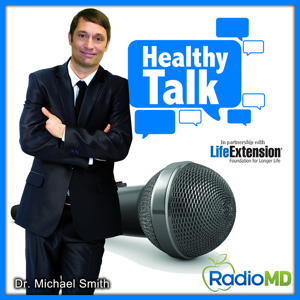
Dr. Michael A. Smith, MD, is committed to providing listeners with the most current health information available. His weekly show is the place to listen to respected experts in the fields of…